Flagging Fathers.

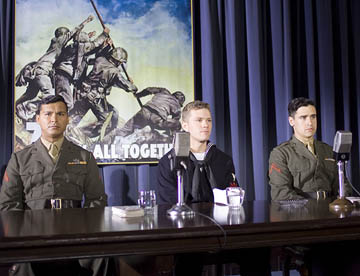
Like Million Dollar Baby (and screenwriter Paul Haggis’ (sigh) Academy-Award-winning Crash), Clint Eastwood’s Flags of our Fathers is, alas, an egregious schmaltzfest, padded to the brim with shallow, one-note characters and ridiculous sentimentalizing. I said of Crash that it “mighta been the most daring movie of 1991,” and Flags has that same sense about it. At best, its attempt to demythologize WWII by making the Battle of Iwo Jima a bleak, desaturated deathscape feels like a retread of Saving Private Ryan, The Thin Red Line, and various other, better films. At worst, Flags of our Fathers subverts its own enterprise by trafficking in blatantly over-the-top symbolism, making the battle close to incomprehensible, and wallowing in “Greatest Generation” kitsch like it’s going out of style (which, pretty clearly, it isn’t.)

As its conceit, the film follows the six soldiers pictured in the famous photograph of the Iwo Jima flag-raising, of which only three made it out alive: John “Doc” Bradley (Ryan Phillipe, better than usual), Rene Gagnon (Jesse Bradford), and Ira Hayes (Adam Beach, also very good). As it turns out, surviving hell on earth was only the first of their trials: Once the federal agitprop powers-that-be figure out what a spectacular image they’ve stumbled upon, these three soldiers — who in fact were putting up the second flag of the day — are forced into a whirlwind publicity tour across the United States to drum up support for war bonds. For Gagnon (and his ridiculously golddiggerish fiancee), this is an unexpected stroke of luck. For Bradley, this is grist for several artfully timed flashbacks of the actual battle. And for Hayes, a Pima Indian forced to confront not only the twin demons of racism and alcoholism but also his own feelings of guilt and inadequacy on the road, the war bond schmooze train seems like it might just be worse than the battlefield… (There’s also a framing device involving Bradley’s son (the author of the book) interviewing the participants in the story, but it’s basically Greatest Generation filler.)

Between the battle itself and the opportunity for trenchant social criticism offered by the war bond tour, this may sound like it has all the makings for a quality film. And, to their credit, the players all acquit themselves decently, with lots of good character actors (say, Robert Patrick, Harve Presnell, and look for Luther of The Warriors (David Patrick Kelly) in a cameo as Harry Truman) around to leaven the likes of grunts Paul Walker and Jamie Bell. That being said, virtually every character in Flags comes across as shallow and inert: From start to finish, Bradley’s a polite, well-meaning cipher, Gagnon a boyish opportunist, and Hayes a weepy drunk, and they’re the well-rounded ones. Moreover, as Ed Gonzalez of The House Next Door aptly put it, “the stink of Crash hovers over Flags of Our Fathers.” Cheap, reflexive sentiment is the order of the day here, and even scenes that should be powerful — say, Hayes being refused service at a white-only bar, or America learning of the death of FDR over the radio — are ruined by Haggis’s usual brand of in-your-face hokum, baldly sentimentalized and applied as a paste. By the time we’re forced to sit through some deathbed histrionics about daddys and heroes — a scene which would seem to undermine the film’s earlier emphasis on not valorizing war simply for its own sake — I’d pretty much completely checked out of the film. In short, Flags of our Fathers means well, I suppose…but it’s far too saccharine here to do its subject justice, and is basically a long-winded, ill-conceived bore.
> Examine Film.

“In the early years of the microcomputer, a special kind of game was being played….in the early 1980s, an entire industry rose over the telling of tales, the solving of intricate puzzles and the art of writing. Like living books, these games described fantastic worlds to their readers, and then invited them to live within them.” Found via Genehack and Recursive Bee, a filmmaker by the name of Jason Scott is prepping Get Lamp, a documentary on the Golden Age of text adventures. I’ve said this several times here in this space, but I’d pay top-money for a new Infocom game any day of the week and twice on Sunday.

Clooney Feels the Burn.

Word is George Clooney is set to reunite with the Coens for Burn After Reading, which is presumably their next film after Cormac McCarthy’s No Country for Old Men. “Production Weekly says the Coen Bros. script is loosely based on the novel ‘Burn Before Reading: Presidents, CIA Directors, and Secret Intelligence,’ by Admiral Stansfield Turner, who served as director of the CIA from 1977 to 1981. The contemporary East Coast caper is about a CIA agent who is writing a book and he loses the disc. Clooney wouldn’t play the agent, but instead a killer.” Well, ok then. But what happened to Hail Caesar! (or, for that matter, Clooney directing the Coens’ Suburbicon)?

The Art of Monologuing.

No, not in that Incredibles way. The House Next Door, an excellent film/television blog I routinely check after every new episode of The Wire, Battlestar Galactica, and Doctor Who, has sparked a fun conversation about choice movie monologues (somewhat akin to the list here.)

Absolutely Sweet Marie.

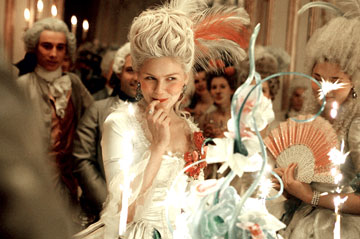
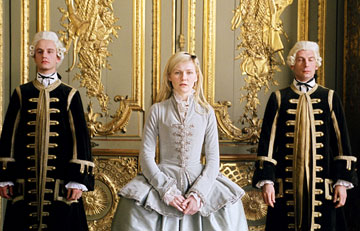
In my generally positive review of Lost in Translation a few years back, I complained that “this story could only have been written by deeply privileged people.” Well, Sofia Coppola’s newest film, Marie Antoinette, makes Lost in Translation seem like a working-class anthem. To be honest, I find my thoughts dwelling on Marie Antoinette in the few days since I saw it, and I’m liking it better in retrospect than I did while actually watching the movie. Still, Coppola’s film seems narrowly conceived to a fault. It conveys both the life-on-Mars quality of Versailles and the innocent decadence of privileged youth decently well (even if Antoinette was almost 35 by the time of the Revolution), but, in my humble opinion, the movie needed a lot more politics and a lot less in the way of shoes and pastries. As it is, despite all the wallowing in material delights, Marie Antoinette displays little in the way of a narrative arc, and, to my mind, it felt both unfinished and unsatisfying.

As the film begins, mirthful 14-year-old free spirit Marie Antoinette (Kirsten Dunst) has just been married off by her mother, the Empress Maria Theresa of Austria (Marianne Faithful), to the pudgy, young, and introverted dauphin of France, Louis XIV (Jason Schwartzman). And so we spend the first forty minutes of the film following young Marie’s introduction to the cauldron of social intrigue that is Versailles, where she is shuffled to and fro by her grim handler, the Comtesse de Noailles (Judy Davis, looking like the Borg Queen), and becomes the target of a whispering campaign due to her still-unconsummated marriage (a plot point that doesn’t work at all, given how far Dunst and Schwartzman are from 14 and 15 respectively.) At any rate, eventually Marie makes a few friends — most notably the Duchesse de Polignac (Rose Byrne) — and a few enemies, such as Madame Du Barry (Asia Argento), courtesan to Louis XV (Rip Torn). And she picks up several bad habits, including but not limited to gambling, shopping, all-night festivities, and the Count Axel von Fersen (Jamie Dornan), most of which are scored — usually pretty effectively — to post-punk or new wave tracks by Gang of Four (“Natural’s Not in It”), New Order (“Ceremony”), The Cure (“Plainsong”), and others.

Of course, as we all know, the party can’t last forever, and Marie Antoinette’s reveries have a particularly nasty end. But the Revolution only takes up about fifteen minutes of the film here, and in fact is basically sidestepped (which feels a bit like making a movie about the Titanic and skipping the iceberg, but ah well.) Obviously, it was Coppola’s artistic decision not to wallow in the horrors that beset Antoinette’s final years, but that same lack of focus about anything other than good times at Versailles mars the rest of the film. Contrary to the figure portrayed here, Antoinette was engaged in the political issues facing her kingdom, particularly late in her reign. But, here’s she seems just a poor-little-rich-party-girl until the merde hits the fan in a big way in 1789. (There are a few scenes involving the French decision to aid the American Revolutionaries, I guess, but they seem unconnected to everything else going on and are in effect shoehorned in.)

Which isn’t to say Marie Antoinette isn’t completely without merit. At times, it — much like The Virgin Suicides, Coppola’s first film — fashions out of the Antoinette story a haunting mediation on the doomed and fleeting transience of youth. (The New Order helps.) And there are several good performances in and around the margins, including Steve Coogan (always threatening to Tristam Shandy at any moment) as the Comte de Mercy-Argenteau and Danny Huston as Emperor Joseph II of Austria (although I do wish he’d thrown in a “hm-hm” to pay homage to Jeffrey Jones.) But, ultimately, this film is just too thin a take on Antoinette’s story to sustain interest over two hours. There’s barely any there there. Even subplots that should be in Coppola’s wheelhouse, given her choice of themes here, seem underdeveloped (most notably Antoinette’s rivalry with Du Barry — It happens, but doesn’t really amount to anything.) And, while the last few shots are undeniably haunting, they can’t justify the long and circuitous route it took to get there. I don’t have a problem with a sympathetic take on Marie Antoinette, per se, but it would’ve been nice to have seen a more fully-developed one.

Magic Most Sinister.

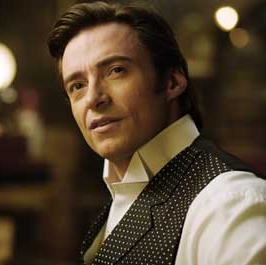
Are you watching closely? I’m having a harder time than usual thinking of what to say about Christopher Nolan’s The Prestige, not only because I think it’s a film best seen cold, with as little information going in as possible, but also because, having read the book by Christopher Priest, my experience with the film was very different from that of most folks. As Michael Caine’s ingenieur Cutter notes at one point, successful magic is all about confusion and misdirection — if you know how it’s done, even a complex and fantastic magic trick can seem blatantly obvious from the get-go. So my time with The Prestige was roughly akin to seeing The Sixth Sense and knowing Bruce Willis is a ghost from the first reel. That being said, while I can’t vouch for how well Nolan conceals his own prestiges from the audience here, I found the movie a dark, clever, and elegant contraption, one that suggests razor-sharp clockwork gears and threatening pulses of electrical current, all impressively encased in burnished Victorian-era mahogany. If you’re a fan of Nolan’s previous work, or of sinister mind-benders in general, The Prestige is a must-see film. Either way, it’s among the top offerings of 2006 thus far.

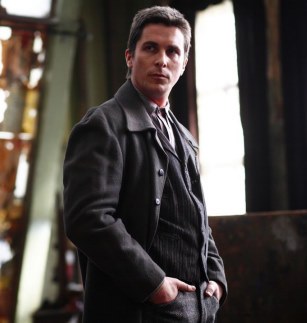
So, what’s the pledge? Slumming aristocrat Robert Angier (Hugh Jackman) and working-class upstart Alfred Borden (Christian Bale, particularly good) both serve as magician’s assistants to a by-the-numbers prestidigitator (Ricky Jay) — they’re audience plants — and both harbor aspirations of taking their own act on the road. But after an on-stage tragedy involving Angier’s escapist wife (Piper Perabo), a wedge is driven between these two would-be men of magick, fomenting a lifelong rivalry that turns increasingly brutal and obsessive. This becomes particularly so after Borden, the more talented illusionist, comes up with a nifty trick — The Transported Man — that Angier, the more impressive showman, can’t seem to match, even with the aid of his longtime ingenieur, Cutter (Caine). Eventually, Angier is compelled to travel to faraway Colorado Springs to pay visit to a wizard of a different order, Nikola Tesla (David Bowie), and perhaps enlist him (and his Igor-by-way-of-Brooklyn assistant, (Andy Serkis)) in unraveling Borden’s secret. (As apparently required by law this year, Scarlett Johansson also factors in the tale as Olivia, a lovely magician’s assistant bandied back and forth by the two rivals, but it’s a smaller part than you might expect, and newcomer Rebecca Hall makes more of an impression as Borden’s long-suffering wife, Sarah.)

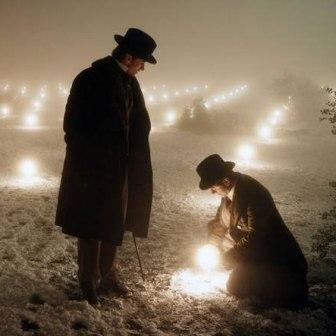
In keeping with Nolan’s usual m.o., The Prestige is not told linearly, but in narrative fragments spurred by memory, sadness, or anger. In fact, the film begins near the end, with Borden first witnessing and then on trial for the apparent murder of Angier. (Well, that is, after a striking title shot of top hats piled up bizarrely in a forest bed, a shot which makes more sense as the story progresses — I’ll admit to being a sucker for films that start off thus.) And, while the film takes a few jags away from Priest’s book (including omitting both the framing device — good choice — and the very last sequence, which I thought was deliriously creepy and somewhat missed here), it nevertheless keeps the basic story arcs of the novel intact. (In other words, and while remaining as oblique as possible, mystery purists may feel somewhat cheated by the Tesla turn the story takes ninety minutes in, but it’s central to the source material, and had to be there.) Also like the book, Nolan’s final hole card is a deeply disturbing one that’ll linger in the senses well after this trick is complete. In sum, along with Memento and Batman Begins, this jagged tale of illusion and obsession should only add to Chris Nolan’s burgeoning prestige: Bring on The Dark Knight.

I Vant to be alone. (So does Beyonce.)

More from the movie bin: Jamie Foxx and Eddie Murphy let Beyonce break up the band in the full trailer for Bill Condon’s Dreamgirls, and Stephen Soderbergh noirs up George Clooney, Cate Blanchett, and Tobey Maguire in a Mr. Movie Voice trailer for The Good German.