
Following up The Pianist and Oliver Twist, veteran director Roman Polanski will next head to Pompeii, with a $130 million budget (his largest ever). “Based on the bestseller of the same name by ‘Fatherland’ novelist Robert Harris, the story follows a young engineer who has to repair an enormous aqueduct whose destruction threatens the Roman Empire.“
Category: Cinema
Blame the Skekses | In the Company of Dent?
The Power of the Dark Crystal, the sequel to the 1982 muppet fantasy announced last year, has officially been put on hiatus. (Sorry, Gelflings.) And Latino Review, breakers of the Heath Ledger Joker casting, says Thank You for Smoking‘s Aaron Eckhart is now in line to play Harvey Dent (a.k.a. Two-Face) in Christopher Nolan’s The Dark Knight. Great choice. (Also, apparently Katie Holmes has been kicked off the Batman Begins sequel — word is she’ll be replaced by Emily Blunt, Rachel McAdams, or Maggie Gyllenhaal.)
Buns in the Oven.
Writer-director Judd Apatow, late of The 40-Year-Old Virgin, gives fellow Freaks and Geeks alum Seth Rogen his time to shine in both the international trailer and the domestic trailer for Knocked Up. And, hey, look, Nick (Jason Segal) is here too. Does he get behind the drum set?
2006 (Finally) in Film.
Well, there are still a number of flicks I haven’t yet seen — David Lynch’s Inland Empire, for example, which I hope to hit up this weekend. But as the Oscar nods were announced today, and as the few remaining forlorn Christmas trees are finally being picked up off the sidewalk, now seems the last appropriate time to crank out my much belated end-of-2006 film list (originally put off to give me time to make up for my New Zealand sojourn.) To be honest, I might’ve written this list a few weeks earlier, had it not happened that I ended up seeing the best film of 2005 in mid-January of last year, thus rendering the 2005 list almost immediately obsolescent. But, we’ll get to that — As it stands, 2006 was a decent year in movies (in fact a better year in film than it was in life, the midterms notwithstanding), with a crop of memorable genre flicks and a few surprisingly worthy comebacks. And, for what it’s worth, I thought the best film released in 2006 was…
[2000/2001/2002/2003/2004/2005]
1. United 93: A movie I originally had no interest in seeing, Paul Greengrass’s harrowing docudrama of the fourth flight on September 11 captured the visceral shock of that dark day without once veering into exploitation or sentimentality (the latter the curse of Oliver Stone’s much inferior World Trade Center.) While 9/11 films of the future might offer more perspective on the origins and politics of those horrible hours, it’s hard to imagine a more gripping or humane film emerging anytime soon about the day’s immediate events. A tragic triumph, United 93 is an unforgettable piece of filmmaking.
[1.] The New World (2005): A movie which seemed to divide audiences strongly, Terence Malick’s The New World was, to my mind, a masterpiece. I found it transporting in ways films seldom are these days, and Jamestown a much richer canvas for Malick’s unique gifts than, say, Guadalcanal. As the director’s best reimagining yet of the fall of Eden, The New World marvelously captured the stark beauty and sublime strangeness of two worlds — be they empires, enemies, or lovers — colliding, before any middle ground can be established. For its languid images of Virginia woodlands as much as moments like Wes Studi awestruck by the rigid dominion over nature inherent in English gardens, The New World goes down as a much-overlooked cinematic marvel, and (sorry, Syriana) the best film of 2005.
2. Letters from Iwo Jima: Having thought less of Flags of our Fathers and the woeful Million Dollar Baby than most people, I was almost completely thrown by the dismal grandeur and relentless gloom of Eastwood’s work here. To some extent the Unforgiven of war movies, Iwo Jima is a bleakly rendered siege film that trafficks in few of the usual tropes of the genre. (Don’t worry — I suspect we’ll get those in spades in two months in 300.) Instead of glorious Alamo-style platitudes, we’re left only with the sight of young men — all avowed enemies of America, no less — swallowed up and crushed in the maelstrom of modern combat. From Ken Watanabe’s commanding performance as a captain going down with the ship to Eastwood’s melancholy score, Letters works to reveal one fundamental, haunting truth: Tyrants may be toppled, nations may be liberated, and Pvt. Ryans may be saved, but even “good wars” are ultimately Hell on earth for those expected to do the fighting.
3. Children of Men: In the weeks since I first saw this film, my irritation with the last fifteen minutes or so has diminished, and Alfonso Cuaron’s Children of Men has emerged for what it is — one of the most resonant “near-future” dystopias to come down the pike in a very long while, perhaps since (the still significantly better) Brazil. Crammed with excellent performances by Clive Owen, Michael Caine, Chiwetel Ejiofor and others, Children is perhaps a loosely-connected grab bag of contemporary anxieties and afflictions (terrorism, detainment camps, pharmaceutical ads, celebrity culture). But it’s assuredly an effective one, with some of the most memorable and naturalistic combat footage seen in several years to boot. I just wished they’d called that ship something else…
4. Borat: Cultural Learnings of America for Make Benefit Glorious Nation of Kazakhstan: True, the frighteningly talented Sasha Baron Cohen spends a lot of time in this movie shooting fish in a barrel, and I wish he’d spent a little more time eviscerating subtler flaws in the American character than just knuckle-dragging racists and fratboy sexists. Still, the journeys of Borat Sagdiyev through the Bible Buckle and beyond made for far and away the funniest movie of the year. Verry nice.
5. The Prestige: I originally had this in Children of Men‘s spot, as there are few films I enjoyed as much this year as Christopher Nolan’s sinister sleight-of hand. But, even after bouncing Children up for degree of difficulty, that should take nothing away from The Prestige, a seamlessly made genre film about the rivalries and perils of turn-of-the-century prestidigitation. (There seems to be a back-and-forth between fans of this film and The Illusionist, which I sorta saw on a plane in December. Without sound (which, obviously, is no way to see a movie), Illusionist seemed like an implausible love story set to a tempo of anguished Paul Giamatti reaction shots. In any case, I prefer my magic shows dark and with a twist.) Throw in extended cameos by David Bowie and Andy Serkis — both of which help to mitigate the Johansson factor — and The Prestige was the purest cinematic treat this year for the fanboy nation. Christian Bale in particular does top-notch work here, and I’m very much looking forward to he and Nolan’s run-in with Heath Ledger’s Joker in The Dark Knight.
6. The Fountain: Darren Aronofsky’s elegiac ode to mortality and devotion was perhaps the most unfairly maligned movie of the year. (In a perfect world, roughly half of the extravagant praise going to Guillermo del Toro’s Pan’s Labyrinth would have been lavished on this film.) Clearly a heartfelt and deeply personal labor of love, The Fountain — admittedly clunky in his first half hour — was a visually memorable tone poem that reminds us that all things — perhaps especially the most beautiful — are finite, so treasure them while you can.
7. The Queen: A movie I shied away from when it first came out, The Queen is a canny look at contemporary politics anchored by Helen Mirren’s sterling performance as the fastidious, reserved, and ever-so-slightly downcast monarch in question. (Michael Sheen’s Tony Blair is no slouch either.) In fact, The Queen is the type of movie I wish we saw more often: a small, tightly focused film about a very specific moment in recent history. Indeed, between this and United 93, 2006 proved to be a good year for smart and affecting depictions of the very recent past — let’s hope the trend continues through the rest of the oughts.
8. Inside Man: The needless Jodie Foster subplot notwithstanding, Spike Lee’s Inside Man was a fun, expertly-made crime procedural, as good in its own way as the much more heavily-touted Departed. It was also, without wearing it on its sleeve, the film Crash should have been — a savvy look at contemporary race relations that showed there are many more varied and interesting interactions between people of different ethnicities than simply “crashing” into each other. (But perhaps that’s how y’all roll over in car-culture LA.) At any rate, Inside Man is a rousing New York-centric cops-and-robbers pic in the manner of Dog Day Afternoon or The Taking of the Pelham One Two Three, and it’s definitely one of the more enjoyable movie experiences of the year.
9. Dave Chappelle’s Block Party: Speaking of enjoyable New York-centric movie experiences, Dave Chappelle and Michel Gondry’s block party last year felt like a breath of pure spring air after a long, cold, lonely winter — time to kick off the sweaters and parkas and get to groovin’ with your neighbors. With performances by some of the most innovative and inspired players in current hip-hop (Kanye, Mos Def, The Roots, The Fugees, Erykah Badu), and presided over by the impish, unsinkable Chappelle, Block Party was one of the best concert films in recent memory, and simply more fun than you can shake a stick at.
10. Casino Royale: Bond is back! Thanks to Daniel Craig’s portrayal of 007 as a blunt, glitched-up human being rather than a Casanova Superspy, and a script that eschewed the UV laser pens and time-release exploding cufflinks of Bonds past for more hard-boiled and gritty fodder, Casino Royale felt straight from the pen of Ian Fleming, and newer and more exciting than any 007 movie in decades.
11. The Departed: A very good movie brimming over with quality acting (notably Damon and Di Caprio) and support work — from Mark Wahlberg, Alec Baldwin, Vera Farmiga, Ray Winstone, and others — Scorsese’s The Departed also felt a bit too derivative of its splendid source material, Infernal Affairs, to merit the top ten. And then there’s the Jack problem: An egregiously over-the-top Nicholson chews so much scenery here that it’s a wonder there’s any of downtown Boston left standing. But, despite these flaws, The Departed is well worth seeing, and if it finally gets Scorsese his Best Director Oscar (despite Greengrass deserving it), it won’t be too much of an outrage.
[11.] Toto The Hero (1991): Also sidelined out of this top twenty on account of its release date, Jaco Von Dormael’s Toto the Hero — Terry Gilliam’s choice of screening for an IFC Movie Night early in October — is definitely one for the Netflix queue, particularly if you’re a fan of Gilliam’s oeuvre. It’s a bizarre coming-of-age/going-of-age tale that includes thoughts of envy, murder, incest, and despair, all the while remaining somehow whimsical and fantastical at its core. (And, trust me: As with Ary Borroso’s “Brazil“, you’ll be left humming Charles Trenet’s “Boum” to yourself long after the movie is over.)
12. Tristam Shandy: A Cock and Bull Story: I guess this is where I should be writing something brief and scintillating about Michael Winterbottom’s metanarrative version of Laurence Sterne’s famous novel, one which gives Steve Coogan — and the less well-known Rob Brydon — a superlative chance to work their unique brand of comedic mojo. But I’m growing distracted and Berk has that pleading “I-want-to-go-out, are-you-done-yet” look and Kevin’s still only on Number 12 of a list that, for all intent and purposes, is three weeks late and will be read by all of eight people anyway. (But don’t tell him that — In fact, I shouldn’t even talk about him behind his back.) So, perhaps we’ll come back to this later…it’s definitely a review worth writing (again), if I could just figure out how to start.
13. Miami Vice: Michael Mann’s moody reimagining of the TV show that made him famous isn’t necessarily his best work, but it was one of the more unique and absorbing movies of the summer, and one that lingers in the memory long after much of the year’s fluffier and more traditional films have evaporated. Dr. Johnson (and Hunter Thompson) once wrote that “He who makes a beast out of himself gets rid of the pain of being a man.” I guess that’s what Crockett and Tubbs are going for with the nightclubs and needle boats.
14. CSA: The Confederate States of America: I wish I were in the land of cotton…or have we been there all along? Kevin Wilmott’s alternate history of a victorious Confederate America is a savvy and hilarious send-up of history documentaries and a sharp-witted, sharp-elbowed piece of satire with truths to tell about the shadow of slavery in our past. With any luck, CSA will rise again on the DVD circuit.
15. The Science of Sleep: Not as good or as universally applicable as his Eternal Sunshine (the best film of 2004), Michel Gondry’s dreamlike, unabashedly romantic The Science of Sleep is still a worthy inquiry into matters of the (broken) heart. What is it about new love that is so intoxicating? And why do the significant others in our mind continue to haunt us so, even when they bear such little relation to the people they initially represented? Science doesn’t answer these crucial questions (how can it?), but it does acutely diagnose the condition. When it comes to relationships, Sleep suggests, all we have to do — sometimes all we can do, despite ourselves — is dream.
16. Rocky Balboa: Rocky! Rocky! Rocky! I’m as surprised as anyone that Sly’s sixth outing as Philadelphia’s prized pugilist made the top twenty. But, as formulaic as it is, Rocky Balboa delivered the goods like a Ivan Drago right cross. Ultimately not quite as enjoyable as Bond’s return to the service, Rocky Balboa still made for a commendable final round for the Italian Stallion. And, if nothing else, he went down fighting.
17. Pan’s Labyrinth: A fantasy-horror flick occurring simultaneously within a Spanish Civil War film, Guillermo del Toro’s Pan’s Labyrinth ultimately felt to me like less than the sum of its parts. But if the plaudits it’s receiving help to mainstream other genre movies in critics’ eyes in the future, I’m all for it. It’s an ok movie, no doubt, but if you’re looking for to see one quality supernatural-historical tale of twentieth-century Spain, rent del Toro’s The Devil’s Backbone instead.
18. Little Miss Sunshine: Another film which I think is being way overpraised, Little Miss Sunshine is still a moderately enjoyable evening at the movies. It felt overscripted and television-ish to me, and I wish it was as way over yonder in the minor key as it pretends to be, but Sunshine is nevertheless a cute little IFC-style family film, and one that does have a pretty funny payoff at the end.
19. The Last King of Scotland: I just wrote on this one yesterday, so my impressions haven’t changed much. Still, Forrest Whitaker’s jovial and fearsome Idi Amin, and an almost-equally-good performance by James McAvoy as the dissolute young Scot who unwittingly becomes his minion, makes The Last King of Scotland worth seeing, if you can bear its grisly third act.
20. Thank You for Smoking: It showed flashes of promise, and it was all there on paper, in the form of Chris Buckley’s book. But Smoking, alas, never really lives up to its potential. What Smoking needed was the misanthropic jolt and sense of purpose of 2005’s Lord of War, a much more successful muckraking satire, to my mind. But Smoking, like its protagonist, just wants to be liked, and never truly commits to its agenda. Still, pleasant enough, if you don’t consider the opportunity cost.
Most Disappointing: All the King’s Men, X3: The Last Stand — Both, unfortunately, terrible.
Worth a Rental: A Scanner Darkly, Brick, Cache, Cars, Curse of the Golden Flower, Glory Road, The History Boys, Marie Antoinette, Match Point (2005), V for Vendetta, Why We Fight
Don’t Bother: Bobby, Crash (2005), The Da Vinci Code, Flags of our Fathers, The Good German, The Good Shepherd, Mission: Impossible: III, Night Watch (2004), Pirates of the Caribbean 2: Dead Men’s Chest, Poseidon, Scoop, Superman Returns, The Wicker Man, World Trade Center
Best Actor: Clive Owen, Children of Men; Forrest Whitaker, The Last King of Scotland; Ken Watanabe, Letters from Iwo Jima
Best Actress: Helen Mirren, The Queen; Q’Orianka Kilcher, The New World
Best Supporting Actor: Mark Wahlberg, The Departed; Michael Caine, Children of Men/The Prestige
Best Supporting Actress: Pam Farris, Children of Men; Vera Farmiga, The Departed; Maribel Verdu, Pan’s Labyrinth
Unseen: Apocalypto, Babel, Blood Diamond, Catch a Fire, Clerks II, The Descent, The Devil Wears Prada, Dreamgirls, Fast Food Nation, Hollywoodland, An Inconvenient Truth, Infamous, Inland Empire, Jackass Number Two, Jet Li’s Fearless, Lassie, Little Children, Notes from a Scandal, The Notorious Betty Page, A Prairie Home Companion, The Pursuit of Happyness, Running With Scissors, Sherrybaby, Shortbus, Stranger than Fiction, Tideland, Venus, Volver, Wordplay
2007: The list isn’t looking all that great, to be honest. But, perhaps we’ll find some gems in here…: 300, 3:10 To Yuma, Beowulf, Black Snake Moan, The Bourne Ultimatum, FF2, The Golden Age: Elizabeth II, The Golden Compass, Grindhouse, Harry Potter and the Order of the Phoenix, Hot Fuzz, I Am Legend, Live Free or Die Hard, Ocean’s Thirteen, PotC3, The Simpsons Movie, Smokin’ Aces, Spiderman 3, Stardust, The Transformers, Zodiac.
Hearts in the Highlands.
 All the King’s Men by way of Heart of Darkness (and more than a dash of Hotel Rwanda), Kevin MacDonald’s The Last King of Scotland is a harrowing portrait of the scampish, fun-loving, paranoid, and genocidal Idi Amin, former president/warlord of Uganda, and a moderately engaging cautionary tale about the dangers of seeking to find oneself in a place one doesn’t belong. Somewhat clunkily assembled (despite being co-written by Peter Morgan, screenwriter of The Queen) and suffering from a third act that, like its protagonist, gets lost somewhere amidst its downward trajectory, The Last King of Scotland is a film mostly redeemed by excellent performances — notably Forest Whitaker as Amin and James McAvoy as our (anti-)hero, but also Gillian Anderson, Simon McBurney, and others in supporting roles. It wasn’t quite as good as I was hoping or expecting, but it’s definitely worth a rental — for Whitaker if for nothing else — if you can handle the increasingly graphic carnage of the film’s final hour.
 As the film begins, it’s 1970, and (the fictional) Nicholas Gerrigan (James McAvoy of The Chronicles of Narnia) is a recently-minted doctor and young, debaucherous Scotsman looking for a life less suffocating than the one on the plate before him, taking over the family practice. Choosing Uganda more or less at random (he spins a globe to choose his fate, but not without first exercising some veto power), Gerrigan soon finds himself one of two doctors on hand in an overworked clinic deep in the African hinterlands, where the only fun to be had is making flagrant passes at his colleague’s do-gooder wife (Gillian Anderson).
Fate rescues Gerrigan from his ennui, however, in the form of a traffic accident — one which brings him to the attention of Uganda’s new leader, the Scotland-adoring Idi Amin (Whitaker). Soon thereafter, Gerrigan has been made Amin’s personal doctor and “closest advisor,” meaning he spends a lot of time dissolute by the pool, unwittingly (and soon deliberately) oblivious to the bloody machinations holding Amin’s regime in power. That is, until his own somewhat-inadvertent complicity in a murder — as well as some really poor life decisions — force Gerrigan to confront the monstrosities laid before him. This place is a prison, he soon discovers, and these people very clearly aren’t his friends.
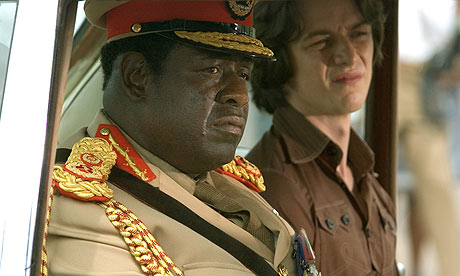 As it almost had to be, The Last King of Scotland is most enjoyable in its first hour, as Gerrigan is slowly seduced by the life Amin offers him, and all the sultry pleasures therein included. When it all turns on him, and Gerrigan discovers the heavy price of his fool’s paradise, the film quickly descends into a hell that’s not only hard to watch (one grisly scene brought back unsettling childhood memories of watching…I think it was A Man Called Horse — you’ll know it when you see it) but also somewhat repetitive. How many slo-mo shots of a druggy and/or horrified Gerrigan set to acid-rock do we really need here? Moreover, the film telegraphs one of the good doctor’s key indiscretions for far too long — at least forty minutes is spent simply waiting for the other shoe to drop, so to speak.
That being said, Forrest Whitaker’s performance here makes up for a lot of mistakes. (Seeing the clearly quiet-natured Whitaker’s shellshocked acceptance speech at the Globes last weekend made his work here seem all the more surprising and impressive.) The Willie Stark last year’s All the King’s Men desperately needed, Whitaker commands the camera in every scene he’s in — His Amin is all the more horrifying because he’s basically an overgrown boy, all appetite and no restraint. In every scene, you can sense him lumbering somewhere on the border between childish glee and murderous rage, and we never know where the axe will fall…only that, when it does, it’s not going to be pretty.
From Baghdad to Ballet.
Two former Watchmen directors receive their next assignments: United 93 and The Bourne Supremacy helmer Paul Greengrass will venture into Iraq’s Green Zone in Imperial Life in the Emerald City, based on the book by WP bureau chief Rajiv Chandrasekaran. And Requiem for a Dream‘s Darren Aronofsky announces his next project will be Black Swan. “John McLaughlin has begun writing the film that looks at the manipulative relationship between a veteran dancer and a rival.” (You can now probably guess who got me into that premiere of The Fountain a few months back.)
Muddled in their Intent.
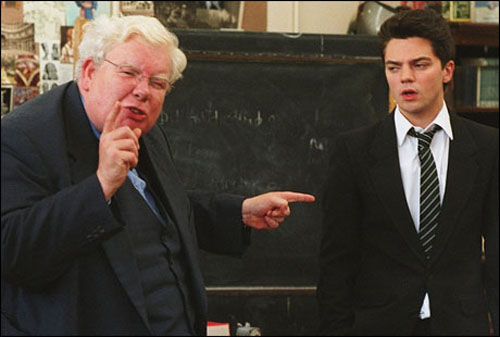
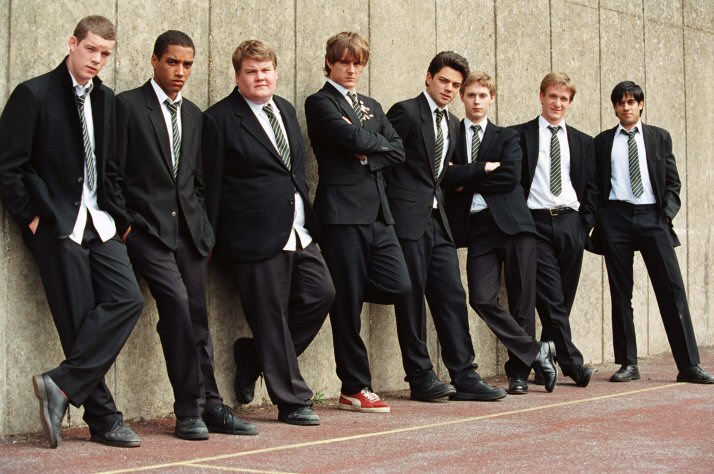
I never caught the source material while it was on Broadway, so I can’t compare it to the play. But, while I found Nicholas Hytner’s film of Alan Bennett’s The History Boys to be a thoughtful and decently engaging piece of work, it makes for a somewhat unnatural and theatrical evening of cinema. The ideas in (the) play are obviously intriguing and worthy of contemplation, but — with several performances better suited for the back rows than the big screen (most notably Clive Merrison as a schoolmaster out of Monty Python) and a gaggle of bon mot-spouting teenagers that, at least in my own personal and teaching experience, act in no way at all like teenagers — The History Boys often felt forced to me. It’s a worthy piece of pedagogy, I suppose, and I’m almost positive it must work better on Broadway. But, overall, I thought it trafficked in archetypes more than it does in real-world, flesh-and-blood characters — more fiction than history, I’d say — and this close to the action, its faults are harder to hide.
As iconic cuts by New Order and The Smiths tip off in the opening moments, The History Boys takes place in the early 1980’s — 1983 Sheffield, to be exact. But don’t let “Blue Monday” and “This Charming Man” fool you: our story in fact takes place in a boys’ preparatory school, one — references to W.H. Auden and Brief Encounter notwithstanding — seemingly hermetically sealed from the outside world at large. Here in this academic biodome, several young lads, having done exceedingly well on their A-levels, now prep for the grueling college application process, in the particular hopes of getting into Oxford and Cambridge.
To aid them in this arduous process are two history professors dueling for their impressionable minds…and bodies: In the relativist corner, Professor Irwin (Stephen Campbell Moore), a sharp, young, and assured (if closeted) new hiree dedicated to promoting the ironies and contingencies of history. Meanwhile, over in the knowledge-for-its-own-sake department rests Professor Hector (Richard Griffiths, the soul of the film.) Orwell looming over his shoulder (the two agree on the debasement of “worrrrds“), Hector is a grotesque but endearing fellow who one might call avuncular, were it not for his rather unfortunate penchant for fondling his students’ genitals. Shrugging off these occasional gropes (far more sanguinely than seems realistic, IMHO), the history boys perform poetry, film scenes, and cabaret tunes for the latter and develop streaks of contrarian skepticism for the former, all the while learning a thing or two not only about life and history, but of the Achilles’ Heels of their esteemed teachers.
In a nutshell, the basic problem I had with The History Boys is this: A decade ago, a friend of mine once described a mutual acquaintance as “the ideal twenty-two-year-old…in the eyes of a fifty-five-year old.” Well, this movie’s got a whole pack of ’em. All of the young actors here are decent enough — if a bit broad, cinematically speaking — with Samuel Barnett (as Posner, a boy trapped in the very special hell that is an unrequited teenage crush) and Dominic Cooper (as Dakin, a young man increasingly hopped up on Nietzsche and the power of his own burgeoning sexuality) given the most to do. But, as they effortlessly spin forth witticisms at the most opportune moments and gather around the piano without even a trace of cynicism or irony (“the shackles of youth,” as the line goes) about them, they all seemed very, very improbable to me…and that’s even notwithstanding their handling of the aforementioned sexual misdeeds. (Full disclosure: I have much the same problem with Whit Stillman films.)
Yet, once you take it as inherently fanciful and somewhat missuited for the big screen, there are still elements to enjoy in Boys, including a number of thoughtful disquisitions on the uses and practices of history as a discipline: for example, on contingency, commemoration, and the rise of a more gender-balanced understanding of the past (the latter memorably delivered by Frances De La Tour, who, while excellent here as a jaded prof, still unfortunately kept reminding me of Madame Maxime.) Admittedly, these digressions do seem shoehorned in at times — and brought back memories of fading historiography seminars — but they still offer some keen grist for the philosophical mill. (That being said, I somehow suspect that the teaching of history is a less sexually charged discipline than as seen here, where it’s rife with more suppressed longing than the Catholic priesthood. But perhaps I haven’t been at it long enough.)
This is how we say goodbye in Germany.
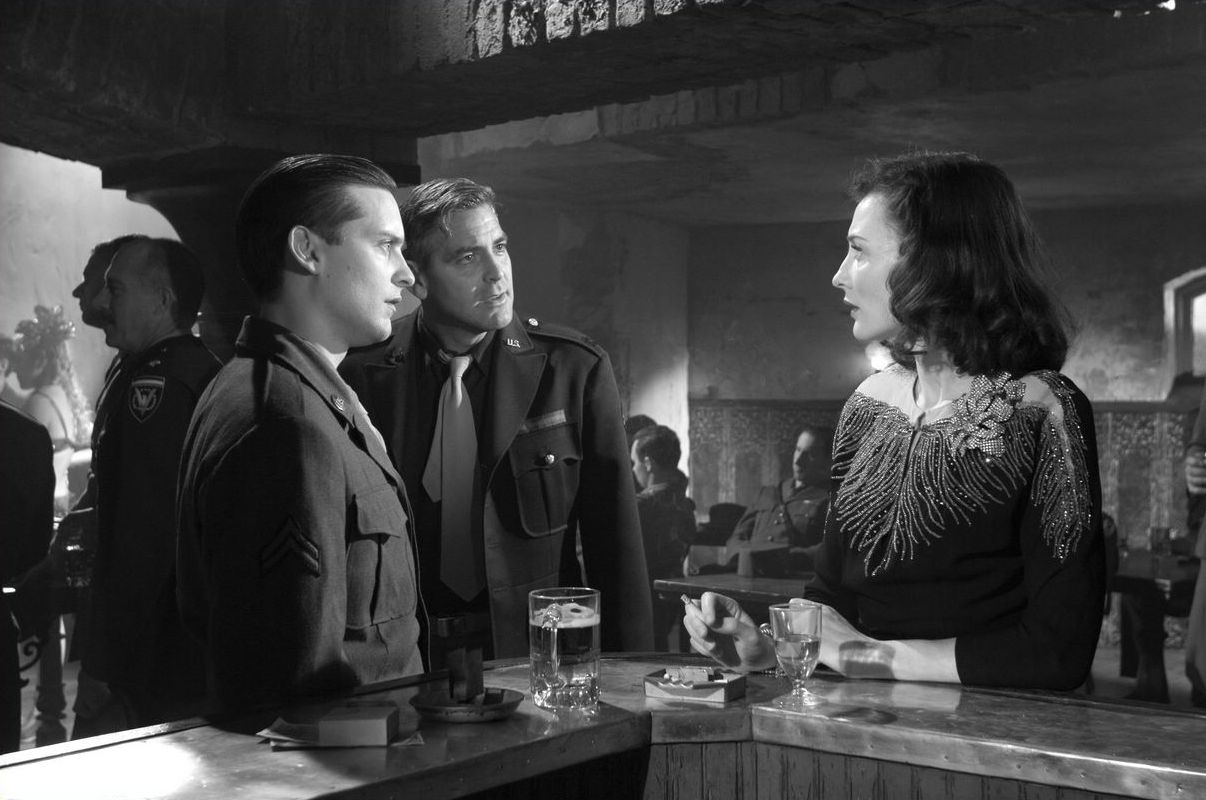
To his credit, Steven Soderbergh is relentlesssly experimental. When he’s at the top of his game (Out of Sight, Traffic, The Limey), few directors are better at telling stories that move with purpose and imagination, and even some of his resolutely mainstream projects (Erin Brockovich, Ocean’s 11, Ocean’s 12) –which might have been staid and forgettable in someone else’s hands — have verve and originality to spare. But, even for a guy as talented as Soderbergh, you keep taking swings, and eventually you’re going to whiff a few. (Full Frontal and Kafka come to mind — I haven’t seen Schizopolis or Bubble, but have heard they might be in this category too.) Alas, Stephen Soderbergh’s period noir, The Good German, is in this latter camp. Written with a 21st century sophistication about sex and language but filmed in the manner of a 1940s war flick — back projections, ancient credits, garish score, and all — German basically comes across as a two-hour gimmick, one that sadly outlasts its welcome by the second reel. George Clooney and Cate Blanchett do what they can (and both look great in B&W), but, surprisingly, the film just never engages — it feels flat and uninvolving from start to finish. In sum, as with the Solaris remake, Soderbergh and Clooney’s errant stab at big-think sci-fi, The Good German feels fundamentally misconceived.
Berlin, 1945. The war in Europe is over, and, divided into four sectors by the victorious Allies, Germany’s capital is now a sordid morass of blackened buildings and anything-goes. Venturing into the urban decay is former resident Jake Geismer (Clooney), now a TNR correspondent sent to cover the Potsdam Conference (which in its own way feels as improbable as Ocean buddy Matt Damon playing a 45-year-old in The Good Shepherd.) But, not ten minutes back in town, Geismer’s wallet is stolen by his too-friendly-by-half army driver (Tobey Maguire, laughably miscast), who, as it so happens, is a well-connected black marketeer, a despicable lout, and the current boyfriend and pimp of Geismer’s old flame, Lena Brandt (Blanchett). After a body shows up at Potsdam, and after that old flame is rekindled, Geismer finds himself tracking down a story that may or may not involve hidden war crimes, atomic secrets, Russian n’er do wells, German scientists, his old prosecutor buddy (Leland Orser), and of course, Lena, a girl who — like so many residents in her fallen city — has faced unspeakable horrors and kept them under wraps.
All well and good…who doesn’t enjoy a seamy noir? But, The Good German is curiously inert, and never gets off the tarmac. The plot ends up being byzantine in its mechanics, as a decent detective story should be, but German never arouses enough interest to makes the many twists and turns feel earned. Tobey Maguire doesn’t help — A decent actor with the right material (say, as Peter Parker), he’s so woefully bad here that it kills the movie from the start. (Also, a random quibble: Maguire also beats up Clooney at one point, as Clooney’s Geisberg is of the Tom Reagan school of noir heroes: he gets his ass kicked a lot. But, unless this is Golden Age Spiderman or something, it makes very little sense here.) But equally jarring is the disparity between the script and the look in The Good German: The period recreation, however clever at times, ends up distracting from rather than enhancing the tale being told. In all honesty, it just doesn’t work.
If The Good German does offer any distinct pleasures, they’re mostly in the margins. Deadwood‘s Robin Weigert (a.k.a. Calamity Jane) plays pretty far from type — the blunt-spokenness notwithstanding — as Lena’s brash, hooker roommate. And, even despite the general failure here, Soderbergh still has a great eye, and the black-and-white cinematography does pay occasional dividends (despite many of the outdoor scenes having a grainy, washed-out look to them.) Speaking of which, I’d be remiss if I didn’t note that the highlight of The Good German for me was Soderbergh’s framing of Cate Blanchett as a classic screen siren. True, her femme fatale accent occasionally lapses into something more like Natasha from Rocky and Bullwinkle than Garbo or Dietrich. But, a beautiful woman under any circumstances, Blanchett often looks breathtaking here, what with all the period accoutrements and chiaroscuro lighting at her service. Careful, Jake, it’s Berlintown…and she’s going to play you for a fool, yes it’s true.

The Anakin Treatment (with a side of chianti.)
The world’s most epicurean cannibal gets psychoanalyzed by Dominic West (again, McNulty, get out of this film, and take Gong Li with you) in another new trailer for Peter Webber’s Hannibal Rising.
The Wicker Boy.
Via Ed Rants and The House Next Door, some wag has distilled the essence of Neil LaBute’s lousy Wicker Man remake into two minutes of sheer ridiculousness. I kinda wish I had seen it like this.