By way of Ed Rants and Youtube, the trailer to David Lynch’s forthcoming three-hour Inland Empire, with Laura Dern, Jeremy Irons, Justin Theroux, Grace Zabriskie, Harry Dean Stanton, and Diane Ladd (as well a gaggle of cameos, from Naomi Watts to William H. Macy and Laura Harring to Mary Steenburgen.) Strange also to see Lynch shooting on DV, but I’ll definitely give it a look-see.
Category: Directors
Goldengrove Unleaving.
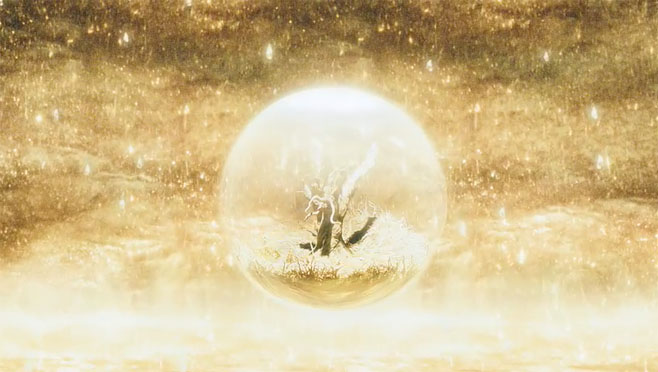
Admirably ambitious and running the emotional gamut from syrupy to sublime, Darren Aronofsky’s The Fountain is a resolutely uncommercial big-think sci-fi piece that I expect will strongly divide audiences. (My guess is, you’ll either love the film or turn on it in the first half-hour.) I found it a bit broad at times, particularly in the early going, and I definitely had to make a conscious decision to run with it. That being said, I thought The Fountain ultimately pays considerable dividends as a stylish, imaginative, and melancholy celebration of the inexorable cycle of life, from birth to death ad infinitum. In its reach, The Fountain at times suggests 2001, and even if that reach probably exceeds its grasp by the end, it should still be applauded for so fearlessly tackling such heady themes, box office be damned. And if nothing else, The Fountain will not only make you contemplate the meaning of it all, but contains several haunting images, like scraps of a fever dream, that will resonate long after the movie’s over. All in all, not bad for ten bucks.
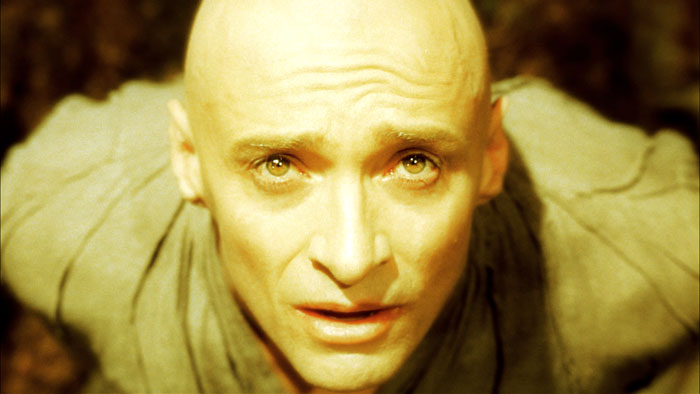
Like Requiem for a Dream and especially Pi, The Fountain is more about mood than plot, per se. Nevertheless, we begin in the sixteenth century, with a scruffy conquistador (Hugh Jackman, having a banner year) paying respects to what appears to be his beloved (Rachel Weisz) before embarking on a suicide mission against a Mayan temple. Before we’re fully acclimated to what’s going on, we’ve leapt to the twenty-sixth century (No, no Twiki), where that conquistador is now a bald, tattooed, Tai Chi practicing monk, traveling across the cosmos with an ailing tree and suffering visions from an age long hence. After a few bewildering minutes here, we find ourselves in our present, where neuroscientist Tom Creo (Jackman) is struggling against time to develop a cure for his wife Izzy (Weisz), before she succumbs to a brain tumor. As The Fountain progresses and we switch back and forth through these three timelines, a picture slowly coalesces of a man-out-of-time (no, not him either), determined beyond all bounds of hope or reason to defeat death and defend his one, true love from its thrall.
In all honesty, The Fountain suffers from some clunky moments in the early going, particularly when Weisz is forced to deliver exposition regarding Mayan beliefs about the Tree of Life, Xibalba (the Mayan underworld), and the Orion Nebula. And some, such as former Slate writer David Edelstein, couldn’t seem to get past the Clint Mansell score, which — as in Pi and Requiem — is hypnotic-bordering-on-intrusive. But, once you get past the somewhat unwieldy set-up, I found the movie’s themes considerably more sophisticated and less banal than most reviewers are giving it credit for. The romance here is pushed front-and-center, sure, but I found The Fountain moving less as a simple love-conquers-all tale than as an eloquent Zen meditation on mortality. (As one character puts it in the film, “Death is the road to awe.”) If matter is neither created nor destroyed, then, in a way, we are all immortal — the elements that make us up were around since the Big Bang and will continue to be around, reconstituted in other forms, long after we’re dead (“in the stars above, in the tall grass, and the ones we love,” to paraphrase a poet when he contemplated a similar plight to Jackman’s.) Indeed, in this fashion, each of us — made up of a combination of matter that, however briefly, has achieved sentience — is the universe trying to express itself. That is no small thing.
Moreover, in The Fountain (and akin to Jacob’s Ladder), Jackman’s character ultimately isn’t fighting to save his love as much as fighting his fear and despair over loss, not only of Weisz but of himself, his own ego: in short, his fear of death. As Weisz’s character says several times over, “I’m not afraid anymore.…Finish it.” Jackman’s Creo is afraid, so he won’t or can’t. “Without accepting the fact that everything changes, we cannot find perfect composure,” writes Shunryu Suzuki in Zen Mind, Beginner’s Mind. “But unfortunately, although it is true, it is difficult for us to accept it. Because we cannot accept the truth of transiency, we suffer.” To my mind, this suffering, and the overcoming of it, lies at the heart of Aronofsky’s The Fountain. I thought the richness of both its vision and its ideas helps it elide over a lot of the pacing and exposition problems in the early going. So, in sum, go see The Fountain: I’m not sure you’ll like it — it’s very possible you’ll love it — but I’m willing to bet, either way, that it’ll stick with you.
[One addendum/caveat/boast: As it happens, I saw The Fountain Monday night at a very private screening/cocktail affair. (How’d I get in? Long story…basically, Aronofsky and I have a mutual friend.) I’ve admitted earlier to being an inveterate celebrity hound, and in terms of celeb-spotting this was manna from Heaven. Of maybe 40-50 attendees, 10-15 were instantly recognizable folk: Not only Aronofsky, Jackman, Weisz, and Ellen Burstyn (also in the film), but a gaggle of other high-profile celebs: Bowie(!), Lou Reed, Mike Myers, Iman, Helena Christiansen, Ben Chaplin, Elizabeth Berkeley, etc. So, I’m almost positive I’d have liked and recommended The Fountain regardless, but I’m forced to admit (re: would like to brag) that I saw it under more-than-ideal circumstances. (Yes, I played it cool despite being famestruck, but I’d be lying if every so often in the first half-hour of the film I found myself thinking “Am I really sharing an armrest with Famke Janssen right now? How bizarre.” Not very Zen of me, I know, but sometimes I’m just a material guy.)]
A Cold Day in the Park.
The Hobbit Nazguled?
“This outcome is not what we anticipated or wanted, but neither do we see any positive value in bitterness and rancor. We now have no choice but to let the idea of a film of The Hobbit go and move forward with other projects…We got to go there – but not back again…” In an e-mail to The One Ring, PJ and Fran say they’re off The Hobbit due to outstanding and unresolved matters regarding their lawsuit against New Line, who want to move on the project now before they lose the rights. MGM (who owns the distribution rights) says it ain’t over yet, but, my, it’s not looking good.
The Straits of Balboa | The Rage of Aquarius
More trailers: Sly tries to go fifteen more rounds in the surprisingly effective second trailer for Rocky Balboa (It’s the music, for sure), and Jake Gyllenhaal, Mark Ruffalo, Robert Downey, Jr., Chloe Sevigny, Donal Logue, Elias Koteas, and Brian Cox venture into Se7en territory in the preview for David Fincher’s Zodiac. (Panic Room was sorta dull and by-the-numbers, but Fincher still has a lot of goodwill in this corner for Fight Club.)
Agent Smith, meet Racer X.
Um, ok. The Brothers Wachowski sign on to make Speed Racer, a highly unnecessary reimagining of the old Saturday morning cartoon. So if Chim Chim ends up being an androgynous leather-clad existentialist kung-fu master, you’ll know why.
The Lunatic is in the Hall.
“I knew what it was right away, because I remember Stanley talking about ‘Lunatic.’ He was always saying he wished he knew where it was, because it was such a great idea.” Apparently, there’s a movement afoot to make a “lost” Stanley Kubrick film, Lunatics at Large. Hey, this could be great news for thespian Brian Atene… (2nd link via Ed Rants/LMG.)
Krypton, Kumar, Halo, & Che.
Quite a bit of movie news lately: Bryan Singer’s next Superman achieves liftoff, as does Harold & Kumar II. (I didn’t think much of Superman Returns, but am willing to give Singer another shot, particularly given how much better X2 was over X-Men. As for H & K…yeah, I’ll see it.) Meanwhile, the Peter Jackson-produced Halo is off for now…probably not a great loss, I suspect. And, finally, Steven Soderbergh and Benicio del Toro’s Che is now two films: The Argentine and Guerrilla, to be shot back-to-back.
Clooney Feels the Burn.
Word is George Clooney is set to reunite with the Coens for Burn After Reading, which is presumably their next film after Cormac McCarthy’s No Country for Old Men. “Production Weekly says the Coen Bros. script is loosely based on the novel ‘Burn Before Reading: Presidents, CIA Directors, and Secret Intelligence,’ by Admiral Stansfield Turner, who served as director of the CIA from 1977 to 1981. The contemporary East Coast caper is about a CIA agent who is writing a book and he loses the disc. Clooney wouldn’t play the agent, but instead a killer.” Well, ok then. But what happened to Hail Caesar! (or, for that matter, Clooney directing the Coens’ Suburbicon)?
Magic Most Sinister.
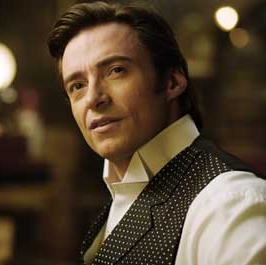 Are you watching closely? I’m having a harder time than usual thinking of what to say about Christopher Nolan’s The Prestige, not only because I think it’s a film best seen cold, with as little information going in as possible, but also because, having read the book by Christopher Priest, my experience with the film was very different from that of most folks. As Michael Caine’s ingenieur Cutter notes at one point, successful magic is all about confusion and misdirection — if you know how it’s done, even a complex and fantastic magic trick can seem blatantly obvious from the get-go. So my time with The Prestige was roughly akin to seeing The Sixth Sense and knowing Bruce Willis is a ghost from the first reel. That being said, while I can’t vouch for how well Nolan conceals his own prestiges from the audience here, I found the movie a dark, clever, and elegant contraption, one that suggests razor-sharp clockwork gears and threatening pulses of electrical current, all impressively encased in burnished Victorian-era mahogany. If you’re a fan of Nolan’s previous work, or of sinister mind-benders in general, The Prestige is a must-see film. Either way, it’s among the top offerings of 2006 thus far.
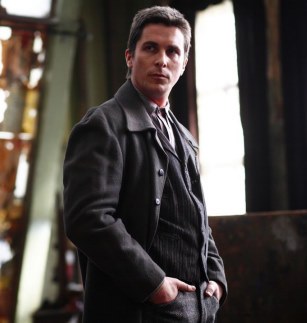
 So, what’s the pledge? Slumming aristocrat Robert Angier (Hugh Jackman) and working-class upstart Alfred Borden (Christian Bale, particularly good) both serve as magician’s assistants to a by-the-numbers prestidigitator (Ricky Jay) — they’re audience plants — and both harbor aspirations of taking their own act on the road. But after an on-stage tragedy involving Angier’s escapist wife (Piper Perabo), a wedge is driven between these two would-be men of magick, fomenting a lifelong rivalry that turns increasingly brutal and obsessive. This becomes particularly so after Borden, the more talented illusionist, comes up with a nifty trick — The Transported Man — that Angier, the more impressive showman, can’t seem to match, even with the aid of his longtime ingenieur, Cutter (Caine). Eventually, Angier is compelled to travel to faraway Colorado Springs to pay visit to a wizard of a different order, Nikola Tesla (David Bowie), and perhaps enlist him (and his Igor-by-way-of-Brooklyn assistant, (Andy Serkis)) in unraveling Borden’s secret. (As apparently required by law this year, Scarlett Johansson also factors in the tale as Olivia, a lovely magician’s assistant bandied back and forth by the two rivals, but it’s a smaller part than you might expect, and newcomer Rebecca Hall makes more of an impression as Borden’s long-suffering wife, Sarah.)
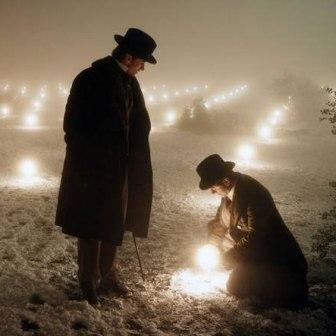
 In keeping with Nolan’s usual m.o., The Prestige is not told linearly, but in narrative fragments spurred by memory, sadness, or anger. In fact, the film begins near the end, with Borden first witnessing and then on trial for the apparent murder of Angier. (Well, that is, after a striking title shot of top hats piled up bizarrely in a forest bed, a shot which makes more sense as the story progresses — I’ll admit to being a sucker for films that start off thus.) And, while the film takes a few jags away from Priest’s book (including omitting both the framing device — good choice — and the very last sequence, which I thought was deliriously creepy and somewhat missed here), it nevertheless keeps the basic story arcs of the novel intact. (In other words, and while remaining as oblique as possible, mystery purists may feel somewhat cheated by the Tesla turn the story takes ninety minutes in, but it’s central to the source material, and had to be there.) Also like the book, Nolan’s final hole card is a deeply disturbing one that’ll linger in the senses well after this trick is complete. In sum, along with Memento and Batman Begins, this jagged tale of illusion and obsession should only add to Chris Nolan’s burgeoning prestige: Bring on The Dark Knight.