
My God, It’s Full of…Planets?


‘The fact that we’ve found so many planet candidates in such a tiny fraction of the sky suggests there are countless planets orbiting sun-like stars in our galaxy,’ said William Borucki of NASA’s Ames Research Center in Moffett Field, Calif., the mission’s science principal investigator. ‘We went from zero to 68 Earth-sized planet candidates and zero to 54 candidates in the habitable zone, some of which could have moons with liquid water.’

After its initial sweep of 1/400th of the sky, NASA’s Kepler telescope finds over 1200 planets — 54 of them potentially inhabitable. (The picture above is a rendering of the six-planet Kepler-11 system, 2000 light-years away.)

Discover‘s Phil Plait puts today’s findings in proper perspective: “Mind you, Kepler is only looking at a sample of stars that is one one-millionth of all the stars in the Milky Way. So it’s not totally silly to take these numbers and multiply them by a million to estimate how many planets there may be in the galaxy…70 million Earth-size planets, and a million in the habitable zone of their stars. A frakking million. In our galaxy alone.

The Art of the Scratch.

Srivastava realized that the same logic could be applied to the lottery. The apparent randomness of the scratch ticket was just a facade, a mathematical lie. And this meant that the lottery system might actually be solvable, just like those mining samples. ‘At the time, I had no intention of cracking the tickets,’ he says. He was just curious about the algorithm that produced the numbers.

In Wired, Jonah Lehrer tells the story of how a Canadian statistician broke the code behind lottery scratch-off tickets. “‘It wasn’t that hard,’ Srivastava says. ‘I do the same kind of math all day long.’” (The trick, in brief: Look for numbers that only appear once on a card, in a winning combination.)

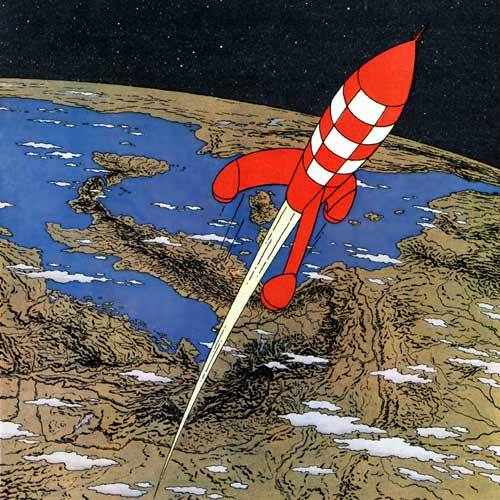
Strapped to the Rocket.


There is no shortage of proposals for radically innovative space launch schemes that, if they worked, would get us across the valley to other hilltops considerably higher than the one we are standing on now–high enough to bring the cost and risk of space launch down to the point where fundamentally new things could begin happening in outer space. But we are not making any serious effort as a society to cross those valleys. It is not clear why.

In Slate, sci-fi author and technophile Neal Stephenson discourses on what rockets tell us about innovation and the course of technology over time. “The phenomena of path dependence and lock-in can be illustrated with many examples, but one of the most vivid is the gear we use to launch things into space.

Into the Murky Deep.


It is a smudge of light only a tiny fraction of the size of our own Milky Way galaxy, and it existed when the universe was only 480 million years old…If confirmed, the discovery takes astronomers deep into an era when stars and galaxies were first lighting up the universe and burning their way out of a primordial fog known as the dark ages.

From a few days ago: The Hubble — also the subject of an excellent IMAX-3D movie I saw on Saturday — (probably) finds the oldest, farthest galaxy yet discovered. “Spectroscopic observations with the forthcoming James Webb Space Telescope, however, are needed to cement the identification of the smudge as a galaxy…The Webb telescope, which is expected to be launched later this decade once NASA figures out how to pay for it, has been designed to find these primordial galaxies and thus illuminate the dark ages.

But The Fighter Still Remains.


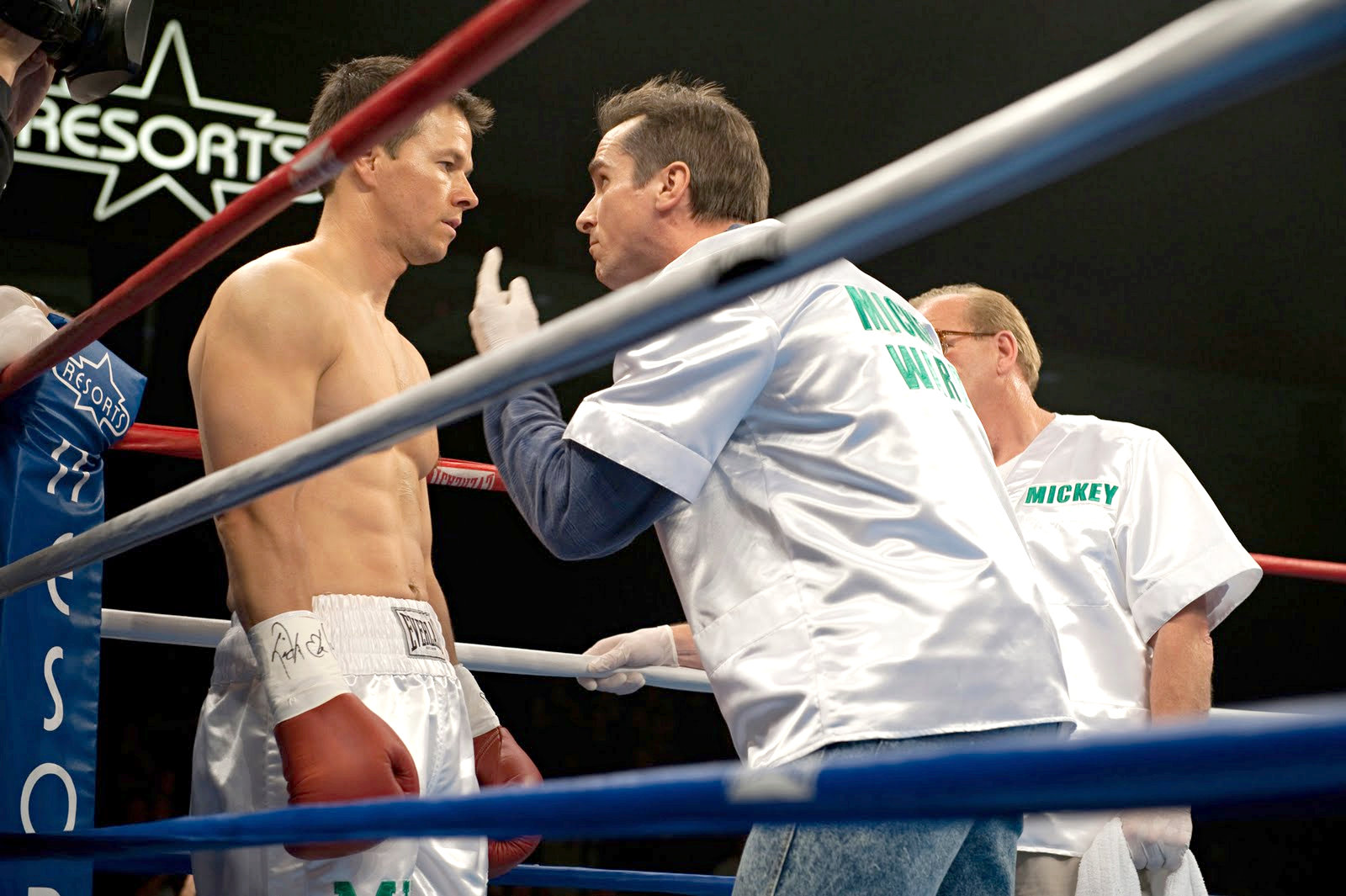
Some unfinished business from earlier this month: David O’Russell’s worthwhile Massachusetts family drama by way of a boxing flick, The Fighter, never got its own long-form review here at GitM. Since I saw it awhile ago now — New Year’s Day, in fact — and since I already basically covered it in the top twenty of 2010 post (where it clocked in at #8), I’ll just let what I wrote there, reposted below, stand. (And for those of you who read this the first time around, my apologies — This is more just a placeholder, should I link to the film in the future.)

Suffice to say, I was pleasantly surprised by David O’Russell’s chronicle of the comeback of welterweight “Irish” Micky Ward, the pride of Lowell, Massachusetts. In fact, I had the opposite experience here that I had with The King’s Speech. There was a potentially interesting story told extremely conventionally, while this is a tried and tested sports movie formula — a boxer with one last shot at a title — that still felt fresh and invigorating.

True, the seven Ward sisters were a bit much — They were the only time this boxing movie veered toward the egregious cartoon rednecks of Million Dollar Baby. But otherwise, solid performances by Mark Wahlberg, Melissa Leo, Amy Adams and especially Christian Bale give this could’ve-been-by-the-numbers film a much-needed heart.

Sentinel of Liberty.


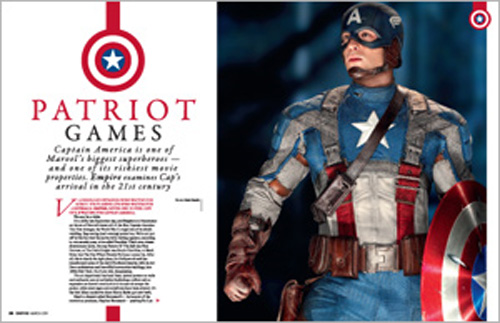
I’ve always loved Raiders and the tone that it had,’ says director Joe Johnston. ‘It was period but didn’t feel like it was made in the period. It felt like a modern-day film about the period, which is what we’re doing on Captain America.‘” The new Empire gives us another look at Chris Evans in Captain America: The First Avenger. (See also the higher-res cover image.) He looks mighty iconic there, I must say.

Englishman in Metropolis.


In the pantheon of superheroes, Superman is the most recognized and revered character of all time, and I am honored to be a part of his return to the big screen. I also join Warner Bros., Legendary and the producers in saying how excited we are about the casting of Henry. He is the perfect choice to don the cape and S shield.

Meanwhile, over on the DC side of things, Sorry Brandon Routh (and the Legion of Jon Hamm Fans): Zack Snyder’s Superman has found its Man of Steel in Henry Cavill, formerly of The Tudors. (The photoshopped Cavill-El above was found here.) I don’t really know the guy, but I hear good things.

Deregulating Rape.

With this legislation, which was introduced last week by Rep. Chris Smith (R-N.J.), Republicans propose that the rape exemption be limited to ‘forcible rape.’ This would rule out federal assistance for abortions in many rape cases, including instances of statutory rape, many of which are non-forcible. For example: If a 13-year-old girl is impregnated by a 24-year-old adult, she would no longer qualify to have Medicaid pay for an abortion.

On the principle that, as per MLK, “in the end, we will remember not the words of our enemies, but the silence of our friends,” I post more often here these days about issues I have with our own, ostensibly-lefty party. But, as Dangerous Meta reminds me: Just in case anyone forgot how crazy the Republicans are these days, the GOP Congress has, for pro-life purposes, actually fashioned a bill that defines rape down. “House Speaker John Boehner (R-Ohio) has dubbed [it] a top priority in the new Congress.” There are no words.

Along the Nile, the Jasmine Blooms.


I brought my American passport today in case I die today,” said Marwan Mossaad, 33, a graduate student of architecture with dual Egyptian-American citizenship. “I want the American people to know that they are supporting one of the most oppressive regimes in the world and Americans are also dying for it.

In the wake of Tunisia‘s “Jasmine Revolution,” and as seen all over the news the past week (once the Village moved past its who-sitting-with-who, SotUprom obsessions), protests continue to roil Egypt — as well as Yemen, Jordan, and the Sudan — in what amounts to an historic popular uprising across the Middle East. Our response so far (Joe Biden notwithstanding): “Saying that ‘no one is satisfied‘ with the steps Mubarak has taken since the protests for political and economic freedom began, Clinton said a transition process was needed ‘so that no one fills a void..what we don’t want is chaos.‘”

As Slate‘s Kai Bid notes: Nor do we want to alienate the Egyptian people further by seeming to back a cruel and repressive government that has clearly lost the confidence of its people. “Obama still has the relatively clean slate and the rhetorical powers to execute a pivot in American policy. In his June 2009 Cairo speech Obama said, ‘America respects the right of all peaceful and law-abiding voices to be heard around the world, even if we disagree with them. And we will welcome all elected, peaceful governments — provided they govern with respect for all their people.‘”

Hopefully, that worthy standard will encourage us to think twice before backing any play involving Egypt’s newly-appointed vice-president (and thus Mubarak’s suggested successor), former intelligence chief Omar Suleiman — a.k.a. the CIA’s point man for extraordinary renditions. “In a nutshell: this appointment will do nothing to pacify the millions of rioting citizens, and if it stands it will perpetuate the same kinds of policies and US power interests in the region to which the people have said enough.

Roll the Hard Sixty.

Cosmetic reduction of partisan conflict appears to be displacing substantive effort to make the Senate an institution that operates according to majority rule. You have to wonder whether Democrats, in the hours leading up to their party leader’s State of the Union, had any sincere desire to enact its programs.

Seem like every time you stop and turn around, something else just hit the ground. Not to be lost in the shuffle, filbuster reform has died anew, and so once again the broken United State Senate has “slipped back into stagnant waters.” Sounds like Two More Years for Presidents Snowe, Collins, Lieberman, and Nelson, then.