
Bob Graham steps aside. This is for the best, really, and kudos to Graham for realizing it. Joe Lieberman, take a long, hard look at this act of statesmanship.
Author: KcM
Rusted Root.
Quicksilver, the first tome in Neal Stephenson‘s new trilogy, has just been released to decent reviews. I may just have to take a break from orals reading and procure a copy…fortunately, Stephenson’s Baroque Cycle seems to be set in Colonial America, so I might even be able to rationalize such a digression.
Paris to the Dogs.
France’s five-star hotels appeal to canine connoisseurs. There’s zero chance of my taking Berk to Paris anytime soon, although we do occasionally trek to Taco Bell.
Seeking Deke.
With their earlier designs on Nick Van Exel apparently stalled, the Knicks plan (once again) to try for Dikembe Mutombo. Hmm. I guess having Mutombo around would help the height-challenged Knicks…but if we were looking for a 40-something center, why’d we ever trade Patrick Ewing in the first place?
Life and How to Live It.
So R.E.M. came to town Saturday night and played probably the best show I’ve seen by Athens’ finest. (This is my fourth over the past decade.) First the setlist:
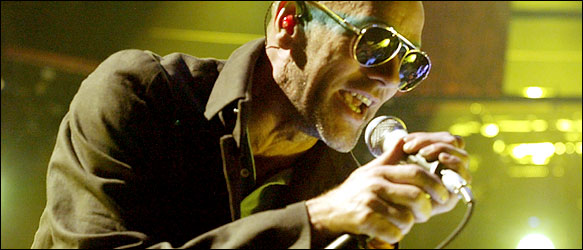
1. Finest Worksong 2. What’s The Frequency, Kenneth? 3. Driver 8 4. Drive 5. Animal 6. Fall On Me 7. Daysleeper 8. Bad Day 9. The One I Love 10. World Leader Pretend 11. (Don’t Go Back To) Rockville 12. The Great Beyond 13. Country Feedback |
14. Losing My Religion 15. Find The River 16. She Just Wants To Be 17. Walk Unafraid 18. Man On The Moon 19. Life And How To Live It |
So all in all, a truly excellent show. There were other R.E.M. songs they’re playing on this tour that I’d have loved to hear (Exhuming McCarthy, Feeling Gravity’s Pull), but they played my two favorites (and my top two requests) — Fall on Me and Country Feedback — so I left happy. I was particularly impressed with Walk Unafraid and She Just Wants to Be, two songs off Up and Reveal respectively that really came into their own tonight, when Peter Buck chose them to show off his considerable guitar mojo. And the band wisely skipped some of their more saccharine moments — Everybody Hurts or Strange Currencies, for example — to showcase old hits (Rockville, Gardening) and political tone poems (Final Straw and World Leader Pretend, a special treat.) In sum, Stipe, Buck and Mills still got it, and I’m very much looking forward to their next swing through the area.
Dubya’s Doggerel.
George W. Bush pens a poem to Laura. It’s not exactly Profiles in Courage, is it?
And Then There Were Nine?
Bob Graham hints on Saturday that the end may be near for his Presidential bid. If so, bully for him for seeing the writing on the wall. (Besides, an early bow-out can’t hurt his veep credentials.)
Confessions of two Dangerous Minds.
Spike Jonze and Charlie Kaufman, the team behind Being John Malkovich and Adaptation, prepare to make a horror film. I’ll go see it.
Deconstructing Harvey.

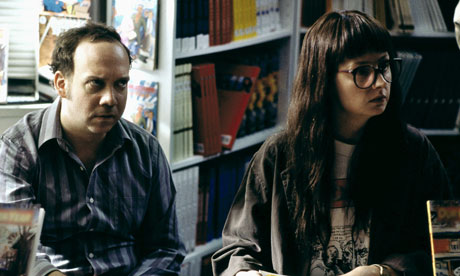
After a few weeks of circling around it, I finally caught American Splendor Thursday night and…I’m finding it a hard movie to write about. On one hand, the film works as a great introduction and overview to the weird world of cartoonist, file clerk, and now weblogger extraordinaire Harvey Pekar. (Indeed, as David Edelstein notes, with its litany of daily mundanities endured and overcome, Pekar’s comic seems an early ancestor of the blog.) The film does a great job of appropriating comic book syntax to tell its story (and in so doing makes Ang Lee’s recent flop look even worse.) And the performances are all quite good, particularly Hope Davis as Pekar’s third wife Joyce Brabner.
All that being said, I admired the film as an intellectual exercise, but never really connected to it emotionally. With a nod to Annie Hall (and of course, the original American Splendor comic), the movie breaks the fourth wall early and often and continually makes a point of its own artifice. But, as a result (and I know this was the point, made explicit with the Donal Logue/Molly Shannon sequence), much of the film came off as artificial and thus not very interesting – I found myself waiting patiently through the Giamatti-Davis scenes just to get another glimpse of the real Pekar, whose impish energy was much more engaging than anything else in the film. (Along the same lines, I thought Splendor also suffered in light of the brilliant and disturbing Crumb – James Urbaniak does a really great Robert Crumb impression, but the memory of that hard-to-forget documentary made him seem all the more like an actor doing an impression.) Moreover, once the story enters the “Our Cancer Year” period, which is obviously a crucial and necessary element of Pekar’s life trajectory, the film takes on the additional thematic weight of encroaching mortality and disease overcome, which is a far cry from the daily dilemmas and annoyances that animate the Splendor comic. As a result, the film seems to devolve in the final third into a conventional biopic. In the end, I enjoyed the movie, and particularly the first half, which feels more like Pekar’s work. But I ultimately found myself thinking that my time with Pekar might have been better spent if I had just unearthed the old issues of American Splendor and started reading. (Pekar blog link via Lake Effect.)
Wes Clark’s Wars.
A former Kosovo War reporter evaluates Wesley Clark’s tenure as NATO commander, and finds that much of the recent criticism leveled the General’s way may be somewhat unfair. In related news, the Village Voice offers a less-sympathetic view of Clark regarding the recent admissions in his new book, Winning Modern Wars.