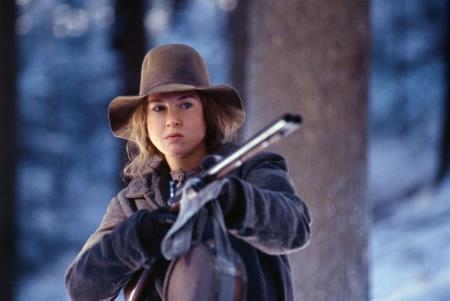
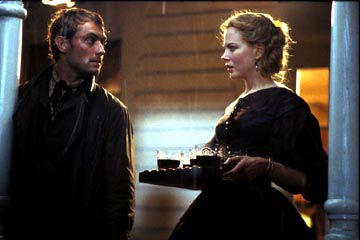
Well, I haven’t read the Charles Frazier novel, but I’d say “Cold Mountain” is an apt and colorful metaphor to sum up this film, its stars, and even its director’s entire body of work. For like Nicole Kidman and Jude Law, and as with The English Patient and The Talented Mr. Ripley, Cold Mountain is beautiful but distant, occasionally breathtaking but often chilly, and not so much high as just plain stilted. In fact, the hike up and down this Cold Mountain includes definite moments of grandeur, but more often than not it feels like a bit of a slog. At times, it’s even glacial.
I should say up front that this is a far better Confederate-centered Civil War film than the vile Gods and Generals. The chaos and carnage of the Battle of the Crater that opens the film seems much more real and visceral than anything in the godawful G&G. Whatsmore, the historical aspects of Mountain generally feel right (In fact, much of the film seems like a fictionalization of Drew Gilpin Faust’s Mothers of Invention, which vividly describes how the lives of Southern women were transformed by the war experience and the collapse of the Confederate patriarchy.)
Unfortunately, the respectable versimilitude of the film keeps getting undermined by the wattage of its star power. From Stalingrad to Petersburg, nobody in the business does starving-but-handsome-and-resolute-warrior as well as Jude Law these days, and he’s quite good here despite the frequent accent-slippage. But, frankly, Nicole Kidman feels all wrong here. It’s not that she’s bad per se, it’s just that, like her ex-husband in 19th-century Japan three weeks ago, she never seems like she fits this milieu at all. (It doesn’t help that she spends most of the end of the film in an outdoor outfit that looks Banana Republic-coordinated.) Finally, others have noted the lack of chemistry between Law and Kidman, and I too thought the central romance here was rather uninvolving.
But, even if the two leads’ remarkable frigidity wasn’t distracting enough, Law and Kidman are just the tip of the iceberg. In fact, in the spirit of the film, I’ll go ahead and torture this metaphor even further…Perhap sensing that the romantic low burn here might be too dim a fire to heat the screen for 150 minutes, Anthony Minghella has packed Cold Mountain so full of stars and cameos that it starts to feel like It’s a Mad, Mad, Mad, Mad World. From Lucas Black getting bayonetted in the opening minutes to Jack White procuring cider at the very end (in yet another of Minghella’s quintessentially ham-handed symbolic moments, but I’ll get to that later), famous faces keep appearing around every corner of the poor, white backcountry South, and it took me out of the movie almost every time. Basically, I found it hard to become engrossed in the film when I kept thinking things like “So, that’s what Kathy Baker‘s been up to…she got married to the manager from Major League,” “James Rebhorn‘s his doctor? He’s toast,” “Well, Jena Malone didn’t last very long,” “and “Hey, that’s Cillian Murphy. Between him and Brendan Gleeson, this is like a sequel to 28 Days Later…um, except it has no zombies and it’s set in the Civil War South.”
Ok, perhaps that’s an unfair criticism, but I’d think even people who don’t go to the movies much are going to be distracted by all the Hollywood faces flitting about. I should say while I’m on the subject that Brendan Gleeson is very good (as always) here – Not only does he handle the accent like a champ, but he conveys more emotion in one winsome smile or knowing grimace than many of the central characters do the entire film. As for other good performances…Despite lugging around a baby that’s as big as she is, Natalie Portman proves here that she can still act when not forced in front of a bluescreen. (By the way, after the Portman episode, why didn’t Inman take one of the Union horses?) Giovanni Ribisi moves into the frontrunning for the Cletus the Slack-Jawed Yokel biopic. And, Renee Zellweger…well, she moons and mugs through this film like a Best Supporting Actress award was her birthright, but she still gives Cold Mountain a very-much-needed jolt in the arm every time she shows up. (She’s particularly energetic when compared to the staid Kidman.)
On the flip side of the coin, somebody should’ve told Donald Sutherland that different parts of the South call for different accents…he sounds miles away from a Charlestonian. And Phillip Seymour Hoffman, perhaps the best thing about Minghella’s Ripley, is perhaps the worst thing about Cold Mountain. Completely unconvincing in his role here, he’s a walking, talking anachronism.
All the unnecessary star voltage aside, of course, this movie eventually rises and falls on its director, and all of Anthony Minghella’s strengths and weaknesses are present here. (I should say that I loathed The English Patient and enjoyed Ripley until Jude Law was killed, after which the film meandered to its conclusion.) Both Patient and Ripley have some very beautiful and striking moments, but more often than not the imagery is so “artfully” composed as to become hamhanded. The same goes here for Mountain…we’ve got a lamb running around in wolf’s clothing, we’ve got a dove trapped in a church until Jude Law sets it free (you do the math)…in fact, we have enough fluttering, portentous birds on a wing here to make John Woo blush. Perhaps these capital-S Symbols are in Frazier’s novel too, but I’d still think a subtler director could have mined them more dexterously. And, while I didn’t know the ending coming in, Minghella foreshadows the conclusion so laboriously (even having Kidman break it down step-by-step to Zellweger) that I spent the last twenty-five minutes just waiting for the other shoe to drop, which killed any real emotion I might’ve felt about the denouement.
Looking back, I’ve been pretty harsh here, so I should repeat that Cold Mountain is not a bad film at all. In many ways, it’s quite good. But, Oscar buzz notwithstanding, it’s definitely not great…in fact, I even found it less involving than The Last Samurai. In the future, were I looking to recommend a film that captures the despair and devastation afflicting the Confederate homefront in the waning days of the war, I just might pick Cold Mountain. But, as for attempts to give The Odyssey a Faulknerian palmetto-and-spanish-moss recasting, give me O Brother Where Art Thou? any day of the week.