570 Channels (And Nothin’ On).

“‘We don’t know whether the media multitasking is causing symptoms of depression and social anxiety, or if it’s that people who are depressed and anxious are turning to media multitasking as a form of distraction from their problems,’ Becker said in a statement.”

And here I thought Netflix and Warcraft went so well together: A new Michigan State study finds a correlation between depression and multi-tasking media. I wonder if the obverse is true also. One of the many reasons I love seeing a movie in the theater is that (ideally) nothing else but the film is impinging on my attention.

Young Despite the Years.


This dates back to February 1981 — the exact day is uncertain — which puts the show some 18 months before the release of the debut EP ‘Chronic Town,’ and a full two years before ‘Murmur.’” From three decades ago, film surfaces of a very young R.E.M. practicing their trade at the 688 club in Atlanta. Contrast with only four years later, in Rockpalast, when the pride of Athens, GA, had really come into their own.

Where the Magic Happens.

“As I move through the book it becomes more demanding…Toward the end of a book, the state of composition feels like a complex, chemically altered state that will go away if I don’t continue to give it what it needs. What it needs is simply to write all the time. Downtime other than simply sleeping becomes problematic. I’m always glad to see the back of that.” Via Brain Pickings, daily routines of famous writers.

The Way We Weir.

The thing they always used to say was ‘We want these kids to have a victory.’ I think what they were trying to say was ‘Is there any way it could be a little less depressing?’ And it’s a fair question when no one’s really watching. We were telling really unconventional stories where the victories were so small they could be confused with not actual victories.

In Vanity Fair, an oral history of Freaks and Geeks. “We didn’t really have to be told we were being canceled. We watched the craft-service table: it started out with, like, cold cuts and delicious snacks, and it was reduced to half a thing of creamer and some Corn Pops by the end.

And also in the same magazine, Paul Feig tells where everyone was headed for Season 2: “With his mom dating Coach Fredricks, Judd and I liked the idea of Bill slowly becoming a jock — that he turned out to be good at basketball and started to get into it, so that he was getting pulled a little more over to the jock side.

The Anti-Wal-Mart.

Mr. Sinegal, whose father was a coal miner and steelworker, gave a simple explanation. ‘On Wall Street, they’re in the business of making money between now and next Thursday,’ he said. ‘I don’t say that with any bitterness, but we can’t take that view. We want to build a company that will still be here 50 and 60 years from now.’

This article is seven years old now, so I don’t know if their admirable corporate policies have survived the Great Recession. (Update: Apparently, they have.) Nonetheless, from 2005 and as seen floating around on Facebook of late, the NYT’s Steve Greenhouse explains how CostCo became the anti-Wal-Mart. “[N]ot everyone is happy with Costco’s business strategy. Some Wall Street analysts assert that Mr. Sinegal is overly generous not only to Costco’s customers but to its workers as well. Costco’s average pay, for example, is $17 an hour, 42 percent higher than its fiercest rival, Sam’s Club.” Oh, yeah, let’s nip that in the bud, then. Assholes.

The Leader and his Drones.

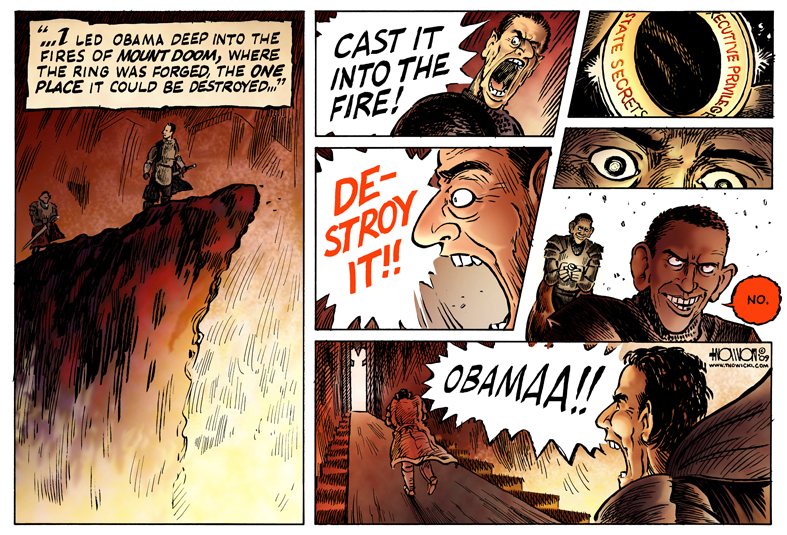
It is literally impossible to conceive of any mindset more at odds with…basic principles than the one that urges that Barack Obama – unlike George Bush or Mitt Romney or whoever the scary GOP villain of the day is – can be trusted to unilaterally and secretly kill or imprison or surveil anyone he wants because he is a Good man and a trustworthy leader and therefore his unproven accusations should be assumed true. But this is, overwhelmingly, the warped and authoritarian sentiment that now prevails in the bulk of the Democratic Party and its self-identified ‘progressive’ faction, just as it did in the GOP and its conservative wing for eight years.”

Upon the revelation that the Obama administration finally moved to codify a drone policy — but only in case they lost the election and Romney took up the Ring of Power instead — Glenn Greenwald calls out the many Democrats who have forsaken their prior civil liberties stances to prop up this sort of obviously unconstitutional behavior by “Our Team.”

See also Marcy Wheeler on this issue, who along with offering an informed and in-depth view of the big picture, has unleashed some devastating tweets of late. To wit: “Shorter Scott Shane: Drone Rule Book exists for NYT A1, but not for ACLU’s grubby little FOIAs.

I’ve said this before, but there’s an easy available metaphor to explain why what the administration is doing here is so unhealthy and reprehensible. As with the Ring, so too with indefinite detention, state secrets, extrajudicial assassinations, unmitigated use of drones, and the rest of the dark tools comprising today’s GWOT arsenal. It does not matter who tries to wield them — they will corrupt regardless, not to mention leave a trail of undeserving dead in their wake.

Note: Cool Mount Doom comic above by Terrence Nowicki, Jr (@deephurting).

Warp Speed…at a Price.

“‘Remember, nothing locally exceeds the speed of light, but space can expand and contract at any speed,’ White told io9. ‘However, space-time is really stiff, so to create the expansion and contraction effect in a useful manner in order for us to reach interstellar destinations in reasonable time periods would require a lot of energy.'”

Just re-reading The Forever War at the moment, so this seems very apropos. io9 looks into the recent possible breakthrough on a functioning warp drive. “Mathematically, the field equations predict that this is possible, but it remains to be seen if we could ever reduce this to practice.

Of course, while mathematicians might have gotten around the “ridiculous amounts of energy required” problem, there’s now the new issue of ridiculous amounts of energy expended — in a lethal frontward cone. “When the Alcubierre-driven ship decelerates from superluminal speed, the particles its bubble has gathered are released in energetic outbursts. In the case of forward-facing particles the outburst can be very energetic — enough to destroy anyone at the destination directly in front of the ship. ‘Any people at the destination,’ the team’s paper concludes, ‘would be gamma ray and high energy particle blasted into oblivion due to the extreme blueshifts for [forward] region particles.'”

A Passage to Tharsis.

“‘The ticket price needs to be low enough that most people in advanced countries, in their mid-forties or something like that, could put together enough money to make the trip,’ he said, comparing the purchase to buying a house in California.”

If you’d prefer to stay within system instead, SpaceX founder Elon Musk sets the cost of a one-way ticket to Mars at $500,000. “‘Some money has to be spent on establishing a base on Mars. It’s about getting the basic fundamentals in place,’ Musk said. ‘That was true of the English colonies [in the Americas]; it took a significant expense to get things started. But once there are regular Mars flights, you can get the cost down to half a million dollars for someone to move to Mars. Then I think there are enough people who would buy that to have it be a reasonable business case.” Start saving up, y’all — Get there before the religious zealots, er, Pilgrims, move in. Update: More details on Musk’s proposal.

Fact-checking Lincoln.

It’s not a question of being wrong, it’s just inadequate,’ Foner said…In fact, he says if the 13th Amendment had not passed in January 1865, Lincoln had pledged to call Congress into special session in March. ‘And there, the Republicans had a two-thirds majority and would ratify in a minute,’ Foner said. ‘It’s not this giant crisis in the way that the film’s portraying it.’

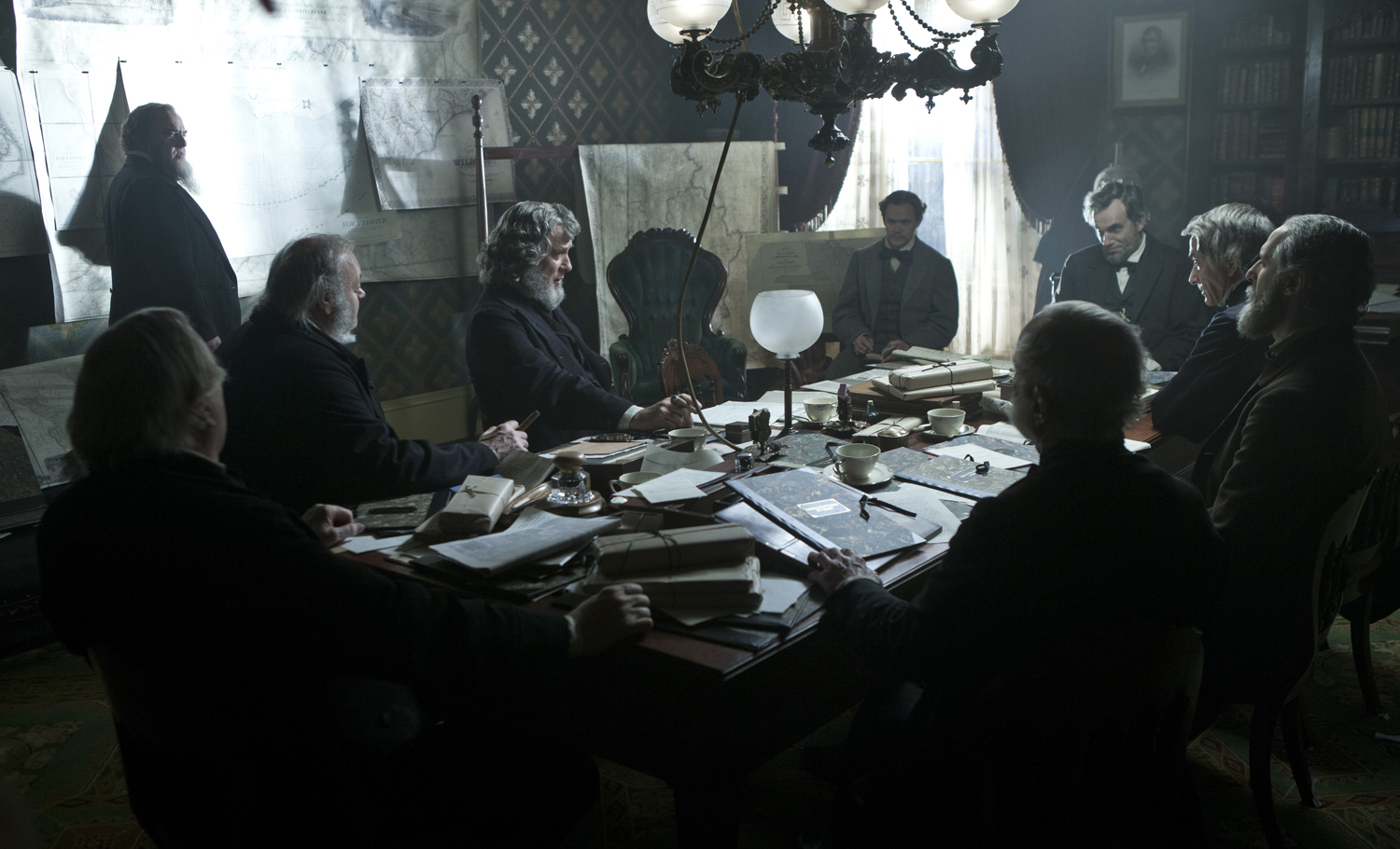
Historian Eric Foner, who knows of what he speaks, fact-checks Steven Spielberg and Tony Kushner’s Lincoln. I enjoyed the film quite a bit, and would recommend it to all comers, particularly Daniel Day Lewis’s typically amazing performance. That being said, I thought the excessive emphasis on the virtues of compromise in this story was fundamentally wrongheaded.

For one, the death of slavery would never have reached the House floor were it not for several decades of uncompromising agitation by abolitionists. “On this subject, I do not wish to think, or speak, or write, with moderation. No! no! Tell a man whose house is on fire, to give a moderate alarm; tell him to moderately rescue his wife from the hand of the ravisher; tell the mother to gradually extricate her babe from the fire into which it has fallen; — but urge me not to use moderation in a cause like the present. I am in earnest — I will not equivocate — I will not excuse — I will not retreat a single inch — AND I WILL BE HEARD.” As many of y’all know, that’s William Lloyd Garrison in 1831, giving one of the most definitive statements against compromising with an evil like slavery. Point being, compromise didn’t end slavery in America — an abject refusal to compromise did.

For another, as Foner notes, Lincoln had the votes in the next Congress — so there was no real need to compromise in this situation in any case. And besides, is it really a heroic moment for Thaddeus Stevens to be downplaying his commitment on the House floor to basic human equality? Surely, misleading the public about one’s true beliefs in congressional debate is not something we should be applauding. Nor does Washington, now or then, need any more erstwhile reformers who think the right thing to do when confronted with a stand on fundamental principle is to obfuscate and capitulate.

Of course, this nation was founded on compromise — some of them quite repellent, like the Three-Fifths — and the United States wouldn’t exist without it. And at other times, intransigence on principle has lost battles that compromise would clearly have won, such as the stubbornness of Woodrow Wilson dooming the League of Nations to defeat in 1919 and 1920, But the problem with this — mostly contemporary — emphasis on compromise is that it leads the filmmakers to a flawed understanding of the history of this period.

However much research Tony Kushner did on Lincoln here — and the film is indeed very well-written — it’s unfortunately quite clear that he doesn’t know jack about what came after the War. Here’s what he said to NPR on the subject:

“I think that what Lincoln was doing at the end of war was a very, very smart thing. And it is maybe one of the great tragedies of American history that people didn’t take him literally after he was murdered. The inability to forgive and to reconcile with the South in a really decent and humane way, without any question, was one of the causes of the kind of resentment and perpetuation of alienation and bitterness that led to the quote-unquote ‘noble cause,’ and the rise of the Klan and Southern self-protection societies. The abuse of the South after they were defeated was a catastrophe, and helped lead to just unimaginable, untellable human suffering.'”

This, I’m sorry to say, is nonsense. Here, Kushner is blithely reciting a century-old popular myth, perpetuated by the Dunning School and D.W. Griffith, that isn’t just anachronistic and wrong. It’s been widely discredited, by some of the very same authors the film cites as sources.

The noble cause and the Klan did not arise because the North was mean to the former Confederate states. They arose because many in the South refused to accord African-Americans the basic civil liberties for which the war had ultimately been fought. To “forgive and reconcile with the South” would mean acceding to the disfranchisement and general abuse that many whites desired to levy upon African-Americans in the former Confederacy. Indeed, when Kushner’s desired move to “forgive and reconcile with the South” came with the end of Reconstruction in 1877, it was followed relatively soon thereafter by the emergence of Jim Crow. In short, Kushner’s argument here is pure wishful thinking, and it has been exposed as bunk by the last 40-some-odd years of Civil War and Reconstruction histories.

TL;DR: Lincoln is an entertaining and worthwhile film, but, then as now, compromise can be overrated. (Kushner quote via Tropics of Meta.) Update: More from Foner.


Secrets of the Supercut.


“Many supercuts provide hard evidence of the existence of tropes long suspected but never quite proved: imperiled characters fretting that they have no cellphone signal; high-tech investigators asking their imaging software to “enhance“; action movie toughs girding for battle by announcing, “We’ve got company.” But what motivates the supercutter to slog through hours of footage to compile these minute observations? And what distinguishes the masters of the form?

In Slate, old friend Seth Stevenson surveys the practice and methodology of supercuts. At the very least it’s both funny and instructive to see how many times, to take the example of ST:TNG, Worf gets denied and bad things happen to Geordi.