Whether or not the world really needed a film about the events that took place on United Flight 93 the morning of September 11, 2001 is, I suppose, still an open question. I can see both sides of the argument: that it’s too soon for a movie about 9/11 and that our current involvement in the war on terror demands we come to terms with what happened that day. (As my father pointed out, the WWII generation saw plenty of war flicks come out while the conflict still raged in Europe and the Pacific.) For my own part, even despite the stellar reviews for Paul Greengrass’ film, it took me a few weeks to crank up the nerve to sit through a movie that I figured would be at best chilling and heart-rending and at worst deeply exploitative and repellent. That being said, having run the gauntlet earlier this week, I can now happily report that United 93 is magnificent, and arguably the best possible film that could’ve been made about this story. Both harrowing and humane, it’s the movie of the year so far.
United 93, like 9/11, begins like any other day. For most of the first third of the film (the opening scenes, where we watch the four terrorists make their final prayers and preparations, notwithstanding) we simply follow people beginning their work day: air traffic controllers look at the weather and discuss possible delays, pilots make small-talk on their way to the cockpit, flight attendants prepare the cabin, and sleepy, anonymous passengers sit around Newark airport, making phone calls or waiting with blank, thousand-yard-stares for their turn to board. It looks exactly like every single airport terminal you’ve ever seen, and, if you had no sense of what’s to come next, you might be deadly bored by all this reveling in mundanity. But, there’s a method to Greengrass’s madness — not only do these early scenes root the film in our world (as well as foster some sickening suspense — we’re obviously waiting for the other shoe to drop), but they take us back to what Karl Rove might call a “pre-9/11 mentality.”
It’s no small testament to the film’s intricate set-up that, when quintessentially Bostonian and New Yorker ATC guys start noticing some planes acting quirky, we sense their palpable confusion even though we know exactly what’s going on, and — when the second plane hits the World Trade Center (which is never shown, except on CNN or in long shots from the Newark control tower) — we feel as shocked as they do, all over again. From there, the film’s second act involves civilian and military air traffic officials (some of whom are played by the real people involved) struggling to make sense of a increasingly horrifying situation for which everyone was totally unprepared. ATC men feverishly watch the wrong planes for signs of a hijacking, FAA authorities put together a board of possible suspect flights and try to track down an AWOL military attache for some answers, a plane that was thought destroyed pops up again on the radar dangerously close to Washington, unarmed fighters (the best anyone could find on short notice) scramble in the wrong direction over the ocean, and NORAD waits desperately for the presidential authorization to fire on hijacked airliners, to no avail. (Think My Pet Goat.)
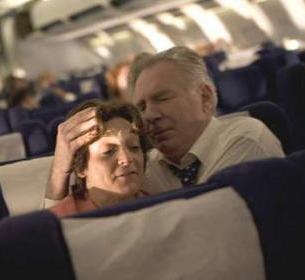 And, in the meantime, United 93 begins its own hellish journey, as the four terrorists on that plane (who, to Greengrass’ credit, are portrayed as multifaceted as they could be, given their vile plan), after some silent soul-searching, spring into action: They take over the cockpit, scare into submission the passengers (all of whom are played by relative unknowns, although some — such as David Rasche of Sledge Hammer — look vaguely familiar), and set a course for the Capitol. Thrust to the back of the plane by a “bomb”-carrying hijacker, having little-to-no sense of what’s going on in the cockpit, and wracked with fear, grief, and confusion, the passengers of United 93 — operating with even less knowledge than the people on the ground — eventually piece enough to discover that they must act. This all takes place in real time, and isn’t played as cheap film heroics in the slightest. Like everything else in United 93, it all feels terrifyingly real, making the passengers’ final, collective, desperate lunge for survival one of the most visceral and cathartic movie sequences in years — it, like the final shot, will linger in your memory for days to come.
In short, United 93 is undeniably hard to watch at times, and I can see why many folks out there would steer clear of it like the plague. Still, if you feel like you can handle the subject matter, United 93 is a must-see film. While it doesn’t even really attempt to offer a broader perspective on the events of 9/11, it’s hard to imagine a movie that could reconstruct the emotional experience of that day as faithfully and without cynicism or exploitation as this one.