
“So the choice is between a terrible decision and one that is even worse. The terrible decision is just to begin leaving, knowing that even more innocent civilians will be killed and that we’ll be dealing with agitation out of Iraq for years to come. The worse decision would be to wait another year, or two, or three and then take that terrible course.” While parsing the forthcoming recommendations of the Baker-Hamilton commission (which, among other things, calls for Iraqification of the war (sound familiar?) and a near-complete troop withdrawal by early 2008), journalist and Blind into Baghdad author James Fallows changes his mind about the merits of maintaining our military presence in Iraq: “If it is not in our power to prevent these disasters, then it is better to do as little extra damage to ourselves as possible before they occur.”
Author: KcM
This Wheel’s on Fire.
“To talk of grand schemes — partitioning Iraq or pressuring Maliki to form a ‘reconciliation government’ and amend his constitution — is, quite apart from their merits, plainly absurd, because we have no control over what the Iraqis do. We still have some control, though, over what we do and, maybe, over what we can persuade others to do with us.” In related news, Slate‘s Fred Kaplan, who seems to advocate hunkering down for the long haul over withdrawal, ponders what to do should the Maliki government in Iraq fall apart.
Diebold Dissed.
A new report by NIST comes out against electronic voting machines, mainly for their lack of an independently verifiable paper trail. Instead, the report recommends an optical-scan system “in which voters mark paper ballots that are read by a computer and electronic systems that print a paper summary of each ballot, which voters review and elections officials save for recounts.“
Don’t be Hastings.
Looking to avoid another contentious fight after the recent Hoyer-Murtha melee, Speaker-elect Pelosi sidesteps both Jane Harman and Alcee Hastings for the House Intelligence Committee head. “Harman, a moderate, strong-on-defense ‘Blue Dog’ Democrat, had angered liberals with her reluctance to challenge the Bush administration’s use of intelligence. Hastings, an African American, was strongly backed by the Congressional Black Caucus but was ardently opposed by the Blue Dogs, who said his removal from the bench disqualifies him from such a sensitive post.” As with Hoyer and Murtha, Hastings’ questionable ethics record is more of a concern to me than Harman’s moderation, but a third choice is fine with me. Update: Pelosi chooses Silvestre Reyes for the post.
Paying for Plaudits.
Considered historically horrible by the ever-expanding reality-based community, Dubya and his advocates plan to remedy the damage by buying their way into the hearts of historians. “Bush’s institute will hire conservative scholars and ‘give them money to write papers and books favorable to the President’s policies,’ one Bush insider said.” Hmm…don’t expect too many Bancroft winners out of that bunch. (Via The Oak.)
That Old-Time Religion.
Speaking of politically partisan reading material, a brief plug: If you’re looking for a stocking stuffer for the politically inclined, How the Republicans Stole Religion (formerly How the Republicans Stole Christmas), a book I worked on last year with pundit and former seminary student Bill Press, is now available in paperback at a bookstore near you.
The Ballad of Bobby.
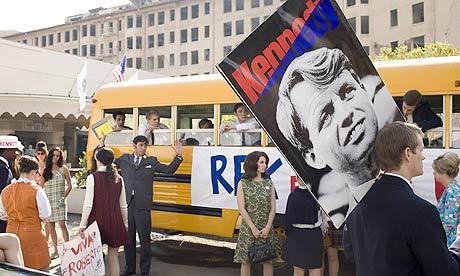
“Now that Dr. King is gone, there’s no one left but Bobby.” And, tragically, America would only have him for two more months. It’s hard to fault the sentiment behind Emilio Estevez’s Bobby, a humane, warm-hearted paean to the slain Senator, whose untimely end marked the final death rattle of hope for countless American liberals and progressives in the sixties. But, frankly, the film — while easy to sit through, to be sure — is also confused and overstuffed. It attempts to be Grand Hotel by way of RFK: Dozens of disconnected lives that intertwine one fateful night and that are ultimately bonded by their common humanity, as so eloquently articulated by Kennedy. But, however ambitious and meritorious its message and its patron saint, Bobby is a well-meaning muddle. The powerful stock footage and a few brief moments aside, a lot of the film just falls flat.
Due to its huge cast and multiplicity of stories, Bobby defies a full summation. Nevertheless, the film follows countless recognizable actors as they go about their lives at the Ambassador Hotel on June 4, 1968, the day before RFK was shot by disgruntled Palestinian Sirhan Sirhan. Among them are elder statesmen (Anthony Hopkins, Harry Belafonte), former A-listers turned B-listers (Emilio Estevez, Christian Slater), aging starlets (Sharon Stone, Demi Moore), TV standbys (Helen Hunt, David Krumholtz), likable character actors (William H. Macy, Freddy Rodriguez), strikingly attractive newcomers (Mary Elizabeth Winstead, Svetlana Metkina), and Frodo (playing, for all intent and purposes, Frodo.) Almost all of the performances are solid and likable (with the notable exception of Ashton Kutcher as a drug dealer — it’s unbelievable how a guy who’s made his living playing a stoner for years is so thoroughly implausible at it — he’s like a kid in a school play.) But there’s a lot of unnecessary overlap or what comes across as extraneous filler in these tales. Two separate stories (Wood and Lindsay Lohan’s quickie marriage, Shia La Boeuf and Brian Geraghty’s day off) cover basically the same ground about Vietnam. Hopkins, Belafonte, Moore, and Stone all talk about the indignities of growing old, while Stone, Macy, Moore, Estevez, Hunt, and Martin Sheen all lament failing marriages…but to what purpose? What, really, does all this have to do with RFK? I get it — it’s about shared humanity. But Bobby tries to do too much in the time given, and would’ve been more effective, I think, if it’d had been pared down some.
The most resonant parts of Bobby are the storylines involving Kennedy campaign workers (Joshua Jackson, Nick Cannon) and, most notably, the simmering racial tension among the kitchen staff (Freddy Rodriguez, Jacob Vargas, Lawrence Fishburne). The latter tale is particularly interesting — despite Slater being stuck as a cartoon “racist but a real person too” barely this side of Matt Dillon in Crash — since it highlights the concerns and aspirations of Latino immigrants, who are often completely neglected in movies dwelling on race in America (even in otherwise sterling shows like The Wire.) But, even here, it’s ultimately played too broadly: What we’re left with are “life is a blueberry cobbler” metaphors and monologues about King Arthur that’ll just make you wince. The problems with the movie can be summed up by the footage used of Bobby at the Ambassador Hotel — obviously powerful stuff. Unfortunately, it’s overlaid with Simon & Garfunkel’s “The Sound of Silence,” which even without the obvious Graduate overtones is entirely too broad a pick — It detracts from rather than enhances the already potent archival footage.
 Still, I don’t want to suggest that I’m completely hating on Bobby. For all its ham-handedness, I enjoyed the experience, and I sat there with a smile on my face through most of the film. And I do applaud Estevez’s obviously strong admiration for Senator Kennedy. I was recently on a date where discussion arose as to whether things would’ve been different if Bobby had lived. She thought not, or rather that it’d be impossible to tell. I’m more inclined to agree with Michael Sandel, who wrote that: “Had he lived, he might have set progressive politics on a new, more successful course. In the decades since his death, the Democratic Party has failed to recover the moral energy and bold public purpose to which RFK gave voice.” Regardless, as with Dr. King, we shouldn’t even have to ask this question. Both men who were continuing to grow and develop, Dr. King and Bobby were tragically ripped from us before their time, a back-to-back blow in an already miserable year that felled progressive ambition in America for decades. I have to think that our nation would be a brighter, happier, and more compassionate place in the years since if we could have continued to benefit from their leadership and counsel.
Since we cannot, we can only honor their examples and remember their words. In the end, Bobby could’ve been a much worse movie than it in fact is, and I still would give it credit for reminding us of Senator Kennedy’s essential creed: “But we can perhaps remember — even if only for a time –that those who live with us are our brothers; that they share with us the same short moment of life; that they seek — as we do — nothing but the chance to live out their lives in purpose and happiness, winning what satisfaction and fulfillment they can.”
‘Til the Last Cat Dies.
“In the Bible, God tells us for everything there is a season, and for me, for now, this season of being an elected official has come to a close. I do not intend to run for president in 2008.” Americans — and Sam Brownback — rejoice (and the stray cats of Tennessee lament) as former Majority Leader Bill Frist announces he won’t be running for president in 2008. Now he can delve full-time into his favorite hobby: cutting things…
Son of a Preacher Man.
Word officially comes down that Garth Ennis’ Preacher is being developed for HBO by Mark Steven Johnston (Daredevil, Ghost Rider) and Howard Deutch (Grumpier Old Men.) Not the most exciting development team in the world, but it’s nice to see HBO get into the comic game. (And if Zack Snyder’s take on The Watchmen falls apart for some reason, as so many earlier attempts at it have, a 12-hour series on the Home Box Office would be a good place for Alan Moore’s magnum opus.)
Venomous Veil.
I’m talking about the man in the mirror…Two new posters for Sam Raimi’s Spiderman 3 make it online, showcasing the Spidey-Venom duality.