Muddled in their Intent.


I never caught the source material while it was on Broadway, so I can’t compare it to the play. But, while I found Nicholas Hytner’s film of Alan Bennett’s The History Boys to be a thoughtful and decently engaging piece of work, it makes for a somewhat unnatural and theatrical evening of cinema. The ideas in (the) play are obviously intriguing and worthy of contemplation, but — with several performances better suited for the back rows than the big screen (most notably Clive Merrison as a schoolmaster out of Monty Python) and a gaggle of bon mot-spouting teenagers that, at least in my own personal and teaching experience, act in no way at all like teenagers — The History Boys often felt forced to me. It’s a worthy piece of pedagogy, I suppose, and I’m almost positive it must work better on Broadway. But, overall, I thought it trafficked in archetypes more than it does in real-world, flesh-and-blood characters — more fiction than history, I’d say — and this close to the action, its faults are harder to hide.

As iconic cuts by New Order and The Smiths tip off in the opening moments, The History Boys takes place in the early 1980’s — 1983 Sheffield, to be exact. But don’t let “Blue Monday” and “This Charming Man” fool you: our story in fact takes place in a boys’ preparatory school, one — references to W.H. Auden and Brief Encounter notwithstanding — seemingly hermetically sealed from the outside world at large. Here in this academic biodome, several young lads, having done exceedingly well on their A-levels, now prep for the grueling college application process, in the particular hopes of getting into Oxford and Cambridge.

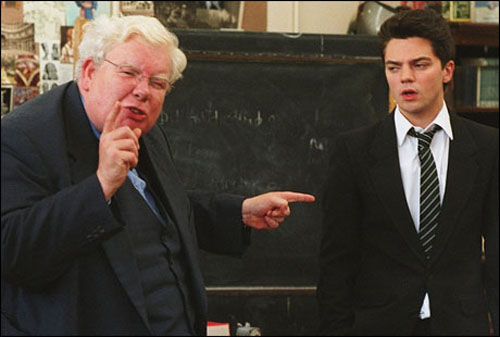
To aid them in this arduous process are two history professors dueling for their impressionable minds…and bodies: In the relativist corner, Professor Irwin (Stephen Campbell Moore), a sharp, young, and assured (if closeted) new hiree dedicated to promoting the ironies and contingencies of history. Meanwhile, over in the knowledge-for-its-own-sake department rests Professor Hector (Richard Griffiths, the soul of the film.) Orwell looming over his shoulder (the two agree on the debasement of “worrrrds“), Hector is a grotesque but endearing fellow who one might call avuncular, were it not for his rather unfortunate penchant for fondling his students’ genitals. Shrugging off these occasional gropes (far more sanguinely than seems realistic, IMHO), the history boys perform poetry, film scenes, and cabaret tunes for the latter and develop streaks of contrarian skepticism for the former, all the while learning a thing or two not only about life and history, but of the Achilles’ Heels of their esteemed teachers.

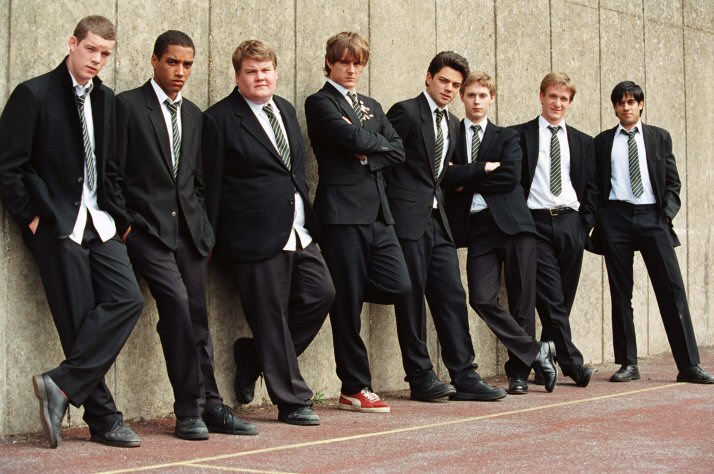
In a nutshell, the basic problem I had with The History Boys is this: A decade ago, a friend of mine once described a mutual acquaintance as “the ideal twenty-two-year-old…in the eyes of a fifty-five-year old.” Well, this movie’s got a whole pack of ’em. All of the young actors here are decent enough — if a bit broad, cinematically speaking — with Samuel Barnett (as Posner, a boy trapped in the very special hell that is an unrequited teenage crush) and Dominic Cooper (as Dakin, a young man increasingly hopped up on Nietzsche and the power of his own burgeoning sexuality) given the most to do. But, as they effortlessly spin forth witticisms at the most opportune moments and gather around the piano without even a trace of cynicism or irony (“the shackles of youth,” as the line goes) about them, they all seemed very, very improbable to me…and that’s even notwithstanding their handling of the aforementioned sexual misdeeds. (Full disclosure: I have much the same problem with Whit Stillman films.)

Yet, once you take it as inherently fanciful and somewhat missuited for the big screen, there are still elements to enjoy in Boys, including a number of thoughtful disquisitions on the uses and practices of history as a discipline: for example, on contingency, commemoration, and the rise of a more gender-balanced understanding of the past (the latter memorably delivered by Frances De La Tour, who, while excellent here as a jaded prof, still unfortunately kept reminding me of Madame Maxime.) Admittedly, these digressions do seem shoehorned in at times — and brought back memories of fading historiography seminars — but they still offer some keen grist for the philosophical mill. (That being said, I somehow suspect that the teaching of history is a less sexually charged discipline than as seen here, where it’s rife with more suppressed longing than the Catholic priesthood. But perhaps I haven’t been at it long enough.)
Shame of Carolina.

If I were a state legislator, I’d vote for it to move off the grounds — out of the state.” Another MLK day means another chance to lament the embarrassment that is the Confederate flag flying prominently outside my home State House (albeit no longer above the Capitol.) In South Carolina today, Senators and presidential hopefuls Chris Dodd and Joe Biden called for the flag’s removal. “Biden expects legislators here will eventually move the flag. Pointing to his heart, he said, ‘as people become more and more aware of what it means to African-Americans here, this is only a matter of time.’

Scattered without the Eye.

“‘Times have changed. I don’t want to be someone who they say is too stubborn to change too,’ said Rep. Rodney Alexander (R-La.), whose 92 percent conservative rating did not stop him from voting with Democrats on the homeland security and minimum-wage bills.” The delightful success of the 100 Hours thus far deserves its own post, one which I hope to get to before that time elapses. But, in the meantime, I must say, it’s nice to watch the House GOP finally crack into pieces, and to discover that many rank-and-file Republicans seemed more than eager to break from the right-wing extremism of Boss DeLay’s leadership. Come on board, you won’t hurt the horse!

The Band’s Too Big Without You.

Are Sting, Stewart Copeland, and Andy Summer reuniting for a 2007 Police tour? It still sounds pretty speculative in this article, but I’d go, as long as they stick to the classic material and don’t play anything later than Sting’s first, decent solo album. If I see “Fields of Gold” or any of the other easy listening stuff on the setlists, I’m taking a walk (as, I suspect, would Copeland.)

This is how we say goodbye in Germany.


To his credit, Steven Soderbergh is relentlesssly experimental. When he’s at the top of his game (Out of Sight, Traffic, The Limey), few directors are better at telling stories that move with purpose and imagination, and even some of his resolutely mainstream projects (Erin Brockovich, Ocean’s 11, Ocean’s 12) –which might have been staid and forgettable in someone else’s hands — have verve and originality to spare. But, even for a guy as talented as Soderbergh, you keep taking swings, and eventually you’re going to whiff a few. (Full Frontal and Kafka come to mind — I haven’t seen Schizopolis or Bubble, but have heard they might be in this category too.) Alas, Stephen Soderbergh’s period noir, The Good German, is in this latter camp. Written with a 21st century sophistication about sex and language but filmed in the manner of a 1940s war flick — back projections, ancient credits, garish score, and all — German basically comes across as a two-hour gimmick, one that sadly outlasts its welcome by the second reel. George Clooney and Cate Blanchett do what they can (and both look great in B&W), but, surprisingly, the film just never engages — it feels flat and uninvolving from start to finish. In sum, as with the Solaris remake, Soderbergh and Clooney’s errant stab at big-think sci-fi, The Good German feels fundamentally misconceived.

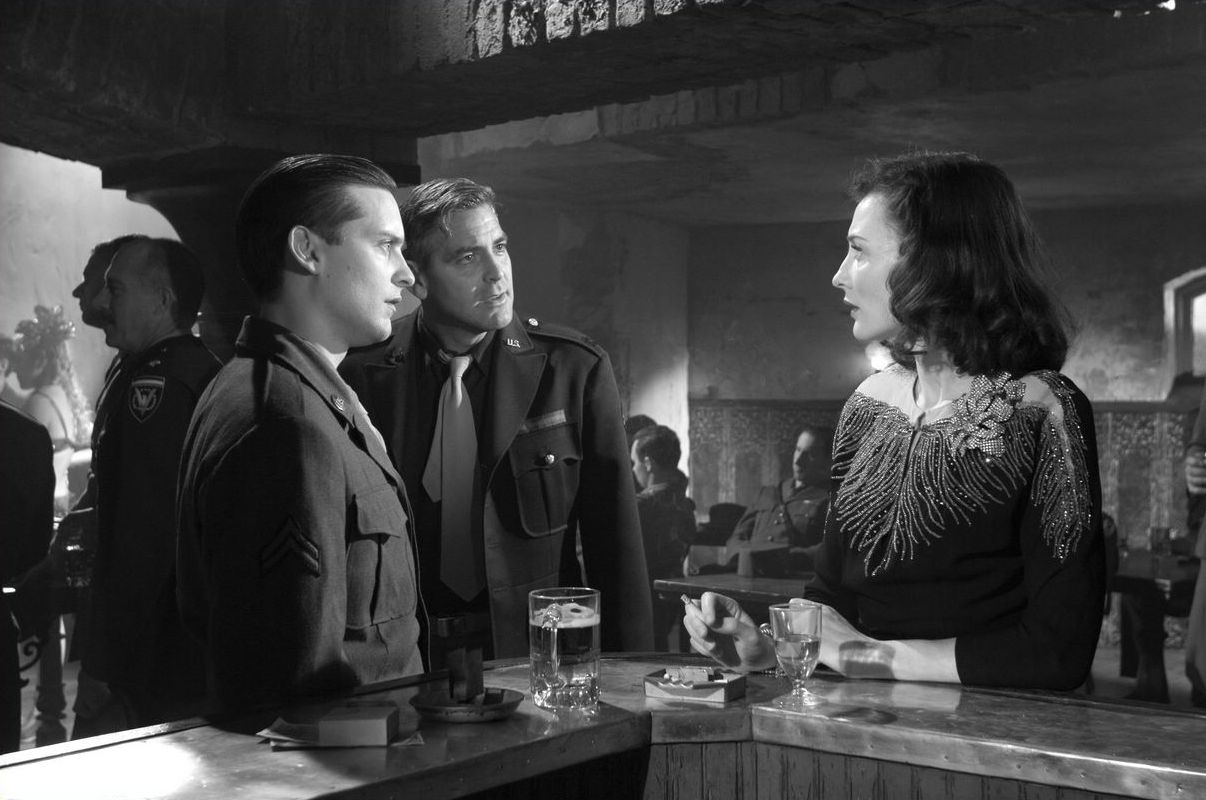
Berlin, 1945. The war in Europe is over, and, divided into four sectors by the victorious Allies, Germany’s capital is now a sordid morass of blackened buildings and anything-goes. Venturing into the urban decay is former resident Jake Geismer (Clooney), now a TNR correspondent sent to cover the Potsdam Conference (which in its own way feels as improbable as Ocean buddy Matt Damon playing a 45-year-old in The Good Shepherd.) But, not ten minutes back in town, Geismer’s wallet is stolen by his too-friendly-by-half army driver (Tobey Maguire, laughably miscast), who, as it so happens, is a well-connected black marketeer, a despicable lout, and the current boyfriend and pimp of Geismer’s old flame, Lena Brandt (Blanchett). After a body shows up at Potsdam, and after that old flame is rekindled, Geismer finds himself tracking down a story that may or may not involve hidden war crimes, atomic secrets, Russian n’er do wells, German scientists, his old prosecutor buddy (Leland Orser), and of course, Lena, a girl who — like so many residents in her fallen city — has faced unspeakable horrors and kept them under wraps.

All well and good…who doesn’t enjoy a seamy noir? But, The Good German is curiously inert, and never gets off the tarmac. The plot ends up being byzantine in its mechanics, as a decent detective story should be, but German never arouses enough interest to makes the many twists and turns feel earned. Tobey Maguire doesn’t help — A decent actor with the right material (say, as Peter Parker), he’s so woefully bad here that it kills the movie from the start. (Also, a random quibble: Maguire also beats up Clooney at one point, as Clooney’s Geisberg is of the Tom Reagan school of noir heroes: he gets his ass kicked a lot. But, unless this is Golden Age Spiderman or something, it makes very little sense here.) But equally jarring is the disparity between the script and the look in The Good German: The period recreation, however clever at times, ends up distracting from rather than enhancing the tale being told. In all honesty, it just doesn’t work.

If The Good German does offer any distinct pleasures, they’re mostly in the margins. Deadwood‘s Robin Weigert (a.k.a. Calamity Jane) plays pretty far from type — the blunt-spokenness notwithstanding — as Lena’s brash, hooker roommate. And, even despite the general failure here, Soderbergh still has a great eye, and the black-and-white cinematography does pay occasional dividends (despite many of the outdoor scenes having a grainy, washed-out look to them.) Speaking of which, I’d be remiss if I didn’t note that the highlight of The Good German for me was Soderbergh’s framing of Cate Blanchett as a classic screen siren. True, her femme fatale accent occasionally lapses into something more like Natasha from Rocky and Bullwinkle than Garbo or Dietrich. But, a beautiful woman under any circumstances, Blanchett often looks breathtaking here, what with all the period accoutrements and chiaroscuro lighting at her service. Careful, Jake, it’s Berlintown…and she’s going to play you for a fool, yes it’s true.

Power Mad.

“In some sense, the president is now as much a prisoner of Guantanamo as the detainees…The endgame in the war on terror isn’t holding the line against terrorists. It’s holding the line on hard-fought claims to absolutely limitless presidential authority.” Slate‘s Dahlia Lithwick discerns the method in Dubya’s madness on the civil liberties front: “expanding executive power, for its own sake.

The Shiftless Plagiarist.

“These examples help bring a crucial issue of plagiarism into focus. Behind the talk of originality lurks another preoccupation, less plainly voiced: a concern about the just distribution of labor.” After reading Richard Posner’s Little Book of Plagiarism, Slate‘s Meghan O’Rourke ruminates on the ethics of stealing someone’s words. (Also seen at — shamelessly plagiarized from? — The Late Adopter.)

Iraq is a Hard Place.

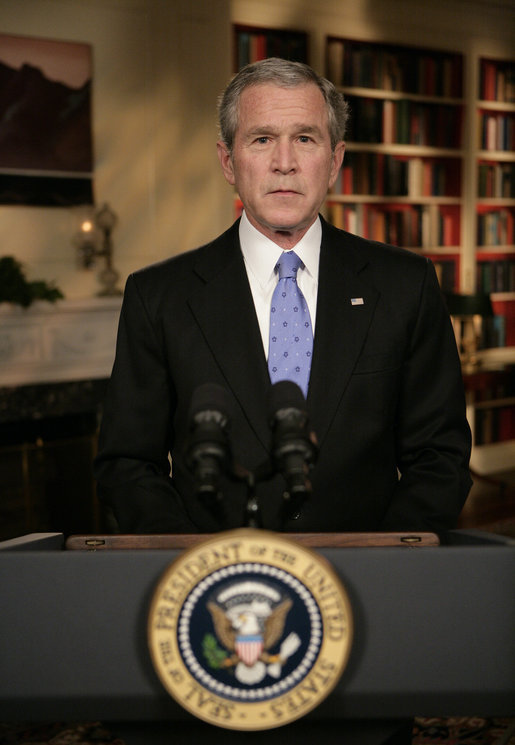
Our troops in Iraq have fought bravely. They have done everything we have asked them to do. Where mistakes have been made, the responsibility rests with me.” I’m still furiously playing catch-up, so I’m obviously a day or two behind on blogging this…Then again, Dubya’s just as obviously three or four years behind in announcing it, so I’ll call it a wash. Nonetheless, after finally admitting that his administration has seriously screwed up in Iraq, Bush — sidestepping the suggestions of the Baker-Hamilton commissioncalls for sending 21,500 more troops to the region, in what’s being billed as a “surge.” (Re: “escalation.”) When you get right down to it, Dubya’s basic argument in his televised address on Wednesday was this: “Through wishful thinking and outright incompetence, I’ve dug two nations into a huge hole. Please, please, please let me keep digging…

Here’s the thing — A massive troop increase would’ve made a good deal of sense in 2003, during those crucial days just after the fall of the Hussein regime. A show of power then — and a quicker restoration of order and basic services — would have paid huge dividends down the road. But, now, all these years later, after so much infrastructure has been destroyed and so many sectarian schisms have been allowed to fester? 21,500 troops — many of them not fresh recruits but wearied soldiers returning to the region or having their tours extended — isn’t going to make a dent in the Whack-a-Mole game we’ve been playing against insurgents since 2003. At best, this escalation is a show of good faith to the al-Maliki government, which seems to be not much more than a brittle political arm of Shiite extremists (Exhibit A: the manner of Saddam’s hanging; Exhibit B: the refusal to do anything — until now — to rein in Al Sadr’s Mahdi Army.) Yes, folks, throwing more troops at a losing situation, backing a shaky government that can’t handle its own security issues, rattling the saber at Cambodia/Iran…who says Dubya isn’t a student of history?

Fortunately, for the first time since the beginning of the war, Congress isn’t having it, with even some Republicans joining Dems in rallying against the proposed troop increase and today venting their wrath at Condi Rice before the Senate Foreign Relations Committee. (No doubt the poll numbers against Dubya’s plan is helping to stiffen some GOP spines.) Still, Dubya has some allies in this fight — While the Dems are universally opposed to the escalation gamble [Dem Response by Durbin | Biden | Clinton | Dodd | Edwards | Feingold | Obama | Pelosi] and a not-insubstantial number of Republicans are balking, some key GOP pols are still supporting Dubya’s move (most notably John McCain, who’s been calling for a troop increase since day one, and Rudy Giuliani, likely trying to right the 2008 ship after his recent devastating document dump.)