
“As political scientist Jacob Hacker has argued, the basic obstacle was nothing less than the government’s failure to have adopted a comprehensive health insurance plan decades earlier. As a result, the system that emerged by 1994 entailed such a crazy quilt of private interests — corporations, small firms, insurers, doctors, unions, HMOs, and so on — that moving all Americans into a new framework without worsening anyone’s situation had become virtually impossible.” Slate and Rutger University’s David Greenberg summarizes the history of health care reform, and of the epithet “socialized medicine.” “[T]he idea of government-run health care dates to the Progressive Era. Originally called ‘compulsory health insurance,’ it enjoyed favor in the 1910s among many quarters, including the American Medical Association…But as the debate heated up, doctors began to worry that it would hurt their incomes, and they banded with business groups like the National Association of Manufacturers to oppose reform. American entry into World War I tabled consideration of the issue, and the postwar Red Scare, Starr notes, ‘buried it in an avalanche of anticommunist rhetoric.’“
Author: KcM
The Dancer Upstairs.
Ok, this one’s a bit creepy. By way of Webgoddess, watch the rotating dancer to ascertain whether you’re left-brained or right-brained. I’m pretty right-brained, it seems (which makes sense, since I’m both left-handed and left-footed). But, if I changed tasks while the dancer was on — say went to click another window or focused on the list at left, she’d sometimes switch direction. Weird…well, I just hope my right-brain knows what my left-brain is doing.
Dont give me that do goody good bulls**t.
Score another one for legalized corruption (and lament anew what passes for Democratic leadership these days): Senate Majority Leader Harry Reid tells private-equity firms they don’t need to fear a tax hike this year. “[P]rivate-equity firms — whose multibillion-dollar deals have created a class of superwealthy investors and taken some of America’s large corporations private — hired dozens of lobbyists, stepped up campaign contributions and lined up business allies to wage an unusually conspicuous lobbying blitz [against a tax hike]…Several prominent lawmakers expressed surprise to find that the managers’ profits, known as carried interest, were taxed as capital gains, for which the rate is usually 15 percent. That is less than half the 35 percent top rate paid on regular income.“
Tie Another One to your Back.
For the R.E.M. fans among us, Stereogum has compiled Drive XV, an Automatic for the People tribute album to commemorate that record‘s fifteenth anniversary. (The album’s site also contains thoughts on the songs by Mike Mills and, as a special treat, an essay, Sweetness Followed, by Matthew Perpetua of Fluxblog and Pop Songs ’07.) AftP came out the fall of my senior year in high school and, as I said in my top 50 REM songs post of a few years back, it hasn’t aged with me as well as I’d hoped. (In fact, I’d probably put both Monster and Up above it these days.) Still, while “Man on the Moon” and “Everybody Hurts” may be well beyond played out (and “Nightswimming” might be getting there), the mournful record also features “Drive” (still an amazing video), “Sweetness Follows,” and “Monty Got a Raw Deal,” all minor-key dirges which resonate now as they did then. In any case, I’m looking forward to seeing what the bands here came up with.
The Loneliness of the Long-Distance Runner.
“For those who attempt it, the doctoral dissertation can loom on the horizon like Everest, gleaming invitingly as a challenge but often turning into a masochistic exercise once the ascent is begun. The average student takes 8.2 years to get a Ph.D.; in education, that figure surpasses 13 years. Fifty percent of students drop out along the way, with dissertations the major stumbling block. At commencement, the typical doctoral holder is 33, an age when peers are well along in their professions, and 12 percent of graduates are saddled with more than $50,000 in debt.”
By way of Little Bit Left, a new site by a Columbia colleague that’s well worth adding to the blogroll, the NYT surveys the sad plight of the modern ABD. (I’ll be 33 at my current expected finish date, seven years after starting, and my cohort’s attrition rate has been significant, so it seems the stats bear out in my case.) “Those who insist on dissertations are aware that they must reduce the loneliness that defeats so many scholars…’It’s easy, especially in our field, to feel isolated, and that tends to slow people down…There’s no sense of belonging to an academic community.‘” Oh, I dunno…Berk and I often have very scintillating conversations…progressive citizenship, New Era consumerism, socks, squirrels, you name it.
An Early Adopter?
A hearty congrats to former Columbia colleague Ted (of The Late Adopter) and his wife Reshima on the birth of their daughter last Thursday. I expect she will be well-versed in both American history and movie lore from a very young age.
Lust in Translation.
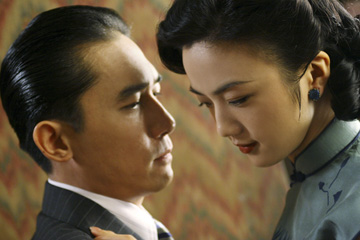 Attempting to be Last Tango in Shanghai by way of Paul Verhoeven’s Black Book, or at the very least to cast straight sex in as taboo a light as the gay love of Brokeback Mountain, Ang Lee’s Lust, Caution is, the lurid promise of its NC-17 rating notwithstanding, sadly a bit dull. As with most of Lee’s oeuvre, the film is ravishingly beautiful throughout, and it recreates WWII Shanghai much more evocatively than, say, Soderbergh’s The Good German did Berlin. But, at two hours and forty minutes, the film also feels overlong, and its central conceit — female agent deep undercover, deep under the covers — is burdened with entirely too much in the way of backstory. Lust, Caution isn’t a bad film by any means, but, its occasional explicitness notwithstanding, it doesn’t make for a particularly memorable one either.
As Lust, Caution begins, it’s 1942 in Japanese-occupied Shanghai, and four wealthy women, seemingly above the harsh impositions of wartime, exchange gossip and veiled state intel over a friendly game of Mahjong. Among this quartet are Yee Tai Tai (Joan Chen), wife of the secret police chief (Tony Leung), and one Mak Tai Tai (Tang Wei), the young and beautiful spouse of a Hong Kong importer. But, as we soon discover (after she leaves the game and makes a suspicious phone call in an English cafe), Mak Tai Tai does not in fact exist. Rather, we are to learn in a very extended flashback (it’s Michael Clayton all over again), she is Wong Chia Chi, a resistance agent whose journey to that Mahjong table began four years earlier, as a displaced schoolgirl in Hong Kong. Falling under the spell of a handsome, earnest young patriot (Wang Lee Horn) then, Wong, a lover of movies, begins appearing in nationalistic plays to much acclaim. And, when it is decided by her schoolyard coterie of six that more drastic action should be taken to fight the Japanese invader, she takes on the role of an importer’s wife to lure a key collaborationist, the aforementioned Mr. Yee, to his demise.
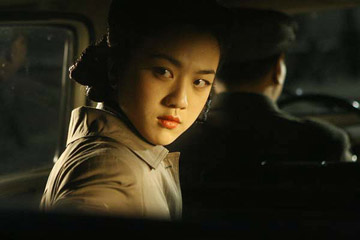 But trapping Mr. Yee poses several quandaries for these budding freedom fighters. For one, there is the rather delicate matter of how an inexperienced virgin could pass for a married woman. For another, this Yee is no provincial rube, but a man who’s at once deeply careful and extremely untrusting. Most problematic, Mr. Yee is no ugly, oafish lout, but the one-and-only Tony Leung, and hardly anybody in this world looks better smoking artfully in period suits than Tony Leung. Nevertheless, the kids go for it…with mixed results. And, when a spy is needed by the real Resistance to trap Mr. Yee a few years down the line, they find one ready-made in Wong, who takes on her role anew with even higher stakes. Only now, she discovers, Mr. Yee is more cruel than he first lets on, and very much into the rough stuff, sexually speaking. And, more to the point, once the Pandora’s Box of her own sexuality has been jarred open by Yee, Wong begins to lose herself in the part, to the detriment of all…
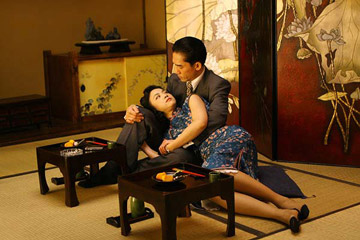 WWII spies, steamy, illicit sex…this seems like it should be an enticing concoction, to be sure…obviously it was right up Verhoeven’s alley in Black Book. But, as several reviewers have put it, Lust, Caution turns out to be much more cautious than it is lustful. Even if you factor out the extra hour of padding here, that’s a problem. Ang Lee’s films, among them Crouching Tiger, The Ice Storm, and Brokeback, have always been noted for their delicacy and artful restraint, which is frankly why he may not have been the best choice for this material, about a couple who lose themselves in sexual passion. The much-discussed sex scenes aren’t as puritanically minded as the nightmare visions of Requiem for a Dream, but there’s a definite coldness and frigidity about them, as if neither participant is having very much fun. They’re not so much erotic as they are animalistic, all acrobatic contortions and grunted yelps. I guess you could argue that’s the point — the two are driven not by love at all but by an inexplicable earthy necessity, and Lee even cuts to a growling German shepherd to forward that idea along. But, if that’s the case, if it’s all just physical — then why — spoiler here — when a key slip-up is made by one of the lovers, doesn’t it happen while in the throes of passion, rather than when one is presented with the sight of a shiny (dare I say gaudy?) bauble?
The acting in Lust, Caution is universally good, with special plaudits going to Tang Wei and Tony Leung. And sex is usually handled so sophomorically in films that I feel bad for faulting Lee’s unabashed use of it to further the story along here. But take away those few explicit scenes, and you’re left with a rather conventional snooze of a cloak-and-dagger movie, however lusciously filmed. And even the sex here could’ve used some of the sensuous warmth of Shanghai-born Wong Kar-Wai’s work. Sadly, when it comes to lust and caution in this film, Lust, Caution pretty much foregoes the red-light, and ends up raising more red flags than a Mao rally.
Doubting Thomas.
“In his telling, virtually everyone who has ever wronged him has done so because of his race…And maybe because he can see no shades of gray, in the end, Thomas careens back and forth in this book between seeing himself as a victim or a self-actualized hero. There is precious little in between.” Dahlia Lithwick reads My Grandfather’s Son, the new autobiography by Justice Clarence Thomas.
Limited Appeal.
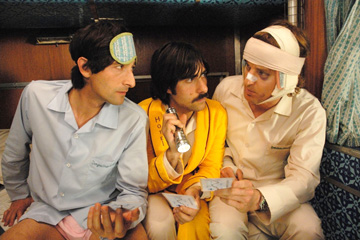
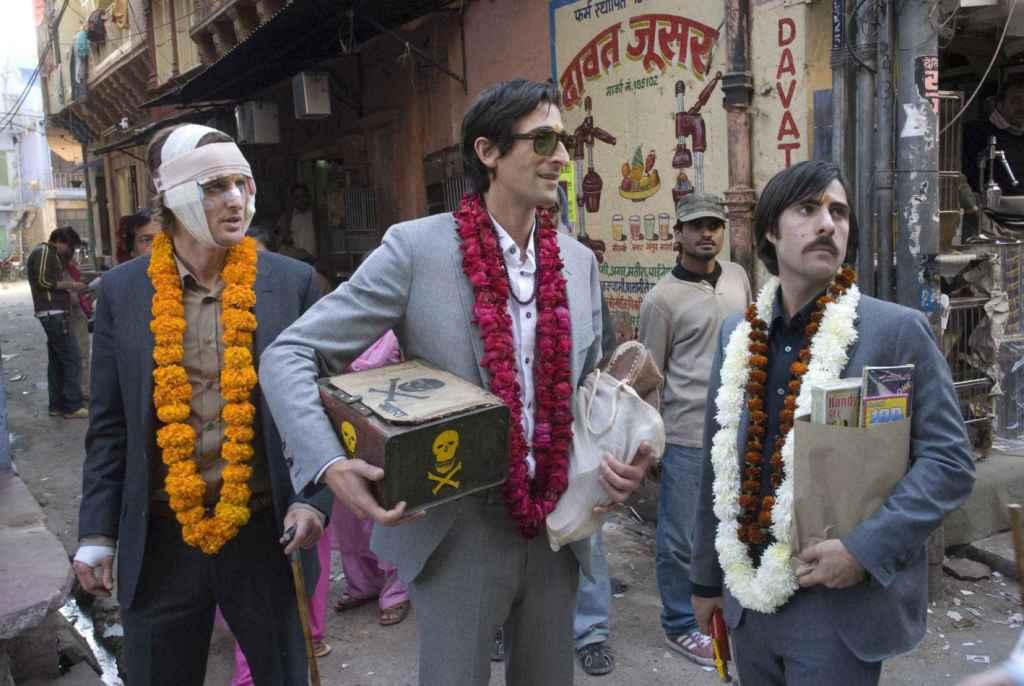
If you’ve ever seen a Wes Anderson movie, you probably already know if you’ll like The Darjeeling Limited or not. For better or worse, this one is right in his wheelhouse — It is to India and trains what The Life Aquatic with Steve Zissou was to Cousteau and boats. I felt pretty much the same about this film as I did about Aquatic — It’s vaguely engaging and mildly diverting at times, but it doesn’t really add up to much, and is basically an excuse for Anderson to parade his usual indulgences for ninety minutes. (Nor is Limited as fresh as Rushmore or as occasionally moving as his best film, The Royal Tenebaums.) I mean, if Wes is your quirky-precious Louis Vuitton bag, don’t let me ruin the fun. But if he isn’t, I suggest taking a plane instead.
Somewhere on the Indian subcontinent, at what passes for rush hour, a flustered American in Organization Man garb (Bill Murray) tries to will his careening taxi through a typically chaotic Third World marketplace, in the vain hope that he can reach his train — the spiffy Darjeeling Limited — on time. Unfortunately for him, this is not his story. Rather, we follow the travails of the three Whitman brothers on this colorful locomotive, who’ve reunited one year after the untimely death of their father to partake in a journey of spiritual bonding. Jack (Jason Schwartzman), the youngest of the three, is currently writhing on the horns of a messy break-up (See The Hotel Chevalier.) Peter (Adrien Brody), the middle brother with a klepto streak, is wrestling with the dilemma of imminent (and seemingly unwanted) fatherhood. And Frances (Owen Wilson), the oldest brother and planner of the trip, is recovering from what looks to have been a self-induced motorcycle accident. (Plus, he’s a bit of a martinet.) These three reluctantly experience the scenic wonders of India at first, spending most of their time quibbling and bickering in fraternal fashion. But, eventually, a tragedy along their travels shakes the trio out of their touristy complacency. And, once they find (a la 3:10 to Yuma) that the train of life can come to an abrupt stop at any time, will the Whitmans then rise above their individual problems and learn the immortal spiritual truth that “brothers gotta hug?” Well, I’ll leave that for you to discover.
And that’s about it, folks…There’s not much else here to speak of. (In fact, the experience of The Darjeeling Limited was almost completely encapsulated by watching the trailer, from the basic outline of the plot to the general mood and rhythm of the film.) I will say that Adrien Brody, fun to watch on most occasions, comes across as right at home in the Andersonverse. And Owen Wilson, whose injuries can’t help but remind us of recent events in his real life, adds a haunted dimension to his character simply by his presence. Still, Darjeeling is a lark — Even with the funeral in the middle going (I’ll let others do the bashing about the dead-anonymous-native-kid-as-plot-point — I’ll confess it did seem a bit off), The Darjeeling Limited has no scene approaching the power of, say, the quietly devastating suicide attempt in Tenenbaums, and no turn as memorable as those of Bill Murray or Olivia Williams in Rushmore. Wes Anderson has shown in the past that he can tell a moving, dramatic story using his signature style. But, Darjeeling is just a rich kid playing with his train set.
The Secret History of Torture.
“‘The administration can’t have it both ways,’ Rockefeller said in a statement. ‘I’m tired of these games. They can’t say that Congress has been fully briefed while refusing to turn over key documents used to justify the legality of the program.” Claiming only that the US “does not torture people,” the White House refuses to turn over Justice Department documents on torture policy, “contending that their disclosure would give terrorist groups too much information about U.S. interrogation tactics.” Those documents, announced by the NYT on Thursday, “provided explicit authorization to barrage terror suspects with a combination of painful physical and psychological tactics, including head-slapping, simulated drowning and frigid temperatures, and “show how the White House has succeeded in preserving the broadest possible legal latitude for harsh tactics.“