
Stating — and Rejecting — the Obvious.

“‘As he’s said many times before, Senator Obama honors and respects Senator McCain’s service, and of course he rejects yesterday’s statement by General Clark,’ Obama spokesman Bill Burton said in a statement.” So…I guess Wes Clark won’t be the veep. For some ill-defined reason, the Obama campaign sees fit to throw the general under the bus because Clark, a guy I run hot and cold on, simply stated the obvious. Getting shot down over Vietnam, however ostensibly character-building, in no way constitutes executive experience: “I certainly honor his service as a prisoner of war. He was a hero to me and to hundreds of thousands and millions of others in the armed forces as a prisoner of war. And he has traveled all over the world. But he hasn’t held executive responsibility…I don’t think riding in a fighter plane and getting shot down is a qualification to be president.”

Said Obama in Independence today: “McCain had ‘endured physical torment in service to our country’ and ‘no one should ever devalue that service, especially for the sake of a political campaign, and that goes for supporters on both sides.’” Fair enough, but that wasn’t at all what Clark was doing. McCain’s basically getting away with the same sort of resume inflation as Sen. Clinton did in the primaries, and Clark — a five-star general who knows what he’s talking about — called him on it.

One could argue that there’s a method to this move by the Obama campaign, but even that theory suggests a certain ugly political opportunism at work. (One could also argue karma had some part to play in all this, since Clark earlier jumped all over Samantha Powers’ gaffe during the primaries.) Nonetheless, between this, the Senator’s switchback on telecom immunity (which I discussed in the comments here), and various other recent triangulations, the Obama campaign has had a pretty lousy week. I don’t know if it’s the recent influx of “veteran” hands, an attempt to beat back the National Journal liberal label, or just an early-summer malaise, but that sickly-sweet smell of Old-School Dem Politics is lingering in the air. Get it together, y’all. I know the polls look good, but this defensive-minded playing-not-to-lose is assuredly not the way to go.

Update: “I’ve said this for some weeks now, they’ve been repeated many times.” Clark sticks to his guns, and Webb has his back. Meanwhile, Salon‘s Glenn Greenwald makes the case against Obama’s last two weeks: “There is no question, at least to me, that having Obama beat McCain is vitally important…[but] his election is less likely, not more likely, the more homage he pays to these these tired, status-quo-perpetuating Beltway pieties.

Update II: Obama clarifies on Clark: “I don’t think that General Clark you know had the same intent as the swift boat ads that we saw four years ago, I reject that analogy…I think in at least one publication was reported that my comments yesterday about Senator McCain were in a response to General Clark. I think my staff will confirm that that was in a draft of that speech that I had written two months ago.

Update III: Fred Kaplan has a theory about Clark v. McCain: Grunts are from Mars, Flyboys are from Venus.
We screwed up Afghanistan…

“Just as it had on the day before 9/11, Al Qaeda now has a band of terror camps from which to plan and train for attacks against Western targets, including the United States…’The United States faces a threat from Al Qaeda today that is comparable to what it faced on Sept. 11, 2001,’ said Seth Jones, a Pentagon consultant and a terrorism expert at the RAND Corporation.

In the NYT, Mark Mazzetti and David Rohde explore how, despite all their endless bluster and unconstitutional behavior, the Dubya administration is losing the war against Al Qaeda, and has apparently given up on catching Bin Laden. “By late 2005, many inside the CIA headquarters in Virginia had reached the conclusion that their hunt for Bin Laden had reached a dead end…’You had a very finite number’ of experienced officers, said one former senior intelligence official. ‘Those people all went to Iraq. We were all hurting because of Iraq.’

…so why not Iran?

“The Democratic leadership’s agreement to commit hundreds of millions of dollars for more secret operations in Iran was remarkable, given the general concerns of officials like Gates, Fallon, and many others. ‘The oversight process has not kept pace — it’s been coöpted’ by the Administration, the person familiar with the contents of the Finding said. ‘The process is broken, and this is dangerous stuff we’re authorizing.‘”

In related news, The New Yorker‘s venerable Sy Hersh reports that the Dubya administration has been stepping up covert activities in Iran…and Congress is once again going along for the ride. “In other words, some members of the Democratic leadership…were willing, in secret, to go along with the Administration in expanding covert activities directed at Iran, while the Party’s presumptive candidate for President, Barack Obama, has said that he favors direct talks and diplomacy.

Frat Club.


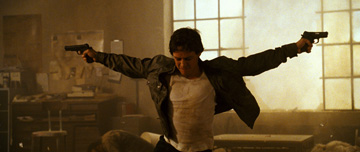
Fool me once, shame on you. Fool me [twice], you can’t get fooled again. A leaden mishmash of The Matrix, Fight Club, and various much-more-entertaining FPS shoot ’em ups, Timur Bekmanbetov’s aggressively dumb and derivative Wanted is what I’d call a total misfire…if it wasn’t totally in keeping with the similarly adrenaline-fueled, barely coherent nonsense that was Night Watch. I haven’t read the source material, although a quick peek at the Wikipedia (and the fact it was penned by Mark Millar) suggests it was probably much more wry and entertaining than this flick turned out to be (and made more sense, given it’s set in a universe with supervillains.)

As it is, however, Wanted plays like Michael Bay’s version of Gus Van Sant’s Elephant, a hyperbolic, stultifying stupid, aggro-laced paean to the Columbine mentality. Now, I’m all for leave-your-brain-at-the-door actioners, and I could forgive Wanted its video game physics, its cheap-and-easy nihilism, its plagiarism from much better movies, and its intrusive whiteboy angst-metal if the movie actually turned out to be entertaining. But, a few minor setpieces aside (namely the limousine hit, which was everything ths film should’ve been in 60 seconds — perhaps Bekmanbetov should try his hand at videos), Wanted is basically the opposite of fun. Like Night Watch, it’s so bogged down by turgid plotting and long bouts of needless exposition (as well as, in this case, scenes cobbled together from other sources) that the film has no pulse. How bad is it? When a baby started screaming in my theater during the final act (when Morgan Freeman started monologuing yet again in the Fraternity’s library), prompting a yelling match between the disgruntled babyless (“Get that goddamn kid out of here!) and the babied (“F**k you! Babies have rights too!“), I was kinda thankful for, at long last, an entertaining diversion.

As Wanted begins, we are introduced to one Wesley Gibson (James McAvoy, who seemed to have learned his American accent solely from Billy Zabka movies and Sprite commercials.) Gibson is a depressed, obsequious worker drone somewhere in the Great American Cubicle Hive — Chicago, to be precise. He hates his job, he hates his boss, he hates his routine, and his “best” friend is pretty obviously sleeping with his aggravating girlfriend. Gibson is such a capital-L Loser, in fact, that his relatively common name brings up 0 hits on Google. (Sigh…would that were the most ridiculous thing about this movie.) One day, however, he is approached in the local supermarket by “Fox”, an alluring — albeit currently on the wrong side of skinny — minx (Angelina Jolie, trying but clearly bored), who immediately gets him involved in a shoot-out and car chase against a rival killer (Thomas Kretchmann).

From there, Gibson is soon initiated into a secret and ancient cabal of assassins known as the Fraternity, led by Morgan Freeman (playing Lawrence Fishburne playing Morpheus) and including members such as The Gunsmith (Common), The Butcher (Konstantin Khabensky), and The Repairman (Marc Warren). Each of these FPS Minibosses, basically, train Gibson in the arts of their order (it seems to involve him needlessly getting his ass kicked a lot) until he’s reached his full potential as a genetic prodigy, and can thus seek out and kill the murderer of his father. But who are these assassins actually killing, and for what purpose? Even total badasses, it seems, aren’t free of the occasional moral quandary.

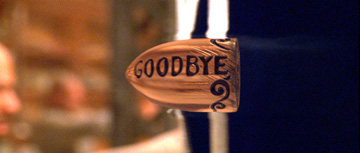
That’s basically the set-up — If it sounds like you’ve heard variations on this story before, you have. I neglected to mention the scene involving Gibson’s father’s final mission, which [a] plays almost exactly like Trinity’s early shenanigans in The Matrix and [b] first establishes that, here, bullets not only travel for miles but can bend their trajectory in flight. This may sound like a cool idea to some, I guess — for me, it put me right in House of Flying Daggers mode. Once you’ve established something so ridiculous, it’s hard to feel invested in any of the ensuing action sequences. There’s no danger at all if the laws of physics don’t apply — You’re just going to show me what you show me, and that’s that. (I would argue that movies like The Matrix bend these sorts of rules, but don’t break them. Besides, the Wachowskis introduced a higher-level threat with the Agents anyway.) In any case, magically-bending bullets is only one example of the suspension of disbelief required here. Don’t get me started on the Loom, or the Moravian Express, or the Total Miracle Body Bath, or anything else in Wanted. Like Night Watch, it doesn’t make a lick of sense.

Again, I could have looked all that over if the movie was good fun regardless. But, it’s not. When Wanted isn’t drowning in expository gobbledygook — which is most of the time — it brays at you with idiotic macho posturing. (There’s a reason a Dubya quote came to mind above when writing this — this is a film tailor-made for “windshield cowboys” and tough guy poseurs.) In other words, Wanted is basically Fight Club for the fratboy Nickleback set, without the intellect or sense of irony that made Fincher’s movie one of the best of the ’90’s. Jolie especially does what she can — she’s a star through and through — but she can’t redeem this boring, moronic pile of dren. In other words, folks, Wanted is effing terrible. In the final moments, McAvoy breaks the fourth wall and asks us, “What the f**k have you done lately?” Sadly, I went to see this film.

To live inside the law, you must be honest.

“In the lower courts, according to a study Professor Long published in the Washington & Lee Law Review last year, Mr. Dylan is by far the most cited songwriter. He has been quoted in 26 opinions. Paul Simon is next, with 8 (12 if you count those attributed to Simon & Garfunkel). Bruce Springsteen has 5.

With great lawyers, you have discussed lepers and crooks: By way of Ted at the Late Adopter, the NYT examines Chief Justice Roberts’ use of Dylan in court opinions. “Mr. Dylan has only once before been cited as an authority on Article III standing, which concerns who can bring a lawsuit in federal court…The larger objection is that the citation is not true to the original point Mr. Dylan was making, which was about the freedom that having nothing conveys and not about who may sue a phone company.

Mellifluous Republic.

“Like other broad-minded and big-hearted works of American culture from the first half of the 20th century — H.L. Mencken’s American Language, John Dos Passos’ U.S.A. trilogy of novels, the Federal Writers’ Project American Guide series, Harry Smith’s Anthology of American Folk Music — Names on the Land reflects a glorious union of two primal forces in the American mind. On one hand, Americanism: the inclination toward the large-scale and industrial, toward manifest destiny and the farthest shore…On the other, Americana: the craving for the local and the lo-fi, for the inward heart of things, for the handcrafted and the homemade.” In Slate, Matt Weiland sings the praises of George Rippey Stewart’s Names on the Land.

The Prodigal Son.

“‘He won a huge amount of people to his side after making a huge amount of blunders and really lying to people,’ the director said…’We are trying to walk in the footsteps of W and try to feel like he does, to try to get inside his head. But it’s never meant to demean him,’ Stone said.” The LA TImes catches up with Oliver Stone on W.

Computer Love.

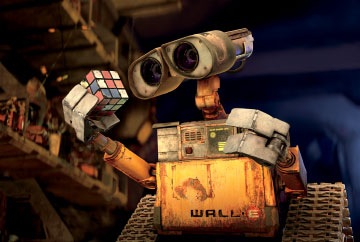
WwwaaaLLLLLL-Eeee! In the end, I can’t say I enjoyed it quite as much as Brad Bird’s The Incredibles, and I really, really wish it’d stayed in the melancholy I am Legend/Lars and the Real Girl groove of its first hour, rather than devolving into an Idiocracy-type satire aboard Douglas Adams’ Starship Titanic. That being said, Andrew Stanton’s ambitious, impressive WALL-E is definitely in keeping with the high standard we’ve come to expect from the Pixar gang, and in scope and theme alone I’d rate it above recent forays Ratatouille, Cars and Finding Nemo. Part Silent Running-ish environmental parable, part whimsical robot romance (think Bjork, but you know, for kids!), and part trenchant political slapstick (note the Dubyaesque Fred Willard), WALL-E fires on significantly more cylinders throughout than, say, your average Dreamworks animation would even attempt. That the reach of WALL-E‘s ambition ultimately exceeds its grasp in the second hour, when the movie becomes a much more conventional family flick, can’t be held too harshly against the film, I think. I wish WALL-E had stayed Earthbound, in a way, but at least the little guy was reaching for the stars. (In any case, I expect WALL-E has a metal, mortal lock on next year’s Best Animation Oscar.)

Bringing a literal meaning to the term “space opera”, WALL-E begins with — of all things — Michael Crawford of Phantom fame crooning a musical number from Hello, Dolly! (“Put on Your Sunday Clothes“), which we hear while traversing the more scenic localities in our corner of the cosmos. Eventually, the swooping camera keys in on our home planet, except it’s clearly surrounded by more satellite debris than seems atmospherically sanitary. As we come down to Earth, matters are worse: Our beloved Terra has become an arid, dusty wasteland, cluttered with decaying buildings, vacuous advertising, and skyscrapers made of garbage. Enter WALL-E (Waste Allocation Load Lifter — Earth Class), a goggle-eyed robot (of the No. 5, Huey, and Vincent persuasion more than Artoo) whose job it is to construct these towers of refuse and who happens to be — along with one solitary cockroach — the lone survivor of our-now abandoned civilization.

Loneliness does funny things to a droid. Over the centuries of isolation, it seems, WALL-E has developed something of a personality — he collects intriguing knick-knacks he finds amidst the trash, repairs himself with pieces of his defunct brethren, and endlessly watches what’s left of a deteriorating VHS copy of Hello Dolly!, honing his song-and-dance routine and his understanding of human rituals of affection in the process. Alas, his skills of courtship go wasted…until, one day, EVE (Extraterrestrial Vegetation Evaluator) literally drops out of the sky, with a gimongous rocket ship in tow. A sleek, ovate, blue-eyed ingenue with massive destructive capability, EVE is pretty much everything WALL-E might want in a female* companion, and so, naturally, our lonely hero sets about to woo her. But, just when everything seems to be going well, WALL-E offers her a gift from his collection that initiates a higher directive…

This gets us to about forty-five minutes into the film, so we have a ways to go yet. That being said, everything that takes place here on Earth, before WALL-E chases his apparently malfunctioning muse off-world, is far and away the strongest and most affecting parts of the picture. I won’t give away the jag the picture takes in the second half, as it’s kinda funny and worth discovering on one’s own. But as WALL-E becomes more of a traditional Pixar pic in the second hour — idiosyncratic allies are made, for example, and the readily identifiable voices of Jeff Garlin and John Ratzenberger come into play — the movie also loses much of its early magic. I like goofy robot chases as much as the next guy — probably more, in fact (“MmmmmmmMo.“) — but I nonetheless found WALL-E‘s otherwise admirable back-end a bit of a disappointment.

The second half is still entertaining, no doubt, but it misses the simplicity, melancholy, and romance that characterized life for WALL-E up ’till then. I dunno…perhaps the kids were getting restless. Still, after centuries of wandering around by himself, gazing at the stars, the Last Robot on Earth has fallen in love. Did we really need to contrive a second act to top that?

The bygones are bygones.

“We cannot let this moment slip away,’ Clinton pressed. “‘For anyone who voted for me and who is now considering not voting, or voting for Sen. McCain, I strongly urge you to reconsider. I urge you to remember what we are standing for in this election.‘” In the aptly-named town of Unity, NH, Sen. Clinton campaigns with Sen. Obama. (They’ve also now maxed out donations to each other, and Obama continues to hire senior Clinton staff.)

In not-unrelated news, new polls put Wisconsin (+13) and Minnesota (+17) pretty firmly in the lean-Obama column. Says CNN: “The Illinois senator now has 231 electoral votes — 39 shy of winning the presidency,” and that’s not counting OH, FL, CO, NM, VA, or IA…all states we have a solid shot of picking up. Again, I don’t want to jinx anything, but I’m feeling pretty confident about our prospects these days.