Battlefield: Earth.

“Sit down, Cylon”: The final ten episodes of Battlestar Galactica start tonight at 10pm EST. As I’ve said several times here already, the show has steadily lost me since the Dylan-scored Final Four reveal of Season 3. But at this point I feel pot-committed for this last handful, so here’s hoping the show ends on a high note.

Update: “This is perhaps the most universal theme you can explore. For the people of ragtag fleet, the dream was Earth. For those of us here on Earth, the dream could be many other things. It may be the house you saved all your life for but now can no longer afford to make payments on. The career you fantasized about since high school, went to college to prepare for, finally landed and loved, then lost when your company downsized. The woman or man you met who seemed to be everything you ever wanted to find in a lover, who betrayed your trust or left you or died. The flood waters that swept your entire neighborhood away. The war in a far away land that took your son or daughter or husband or wife. The spot on an X-ray that now wants to eat you alive.” The Chicago Tribune‘s Maureen Ryan talks with Ron Moore and David Weddle on last night’s reveals, including, of course, the final Cylon.

Farewell, Khaaaaaaaaan.

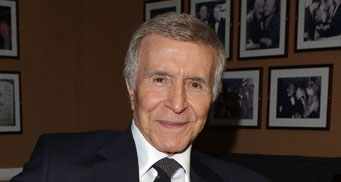
“‘Working with Ricardo was a joy,’ Spelling, who died in 2006, wrote in ‘Aaron Spelling: A Prime-Time Life,’ his 1996 memoir. ‘Ricardo made good scripts better and not-so-good scripts work. I don’t remember him ever doing any rewrites. He set a perfect example for the rest of the cast.’” Veteran stage and screen actor Ricardo Montalbán, 1920-2009.

“He will always be Captain Kirk’s finest foe…Montalbán’s magnetic, robust presence; that voice that sounded like a ride over rolling hills — he made Khan Noonien Singh the worst kind of despot: the kind you’re pretty sure you’d die for.” In memoriam, EW’s Marc Bernadin pens an appreciation of Montalbán’s Khan.

“Depressed Mode” no longer?

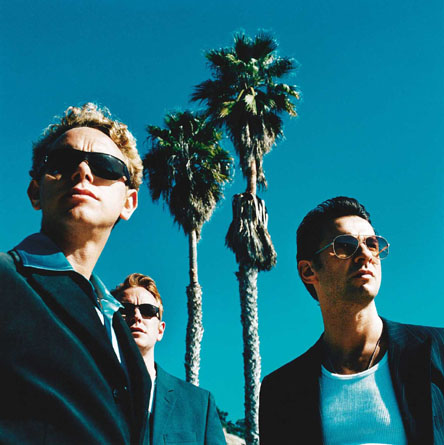
“I feel like [the record] is [about] looking outside and a yearning for somehow coming together. The world is changing. Watching Obama getting elected was great. We watched it on TV in Santa Barbara and I get goosebumps thinking about that still. It’s going to take a long time, but I think some of that same feeling, that sentiment [of hope] is in the work.” Well, it’s not too optimistic, I hope. Depeche Mode frontman Dave Gahan talks with the LA Times about the new album, due out in April.

For fans of the old-school sound like yours truly, there’s reason for hope in any case: “‘Martin’s got this new fetish which is basically buying gear on EBay,’ Gahan said. ‘He must have bought up half of the analog equipment around the world. We’ve got all these old drum machines from the 1970s, and even some of the stuff that we used in the ’80s as well, like old Moogs and Arps.’ As an example, Gahan noted that one of the new album’s stars is a piece of gear dubbed ‘The Colonel’ – a vintage 1970s-era Steiner Parker synthesizer. It’s an instrument, said Gahan, ‘that makes crazy noises. We found it really inspiring and used it in a lot of things [on the new record].’

Apparently the band has finished 18 tracks, 13 of which will appear on the album (and ten of which, happily, are penned by M.L. Gore. I’m not sold on Gahan as a songwriter just yet.) “[T]he band will release a special EP or online-only add-on with the extra material next year.” In the meantime, Dave’s singing back-up for frYars’ “Visitors” (a slightly more New Romantic version of (blatant Joy Division imitators) She Wants Revenge, it seems), and Marty will soon be braving the novelty-music-paparazzi to croon “Master and Servant” once more with lounge act Nouvelle Vague.

The Car that Goes Boom.

Neither as resonant as Letters from Iwo Jima or Mystic River nor as atrocious as Million Dollar Baby or Flags of our Fathers, Clint Eastwood’s Gran Torino is a solid, decently engaging, and even well-meaning two hours of cinema, despite the seemingly endless tirade of dated ethnic slurs issuing from Eastwood’s mouth therein. (Like Alvy Singer, Eastwood’s Walt Kowalski is a bigot, but for the left.) Its goofy and often didactic racists-have-a-heart-too messaging aside, Torino — or, as my dad accurately labeled it, Dirty Old Man Harry — pretty clearly attempts to be the coda and meta-commentary on Eastwood’s famous vigiliante films that Unforgiven (more successfully) was to his westerns.

Yet, even if it’s clunky and heavy-handed at times, and even if its over-the-top ending seems lifted straight out of your average Mel Gibson movie (you’ll know what I mean if/when you see it), I still ended up feeling reasonably charitable towards Torino in the end, perhaps because it’s good to see Eastwood, aged and wizened but with a undeniable twinkle in his eye, still willing to draw outside the lines of his cinematic legacy. (And perhaps because, speaking as someone of the Caucasian persuasion — or at worst a “mick” — we get off easy. I could imagine feeling much less sanguine about listening to a mostly-white audience chuckle and guffaw their way through the litany of racial slurs here, if they felt directed at me or my kids.)

If you saw any of the trailers for Gran Torino, you’re pretty much up to speed. The 1972 muscle car in question is the MacGuffin of this particular tale, and, with the passing of his wife, one of the three things left in this world still loved unconditionally by retired autoworker and Korean war vet Walt Kowalski (Eastwood) — the other two being his aging golden retriever and watery American beer. Basically written off by his biological family as a cantankerous, curmudgeonly funeral-waiting-to-happen (his granddaughter is particularly one-dimensional in this regard — she reminded me of Hillary Swank’s redneck family in MDB), Walt is for all intent and purposes an island unto himself in his Michigan neighborhood, which is now mostly populated by Hmong emigrants. His only friends are the other (white) retirees down at the local, with whom he occasionally shares a drink or three, and his “dago” barber (John Carroll Lynch), with whom he occasionally engages in what passes for witty ethnic repartee.

But when the boy-next-door Tao (Bee Vang) is enticed by the local gang to steal Walt’s Gran Torino as part of his initiation, and the girl-next-door Sue (Ahney Her) gets pawed walking home from school by some local African-American youths (Walt would use another term), Kowalski becomes increasingly drawn into the life of the Hmong community all around him despite himself. And soon, in full defiance of his oft-professed contempt for “gooks” and “zipperheads,” Walt takes it upon himself to educate Tao in the ways of true American manhood (which apparently is comprised of being good with tools and ethnic banter — who knew?) Still, that aforementioned gang ain’t going anywhere, and — worse for Walt, Tao, and particularly these hapless gang members — they don’t seem to have ever watched Dirty Harry. Clearly, somebody in the neighborhood is going to have to stand up to this crew…but, at his advanced age, laying down the law with the barrel of a big gun just doesn’t make Walt’s day quite like it used to.

In the end, Torino actually reminded me less of the glory days of Harry Callahan than of another film I happened to catch last week (on Blu-Ray), Tom McCarthy’s The Visitor. Gran Torino and The Visitor play like the (aging) McCain and Obama voters’ guides to 21st Century Immigrants respectively. In both films, an older white guy in a rut has his heart opened and life transformed by America’s spunky newest arrivals, until he gets a first-hand taste of the downside of new-immigrant life. (In one case, ethnic gangs; in the other, the INS.) Both are commendable films anchored by impressive and even nomination-worthy lead performances (in The Visitor‘s case, by Richard Jenkins)…but both exude more than a whiff of Bagger Vance-ish sentiment in their storytelling. (See also Gbenga Akinnagbe’s character in the otherwise solid The Savages.) In other words, the immigrants in question often feel like static plot points to move the white fellow’s story arc forward rather than full-fledged characters themselves.

Now, there’s no one in Torino as galling in this regard as Haaz Sleiman’s ridiculously friendly Syrian drummer in The Visitor, but the feeling persists nonetheless, particularly in the way Walt’s Hmong neighbors continually just shrug off the voluminous stream of bile emanating from his mouth. Eastwood or no, it’s hard to shake the sense that Walt’s blustery bravado would’ve at the very least cut back on the respectful offerings he’s given and Asian barbeques to which he’s invited during the film, and more than likely quite justifiably would’ve gotten his teeth kicked in a few times before the events shown here. Of course, in the world according to Gran Torino, physical violence is ultimately never the answer. So what the hell are we supposed to use, man? Harsh language?

On the Shoulders of Giants.

Two recent and choice Columbia-related links by way of Ted at The Late Adopter:

“Lincoln is important to us not because of his melancholia or how he chose his cabinet but because of his role in the vast human drama of emancipation and what his life tells us about slavery’s enduring legacy…In the wake of the 2008 election and on the eve of an inaugural address with ‘a new birth of freedom,’ a phrase borrowed from the Gettysburg Address, as its theme, the Lincoln we should remember is the politician whose greatness lay in his capacity for growth.” In The Nation and on the 200th anniversary of Lincoln’s birth, Eric Foner evaluates the continuing legacy of the 16th president.

“Economic orthodoxy — which gave high priority to balanced budgets and fiscal restraint — remained a powerful force in the 1930s, even as its limitations became increasingly obvious. Similar arguments can still be heard today…The New Deal was least successful when it was least aggressive–when it let concerns about fiscal prudence override the urgent need to pump enormous sums of money into a moribund economy.” And, over in TNR, Alan Brinkley notes what the Obama administration can learn from the New Deal.

Update: “Most Americans, I suspect, if asked whether they would prefer a president with strong principles or one who prefers pragmatic politics, would choose an idealist over a realist in a flash. But almost all successful politicians combine principle with pragmatism constantly.” In a TNR piece that ties the two above together quite well, Prof. Brinkley speculates on the fatal flaw in Dubya’s make-up: certitude. “For whatever reasons…Bush has seemed to be comfortable only when he could make quick and firm decisions, however complicated the issue, and then move on. Admitting mistakes or changing course seems almost contrary to his nature.

You need us in that trough.

“The Republican Party’s suit was clearly prompted by its troubles in the 2008 election, in which Mr. Obama proved far more adept at fund-raising than John McCain. It is disturbing that the R.N.C. sees its salvation in clearing the way for corporations and other special interests to flood its campaign coffers once again.”

I missed this when it first went down, but the NYT just apprised me of it: On the verge of electoral oblivion — the retirements of Sens. Martinez, Brownback, Bond and Voinovich don’t help — the Republicans have filed two lawsuits aimed at overturning McCain-Feingold, apparently in the hope that they could then feasibly prostitute themselves back into power. (Feingold’s response.)

In 2003, in McConnell v. F.E.C., the justices upheld the precise provisions the Republicans are now challenging…The McConnell decision should end the matter. But the R.N.C. seems to be hoping that because of changes in the court — in particular, Justice Sandra Day O’Connor’s replacement by Samuel Alito — it can persuade the court to undo this recent and important precedent.” Hmm. I’ve got a bad feeling about this.

Americans, Living Large.

“Numbers posted by the National Center for Health Statistics show that more than 34 percent of Americans are obese, compared to 32.7 percent who are overweight…In the 1988-1994 surveys, 33 percent of Americans were overweight, 22.9 percent were obese and 2.9 percent were morbidly obese. The numbers have edged up steadily since.” In dire news on the national health front, we Americans are fatter than ever. Perhaps it’s time to dole out Wii Fits as part of the stimulus package? The health care savings might actually make it worthwhile.

Don’t let the door hit you on the way out…

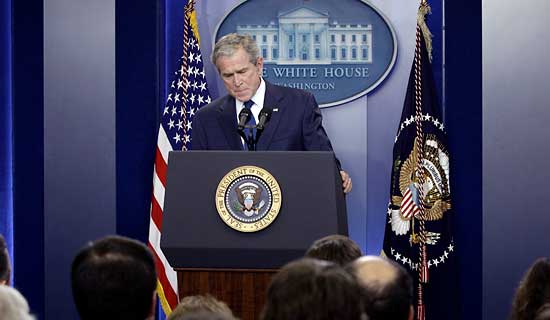
“I have often said that history will look back and determine that which could have been done better, or, you know, mistakes I made. Clearly putting a ‘Mission Accomplished’ on a aircraft carrier was a mistake. It sent the wrong message. We were trying to say something differently, but nevertheless, it conveyed a different message. Obviously, some of my rhetoric has been a mistake. I’ve thought long and hard about Katrina — you know, could I have done something differently…”

After eight long years, the end is in sight, and the Idiot Wind is at long last subsiding. For the 43rd president of these United States, George Dubya Bush, gave his final press conference today, during which he finally conceded that “there have been disappointments.” Why, yes, yes, there have. Abu Ghraib obviously was a huge disappointment during the presidency. Not having weapons of mass destruction was a significant disappointment. I don’t know if you want to call those mistakes or not, but they were — things didn’t go according to plan, let’s put it that way.” Um, yeah.

At any rate, don’t worry: I’m sure we’ll be getting one last round of 9/11, 9/11, 9/11 before closing time, when Dubya delivers his “farewell address” on Thursday. One can only hope that it turns out to be Eisenhoweresque, and not one more final, futile attempt to rewrite the history books. But I’m not keeping my fingers crossed.