On one hand, the film makes for an interesting moral counterpoint to The Fog of War: Ellsberg’s actions put the lie to a lot of McNamara’s convenient post-hoc rationalizing therein — clearly, SecDef could’ve done more at the time to end the war in Vietnam.) On the other, Ellsberg also works as a prequel of sorts to All the President’s Men — to say nothing of a generation of seventies paranoia epics like The Parallax View and Three Days of the Condor. But in the end, The Most Dangerous Man in America probably works best as an eloquent testament to the words of the late Howard Zinn (who appears here as an old friend of Ellsberg): “Dissent is the highest form of patriotism.“
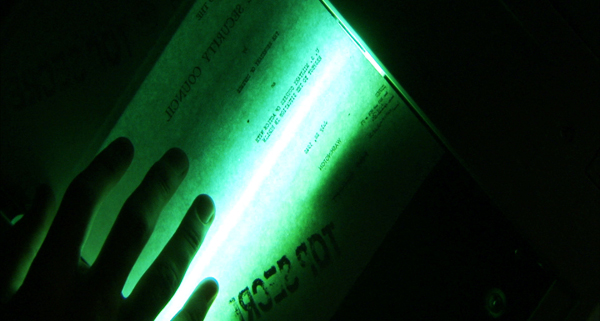
Like Man on Wire, Ellsberg starts here in media res, and at the scene of the history-making crime. Furtive eyes scan back and forth as an old-school Xerox copier whirrs in the dark, its green light illuminating maps of Southeast Asia and the ominous words “Top Secret” from below. With no zip drives or electronic files to speak of, analyst Daniel Ellsberg is forced to copy the 7000 pages of the Pentagon Papers page by painstaking page. It’ll take months (and eventually he enlists the aid of his kids.) As the Xerox churns, we get up-to-date on the ramifications of the document being processed — bombs fall from the sky over North Vietnam and Cambodia, weary troops patrol the hot, fetid jungle, and Nixon and Kissinger obsess over the leaks in their war machine (with Kissinger giving Ellsberg his moniker: “the most dangerous man in America.”)
Cut back to several years earlier, when the future leaker of the Pentagon Papers seemed quite a different man indeed. A fresh-faced young ex-Marine with a crisp, no-nonsense Kennedy era haircut, Ellsberg began his tenure in government as one of the Best and the Brightest, with an enthusiasm for his 80-hour workweek matched only by his hawkishness. As one of McNamara’s boys, Ellsberg concedes to helping massage the data to create a casus belli for the war. His first day on the job is the Gulf of Tonkin incident that wasn’t, and he spends subsequent weeks trying to dredge up some, any, horrible atrocities in the region that might involve Americans.
But, over time, the scales fall away from Ellsberg’s eyes. In part because he makes the acquaintance of a luminous lefty-leaning journalist named Patricia, who eventually becomes his fiancee…twice. (Ellsberg has a great line about a guy he meets at a peace rally who’s a Trotskyist. He asks this fellow how in Hell he ever became a Trotskyist. The answer: “The same way anybody becomes anything. I met a girl.”) And in part because, driven with an analyst’s overriding compulsion to find the right answer, he starts going to Vietnam himself to lead recon missions on the side and get a better sense of the situation on the ground. Simply put, the Ground Game is not going well.
The rest, as they say, is history. Moved to throw a shoe into the gears of the war machine he had helped nurture into existence, Ellsberg goes rogue and decides to publish the top-secret history of the war. But, even if you feel like you know the story of the Pentagon Papers pretty well, and I thought I did, there are some fresh and intriguing insights here. For example, I’m not really one for Freudianism or overthinking coincidences, but it turns out Ellsberg suffered a tragedy at the age of 15 that made him uniquely primed to play the role in history he ended up playing. (His father fell asleep at the wheel during a road trip, prompting a crash that sheared the car in two and killed Ellsberg’s mother and sister. In other words, watch the authority figures at the wheel verrry carefully.)
And then there’s the man himself, who’s an engaging presence throughout (if perhaps with a touch of monomania — I could see him being a hard guy to get along with.) If The Most Dangerous Man in America has a flaw, it’s that the movie is quite one-sided in the end — Ellsberg even narrates much of the story, and you get the sense at various points there may well be some whitewash being applied. (Ellsberg has an ex-wife, and kids, that aren’t even mentioned for the first 45 minutes or so.) Still, I’m inclined to give Ellsberg — and Ellsberg — the benefit of the doubt (and not just because the man loves his movies.) Ever since George and the cherry tree, we’ve been smoothing the edges of our patriotic tales. And, whatever his misdeeds as a man, Daniel Ellsberg, the film makes clear, is a patriot, through and through.
I use this Cornel West quote rather often, but that doesn’t make it any less true: “To understand your country, you must love it. To love it, you must, in a sense, accept it. To accept it as how it is, however is to betray it. To accept your country without betraying it, you must love it for that in it which shows what it might become. America – this monument to the genius of ordinary men and women, this place where hope becomes capacity, this long, halting turn of the no into the yes, needs citizens who love it enough to reimagine and remake it.“
Daniel Ellsberg is one of those citizens. He saw an obvious crime being perpetrated by our government across multiple presidencies, and he did his part to help put a stop to it. In many ways, the story told in The Most Dangerous Man in America seems quaint: Johnson actually asked Congress for authority to bomb Vietnam? The press wasn’t rolling over like a lapdog in the wake of obvious propagandistic lies? (In fact, the media types who show up late in Ellsberg clearly possess some of the narcisstic sense of self-entitlement that has been our undoing of late. Ellsberg the civilian sweats blood and tears to get this 7,000-page document out in public, and the press poobahs act like they’re both the knowing gatekeepers and the heroes of the story.)
But just because Ellsberg’s brand of patriotism has fallen out of fashion in the era of Judith Miller and the chattering class doesn’t make this story any less relevant. It makes it more relevant. If we’re going to keep our young republic through its third century, we need more men and women of Ellsberg’s stripe. Men and women who will buck the trend, risk the ridicule and wrath of their well-connected peers, and stand up against injustice done under our collective name when they are party to it.
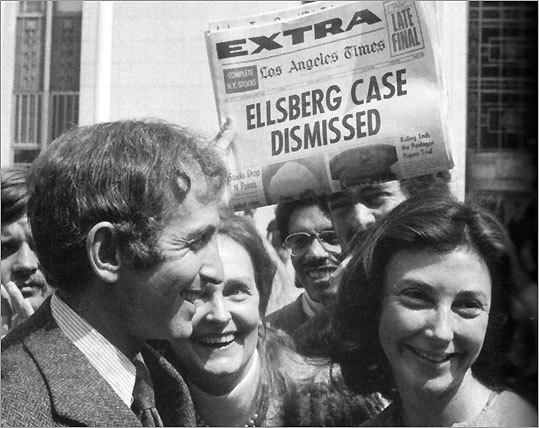
Presidents will get their due on this and every subsequent Presidents Day to come. But, now and again, it’s good to honor those patriots who, through non-violent principle and sheer, dogged determination, help to keep our leaders in check when the separation of powers fails — ordinary folks like you, me, and Daniel and Patricia Elllsberg.

“‘There are times when an abortion is necessary. I know that. When you have a black and a white,’ he told an aide, before adding, ‘Or a rape.’” Another round of newly-released Nixon tapes sheds more light on the dark and troubling imaginings of the 37th president. “‘What I really think is deep down in this country, there is a lot of anti-Semitism, and all this is going to do is stir it up,’ Nixon said…’It may be they have a death wish. You know that’s been the problem with our Jewish friends for centuries.’” Class act, this guy.

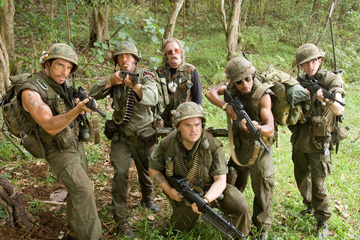
All of which is to say that, even more than usual, my thoughts on Ben Stiller’s Tropic Thunder should be taken with a grain of salt — Actual results may vary. For my part, even though both Stiller and Jack Black were basically doing their usual schtick, and Steve Coogan is pretty much wasted (in more ways than one), I found Thunder to be a decently funny experience last Wednesday. It’s got a bit of the “throw everything at the wall and see what sticks” approach, and some jokes — say, Tom Cruise gyrating in a Harvey Weinstein fat suit — end up getting run into the ground through overuse, Austin Powers-style. But, that being said, I had a good time. It helped that I’m a sucker for the sort of Hollywood inside-baseball humor that Thunder endlessly trafficks in. (IMHO, that’s also the only redeemable thing about HBO’s otherwise aggravating Entourage.) And there are elements of it that just appealed to my funny bone — seeing Nick Nolte finally get all Chris Walken up on us, for example, or the funny-’cause-they’re-tired ‘Nam-era ditties (Creedence, Rolling Stone, Buffalo Springfield) interspersed throughout the flick. So, I’m not going to say it was the best film of the year or anything, but as a diverting and amusing morsel of late-summer fare, Tropic Thunder gets the job done…for me anyway.
The story, as you probably know, involves a behind-the-scenes look at an Apocalypse Now-level movie disaster deep in the jungles of Southeast Asia. After a few wry trailers (the funniest and most dead-on being Satan’s Alley, although I’d have hated to be Eddie Murphy during The Fatties 2), we’re introduced to the gang on hand. There’s fading action star Tugg Speedman (Stiller, being Stiller), drug-addled comedian Jeff Portnoy (Black, going for Farley/Belushi and ending up with Black), Aussie thespian Kirk Lazarus (Robert Downey Jr, weirdly genius), hip-hop phenom Alpa Chino (Brandon T. Jackson, used mainly to cover Downey’s ass), and newbie Kevin Sandusky (Jay Baruchel, late of the Apatow factory), all under the supervision of video director Damien Cockburn (Coogan). Once the film ends up a month behind schedule (three days into filming), the who’s-more-grizzled source material for this ‘Nam picture, Four-Leaf Tayback (Nolte), insists Cockburn bring his bevy of spoiled stars into “the s**t.” Well, things go wrong, of course. And, soon, stranded somewhere near the Laotian border without even a Tivo on hand, this cast of thespians — only some of whom seem to understand the trouble they’re in — must navigate and negotiate their way back to SoCal-style civilization…but not before ticking off the local drug cartel, living out the inexorable men-on-a-mission tropes, and, just possibly, making a decent 80′s-style actioner in the process.
The aspect of Tropic Thunder which *originally* was drawing the most heat is Downey, Jr.’s resurrection of one of Hollywood’s darker stains in its past, blackface. (Controversy has since moved on to the portrayal of mentally handicapped people in the film-within-the-film Simple Jack, which, to my mind, is patently absurd. Watch Forrest Gump or Rain Man again sometime and you should get the point.) At any rate, surprisingly given the poor taste involved in reviving minstrelsy in any form, I thought Downey and the writers actually pulled it off. This is mainly thanks to the incredulity of Jackson’s Alpa Chino to most of Downey’s racist tics, such as reveling in crawfish, gumbo, and the like. All in all, I’d say David Roediger should be proud: Downey and the Tropic Thunder team managed to make their blackface routine a comment about the enduring racist foibles of white people (and the supreme actorly ego of Russell Crowe-type Method men) more than anything else, and thus help to subvert black stereotypes by drawing attention to them. (Of course, one irony here, at least from Spike Lee’s perspective, is that Jackson’s “Alpa Chino/Booty Sweat” act could be construed as even more minstrel-ish than Downey’s role.) In any case, it was a high-wire tightrope act for Downey to pull off, and the fact that his performance has elicited so little controversy suggests how well he pulled it off. (In fact, the five minutes where Downey pretends to be Asian, and pretty much just chop-sockey’s it up rather embarrassingly, illustrates how badly this could’ve gone, and how much we’ve still got to work on.)
Another personal plug: As part of the online rollout for a new edition of Walter LaFeber’s The American Century, I recently composed four brief classroom essays on various 20th century events, as evaluated from a 21st century (re: ruthlessly presentist) perspective. In case anyone’s interested, they’ve now gone live: The Versailles Conference | The Military Industrial Complex Speech | The Tet Offensive | A Second American Century? Now, that’s edutainment.
“There was another price to our withdrawal from Vietnam, and we can hear it in the words of the enemy we face in today’s struggle — those who came to our soil and killed thousands of citizens on September the 11th, 2001.” Every time he thinks he’s going to wake up back in the jungle…In a fit of self-serving revisionism, Dubya attempts to reinvent the lessons of Vietnam before the Veterans of Foreign Wars, arguing that our problems really began because we withdrew from Southeast Asia too early. (Also, apparently we lost the war because of Graham Greene’s The Quiet American. So, on the bright side, it looks like Dubya is progressing along his high-school reading list.) As you might expect, this line of argument is not sitting well with many historians, among them the venerable Robert Dallek: “What is Bush suggesting? That we didn’t fight hard enough, stay long enough? That’s nonsense. It’s a distortion,’ he continued. ‘We’ve been in Iraq longer than we fought in World War II. It’s a disaster, and this is a political attempt to lay the blame for the disaster on his opponents. But the disaster is the consequence of going in, not getting out.‘”
“It’s not quite clear what George W. Bush wants Robert Gates to do. But it’s doubtful Gates would have come back to Washington, from his pleasant perch as president of Texas A&M, if the job description read ‘staying the course on Iraq.’” Invoking Clark Clifford to make his case, Slate‘s Fred Kaplan suggests what incoming SecDef Robert Gates may be able to accomplish over the next two years.
In the trailer bin, Steve Coogan breaks the fourth wall (again) — and gets his Scully on — in the trailer for Michael Winterbottom’s Tristam Shandy: A Cock-&-Bull Story, and Christian Bale gets uber-skinny (again) with Steve Zahn for Werner Herzog’s Vietnam movie Rescue Dawn.
According to National Security Agency historian Robert Hanyok, his recent work outlining a deliberate NSA cover-up following the Gulf of Tonkin incident has been suppressed by the agency since 2001, in part because of Weaponsgate. “He said N.S.A. historians began pushing for public release in 2002, after Mr. Hanyok included his Tonkin Gulf findings in a 400-page, in-house history of the agency and Vietnam called ‘Spartans in Darkness.’ Though superiors initially expressed support for releasing it, the idea lost momentum as Iraq intelligence was being called into question, the official said.“
“Bringing Kutler to the library was going to be like Nixon going to China.” The Nixon library in Yorba Linda — the only presidential library under private management — incurs the wrath of the historical community by spiking a conference on the Vietnam War that would undoubtedly have been critical of Tricky Dick. Whatsmore, “historians still did not have access to about 800 hours of tapes and 50,000 documents withheld by the Nixon estate on the grounds that they deal with personal or political, rather than presidential, matters.” That represents a significantly larger gap in the historical record than 18 and a half minutes.
A federal judge dismisses a case brought against chemical companies by Vietnamese plaintiffs for the manufacture of Agent Orange during the Vietnam War. I’m torn on this one. While the fact that the companies settled a similar lawsuit by American veterans for $180 million makes them seem rather shady, I think their reasoning is probably sound — the decision for the defoliant’s use was ultimately made by the US Government. (If it can be proven that these companies covered up the harmful side effects of Agent Orange to the US, then the government should be bringing the suit against them — either way, though, it seems to me the responsibility for deployment of Agent Orange rests in Washington.)
As Dangerous Meta similarly noted, Judge Weinstein’s argument that Agent Orange wouldn’t be included in the Geneva prohibition against chemical weapons seems like a reach. “‘The prohibition extended only to gases deployed for their asphyxiating or toxic effects on man,’ said the decision…’not to herbicides designed to affect plants that may have unintended harmful side-effects on people.’” Hmmm…so long as side-effects of a given chemical are “unintended” (which itself is an open question regarding Agent Orange), it can be used in the field? That opens the door to a lot of horrible and underhanded trickery in wartime. Despite what some Dubya-appointed freakshows might think, we should be trying to make the international restriction against chemical weapons more, not less, stringent.
Another semester begins here at Columbia today, although the class I’m teaching this term — “The Asia-Pacific Wars 1931-1975″ with Prof. Charles Armstrong — doesn’t meet until tomorrow. (I had been slated originally for Anders Stephanson‘s “US Foreign Policy” class, but have moved over to this Pacific-Specific class due to the usual overbooking and underbooking issues…so, while I’m missing out on a few books on progressive internationalism that had caught my fancy, the reading list for this new class seems intriguing in its own right.)
“[O]n close examination, the accounts of Swift Boat Veterans for Truth prove to be riddled with inconsistencies. In many cases, material offered as proof by these veterans is undercut by official Navy records and the men’s own statements. Several of those now declaring Mr. Kerry ‘unfit’ had lavished praise on him, some as recently as last year.” The Times ably dissects the Swift Veterans smear-job, complete with a spiffy graphic linking its moneymen to Dubya. “Records show that the group received the bulk of its initial financing from two men with ties to the president and his family – one a longtime political associate of Mr. Rove’s, the other a trustee of the foundation for Mr. Bush’s father’s presidential library.“
Hmm. So the military records that would theoretically prove that Dubya was not AWOL and hiding from a drug test in 1973 have been “inadvertently destroyed” by the Pentagon. Funny, that. (Via Princess Diana/Medley.)
Slate‘s David Greenberg (a Columbia PhD recently hired at Rutgers…congrats) examines the use and misuse of Iraq-Vietnam analogies.
As Kerry readies for the big fight ahead, the GOP starts getting real ugly, with doctored Hanoi Jane photos and Drudge-inspired, Murdoch-driven tales of a possible extra-marital dalliance. Yep, the GOP sure loves them the adultery card, but I don’t think that dog will hunt this time around…not after the impeachment fiasco. Update: The accused woman says drop it, already, and Drudge — without apologizing for slandering her or Kerry — changes his tune about the alleged affair.
On the flip side of the card, Dubya’s Document Dump answers few questions about his guard duty, and reports are now surfacing of National Guard documents destroyed by Governor Bush’s people in 1997. And then, of course, there’s the matter of that skipped drug test…

Nor do we ever seem to get under McNamara’s skin here — he remains intelligent and composed throughout, deflecting the tougher questions about Vietnam with a practiced ease. Still, McNamara, a surprisingly spry 86, does offer us some intriguing (and occasionally self-serving) reminiscences here about his experiences in the corridors of power, from his assessment that the Cuban Missile Crisis was defused mainly by simple, dumb luck to his thoughts on the morality of civilian fire-bombing, which he efficiency-maximized for Curtis LeMay during WWII.
As a documentary, The Fog of War sometimes gets clouded by its own cinematic devices — to take just one example, there’s a shot of dominoes across a map of Asia that is striking at first but fast becomes overused. And the continual Phillip Glass cascading over falling bombs and rushing people had me thinking of Koyaanisqatsi outtakes a lot of the time. In sum, the film works best when it’s simply an engaging monologue by an intelligent, evasive, and often frustrating Cold Warrior as he muses over a life perhaps not-so-well lived.
While General Clark comes out for national service, fellow candidates Dean and Kerry bicker over Vietnam. Hmm…while I’m very sympathetic to the idea that a war record should not be a prerequisite for political office, Kerry’s military service is obviously one of his main selling points, particularly when placed in contrast to Dubya’s AWOL year. So I’d say it’s a dumb call for Dean to begrudge Kerry’s mentioning of Vietnam, and especially given Dean’s own tour in Aspen during that time. For the Deanies, I’d think the less said about ‘Nam, the better.
Fred Kaplan of Slate reexamines the lingering question of Kennedy and Vietnam in light of Robert Dallek’s new biography.
My current favorite columnist at Slate, David Greenberg (he’s right up there with Dahlia Lithwick), offers another short history lesson – this time on the changing outlook on American POWs.
As the protests heat up in NYC, Slate‘s David Greenberg evaluates the many contributions of American antiwar efforts over the centuries, and reminds us anew that anti-war advocates are also more often than not pro-troop. Something for the Right to consider before they break out the paintball guns.
Ethel the Blog recently posted this old article reaffirming the fact that GOP House Majority Leader Tom DeLay is a freak show. Worth perusing on the eve of an Iraq war, as DeLay calls Dems the “appeasement party”, is this choice nugget – DeLay on Vietnam: “He and Quayle, DeLay explained to the assembled media in New Orleans, were victims of an unusual phenomenon back in the days of the undeclared Southeast Asian war. So many minority youths had volunteered for the well-paying military positions to escape poverty and the ghetto that there was literally no room for patriotic folks like himself.“
The NYT watches John Kerry’s old Vietnam footage with the Senator and contemplates the relevance of military service to political life.
What the World Thinks of America, from Gary Kamiya of Salon (premium). A fascinating read.