December 2003 Archives
Well, it's that time of year again, New Year's Eve. So, without further ado...
[2000/2001/2002]
1. Lord of the Rings: Return of the King. If you didn't see this pick coming, welcome to GitM. Ever since this blog started four years ago, I and it have been breathlessly awaiting Peter Jackson's trilogy, and, boy, he delivered in spades. Even in spite of the pacing problems mandated by the TE running time, Return of the King is a marvel, the perfect ending to this epic for the ages and easily the best third-movie in a series ever. There's so many ways these films could've turned out atrociously. (To take just three examples, think Brett Ratner doing the Pullman books, or the Wachowskis faltering on the early promise of The Matrix, or how Chris Columbus has made the magical world of Harry Potter so four-color monotonous.) The fact that they didn't -- that they instead shattered all expectations while staying true to Tolkien's vision -- is a miracle of inestimable value. In the post-Star Wars age, when epics have been replaced by "blockbusters," and most event movies have been hollowed-out in advance by irony, excessive hype, dumbing-down, and sheer avarice, Peter Jackson has taught us to expect more from the cinema once again. Beyond all imagining, he took the ring all the way to Mordor and destroyed that sucker. So have fun on Kong, PJ, you've earned it.
2. Lost in Translation. It was fun for a while, there was no way of knowing. Like a dream in the night, who can say where we're going? I still think Sofia Coppola cut a little close to the bone here in terms of autobiography, particularly given her recent split with Spike Jonze. Still, I find this tale of chance encounters and foreign vistas has a strange kind of magic to it, and it has stayed with me longer than any other film this year. Bill Murray comes into full bloom in a part he's been circling around his entire career, and while I suspect he'll get some stiff competition from the Mystic River boys come award-time, I'd say he deserves the Oscar for this one. Lost in Translation has its problems, sure, but at it's best it's haunting, ethereal, and touching like no other film in 2003.
3. Intolerable Cruelty. I expect I'll be in the minority on this pick - This more-mainstream-than-usual Coen joint only got above-average reviews, and hardly anyone I've spoken to enjoyed it as much as I did. Still, I thought Intolerable Cruelty was a pop delight, 99.44% pure Coen confection. George Clooney is used to much better effect here than in O Brother (gotta love the teeth thing), and everyone else seems to be having enormous amounts of fun along the way. Light and breezy, yeah, but I thought it was that rare breed of romantic comedy that actually manages to be both romantic and hilarious. In the post-Tolkien era, it's good to know we can always rely on the Coens for consistently excellent work, and I for one am greatly looking forward to The Ladykillers.
(3. The Pianist.) A 2002 film that I caught in March of this year, The Pianist is a harrowing and unique survivor's tale that's hard to watch and harder to forget (and I can't have been the only person who thought post-spider-hole Saddam bore a passing resemblance to Brody's third-act Szpilman.) Speaking of which, I said in my original review of Adrien Brody that "I can't see the Academy rewarding this kind of understatement over a scenery-chewing performance like that of Daniel Day-Lewis in Gangs of New York." Glad to see I was wrong.
4. Mystic River.: The waters of the Charles are disturbed, something is rotten in the outskirts of Boston, and it's safe to say the Fates are wicked pissed. Much like In the Bedroom in 2001 (and Clint Eastwood's own earlier Unforgiven), Mystic River is inhabited and propelled by a spirit of lumbering, impending, inexorable doom...what Legolas might call a "sleepless malice." It is that existential malice, rooted so strongly in local color, that gives this River its considerable power. And unlike Cold Mountain, where stars stick out here and there with showy turns, the ensemble cast of Mystic River never overwhelm the strong sense of place at the heart of the film -- indeed, they sustain it with consistently excellent and nuanced performances. Big ups for all involved, and particularly Tim Robbins and Marcia Gay Harden.
5. X2: X-Men United. Laugh if you want, but I can't think of any other movie where I had more fun this year. Arguably the most successful comic film since Superman 2, X2 improved over its rather staid predecessor in every way you can imagine. From Nightcrawler in the White House to the assault on the mansion to Magneto's escape to Ian McKellen and Brian Cox chewing the scenery in inimitable fashion, X2 was ripe with moments that seemed plucked directly out of the comics, if not straight out of the fanboy id. To me, my X-Men.
6. Master and Commander: The Far Side of the World. It's a long title, it's a long movie. But a good kinda long...in fact, as I said in my initial review, it seemed to move to the langorous rhythms of a long sea voyage, one that I may not take again for awhile, but one that I still thoroughly enjoyed. And I'll say this for Russell Crowe...somewhere along the way in each of his films, I tend to forget that he's Russell Crowe. His Capt. Jack Aubrey was no exception.
7. The Matrix Reloaded. If we can, let's try to forget the resounding thud on which the Matrix trilogy ended. For a time there, five short months, the fanboy nation was abuzz in trying to figure out exactly where the Wachowskis were going after the second chapter. Previous Matrices, previous Ones? How was Neo manipulating the real world? What was Smith up to? It all seems kinda pedestrian now, of course, but at the time Reloaded was a sequel that outdid its predecessor in pizazz while building on the questions that animated the first film. I won't defend the first forty-five minutes or the ridiculous rave scene. But, right about the time Hugo Weaving showed up to do what he does best, Revolutions found a new gear that it maintained right up until the arc-twisting Architect monologues at the end. And, as far as action sequences go, it's hard to beat the visceral thrill of the 14-minute highway chase.
(7. The 25th Hour.) Another 2002 hold-over, and the best film yet made about the aftermath of 9/11, (which only seems natural, given that it's by one of New York's finest directors.) Haunted by might-have-beens, what-ifs, and what-nows, The 25th Hour feels real and immediate in its attempt to grapple with both 9/11 and the slamming cage in Monty Brogan's future. Only once, with the Fight Club-like fracas in the park, does the film flounder. Otherwise, it's a thought-provoking meditation throughout.
8. The Last Samurai: Breathtaking New Zealand landscapes, furious suicide cavalry charges, rustic untainted pre-modern villages...no, it's not Return of the King, just the warm-up. [And, as I said earlier, I prefer my anti-modern nostalgia hobbit-like (peaceful, environmental, epicurean) rather than samurai-ish (martial, virtuous, stoic)] While I think Cold Mountain got the Civil War right, I ultimately found this film to be the more engaging historical epic of December 2003. So take that, Miramax.
9. Finding Nemo. Oh, my...I almost forgot about Nemo. (Just like Dory sometimes.) Pixar's films have been so consistently good that there's a danger of taking them for granted. They hit another one out of the park in this tale under the sea. As with the Toy Stories and Monster's Inc. before it, just an all-around solid kid's movie filled to the brim with eye-popping wonders.
10. Dirty Pretty Things. Although it becomes more conventional as it goes along, DPT starts very well, features a star-making turn by Chiwetel Ejiofor, and manages to include a Audrey Tautou performance that isn't fingernails-on-the-blackboard bothersome. As with Hugh Grant in About a Boy last year, that deserves plaudits if nothing else.
11. L'Auberge Espagnole. Hmm...two Tautous in a row....perhaps I should stop playa-hatin'. At any rate, while Lost in Translation trafficked in existential detachment, L'Auberge Espagnole showed the fun Scarlett Johannson could've been having, if she'd just lighten up and get out of the hotel once in awhile. This paean to the pan-Continental culture of the EU captured the excitement and possibilities of youth in a way that was both sexier and funnier than any of the teen shock-schlock emanating from our own side of the pond. Road Trippers, take a gander.
12. The Quiet American. A bit by-the-numbers, perhaps, but Phillip Noyce's take on Graham Greene's novel was blessed with timeliness and two great performances by Michael Caine and Brendan Fraser, both of whom expertly exemplified their homelands' diplomatic tendencies without becoming overly tendentious. I'm not sure if giving away the end before the credits was the right way to go, but otherwise the film rarely falters.
13. The Fog of War. From Alden Pyle to one of his real-life counterparts, Robert McNamara, who now only remains quiet when questioned about his own culpability over Vietnam. Despite this central failing, a spry McNamara succeeds in penetrating the fog of time to examine how he himself became lost in the maze-like logic of war. If you can withstand the frequent Phillip Glass-scored barrages, it's worth a see.
14. Pirates of the Caribbean. My initial upbeat opinion on this one has faded somewhat over the autumn and winter months. Still, at the time PotC was a surprisingly good summer popcorn flick, and rollicking fun for about two of of its two and a half hours. Johnny Depp and Geoffrey Rush were great fun, Keira Knightley and Orlando Bloom make for great eye candy, and Sam Lowry was in it. I'm just going to assume it was much, much better than The Haunted Mansion.
15. The Station Agent. Ok, it's got Sunday afternoon bored in front of the IFC Channel written all over it. And not much happens for the last forty minutes or so. Still, The Station Agent proves that if you write a few interesting, well-rounded, complicated characters and throw them in a situation together, the story almost writes itself.
16. American Splendor. The first of a couple of movies that I seemed to like less than most people. Sure, I thought Splendor was well-done, but it never really grabbed me, and I'd be more impressed by its breaking-the-fourth-wall daring if it hadn't already been done twenty-five years ago in Annie Hall. (Similarly, I thought this kooky underground comic world was captured better in Crumb.)
17. Spellbound. Could you use it in a sentence? Again, people seemed to love this flick, and I was definitely entertained by it. But, when you get right down to it, what we have here is kids spelling for two hours...I couldn't imagine ever sitting through this one again. And, as I said in my original post, I thought Spellbound was more manipulative than it lets on. Less kids and more complexity would've made the film more satisfying. S-A-T-I...
18. Cold Mountain. I've already written about this one at length today, so I'll just refer you to the review. To sum up, occasionally beautiful but curiously uninvolving and way too top-heavy with star power distractions.
19. 28 Days Later. Great first third, ok second third, lousy finish. The film was much more interesting before our team makes it to Christopher Eccleston's countryside version of Apocalypse Now. And I can't stand horror movies where the protagonists make idiot decisions, like driving into tunnels for no reason or taking downers when surrounded by flesh-eating, spastic zombies. But the cast -- particularly Brendan Gleeson -- do yeoman's work, and the opening moments in an empty London are legitimately creepy.
20. T3: Rise of the Machines. Before he was the Governator, he was the T-1000 one (last?) time. Let's face it, this movie is mainly here by virtue of not being bad. I mean, c'mon, it was better than you thought, right? Well, me too. Claire Danes was insufferable, but Nick Stahl and Kristanna Loken give it the ole college try, and the story takes a few jags that weren't immediately apparent. Bully to Jonathan Mostow for not running James Cameron's franchise into the ground.
As Yet Unseen: 21 Grams, Bad Santa, The Cooler, House of Sand and Fog, In America, Love, Actually, Something's Gotta Give.
Best Actor: Bill Murray, Lost in Translation. Sean Penn, Mystic River. Chiwetel Ejiofor, Dirty Pretty Things. Michael Caine, The Quiet American.
Best Actress: Scarlett Johannson, Lost in Translation (who's sort of here by default...I expect competition from Diane "Something's Gotta Give" Keaton, Samantha "In America" Morton, Jennifer "House of Sand and Fog" Connolly, and Naomi "21 Grams" Watts.)
Best Supporting Actor: Tim Robbins, Mystic River, Sean Astin, Return of the King, Billy Boyd, Return of the King, Ken Watanabe, The Last Samurai.
Best Supporting Actress: Renee Zellweger, Cold Mountain, Marcia Gay Harden, Mystic River, Patricia Clarkson, The Station Agent.
Worst Films: 1. Gods and Generals, 2. Dreamcatcher, 3. Scary Movie 3. 4. Underworld.
Worst Disappointments: 1. The Hulk, 2. The Matrix: Revolutions, 3. Kill Bill, Vol. 1.
Ho-Hum: 1. LXG, 2. Bubba Ho-Tep, 3. Big Fish, 4. Masked and Anonymous. 5. Tears of the Sun. 6. Veronica Guerin, 7. The Core.
Slate evaluates the Law and Order crew as economic poster-children. I'll vote for the candidate who can promise us a Claire Kincaid economy.
With Iowa and New Hampshire seemingly for Dean, both the Doctor and his rivals continue to hone in on South Carolina as a make-or-break state. As I said earlier, SC is probably the last, best hope for a Clark, Edwards or Gephardt to establish themselves as the Southern anti-Dean. As for Lieberman and Kerry, barring a fantastic upset in New Hampshire, it seems to be all over for the both of them, as their increasingly scorched earth rhetoric attests.
While unconfirmed, an interesting scoop for the Nolan Batman (apparently titled Batman: Intimidation) has recently emerged online: Apparently, neither Viggo nor Cillian Murphy are playing the villains - they have yet to be cast. In fact, Viggo is somebody named Judson Caspian (apparently, Katie Holmes's father...I dunno, this sounds like Ras Al Ghul/Talia to me), while Murphy is playing a young Harvey Dent (a.k.a. Two-Face, previously portrayed by Billy Dee Williams in the first Batman and hammed into the ground by Tommy Lee Jones in Batman Forever.) More intriguing still, the scooper says Chris Cooper is on for Commissioner Gordon. (Michael Caine is already squared away as Alfred.) Perhaps it's all fanboy wishful thinking...but that sounds like great casting.
Ok, clearly I owe Isiah Thomas an apology. In the past week, the revitalized Knickerbockers have won four in a row, and three of 'em were extended garbage-time blowouts (20, 28, and 29 points respectively.) Moreover, Thomas somehow convinced the Rockets to take Clarence Weatherspoon for Moochie Norris, which is a great deal for NY any way you cut it. Of course, the real test will come against real opponents (not just Miami and Orlando) early next month...but still, I'm quite surprised by the way Thomas has engineered this turnaround so quickly. Let's hope it lasts.

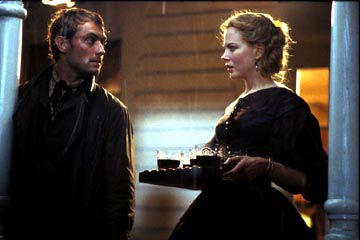
Well, I haven't read the Charles Frazier novel, but I'd say "Cold Mountain" is an apt and colorful metaphor to sum up this film, its stars, and even its director's entire body of work. For like Nicole Kidman and Jude Law, and as with The English Patient and The Talented Mr. Ripley, Cold Mountain is beautiful but distant, occasionally breathtaking but often chilly, and not so much high as just plain stilted. In fact, the hike up and down this Cold Mountain includes definite moments of grandeur, but more often than not it feels like a bit of a slog. At times, it's even glacial.

I should say up front that this is a far better Confederate-centered Civil War film than the vile Gods and Generals. The chaos and carnage of the Battle of the Crater that opens the film seems much more real and visceral than anything in the godawful G&G. Whatsmore, the historical aspects of Mountain generally feel right (In fact, much of the film seems like a fictionalization of Drew Gilpin Faust's Mothers of Invention, which vividly describes how the lives of Southern women were transformed by the war experience and the collapse of the Confederate patriarchy.)
Unfortunately, the respectable versimilitude of the film keeps getting undermined by the wattage of its star power. From Stalingrad to Petersburg, nobody in the business does starving-but-handsome-and-resolute-warrior as well as Jude Law these days, and he's quite good here despite the frequent accent-slippage. But, frankly, Nicole Kidman feels all wrong here. It's not that she's bad per se, it's just that, like her ex-husband in 19th-century Japan three weeks ago, she never seems like she fits this milieu at all. (It doesn't help that she spends most of the end of the film in an outdoor outfit that looks Banana Republic-coordinated.) Finally, others have noted the lack of chemistry between Law and Kidman, and I too thought the central romance here was rather uninvolving.
But, even if the two leads' remarkable frigidity wasn't distracting enough, Law and Kidman are just the tip of the iceberg. In fact, in the spirit of the film, I'll go ahead and torture this metaphor even further...Perhap sensing that the romantic low burn here might be too dim a fire to heat the screen for 150 minutes, Anthony Minghella has packed Cold Mountain so full of stars and cameos that it starts to feel like It's a Mad, Mad, Mad, Mad World. From Lucas Black getting bayonetted in the opening minutes to Jack White procuring cider at the very end (in yet another of Minghella's quintessentially ham-handed symbolic moments, but I'll get to that later), famous faces keep appearing around every corner of the poor, white backcountry South, and it took me out of the movie almost every time. Basically, I found it hard to become engrossed in the film when I kept thinking things like "So, that's what Kathy Baker's been up to...she got married to the manager from Major League," "James Rebhorn's his doctor? He's toast," "Well, Jena Malone didn't last very long," "and "Hey, that's Cillian Murphy. Between him and Brendan Gleeson, this is like a sequel to 28 Days Later...um, except it has no zombies and it's set in the Civil War South."
Ok, perhaps that's an unfair criticism, but I'd think even people who don't go to the movies much are going to be distracted by all the Hollywood faces flitting about. I should say while I'm on the subject that Brendan Gleeson is very good (as always) here - Not only does he handle the accent like a champ, but he conveys more emotion in one winsome smile or knowing grimace than many of the central characters do the entire film. As for other good performances...Despite lugging around a baby that's as big as she is, Natalie Portman proves here that she can still act when not forced in front of a bluescreen. (By the way, after the Portman episode, why didn't Inman take one of the Union horses?) Giovanni Ribisi moves into the frontrunning for the Cletus the Slack-Jawed Yokel biopic. And, Renee Zellweger...well, she moons and mugs through this film like a Best Supporting Actress award was her birthright, but she still gives Cold Mountain a very-much-needed jolt in the arm every time she shows up. (She's particularly energetic when compared to the staid Kidman.)
On the flip side of the coin, somebody should've told Donald Sutherland that different parts of the South call for different accents...he sounds miles away from a Charlestonian. And Phillip Seymour Hoffman, perhaps the best thing about Minghella's Ripley, is perhaps the worst thing about Cold Mountain. Completely unconvincing in his role here, he's a walking, talking anachronism.

All the unnecessary star voltage aside, of course, this movie eventually rises and falls on its director, and all of Anthony Minghella's strengths and weaknesses are present here. (I should say that I loathed The English Patient and enjoyed Ripley until Jude Law was killed, after which the film meandered to its conclusion.) Both Patient and Ripley have some very beautiful and striking moments, but more often than not the imagery is so "artfully" composed as to become hamhanded. The same goes here for Mountain...we've got a lamb running around in wolf's clothing, we've got a dove trapped in a church until Jude Law sets it free (you do the math)...in fact, we have enough fluttering, portentous birds on a wing here to make John Woo blush. Perhaps these capital-S Symbols are in Frazier's novel too, but I'd still think a subtler director could have mined them more dexterously. And, while I didn't know the ending coming in, Minghella foreshadows the conclusion so laboriously (even having Kidman break it down step-by-step to Zellweger) that I spent the last twenty-five minutes just waiting for the other shoe to drop, which killed any real emotion I might've felt about the denouement.
Looking back, I've been pretty harsh here, so I should repeat that Cold Mountain is not a bad film at all. In many ways, it's quite good. But, Oscar buzz notwithstanding, it's definitely not great...in fact, I even found it less involving than The Last Samurai. In the future, were I looking to recommend a film that captures the despair and devastation afflicting the Confederate homefront in the waning days of the war, I just might pick Cold Mountain. But, as for attempts to give The Odyssey a Faulknerian palmetto-and-spanish-moss recasting, give me O Brother Where Art Thou? any day of the week.
Hello out there...I hope and trust y'all are in the midst of a happy, healthy holiday season. Berk and I have returned to NYC from a family christmas in Norfolk, where I received a number of books on my Orals list, an XBox, some clothing, some cash, and sundry assorted goodies and gadgets. And, as per usual on and around December 29, I'm a year older as of yesterday....29, for the first time. At any rate, expect normal update schedule to resume from now herein.

A very Merry Christmas from Berk and I to you and yours.
On the verge of effectively ending another season before the new year starts, the Knicks finally fire Scott Layden. This'd be great news for Gotham if his replacement weren't Isiah Thomas, who's recently run the CBA into the ground and treaded water for years with the hyper-talented Pacers. Hmmm. Well, at least Thomas isn't coaching, and perhaps he can manage to draw some top talent back to the mecca of basketball.
"We must all have waffles forthwith." Tom Hanks, a.k.a. Professor Goldthwait Higginson Dorr, takes the Coen road in this trailer for their Ladykillers remake, and it looks like it fits him swimmingly.

If you can stand being bombarded by endless slo-mo shots of dropping ordnance set to a Phillip Glass pulse, The Fog of War, the new Errol Morris documentary about and extended interview with former Secretary of Defense Robert McNamara, makes for an interesting evening out. Despite the heavy saturation on screen, there are no real historical bombshells dropped here -- The movie doesn't aim to muckrake a la The Trials of Henry Kissinger, and the picture you get of Vietnam-era McNamara is the same one you'd find in a book like Robert Schulzinger's A Time for War: Publicly optimistic, McNamara seems deeply cognizant from early on that Vietnam will be a quagmire, but he -- like LBJ and almost all of the foreign policy establishment -- are too blinded by the fear of falling dominoes to consider withdrawal as a viable option. (McNamara does add fuel to the fire here that Kennedy wanted a full withdrawal by 1965. I guess if anyone would know, he would, but the books I've read don't really bear this out.)

Nor do we ever seem to get under McNamara's skin here -- he remains intelligent and composed throughout, deflecting the tougher questions about Vietnam with a practiced ease. Still, McNamara, a surprisingly spry 86, does offer us some intriguing (and occasionally self-serving) reminiscences here about his experiences in the corridors of power, from his assessment that the Cuban Missile Crisis was defused mainly by simple, dumb luck to his thoughts on the morality of civilian fire-bombing, which he efficiency-maximized for Curtis LeMay during WWII.
As a documentary, The Fog of War sometimes gets clouded by its own cinematic devices -- to take just one example, there's a shot of dominoes across a map of Asia that is striking at first but fast becomes overused. And the continual Phillip Glass cascading over falling bombs and rushing people had me thinking of Koyaanisqatsi outtakes a lot of the time. In sum, the film works best when it's simply an engaging monologue by an intelligent, evasive, and often frustrating Cold Warrior as he muses over a life perhaps not-so-well lived.
A flurry of probes, headed by the ESA's Beagle 2, prep for christmas on Mars. Let's hope they fare better than the '99 wave.
"Many Democrats figured they had hit bottom last year when Republicans captured control of the Senate, completing their federal government takeover. Then the bottom dropped out, too." The Post surveys the dismal days for Dems in Congress.
In the interests of equal time, a dissenting opinion on RotK: "The final entry in the 'Lord of the Rings' trilogy reveals once more that what the chick flick is to men, this trilogy is to women...The well-calculated hype and exaggerated praise...has obscured what the series really is: an FX extravaganza tailored to an adolescent male's fear of sentiment and love of high-tech wizardry...Who would have thought that Peter Jackson would direct such soulless films?" Sigh...I figured somebody would write a piece like this, but I didn't expect it to show up in the Times, of all places. Just goes to show, there's no accounting for taste. Update: Stephanie Zacharek responds.
creeps about this petty pace 'til Summer 2004, as three sci-fi/fantasy trailers are released in the wake of the King: Vin Diesel returns in The Chronicles of Riddick, aka Pitch Black 2. I enjoyed the first one decently enough, but this teaser doesn't do anything for me. Meanwhile, Jude Law, Gwyneth Paltrow, and Angelina Jolie fight giant robots in Sky Captain and the World of Tomorrow, which looks like a great idea for a short film but may be hard to sustain for a full two hours. (And Jolie looks ridiculous.) Finally, Spiderman 2 gets the Quicktime treatment (I already commented on this one here.)
Wow. If you haven't seen Return of the King yet, go now. If you have seen it, see it again...There's so much going on that the film, as great as it is the first time, improves vastly with a second viewing. The rest of this post is going to be full of huge, major spoilers, so if you haven't seen the movie yet, come back here in three hours and twenty minutes, give or take.
I went into my second viewing of RotK knowing I already liked it better than TTT (which I also thought was superb) and wondering if it was better or just equal to FotR. By the end, I had decided the question was moot. On one hand, Fellowship and King are two very different films: the former a road-trip, men-on-a-mission travelogue of Middle Earth, the latter a full-on, apocalyptic war movie. On the other hand, Fellowship, Towers and King are the same movie, the three chapters of what has to be considered the best ten-hour film ever made.
So, in short, I loved it. As in the past two years, my inordinately high expectations were met, even surpassed. Of course, I had some problems with the film (which I'll get to in a bit), but I'd be doing PJ & co. a great disservice if I didn't make it emphatically clear that the positives far outweigh the negatives. In that spirit, some of the stuff I really liked:
Fear and Loathing in Minas Tirith: I thought one of the biggest surprises of RotK was seeing PJ's background in horror films come to the fore. To take just one example, one of my major concerns going in was that Shelob wouldn't seem qualitatively different from your average Kong-sized monster (for example, the Watcher in the Water in Fellowship.) After building Her Ladyship up since the end of Towers, it was crucial that She seem more ancient and malevolent than anything Frodo and Sam had yet faced, with the possible exception of the Balrog. And, while I think her lair was too brightly lit (there's not much point in having the light of Earendil if we can already see around the place), Shelob seemed just as cunning and dastardly as I'd hoped. (It was also a nice touch for PJ to have a little fun wth the purists, and make it seem Frodo had escaped.)
From cascading heads to Grond to the pyre of Denethor to everything having to do with Minas Morgul and the Witch-King, PJ's horror maven cred was put to great effect in Rotk and greatly enhanced the apocalyptic dread necessary to make the third book work. In fact, I thought Jackson made a great decision to place one of the most chilling moments in the movie right at the beginning. "We even forgot our own name..."
The Tides of War: Another concern I had going in was that Jackson would short-shrift Tolkien's characters in favor of long, drawn-out, and indistinguishable battle sequences. And, while some might think this is in fact the case (no Houses of Healing, for example), I was surprised by how engaging the battle scenes turned out. When you think about it, Pelennor Fields is written a lot like Helm's Deep...a siege that, just when all seems hopeless, is turned by the arrival of the cavalry. But it is to Jackson's credit that I not only found myself enthralled by the ever-changing course of combat but also oblivious to the memory of Helm's Deep. There are plenty of searing images herein -- the Ride of the Rohirrim (made sublime by the return of Howard Shore's Rohan theme), the chunks of masonry flung from Minas Tirith, the berserker trolls leading the charge at the gate, the Nazgul air support diving down over the White City like Stuka bombers. Speaking of which, there's a shot of a fell beast lunging for the head of one of Faramir's retreating Gondorians that made me swing my head out of the way both times.
High Fidelity: One of the main reasons why I found RotK more enticing than TTT (other than the obvious plot resolution here) is that it seemed a return to Tolkien's vision after the warg attack/Helm's Deep-wallowing of TTT. (There are some notable exceptions, of course, which I'll get to in a bit.) In particular, the Professor's inimitable turns of phrase breathe through many more scenes here: "Did you think the eyes of the White Tower were blind?" "No tomb for Denethor and Faramir. No long, slow sleep of death embalmed. We will burn like the heathen kings of old." "Come not between the Nazgul and his prey!" "Don't go where I can't follow." "We set out to save the Shire, Sam, and it has been saved, but not for me." Towers has its share of great Tolkien moments too, of course, but -- as in Fellowship -- I was continually reminded during King of how great the original books are, and how unique and absorbing Tolkien's deliberately archaic prose can be.
The Crack of Doom and Beyond: "I'm glad you're with me, Samwise Gamgee, here at the end of all things." And, of course, there's the payoff. While I thought Frodo and Sam hopped and skipped across Mordor entirely too quickly (I expect this will be rectified in the EE), I thought the failure of Frodo at the Sammath Naur was dramatized just about perfectly, right down to the evil smile on Frodo's face and Gollum's ecstatic Superbowl dance. As for the "too many endings" issue that seems to be a focal point of the criticism, I did feel it went on a bit long the first time (perhaps because it was nearing 3:30am by then), but thought it was paced very nicely the second time around. And, though the Scouring of the Shire (while critical to Tolkien's narrative arc) seems justifiably expendable here, the film just couldn't do without the Grey Havens. In fact, if anything, I thought Frodo should have been more recognizably damaged at the end of the film. He seemed all smiles at the Green Dragon and Sam's wedding, which to me is something of a problem...I figured the idea, as befitting Tolkien's "Lost Generation," was that he never really made it back, and I don't think this is emphasized enough in the film. Still, for the most part, I thought Jackson handled the resolution quite well, paying homage to the arch-Christian overtones of Frodo's death and rebirth without necessarily wallowing in them.
Miscellany: The categories above just can't do justice to all the moments and flourishes I loved about RotK. All of Smeagol/Gollum's scenes were top-notch, even the film-added-framing of the fat one. I loved the dressing of the witch-king and his sonic scream atop Minas Morgul. The lighting of the beacons was great. Theoden seemed like he was missing a scene (he goes from anti-Gondor to pro-Gondor too quickly), but Bernard Hill was a standout (along with Billy Boyd's Pippen and Sean Astin's Sam...heck, everyone was good, except for a few minor players.) Minas Tirith was a marvel (and, unlike the too-small Edoras, seemed like a capital city.) Merry and Pippen at the gate of Isengard. "In fact, it's probably best if you don't speak at all, Peregrin Took." Peter Jackson dolled up as a Corsair Captain. LotR: Return of the Moth. The angelic eagles come to rescue Frodo...
Well, I could go on for awhile here, but perhaps it's time to accentuate the negative a bit.
Editing/Pacing: In the theatrical Fellowship, only one scene seemed cut all to hell, and that was Lothlorien. Here in Return of the King, though, the movie keeps eliding over cut moments in a way that can be seriously distracting. I'm not going to harp on this too much, because I expect a lot of this will be solved by the Extended Edition. But, still, it was clear here more than ever before that we weren't seeing the whole story. How did Theoden change his mind about coming to Gondor's aid? Why does Denethor talk about the "eyes of the White Tower" without showing his palantir? (For that matter, does Aragorn challenge Sauron in the palantir?) Why does the Witch-King claim he will "break" the white wizard without confronting him? (It was even in the trailer!) Why set up a head orc like Gothmog (Slothmog, the Elephant Man) and not show him killed? Where were the Easterlings (whom Frodo and Sam saw entering the Black Gate in TTT)? Why do Sam and Frodo get in and out of orc armor? How do they cross Mordor in a day? What happened to Eowyn and Faramir? Where was the Mouth of Sauron? Who's wearing the three Elven Rings?
And so on and so on. I know PJ has to make some cuts for the theatrical version (although some might say that he'd have more time here if not for the warg attack/Aragorn's fall in TTT), and some of the cuts -- Voice of Saruman, the Scouring -- just make cinematic sense. But others not only seem integral to Tolkien's book but also integral to the story Jackson is telling here (particularly Denethor and the palantir.) Speaking of which...
The Steward of Gondor: I'm not going to complain too much about what's not in the film until I've seen the EE. But, as for what's actually in the film, Denethor is the biggest problem. I've never really been bothered about the changes made to Faramir (or, as the purist wags refer to him, Filmamir/Farfromthebookamir) in TTT...they heightened his dramatic arc. But I think Denethor kinda gets screwed here, and only in part because of the lack of palantir. John Noble is surprisingly good as the Steward, and does a great job with what he's been given. But the single worst moment in the movie for me is Gandalf clocking Denethor to take over command of the White City. It's goofy, it's slapstick, and it cheapens both characters (Is all of Gondor really just going to stand around and let Gandalf exercise what is now basically a coup?) Similarly, I thought the pyre of Denethor was handled quite well until the last few moments, when Gandalf/Shadowfax kick Denethor to his doom!! That's completely botched...Gandalf was trying to prevent Denethor's suicide, but here he acts like the wizard Kevorkian. If the palantir is reintroduced in the EE, some of this is forgiven, but still...those two choices are the only times I was taken out of the film.

Miscellany: Not much in this department. I thought the whole Paths/Army of the Dead subplot was a deus ex machina and, as others have noted, Haunted Mansion goofy...but, y'know, that's also a problem with Tolkien's book. (I did like Stephen Hunter's take on 'em here, though.) Very occasionally, one of the minor players came off like community theater (I'm thinking particularly of Shagrat (or is it Gorbag?), the orc who explains that the Shelob-stung Frodo isn't dead.) As in TTT, we seem to spend a lot of time in Osgiliath, and perhaps some of it is unnecessary given the other cuts. Hugo Weaving has a Father of the Bride simper on his face at the coronation that's completely un-Elrond-like. Um, yes, Legolas, we are talking about a diversion. Etc. etc.

But let's not miss Fangorn for the Huorns. Return of the King is an amazing conclusion to a trilogy that's surpassed all expectations and, I say this without hyperbole, redefined the medium -- From the technical breakthrough of Gollum to the seamless intertwining of jaw-dropping FX and character-driven emotion throughout, these films have expanded our vision of the possible and set a new standard for epic filmmaking, one left by the wayside since the days of David Lean. I am eternally thankful to Peter Jackson, Fran Walsh, Phillipa Boyens, Alan Lee, John Howe, Richard Taylor, Barrie Osborne, Andrew Lesnie, and everyone else involved in The Lord of the Rings for making these films as good as they are. When so many eagerly-awaited movies have proven disappointments, perhaps none so glaring as the Star Wars prequels, it's a beautiful thing that these films came along, surpassed even my extremely high expectations, and restored to me the type of cinematic thrill I once feared I might have grown out of. In sum, Fellowship of the Ring, The Two Towers, and Return of the King -- inarguably the best fantasy trilogy in the history of cinema -- are a priceless gift not only to filmgoers and fantasy readers but to the memory and words of J.R.R. Tolkien himself, and it is one I will love and cherish until the end of my days.
It's funny, though. I expected to suffer from some form of fanboy post-partum after seeing The Return of the King. But, in fact, I'm thrilled...I can now go see this movie any time I want to. And then there's the Extended Edition to look forward to in November, and perhaps, some day in the not-so-distant future, The Hobbit (Being the tale of Bilbo Baggins and the Finding of the Ring of Power) will make the screen. Even after the end of all things, the road goes ever on.

From the ashes a fire shall be woken,
A light from the shadows shall spring;
Renewed shall be blade that was broken,
The crownless again shall be King.
[Fellowship][ Towers]
We come to it at last. Reviews and clips below for those of you who aren't yet swayed. For everyone else, our wait is finally over, our journey at an end. But not before one last foray into Middle Earth, and I get the sense this'll be one for the ages.
Update: Well, I'm back. In short, RotK is awe-inspiring, at times genuinely scary, and often overwhelming. As per the last two, it's going to take another viewing to fully wrap my head around it (I'm going again this evening), but I already know it's head and shoulders above TTT. A full report soon.
It is close now, so close to achieving its goal. (Yes, my count is a day ahead of most people's, but I'm going at midnight tomorrow night, and for me that's Tuesday.) A lot of the US press hasn't weighed in yet, but as they do, check below. Update: One last scratchy, bad-quality clip, precious? Faramir runs into a spot of trouble. To be honest, the resolution's so bad here that it's almost not worth watching, but if you really need a fix... [9, 8, 7, 6, 5, 4, 3, 2]
New York Film Critics Circle: Best Film of 2003.
Rotten Tomatoes: 98% (156-4)
Metacritic: 94% (40)
New York Times: "After the galloping intelligence displayed in the first two parts of 'The Lord of the Rings' trilogy, your fear may be that the director, Peter Jackson, would become cautious and unimaginative with the last episode...But Mr. Jackson crushes any such fear. His 'King' is a meticulous and prodigious vision made by a director who was not hamstrung by heavy use of computer special-effects imagery."
New York Post: "'The Lord of the Rings: The Return of the King' rules as the crowning achievement of Peter Jackson's awesome adaptation of J.R.R. Tolkien's trilogy, a majestic conclusion to a nine-plus-hours epic that stirs the heart, mind and soul as few films ever have...it's also one of the most beautiful films ever shot."
New York Daily News: "With 'The Return of the King,' New Zealand director Peter Jackson has completed his trilogy of J.R.R. Tolkien's mammoth 'The Lord of the Rings,' and can lay claim to one of the greatest achievements in film history. Taken as a whole, 'The Lord of the Rings' is the first masterpiece of the 21st century."
Chicago Tribune: "One 'Ring' - finally - rules them all. In 'The Lord of the Rings: The Return of the King,' a great mythic movie cycle gets the ending it deserves - and we can finally see this stunningly completed film trilogy for what it is: one of the major achievements of film history."
LA Times: "It took one ring to rule them all, and now there's one film to end it all, to bring to a close the cinematic epic of our time, the one by which all others will be judged...As a model for how to bring substance, authenticity and insight to the biggest of adventure yarns, this trilogy will not soon, if ever, find its equal."
Washington Post: "one thing Jackson does brilliantly is capture the exhilaration, fatigue, heroism and despair of war. He looks at it as something not ennobling but exhausting, more ordeal than crusade but -- completely necessary...'The Return of the King' puts you there at Waterloo, or Thermopylae or the Bulge, any desperate place where men ran low on blood and iron and ammo, but not on courage."
Boston Globe: "'The Lord of the Rings: The Return of the King' delivers on all the mighty expectations Peter Jackson created in 'The Fellowship of the Ring' and 'The Two Towers.'...[It] unfurls with the sprawling pageantry of the first two installments, movies in which Jackson reclaimed the fantasy epic as a source of headlong astonishment."
USA Today: "****....As good as each individual movie is, the third film vaults the work into the stratosphere of classic movies. Key characters are enhanced, new civilizations visited and battles fought more intensely, while feelings and motivations are plumbed more deeply and movingly...In its entirety, The Lord of the Rings surpasses other multi-part sagas such as Star Wars or even The Godfather."
San Jose Mercury Tribune: "'Return of the King' combines the best moments of 'Fellowship' and 'Two Towers' and brings the Arthurian trilogy to a rousing, satisfying finish. Taken alone, it's a great movie. In conjunction with the other installments, it's a historic movie event, one that the Academy Awards will have to work hard to ignore when doling out this year's top honors."
Atlanta Journal-Constitution: "With 'The Lord of the Rings: The Return of the King,' Peter Jackson brings his epic series to a glorious finish. And in doing so, he's made the greatest movie trilogy in cinema history...Peter Jackson has taken us there and back again. And he's done it with a masterwork that truly is the one trilogy to rule them all."
Village Voice: "The most hallucinatory of war films, The Return of the King concludes the Lord of the Rings trilogy with a burst of smoky grandeur...Peter Jackson's hobbit epic is certainly the greatest feat of pop movie magic since Titanic."
Slate: "This is the best of the three Rings movies—more than that, it makes the others look even better. You can finally see the arc of the trilogy: not just J.R.R. Tolkien's, with its blend of Norse and Christian myth, but Peter Jackson's....The Lord of the Rings took seven years and an army of gifted artists to execute, and the striving of its makers is in every splendid frame. It's more than a movie—it's a gift."
San Francisco Chronicle: "With the possible exception of the Russian 'War and Peace,' such a combination of monetary resources, creative talent and technical mastery has never been brought to bear on a movie project, and nothing on this scale is likely to occur again soon....the movie reaches us with special recognition, even as it reaches both behind us and past us, with the universality of a classic. It is the old story, the timeless thing. The human struggle, made noble."
CNN: "This third in the series of the 'Rings' franchise is utterly breathtaking. Even J.R.R. Tolkien would be highly impressed...All in all, 'The Lord of the Rings' is the stuff that dreams are made of. "
Philadelphia Inquirer: "Peter Jackson's The Lord of the Rings trilogy is, by any measure, a crowning moment in cinema history...It is an achievement of bewildering scale."
Roger Ebert: "This is the best of the three, redeems the earlier meandering, and certifies the Ring trilogy as a work of bold ambition at a time of cinematic timidity...Jackson's achievement cannot be denied. The Return of the King is such a crowning achievement, such a visionary use of all the tools of special effects, such a pure spectacle, that it can be enjoyed even by those who have not seen the first two films."
Miami Herald: "****. With the spectacular The Return of the King, Peter Jackson's Lord of the Rings film trilogy becomes the new benchmark against which all future fantasy movies must now be judged...The Return of the King feels like a miracle, a movie that exceeds even the most formidable expectations without straying from its singular path. All hail this King.
Charlotte Observer: "****. 'Return' is the equal of the magnificent opening episode, 'The Fellowship of the Ring.'...[It] should convince even the most hardened skeptic that 'The Lord of the Rings' is one of the great achievements of film history...Jackson had the vision, persistence, insight and patience for this mighty job, plus the smarts to shape stage veterans and overlooked film actors into a seamless cast. He's made himself as immortal as a movie director can be."
Detroit Free Press: "So hail this 'King.' It not only stands as fantasy filmmaking on a peak of previously unscaled proportions, it now officially takes its place in the Great Hall of Movie Mythology, the place we return to again and again to share our dreams."
Dallas Morning News: "But the trilogy's real hero is Peter Jackson. The director and screenwriter brings unity to a somewhat unwieldy story and handles the spectacle scenes with flourish and coherence. The Return of the King is the best of the Tolkien-inspired cinema trinity. It's got heart, soul and monsters."
Baltimore Sun: "[A]s the final chapter of, essentially, a single 10-hour movie, [RotK] has a narrative beauty and a sublime ensemble performance that put it in a class by itself...The Lord of the Rings: The Return of the King is so replete with imagistic and literary treasures that it repays re-viewing. After seeing it, I felt as I did after seeing E.T. - that unless the distributor wants to pull it back, there's no reason for it ever to stop running."
Salon: "With 'The Return of the King,' Jackson, his remarkable cast and his enormous ensemble of collaborators have found victory at the end of their improbable quest...Packed with passion and heroism, the grimness of death and the hope of salvation, this final chapter flies past with the speed of Shadowfax...None of us is ever again likely to encounter a 200-minute movie we are so reluctant to see come to an end...this one is Jackson's crowning achievement. It marks 'The Lord of the Rings,' without any serious question, as the greatest long-form work in the history of mainstream cinema."
With the Lord of the Rings sadly, inevitably drawing to its conclusion, the Post delves into His Dark Materials. Hopefully, the powers-that-be will have the sense to get Brett Ratner the hell away from this project.
The Dems lose another Senate Southerner with the impending retirement of John Breaux (D-LA). (He joins Edwards, Graham, Hollings, and Zell on the way out.) Dems have done decently well in Louisiana of late, but you have to think that this is ripe territory for a GOP pickup. And that's just trouble.
Well, having seen Big Fish the other night, I can safely say it's better than 2001's Planet of the Apes, and I enjoyed it more than 1999's Sleepy Hollow. Still, I expected more from this most recent outing by Tim Burton. You'd think Burton would be the perfect guy to construct a tale of fantastical, overgrown whoppers, but half the time I was wondering, "Where's the beef?"
It's not the cast's fault, really. Ewan McGregor is charming as ever in the lead (even if he and Jude Law seem to be in a dead heat as to which son of the Isles can strike the goofiest Southern accent this Christmas), Albert Finney is fine, Billy Crudup does what he can in a thankless role, and most if not all of the supporting players are solid.
But the writing...I haven't read the book, so I don't know how close it adheres to the original stories. But I thought the film was hit-or-miss and, well, episodic. Some of the fish tales, like Ed Bloom's mission to Korea or his tear through his small town, are pretty funny and enjoyable. Others, like his sojourn in Spectre, go on for far too long. And others, like the secret in Danny DeVito's trailer, never really get off the ground and seem throwaway.
Of course, the larger problem here is the saccharine nature of the whole project, which is particularly surprising given Burton's normal talent for subversiveness. He's always been good at creating dark, edgy, temperamental worlds (Beetlejuice, Nightmare before Christmas, Batmans 1&2), but somehow this sickly-sweet, frothy, straightforward story turned Tim Burton into Chris Columbus. Sure, the denouement of the film is moving in its own way, but only because Burton hits you over the head with hospital bed tearfulness and graveside eulogizing...I'm surprised he didn't kill a puppy while he was at it.
In sum, the movie seems to be missing that imaginative spark I once expected from Burton. What could have been an imaginative Ed Wood-like fusion of the mainstream and the perverse ended up coming across as a rather bland and staid studio project (As Buck Henry might put it, "On Golden Pond meets O Brother Where Art Thou.") The thing about Big Fish is, I didn't dislike it in the end. I just ended up feeling rather ambivalent about it. Hopefully, Burton will bring more of his trademark minor-key mischievousness to the table in Charlie and the Chocolate Factory.
The friendly neighborhood trailer for Spiderman 2, soon to sling in on the coattails of RotK, shows up online. I didn't much care for the long set-up, but Alfred Molina seems pitch-perfect as Doc Ock.
"Perhaps that's why former vice president Al Gore's endorsement of Dean last week felt so strange -- less like the traditional benediction of a fellow member of the party "club" than a senior executive welcoming the successful leveraged buyout specialist." Everett Ehrlich pens an intriguing article on Dean, Ronald Coase, and "virtual parties."
As the recent banishment of a newspaperman suggests, the small towns of The Sims Online are less George Bailey than Old Man Potter. So does this make them more or less realistic? And what does Curt Schilling think?
"All the laws of Washington and all the bayonets of the Army cannot force the Negro into our homes, our schools, our churches," decried Strom Thurmond in 1948 as he led the Dixiecrat segregationists out of the Democratic Party. Of course, as always in the Souths Old and New, the bedroom was another matter. To no one in South Carolina's real surprise, 78-year-old Essie Mae Washington-Williams announces she is Thurmond's mixed-race daughter. True to the character and hypocrisy of the Jim Crow South, here is a man who broke the Democratic Party and the filibuster record of the United States Congress trying to deny basic civil rights to his own child. How's that for "family values?" Unbelievable. Update: Surprise, surprise. The Thurmond family confirms it.
In a hole in the ground lived a Hussein...until today. (There's also a Gimli joke in here somewhere, but let's not be too flippant.) Any way you cut it, this is excellent news. By capturing Saddam, we've struck a considerable blow against the continuing Iraqi resistance (even if this capture won't faze many anti-American groups joining in the fight.) By capturing him alive, we've prevented his martyrdom. By turning him over to an international tribunal, we can now help bridge the widening gaps between the US and the world on Iraq. (And, for the Dems, it's better for Saddam to have been found now, eleven months before the election, than for a October surprise later down the road.) Of course we still haven't found anything to suggest our WMD casus belli was legitimate, but hopefully this capture will make the situation in Iraq much more stable and less deadly for our troops abroad. And, while it might be too much to ask, perhaps it will encourage the Bush administration to refocus on capturing America's public enemy #1, Osama Bin Laden, before they launch any more military sideshows.
Reelviews: "There can be no greater gift for a movie lover than the one bestowed upon audiences by Peter Jackson, whose The Lord of the Rings: The Return of the King is not only the best movie of 2003, but the crowning cinematic achievement of the past several years. In fact, labeling this as a "movie" is almost an injustice. This is an experience of epic scope and grandeur, amazing emotional power, and relentless momentum...Not only is this motion picture an entirely worthy conclusion to the landmark trilogy, but it's better than its predecessors." Mori at AICN: "[T]hese films represent a high point for genre filmmaking that will be nearly impossible to equal or surpass...It’s overwhelming. It’s incredibly powerful, with battle sequences that will sweep over you like virtual reality and emotional crescendos that would be impossible to hit in a single film."
The Daily Mail: "How about amazing, stupendous, jawdropping and overwhelming? For this is wonderfully imaginative cinema on the grandest possible scale...There are sights here unparalleled in cinema...For its scale, imagination and passion, this is, without doubt, the greatest cinematic trilogy ever." Financial Times: "This concluding film may be the greatest fantasy- adventure epic ever made. It is almost certainly the most spectacular." Harry at AICN: "This is frankly one of the greatest films ever made...for me, it is without equal or parallel. It does not diminish the others to any degree, it is just what it is… perfect. Like when Lean did BRIDGE OF THE RIVER KWAI, LAWRENCE OF ARABIA and DR ZHIVAGO… there was just fate leaning over the shoulder and perfection was achieved." Wow, after all that superlative madness (which, ok, we expected from Harry), how bout a new commercial? Beware: this one's a money-shot trailer...there's a very good chance you might not want to see some of this stuff until after Tuesday. Then again, maybe you do...
Well, due to various other projects -- end of term grading, freelance history textbook work, attending multiple job talks for a pending Columbia hire -- my online note-taking has fallen even farther behind my orals reading lately. But, the spirit marches on. So, without further ado:
| John Lewis Gaddis, Strategies of Containment: A Critical Appraisal of Postwar American National Security Policy. David Kennedy, Over Here: The First World War and American Society. |
BBC: "The Return of the King brings an overwhelming air of expectation and of consequence - and in almost every sense it dwarfs what has come before...This three-hour, 11-minute epic is an unqualified triumph, one that raises the bar for any spectacle-respecting director of the future. The Oscar, surely, must go to Peter Jackson." CTV: "Are there enough M words to describe Lord of the Rings: Return of the King? Majestic, monumental, magnificent." Times Online: "AND so it ends, the greatest film trilogy ever mounted, with some of the most amazing action sequences committed to celluloid. The Return of the King is everything a Ring fan could possibly wish for, and much more."
28 Days Later star Cillian Murphy joins the Nolan Batman. If the rumors about Viggo as Ras Al Ghul hold up, then Murphy has to be the Scarecrow, and, y'know, as I noted awhile back, that's pretty darn good casting.
There are conservatives and there are conservatives. Is Dubya a free market Friedmanite? Nope, just a stooge for business.
Reformers rejoice as interest groups on the left and right sputter to make sense of the brave new McCain-Feingold world. Everyone seems to agree that McConnell v. FEC is both a surprisingly bold decision and bad news for the Dems in the short term. Well, so be it. With the Supreme Court finally admitting that dollars debase democracy, the door is now open for tougher campaign finance laws in the very near future.
"'He'd be like Jack Nicholson in A Few Good Men, 'the operative said. 'When he's being questioned, he gets redder and redder, like his head is exploding, and then he blurts out, "You can't handle the truth." Dean is just exactly like that. I see it written all over him.'" Dubya's minions prep for a race against Dean.
Lisa Schwarzbaum of Entertainment Weekly: "All hail The Lord of the Rings: The Return of the King! I can't think of another film trilogy that ends in such glory, or another monumental work of sustained storytelling that surges ahead with so much inventiveness and ardor. The conclusion of Peter Jackson's masterwork is passionate and literate, detailed and expansive, and it's conceived with a risk-taking flair for old-fashioned movie magic at its most precious." And, we've got another clip! Gollum connives above Minas Morgul...relatively spoilerish. (If you do watch it, notice how he licks his lips. It's amazing CGI.)
The Dubya administration ticks off the world again by attempting to freeze non-coalition countries out of rebuilding Iraq. They're dividers, not uniters.
As the media parses the meaning of the Gore-Dean union, Dick Gephardt picks up a key endorsement from Jim Clyburn, former head of the Congressional Black Caucus (and the rep of my hometown, Florence, SC.) Hmmm...interesting. If Clyburn can deliver the votes and Gephardt comes up big in South Carolina, it could blunt a Southern Swing by either Clark or Edwards and definitively set up Gephardt as the Anti-Dean. Well, if it comes down to Gephardt or Dean, I'm easily for the latter. Update: Clark fights back with an endorsement by Andrew Young. Oh, and since I forgot to mention it before, Will Saletan is correct in noting that Ted Koppel was a total buffoon at the final Dem debate last night.
By a vote of 5-4 (Justice O'Connor the swing vote as expected), the Supreme Court upheld the McCain-Feingold soft-money ban today in McConnell v. FEC. Well, Scalia may call this a "sad day for the freedom of speech," but I for one think this is great, great news. "Money, like water, will always find an outlet," as the majority put it, but at least the highest Court in the land has now recognized the corrosive impact of unregulated loot on the political process. This decision will hopefully do much to disentangle the pernicious conflation of speech and money in Buckley v. Valeo, and set the stage for continued meaningful campaign finance reform in the years to come. While McConnell v. FEC doesn't eliminate the bad taste of Bush v. Gore, it is a huge step in the right direction by this Court.
"From gratefully accepting a basic level of assistance back in the early decades of Social Security, America's elderly have come to expect everything their durable little hearts desire." Steve Chapman of Slate examines the growing problem of the "greedy grandparents". As I said after passage of the GOP Medicare bill, it's ridiculous that we're even considering a prescription drug benefit for the nation's wealthiest generation, when so many Americans don't even have basic health insurance yet. And, as Chapman notes, with the retirement of the Boomers, things are going to get worse before they get better.
Christopher Nolan and David Goyer think about adding Katie Holmes to the new Batman. (Early word was she might play Talia, daughter of Ras al Ghul, but it sounds like she's just the love interest.) I'm not sure if she and Bale work together, but hopefully the romance will remain a relatively minor subplot anyway. Update: Viggo as Ras Al Ghul?
Stuff.NZ: "It is now possible to view the three films as one movie, and the three combined are a spectacular triumph. The devotion of cast and crew to Tolkien's work shines through, and through their dedication movie history has been made." UK Mirror: "[Peter Jackson's] challenge was to make it bigger, better and more spectacular than the first two - and, hobbit-like, he has triumphantly succeeded against all the odds." Courier-Mail (SPOILERS): " It unfolds with the majesty and power of all great movie experiences. The result is we have an epic that sets a new benchmark for battle sequences..."
TIME: "Here is an epic with literature's depth and opera's splendor — and one that could be achieved only in movies. What could be more terrific?...three huge installments, one supreme enthrallment. Ecstasy trumps exhaustion in the reliving of a great human quest, a cinematic triumph." Also, an interview with PJ on Christopher Lee and the EEs, and an all-new clip! This one's more spoilerific than the nine-minute batch of a few days ago (it's an event early in the film), so you may just want to keep away.
Whoa. Word is Al Gore will endorse Howard Dean tomorrow. I must say, I'm quite surprised by this announcement, particularly given all the water Gephardt and Kerry carried for Al last election cycle (to say nothing of Joe Lieberman, of course.) I guess Gore has either decided the Dems need to rally around a candidate immediately, or he's recently experienced what alcoholics refer to as a moment of clarity. Either way, it's obviously now even harder to envision anyone else but Dean winning the nod, barring a nuclear gaffe by the good Doctor. Update: It's official.
The White House tsk-tsks John Kerry for the F-word. C'mon, now. Kerry's youth-targeted outburst in Rolling Stone undoubtedly has a whiff of Gore-like "let-your-hair-down" calculation/desperation about it, but let's not make a mountain out of a molehill here. We all know good and well that our presidents and political leaders have been swearing up a blue streak since time immemorial. (Richard "expletive deleted" Nixon is just the most notorious example.) And it wasn't all that long ago that George "Major League" Dubya and Big Time needed their own mouths washed out with soap. So let he who is without sin cast the first #$%@ stone.

An angry and confused American man, disgusted by the valuelessness, rapacity, and interminable selfishness that he believes characterizes the United States in the throes of unfettered capitalism, finds meaning and community overseas in an antimodern movement dedicated to tradition, discipline, martialism, and fighting Westernization. Taking arms against the side his mother country supports, this scruffy, bearded fellow watches proudly as his comrades-in-arms attempt to achieve honor and purity through a wave of suicide attacks against superior American-backed firepower. The John Walker Lindh story? Nope, The Last Samurai. Funny how the same narrative looks completely different once Tom Cruise gets involved.

Ok, ok, I should say that The Last Samurai is both very well-made and for the most part very enjoyable. Despite having the straightest teeth in the nineteenth century, Cruise is quite good in the lead (give or take the first five minutes -- somebody should have already figured out by now that, after Jerry Maguire and Vanilla Sky, Cruise should never, ever, play a drunk.) Moreover, Ken Watanabe in the semi-fictional title role is a revelation -- he commands the screen's attention and suggests comparison with some of Kurosawa's stars of yesteryear. There's tons of solid supporting performances here, particularly by the residents of Katsumoto's village. The cinematography and the New Zealand scenery (while obviously recalling Middle Earth) are often beautiful, and the action scenes (if not the CGI) are first-rate. And, there's ninjas in it, and, let's face it, that's pretty cool.
But, still, something about the film ultimately left me hollow, and it wasn't just the drawn-out, increasingly Hollywood-y ending. In some ways, the movie seemed like a textbook-case fictionalization of T.J. Jackson Lears' No Place of Grace: An American seeks meaning and refuge from the vicissitudes of Gilded Age capitalism in the antimodern, the martial, and the Orient. So, in that sense, the history checks out.
But, as Louis Menand's The Metaphysical Club points out, many - if not most - Americans who'd fought in the Civil War had soured on the purported romance of dying for a cause (In fact, Menand argues, perhaps a bit dubiously, that it is this realization, borne of Antietam and Cold Harbor, that undergirds the philosophy of pragmatism.) And you'd think that after the carnage of Pickett's charge and Petersburg, most Civil War veterans -- particularly ones as disillusioned as Tom Cruise's Algren -- wouldn't think charging a Howitzer is a particularly valiant way to go out. (Although I haven't read the book, I expect Cold Mountain to make some hay of this come Christmas Day.) Besides, c'mon y'all, didn't we learn anything from WWI?
I know, I know, I'm probably thinking about this way too much. After all, the "fight to the last man in the name of the cause" suicide charge is a staple of both samurai films and war movies (including Edward Zwick's own Glory), and The Last Samurai is both a very good war movie and a superlative samurai flick. And, of course we're going to see a few variations on this trope next week in RotK, a film I was lavishly anticipating just one entry ago -- in fact, change the costumes a bit and we've got the Ride of the Rohirrim here.


<