The Vampires (Back) Next Door.


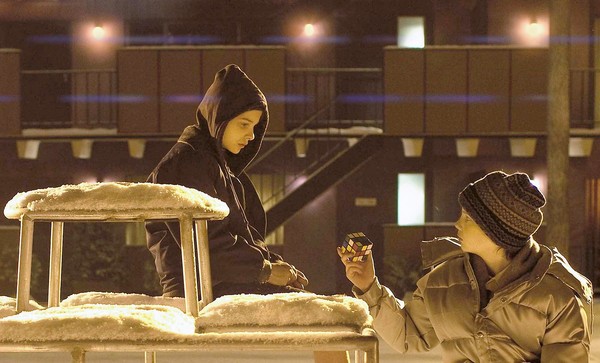
Hit-Girl trades in butterfly knives for fangs (and a Rubik’s cube) as the first stills emerge from Matt’s Reeves forthcoming Let Me In, i.e.,the potentially-unnecessary American remake of Let the Right One In, with Chloe Moretz ((500) Days of Summer, Kick-Ass), Kodi Smit-McPhee (The Road), and the venerable Richard Jenkins (The Visitor, Six Feet Under.) Well, so far it looks a lot like the original, I’ll give it that. (Although, as an observant AICN’er noted, why is Eli/Moretz wearing a hoodie? That was part of the eeriness of the original, that this tiny girl was somehow not feeling the frigid Swedish winter.)

And, elsewhere on the neighborly vampire re-make front, Anton Yelchin’s Charlie Brewster now has his Jerry Dandridge: Apparently, Colin Farrell is taking Chris Sarandon’s role in the remake of Fright Night. (Toni Collette also joins as Charlie’s mom.) Well, I would’ve preferred Mark Strong, but that works too. Now, on to casting the crucial part of Peter Vincent, nee Roddy McDowell. (And perhaps Christopher Mintz-Plasse as Evil Ed?)

Change You Can Be Afraid Of.


“‘You’re coming of age in a 24/7 media environment that bombards us with all kinds of content and exposes us to all kinds of arguments, some of which don’t always rank all that high on the truth meter,’ Obama said at Hampton University, Virginia. ‘With iPods and iPads and Xboxes and PlayStations, — none of which I know how to work — information becomes a distraction, a diversion, a form of entertainment, rather than a tool of empowerment, rather than the means of emancipation.

Sigh. We’ve come a long way from “Dirt Off Your Shoulder.” In a commencement speech at Hampton University over the weekend, President Obama channels his inner grumpy-old-man (Roger Ebert?) to warn new grads about the perils of gaming and gadgetry. First off, it’s a ludicrous statement on its face: iPods are not particularly hard to work — and, if they’re really insidious Weapons of Mental Distraction, why give one to the Queen (who, by the way and to her credit, has fully embraced the Wii?)

Speaking more broadly, misinformation has been around as long as the republic — go read up on the Jefferson v. Adams race of 1800. If anything, today’s information society allows people to more easily hear the news from multiple sources, which is a very good thing. In fact, the reason our political culture these days is constantly bombarded with irrelevant, distracting, and inane mistruths has nothing — none, zip, zero — to do with iPods, iPads, Xboxes, or Playstations. It has to do with ABC, CBS, WaPo, Politico, and the rest of the Village, i.e. the very same people the President was noshing with a few weeks ago at the ne plus ultra of “information becoming distracting entertainment“, the White House Correspondents’ DInner.

Finally, while the “multi-tasking is distracting” proposition does seem to hold water, scientifically speaking, the jury’s still out on the pernicious effects of Xbox’s and the like. In fact, there are plenty of studies suggesting that video games improve vision, improve reflexes, improve attention, improve cognition, improve memory, and improve “fluid intelligence,” a.k.a. problem-solving. So, let’s not get out the torches and pitchforks just yet. It could just be that the 21st-century interactive culture is making better, smarter, more informed citizens. (And, hey, let’s not forget Admongo.)

To get to the point, while it’s not as irritating as the concerned-centrist pearl-clutching over GTA in past years, it’s just a troubling dynamic to see not only a young, ostensibly Kennedyesque president but the most powerful man in the world tsk-tsking about all this new-fangled technology ruining the lives of the young people. Let’s try to stay ahead of the curve, please. And let’s keep focus on the many problems — lack of jobs, crushing student loan and/or credit card debts, etc. — that might be distracting new graduates right now more than their iPods and PS3s. (Also, try to pick up a copy of Stephen Duncombe’s Dream — Video game-style interactivity isn’t the enemy. It’s the future.)

Govt’s in Ur PC Taking Ur Net! …or not.


This statement describes a framework to support policies that advance our global competitiveness and preserve the Internet as a powerful platform for innovation, free speech, and job creation. I remain open to all ideas on the best approach to achieve our country’s vital goals with respect to high-speed broadband for all Americans, and the Commission proceeding to follow will seek comment on multiple legal theories and invite new ideas.“In happier news on the Obama tech policy front (and after a disconcerting public wobble in the final days before the decision), FCC Chairman Julius Genachowski outlines a “third way” for Internet oversight that includes Net Neutrality and gives the agency Title II (i.e. regulatory) authority over transmission services, to prevent bad behavior by internet services providers (ISPs) controlling the pipe. (Net neutrality is explained here, but the “First Amendment of the Internet” is a good way of looking at it. Basically, it means ISPs can’t privilege and/or block content on a whim.)

While the Big ISPs begin to mount their counter-offensive, the usual blatherers on the Right are, naturally, decrying the decision as Phase 2 in the administration’s socialist-cryptofascist takeover to take over all things good and wonderful. Suffice to say, they don’t seem to understand the issue or the Internet very well. (Also, this is really a side matter, but, regarding the highly goofy “Big Guvmint is taking over the Internet!” meme: This is completely and utterly not true in any way. But, just so we all have the history straight: Big Guvmint created the Internet. If you haven’t heard of DARPA or J.C. Licklider, think Al Gore.)

Some Assembly Required.


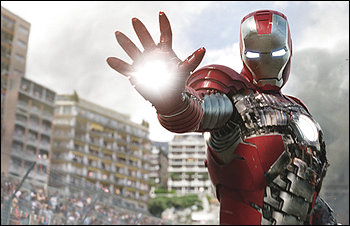
Alas, while Tony Stark’s original outing was a smart and surprisingly fun thrill ride that kicked off its summer in grand fashion — put another way, it was the Kick-Ass of 2008 — I am sorry to report that Jon Favreau’s leaden, unwieldy Iron Man 2 falls back down to Earth. In short, it’s basically the so-so, overripe, big-dumb-action flick I expected the first time around.

To be clear, the movie isn’t an embarrassment — On acting alone, it’s miles above recent big-budget studio dren like Alice in Wonderland or Clash of the Titans. But, if the first Iron Man soared, this one dutifully plods along, earthbound. Usually, comic book franchises, freed of their origin story, gain momentum in their second chapter — Superman II, Spiderman 2, X2, The Dark Knight. But here, unfortunately, we’re closer to Quantum of Solace territory — after a promising opening round, both films relapse into the lazy writing and unseemly summer-blockbuster habits whose surprising absence had defined their first go-round.

The thing that makes Iron Man 2 so maddening, and even kinda sad in the end, is that the powers-that-be clearly tried to capture the same lightning in a bottle that propelled the first one. As such, this movie feels like it was made by a committee, who sat down with Iron Man, a DVD player, and some notepads and tried to figure out exactly what made the first one tick. Then they took the various strands they came up with, made each one bigger-faster-stronger, and tried to recombinate them for Iron Man 2. Blammo, we have a sequel!…Only, it doesn’t quite work like that. That sort of reverse-engineering may work in advanced weapons manufacturing — but for movies, not so much. And, as a result, Iron Man 2 doesn’t cohere nearly as well as the original. It feels disparate and shapeless and, well, rusty.

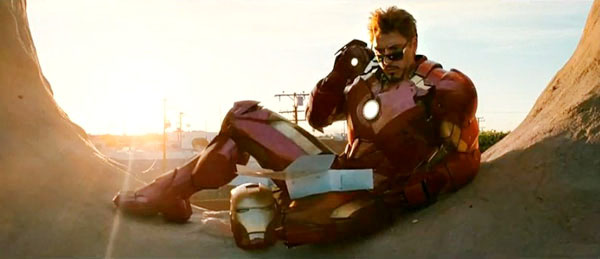
So, let’s see here, we have Robert Downey, Jr. being charmingly egotistical, tossing off off-kilter line readings, wooing Gwyneth Paltrow, mouthing off to authority figures (this time, Senator Garry Shandling), and trading in on his troubled past to bring pathos to alcoholic billionaire Tony Stark. Check. We have a few exceedingly likable actors known for talent rather than bankability — Mickey Rourke, Sam Rockwell — in the villain roles. Check. We have lots of future-think computer displays in Tony’s office, maybe a funny robot or two. Check. We have plenty of state-of-the-art military-grade hardware for the boys-and-their-toys crowd, and a bunch of random “Avengers! Coming-soon-to-a-theater-near-you” comic nods to keep the rest of the fanboys happy. Check. Oh, yes, ‘splosions too, and don’t forget the extra Bigger Robots Iron Man has to fight at some point. Check and check.

All the right boxes are checked off, and they even add a few more. (Hey, everybody digs Mad Men. Roger Sterling? Check!) And yet Iron Man 2 still ends up feeling more like an attempt to sell happy meals at Burger King and cups at 7-11 than an actual, full-fledged movie experience. Why? Well, I’m guessing it’s because the film is undercooked. Simply put, the whole thing just feels like it was rushed out of the gate to make this 2010 release date, most notably in the writing department. Screenwriter Justin Theroux is a decent actor (Mulholland Drive, Six Feet Under), and he obviously scored a hit as one of three writers on Tropic Thunder (with Ben Stiller and Etan Cohen.) But, to say this plot has holes would suggest it’s somehow more form than void in the end. As told, this film barely makes any sense whatsoever. You may have heard that Mickey Rourke recently admitted he doesn’t know what the movie was about. Well, I sat through the durned thing, and I’m not sure myself.

There’s no point in nitpicking every little thing that doesn’t make sense in Iron Man 2 — it’s a fool’s errand. But even by the lax standards one must accord a film about a guy in a flying metal tuxedo, it just doesn’t hang together. You could wrestle over the basic plot points: What is Whiplash’s plan here, exactly — just to hope he picks up a benefactor? How does he know Tony will be racing at Monaco, and how does he — or Pepper or Happy — get on the track? Why does Justin Hammer want shoes? For what crime do the cops go after him in the end? Or you can go bigger with it: Why is Pepper Potts the head of Stark now? Why is Rhodey so trusting of the Big Bads? You’re kidding me with this new element stuff, yes? Why can the Black Widow turn off some suits and not others? For that matter, why is she even in this film? But the answer seems to be: Sorry, because that’s all we could think of to keep the story moving along. Sheesh, get over yourself, will ya? Sit back, eat some popcorn, don’t think so much.

Well, maybe they’re right, but the beauty of the first Iron Man is that it was slick, smart, and reasonably self-contained — It hung together quite well, and you didn’t have to turn your brain off to enjoy it. But this one’s lumbering and bric-a-brac and all over the place in that summer-action-movie way, partly because I guess they wanted to top the first film, and partly because it’s overburdened with all the random Avengers-prequel nonsense. See: Samuel L. Jackson as (nu-school) Nick Cage and Scarlett Johansson as the Widow. (I don’t want to hate on Johansson too much, although I still think somebody like Olga Kurylenko was a much better fit to play a sleek Russian super-spy. Suffice to say, they didn’t even give her an accent for some reason, and, when it comes to her big Trinity-ish action setpiece…well, I found Hit-Girl more plausible.)

So, is there a silver lining here? Well, Mickey Rourke isn’t given near enough to say or do, but he’s fun while he lasts. And, while Sam Rockwell may be slumming in a well-worn groove as “the guy who’s not quite as cool as he wants to be” (Galaxy Quest, Zaphod), he just about steals the movie away every time he shows up. (Consider the scene where he’s arming War Machine, and that business with the little nuke — a joke lifted from MIB‘s “noisy cricket,” by the way.) So, there’s hope for the franchise yet, if they keep up the quality casting and just spend a little more time putting it all together next time. The first weekend alone already suggests Iron Man 3 will be a go. Here’s hoping Favreau, Downey, et al get the pieces in order first before embarking on part III. Gotta break that rusty cage, y’all.

The Thespian, the Fantasist, and the Siren.


[T]here isn’t any such thing as a bad day. Yes, bad things happen. But any day that I’m still here, able to feel and think and share things with people, then how could that possibly be a bad day?Lynn Redgrave, 1943-2010

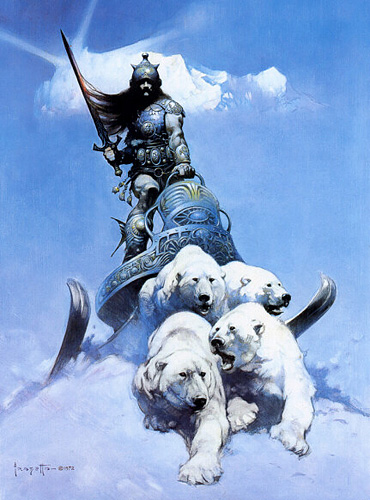
‘He’s going to be remembered as the most renowned fantasy illustrator of the 20th Century,’ Pistella said.Frank Frazetta, 1928-2010.

‘The whole thing that made me a star was the war,’ Ms. Horne said in the 1990 interview. ‘Of course the black guys couldn’t put Betty Grable’s picture in their footlockers. But they could put mine.Lena Horne, 1917-2010.

The Dream Knight.


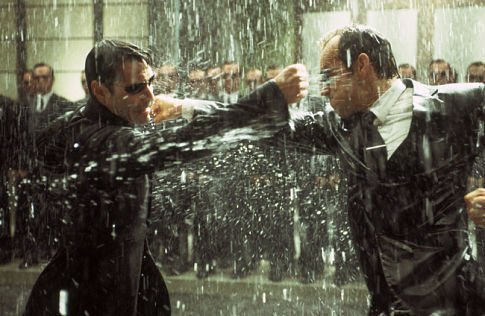
You musn’t be afraid to dream a little bigger, darling.” Our minds are the scene of the sale after this very appealing new trailer for Christopher Nolan’s Inception, with Leonardo di Caprio, Joseph Gordon-Levitt (still broke up over Summer, it seems, or is he auditioning for Nolan’s new Joker?), Ellen Page, Marion Cotillard, Cillian Murphy, Tom Berenger, Ken Watanabe, Tom Hardy, Michael Caine, and a lot of pulsating TDK-like strings. Even if this looks basically like The Dark Knight meets The Matrix meets Dreamscape (with a splash of MW2), it’s on the top of my summer queue — July 16, 2010.

I Think I Feel Better.


It may be, then, that the simplest and least ethically hazardous way to capitalize on the placebo effect is to acknowledge that medicine isn’t just a set of approved treatments — it’s also a ritual, with symbolism and meaning that are key to its efficacy. At its best, that ritual spurs positive expectations, sparks associations with past healing experiences, and eases distress in ways that can alleviate suffering. These meanings, researchers say, are what the placebo effect is really about.

In the Boston Globe, Rebecca Tuhus-Dubrow examines the past, present, and future of the placebo effect. “You’re talking about many, many, many millions of dollars a year in drug treatment costs…If [doctors] can produce approximately the same therapeutic effect with less drug, then it’s obviously safer for the patient, and I can’t believe they wouldn’t want to look into doing this.’

Nashville Waterline.


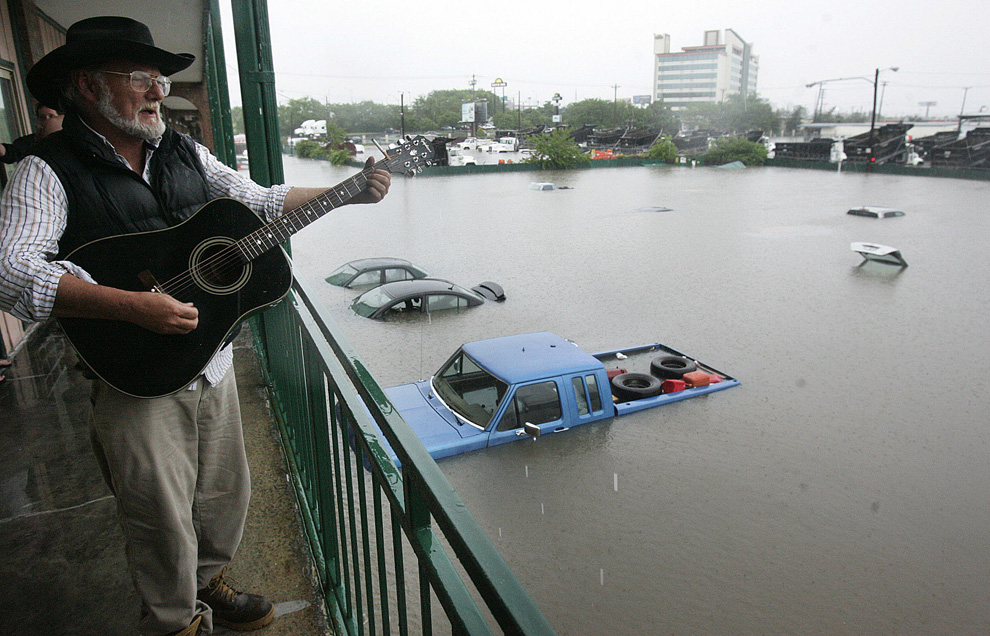
“‘This situation is going to require a very large recovery process,’ Dean said. ‘The magnitude of the damage to our community was much more than what I expected…The safety of some of our infrastructure is questionable.’” Sigh…As if Katrina’s trouncing of New Orleans wasn’t depressing enough, the elements have now seemingly conspired against another great American music city: Nashville. “Historic landmarks like the Grand Ole Opry, the Country Music Hall of Fame, and Opryland have all been flooded.” Along with 29 lives lost, damage from the Tennessee floods has been estimated to exceed $1 billion. (Pic via here.)

Thune Unleashes a Corker.

‘I think he’s a guy who’s willing to get down into the weeds,’ said South Dakota Sen. John Thune, who is No. 4 in GOP leadership. ‘Because he immerses himself in that and understands it so well — the positions he adopts may not always be the ones that everyone else in our conference comes to.’

Hmmm, that explains a lot. In trying to explain why Sen. Bob Corker has been bucking the GOP line on financial reform of late, Sen. John Thune gaffe-tastically concedes that it’s because Corker actually tries to figure out what he’s talking about. “When Sen. Richard Shelby of Alabama started working on a draft outline of a GOP alternative to the Democrats’ bill, Corker said he didn’t plan on spending ‘any time’ on it. ‘At the end of the day — look it’s a messaging piece, isn’t it?’ Corker smiled.

Justice is Closed (To You, Anyway).


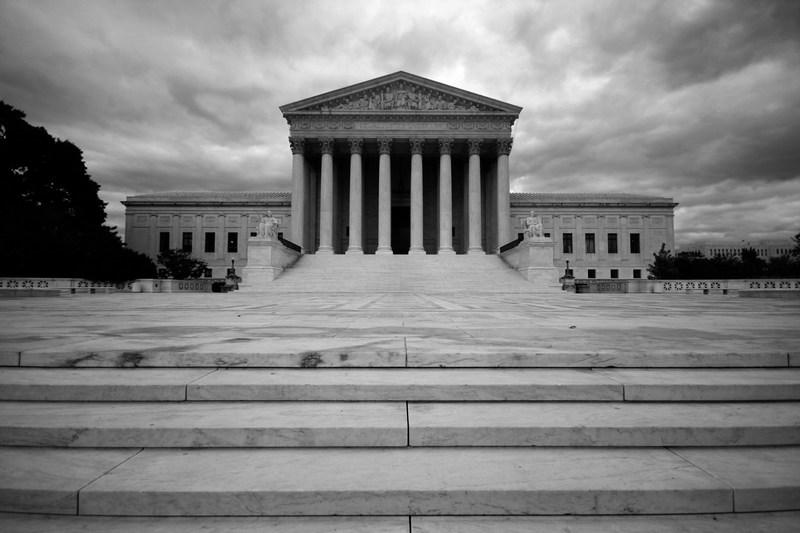
All across Washington, the doors, terraces and plazas of our essential public buildings have been closed off to the public, likely forever. But the closing of this front door, which will now be used only for exiting the building, is not just another front door lost to paranoia. It is the loss of what may be the nation’s most important portal.

In the WP, architecture critic Phillip Kennicott lambasts the Supreme Court for closing its front doors in fear of the Big Bad Terr’ists. “The justices, with Stephen G. Breyer and Ruth Bader Ginsburg dissenting, have made their priorities known, as clearly as if they had they had sold naming rights to the Great Hall to the highest corporate bidder. They stand on the side of security — a regime of absolute and irrevocable decisions often made by unelected officials and not subject to any meaningful public appeal. Beauty, architecture and the need for a democratic people to experience inspiring symbolic public space weigh lightly, if at all, in the scales.” (See also Paul Goldberger’s similar case in The New Yorker.)