
Mickey Rourke signs on to play The Wrestler for Darren Aronofsky, set to begin shooting this January. (He replaces Nicolas Cage in the role.) And, more casting on the Star Trek reboot front: Bruce Greenwood is Capt. Christopher Pike, Winona Ryder is Spock’s mother, Amanda Grayson, and House‘s Jennifer Morrison and P2‘s Rachel Nichols are in too, possibly as Yeoman Rand and/or Nurse Chapel. Well, ok then. Update: Another Trek addition: Clifton Collins Jr. of Capote will play Big Bad Eric Bana’s #2.
Month: November 2007
Glaucous Witchcraft.
“But even those who hailed absinthe saw unsettling shadows. Wilde explained: ‘After the first glass, you see things as you wish they were. After the second, you see them as they are not. Finally you see things as they really are, and that is the most horrible thing in the world.’” In the NYT, critic Edward Rothstein sings the praises and surveys the notoriety of “the green muse,” absinthe, which is apparently making a legal comeback both here and in the EU. “Absinthe was the premier bohemian drink, as inseparable from the avant-garde of mid-19th-century Paris as was scorn the bourgeoisie. It played the role well; absinthe helped overturn that bourgeois world with seductive visions of another.“
Leafy at Grinnell.
“‘As a young person,’ said the well-spoken Muriel Gallo-Chasanoff, ‘I’m worried about the long-term effects of global warming. How does your plan combat climate change? ‘Well, you should be worried,’ Clinton replied. ‘You know, I find as I travel around Iowa that it’s usually young people that ask me about global warming.’ There’s a good reason for that, too. The question was a plant, totally rigged in advance, like a late-night infomercial.” And you thought Planty McPlants only posted over at AICN…Compounding their bad run of late, the Clinton campaign gets caught planting questions in an Iowa audience. Well, in her defense, this is considered presidential behavior these days. (2nd link via Supercres.) Update: CNN interviews the student in question: “‘The top one was planned specifically for a college student,’ she added. ‘It said “college student” in brackets and then the question.’…’I don’t know whether Hillary knew what my question was going to be, but it seemed like she knew to call on me because…I was the only college student in that area.’”
30 Years of Night.
“On another tape, Pete Kott, the former Republican speaker of the Alaska House of Representatives, crowed as he described beating back a tax bill opposed by oil companies. ‘I had to cheat, steal, beg, borrow and lie,’ Kott said. ‘Exxon’s happy. BP’s happy. I’ll sell my soul to the devil.’” The WP surveys the sinkhole of corruption engulfing Alaska state politics, and the federal probe that threatens to swallow the state’s long-serving Senator, Ted Stevens. “‘It was common knowledge that everything was corrupt,’ said Ray Metcalfe, a former Republican legislator…’It was common knowledge, but nobody wanted to talk about it.‘”
The Big Empty.
“Later the young soldier, by now out of uniform, approached me on the street and introduced himself as a writer. His name, he said, was Mailer. He had just seen my play [‘All My Sons‘]. ‘I could write a play like that,’ he said. It was so obtusely flat an assertion that I began to laugh, but he was completely serious and indeed would make intermittent attempts to write plays in the many years that lay ahead.” Norman Mailer, 1923-2007. To be honest, Mailer’s writing never much appealed to me, and his public persona less so. But, if nothing else, he proved how far sheer, undiluted ambition can take you in this world. (Remembrances.)
Dispatch: Bodymore.
“BALTIMORE, Md. — Crime is up. The drug trade [still] rules the corners. The next election consumes every politician. And McNulty is drinking again.” A new day is [not] dawning: The Wire, Season 5, January 2008.
In the Country of Last Things.
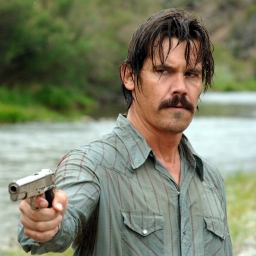 “Seen the arrow on the doorpost, saying, ‘This land is condemned’…” Well, Bob, East Texas may seem rough, but trust me, West Texas is even worse. I’m always going to have a soft spot for Miller’s Crossing, and The Big Lebowski is its own strange and beautiful beast, but the Coen Brothers’ tense, brooding No Country for Old Men, which I caught this morning, is right up among their best work, and that is no small thing. Admittedly, in some ways the Coens don’t seem quite right for a Cormac McCarthy adaptation: They usually thrive on witty, motormouth dialogue, but McCarthy’s men (Woody Harrelson’s character notwithstanding) are invariably strong, silent types. And you can feel the brothers trying to restrain their usual mordant sense of humor through much of the otherwise bleak No Country. (It still leaks out here and there: the mariachi band, “I pre-visioned it,” “these look to be managerial types,” the constant noting of the dead dog, and so on.) Nonetheless, for all intent and purposes, they nailed it. No Country is easily one of the better films out this year, and, if you harbored any doubts about the Coens after their botched remake of The Ladykillers, fret not. The brothers are back in form.
“The crime you see now, it’s hard to even take its measure.” No Country opens on the arid, forbidding landscape of west Texas, as we hear local sheriff Ed Tom Bell (Tommy Lee Jones, doing a lot of soul-searching this autumn between here and Elah), in voiceover, lament what the world has come to. As if to prove his point, we are then introduced to one Anton Chigurh (Javier Bardem, unforgettable), a chilling, wide-eyed psychopath with a lousy haircut, an air-powered cattle gun, and a penchant for making coin tosses with weighty implications. While Chigurh calmly breaks out of police custody (by strangling a deputy to death and murdering an unlucky motorist), a down-on-his-luck local named Llewellyn Moss (Josh Brolin) happens upon the scene of a horrific shootout in the middle of the desert, one which has all the markings of a drug-deal-gone-bad…including $2 million in a black briefcase. Thinking his ship has come in, Moss decides to takes the money and run. But, he’s savvy enough to expect some blowback, and thus sends his wife (Kelley MacDonald, of Trainspotting) off to her mother’s place in Odessa and vacates his old trailer park before hitting the road, traveling from motel to motel across west Texas. But right behind him, ruthless, inexorable, is Chigurh, armed with a transponder that follows the money. And, if Moss can’t stay one step ahead of the madman, or if Sheriff Bell doesn’t find a way to reach him before Chigurh does, there’ll be hell to pay like West Texas hasn’t seen since…well, probably since this morning.
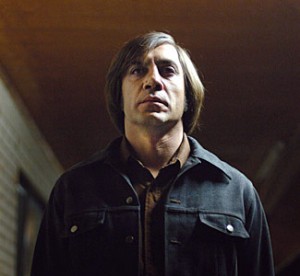 Having read the novel a few summers ago, I knew what I was getting into here, and thus (as with Chris Nolan’s The Prestige) I was prepared for a third-act jag that’s irritated a few moviegoers out there who expected a more conventional resolution. But, frankly, that’s the book. Near the end of No Country, one of the men we’ve been following tells us about two dreams he’s had recently: While it may seem in the early going that this movie is about the first, it’s actually more about the second. (Put another way, I’m guessing people who saw Lord of the Rings and thought the story was about the ring found all the endings to Return of the King more unnecessary and unsatisfying than those who thought the story was about Frodo and the fellowship.)
Yes, No Country is a crime yarn a la Fargo and Blood Simple, but it also has bigger game in its sights. One of the scariest aspects of Anton Chigurh is that he seems to believe himself an Agent of something else, something completely and utterly out of his control, and perhaps the scariest notion of all is that he might be right. “If the rule you followed brought you to this,” Chigurh tells one victim, “what was the use of it?” And would following any other rule have made any difference? Sheriff Bell is heartsick over the madness and grotesque violence that seeps out of the corners of society, and another aging lawman tries to lay the blame for “the dismal tide” on “kids with green hair and bones in their noses.” But, as another character reminds us, the West, and the world, has always been like this. You can’t stop what’s coming. At best, all you can do is light a fire in the dark.
Risky Business.
As Claus von Stauffenberg, Col. Tom Cruise (sporting a funky, funky eyepatch, man) plots to kill Adolf Hitler in the new trailer for Bryan Singer’s Valkryie, also starring Kenneth Branagh, Bill Nighy, Tom Wilkinson, Terence Stamp, and Eddie Izzard. Hmmm, maybe.
Tears of a Clown.
“Let me be the way I’m not in interviews. I’m furious. I’m furious…They never asked me about a sequel with the Joker. I know how to do that! Nobody ever asked me.” Strangely enough, apparently Jack Nicholson wanted another run at the Joker for Christopher Nolan’s The Dark Knight. “Well, the Joker comes from my childhood. That’s how I got involved with it in the first place. It’s a part I always thought I should play.” Well, maybe so, but even back in 1989 Nicholson seemed like stunt casting, and his performance hasn’t aged well. Here’s to a new take on the character.
The Line has Failed.
“‘I hear you’re looking for me,’ he said. ‘You wanna go mano a mano right here?’” In excerpts from his new book, Fall of the House of Bush, published in Salon, Craig Unger examines the ideological divide between Bush father and son and tells the true story of Dubya’s coming to Jesus. “One way of examining the growing crisis could be found in the prism of the elder Bush’s relationship with his son, a relationship fraught with ancient conflicts, ideological differences, and their profound failure to communicate with each other…According to the Bushes’ conservative biographers, Peter and Rochelle Schweizer, family members could see [Bush 41’s] torment. When his sister, Nancy Ellis, asked him what he thought about his son’s plan for the war, Bush 41 replied, ‘But do they have an exit strategy?’” This goes a long way toward explaining the elder Bush’s recent spate of (really depressing and hard to watch) public crying jags. (See also Joan Walsh.)