

Everybody knows the dice are loaded.

Simply put and for better or worse, Steven Soderbergh’s breezy Ocean’s Thirteen is two hours of sheer froth. The film attempts to dial back some of the in-jokes and meta-ness that marked the slack, sprawling Eurotrip of Ocean’s Twelve (which I actually enjoyed the most of the three) and tries to fuse it with the narratively leaner Vegas-centric heist flick that was Ocean’s Eleven (which I enjoyed the least.) The resulting film, like its gaggle of leading men (no women here, basically — Julia Roberts and Catherine Zeta-Jones are written out in the first five minutes of dialogue), is cool, unruffled, occasionally razzle-dazzle, and, frankly, beginning to show its age. If you liked either of the first two or enjoy watching this collection of actors suavely goof around on camera, Ocean’s Thirteen is good for a mindless, moderately engaging two hours. But, even with Soderbergh’s considerable expertise on display, there’s really not much here. All in all, I was entertained during the film and forgot about it almost immediately afterward.

Ocean’s Thirteen wisely foregoes much of the “let’s get the band back together again” grandstanding of the last film to dive right in to the problem: Avuncular team member and scion of Old Vegas Reuben Tishkoff (Elliot Gould) has been screwed out of his partnership in a towering new casino on the Strip by the Wynn-like impresario Willie Bank (Al Pacino), despite them both being among the rarified elite who once shook Sinatra’s hand. To avenge this slight, Danny Ocean (Clooney) and Rusty Ryan (Pitt) reassemble their team of con-men, scoundrels, n’er-do-wells, roustabouts, and acrobats to take down the new hotel (The Bank) via a “Reverse Big Store,” i.e. break The Bank by having every guest win big on the casino’s (soft) opening night.
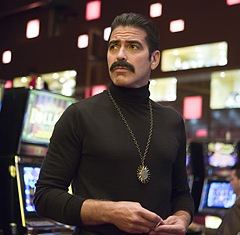
Unfortunately for them, Bernie Lootz is not on hand, and The Bank boasts many formidable defenses, from the world’s greatest Artificial Intelligence (“The Greco,” devised by Julian Sands, no less) in the basement looking for gambling anomalies to the well-preserved Ellen Barkin as Pacino’s sexy, take-no-guff majordomo Abigail Sponder. And thus the Ocean team’s foolproof plan instead involves, among other things, myriad disguises, lots of cybernetic and electronic doodads, more than a few random accomplices and compatriots, moles in Mexican factories, simulated natural disasters, making David Paymer’s life a living hell, and multimillion-dollar underground drills, at least one of which may force the team to involve their old nemesis, Terry Benedict (Andy Garcia) in the takedown. (Oh, and, to constrain Barkin’s Dragon Lady, they resort to some drug that amounts to a cross between Axe Body Spray and Roofies, which seems like sort of a nasty turn for our otherwise gentlemanly near-dozen to take in their quest for revenge, I thought.)

All of which is to say, the heist makes very little sense, which is part of the problem here. I confess, while I really enjoy a caper flick like Spike Lee’s Inside Man, I get irritated with films that show criminals spending $29 million in order to steal $30 million, even if, as it is here, the motive is revenge. In Ocean’s Twelve, of course, the heist didn’t much matter — it was clearly just a flimsy excuse for Soderbergh & co. to fool around in Amsterdam and act like movie stars on vacation. Everything from Shaobo Qin getting lost in the luggage (“He’s the Modern Man, disconnected, frightened, paranoid for good reason“) to Pitt referencing Miller’s Crossing to Topher Grace “totally phoning in that Dennis Quaid movie” to all the breaking-the-fourth-wall shenanigans with Julia Roberts and Bruce Willis made that clear.

But by focusing so relentlessly on the plot contrivances here in Thirteen, we’re forced to recognize several times over that, frankly, the plot makes very little sense. There’s no danger here at all (with the possible exception of Vincent Cassel’s return as the Night Fox from the last film, but even he turns out to be a dud of an X-factor.) Even in Vegas, that veritable boulevard of broken dreams most of the time, we know this gang of Hollywood high-rollers are all going to come up aces…so why focus so relentlessly on the mechanics of a totally implausible scheme? Given this problem, my favorite moments of Ocean’s Thirteen were the ones where, as in Twelve, the gang just dropped the tired old rules of the caper flick and let their freak flag fly: Casey Affleck and Scott Caan unionizing a Mexican dice factory, Pitt channeling a hippie seismologist, Cheadle liberated, however briefly, from that godawful British accent, Matt Damon (for awhile) in that goofy Soderberghian nose. The nose, and its ilk, play — the actual heist here doesn’t.

Hurt v. Hulk, Norrin from Cincinnatti, Matt takes Mjolnir?

In Marvel comic-to-film news, William Hurt joins Louis Letterier’s increasingly-stacked The Incredible Hulk as Gen. Thad “Thunderbolt” Ross. (The movie, it may be remembered, already stars Edward Norton, Liv Tyler, and Tim Roth.) And, also rumored to be in the works: a Silver Surfer film written by J. Michael Straczynski of Babylon 5 (Will the character have any life in him after FF2 this weekend? I somehow doubt it) and a Thor film directed by Matthew Vaughn of Layer Cake and Stardust. (Ooh…can we get Beta Ray Bill?)

What Rough Beast?

I am going to say something that few people in public life will say, but most know is absolutely true: a vast aspect of our jobs today – outside of the really major decisions, as big as anything else – is coping with the media, its sheer scale, weight and constant hyperactivity. At points, it literally overwhelms.” In his final weeks as prime minister, Tony Blair addresses the problem of the media, calling it “like a feral beast, just tearing people and reputations to bits.” (Full text of remarks.) “The result is a media that increasingly and to a dangerous degree is driven by ‘impact’. Impact is what matters. It is all that can distinguish, can rise above the clamour, can get noticed. Impact gives competitive edge. Of course the accuracy of a story counts. But it is secondary to impact. It is this necessary devotion to impact that is unravelling standards, driving them down, making the diversity of the media not the strength it should be but an impulsion towards sensation above all else.

I wouldn’t say the feral beast metaphor gets right at it — until last year, most of the major news media, in this country at least, was rather well domesticated: It let Dubya lie his way through just about anything, including building a case for war in Iraq on false pretenses, with impunity. But, clearly something is broken with “this relationship between public life and media,” as Blair put it. In the midst of a conflict that’s been dragging on longer than World War II, you’re still likely to hear more about Paris Hilton’s jail travails (Prison sucks? Our criminal justice system tends to favor the wealthy? Who knew?), Don Imus’s racist bromides (A bile-spewing racist on talk radio? Wherever did they find him?), or the winner of American Idol, to take only three recent examples, than anything of use about the status of the conflict, or our actions, there. And even coverage of the horrifying tragedy at Virginia Tech, obviously a legitimate news story, descended into exploitation almost immediately (and provoked very little understanding that this level of tragedy has become virtually a daily occurrence in Iraq.) They’re just giving us what they want, I suspect the comeback is, and that’s almost assuredly true. But, still, it’d be nice to see a little more daily recognition from our major journalistic outlets that the mass media in our society performs a crucial — if not the crucial — function in informing the electorate on current events and providing the information indispensable to maintaining an active, responsive citizenry, and that other factors should come into play in their coverage than just the corporate bottom line. Update: From the press box, Slate‘s Jack Shafer cries foul.

Anarchy in the U.K.


So I’m still catching up on movie reviews of flicks I saw a few weeks ago, and, while I don’t really care about letting Pirates 3 languish without comment for a fortnight, I do wish I’d written something faster about Juan Carlos Fresnadillo’s surprisingly excellent 28 Weeks Later. I thought Danny Boyle’s 28 Days Later was a so-so enterprise, a very chilling and effective first forty-five minutes undone by the poor decision-making and Col. Kurtzian tangents which comprise the second and third acts. But this outing holds together much better, I thought, and remains intelligent and fearless from frightening beginning to inexorable end. As my brother aptly noted, this installment is the Aliens of the franchise — everything’s been taken up a notch, and the military training of some of our heroes and heroines this time around is, as per Cameron’s flick, only intermittently useful. And, if you like your zombie films awash with social commentary, as they’ve tended to be from Night of the Living Dead to They Live to even Shaun of the Dead, there’s plenty of grist for the mill here, no matter what your political persuasion. If it’s still playing in your neighborhood, run to catch it if you can…just watch out for the fellow sitting next to you.

If you didn’t catch 28 Days Later, no worries: The eerie prologue of this film, which takes place back in the early days of the “Rage Virus” outbreak, will give you the basic gist. We begin with a couple (Robert Carlyle of Trainspotting, Catherine McCormack of Braveheart) holed up in an English cottage somewhere in the countryside, counting their canned goods and waiting, with a handful of other survivors, for the storm to pass. But, pass it doesn’t, and soon enough the virus, which turns one almost instantly from well-meaning human to ferocious, bloodthirsty monster (Think the Black Smurfs. Gnap!), is extant in the cottage, and tough split-second decisions must be made. Flash-forward to 28 weeks later, as this couple’s two children (Mackintosh Muggleton, Imogen Poots) — thankfully at summer camp in Spain during the outbreak — are returned to the “Green Zone” of a nearly-empty London. England’s capital, as it turns out, is now being run and reconstructed by the United States Military, under the auspices of a no-nonsense Gen. Stone (Idris Elba, a.k.a. Stringer Bell. No Slim Charles around, tho’, which is too bad for everyone else.) Life proceeds somewhat normally in the Emerald City, thanks to the watchful eyes of army snipers such as the Cpl. Hicks-ish Doyle (Jeremy Renner of Dahmer) and savvy military doctors such as Scarlett (Rose Byrne of Troy.) But, partly due to an ill-advised expedition by the children to their old home — you just knew somebody was going to do something stupid — the Rage Virus breaks loose in London again, and the American military presence finds that really drastic actions may be necessary to win the worldwide war on zombies…

Reconstruction, an American occupation gone horribly wrong, Green Zones irrevocably infected by viral terror from the surrounding areas…I don’t really need to draw a map, do I? Still, one of the strengths of Fresnadillo’s 28 Weeks Later, like BSG and the best in sci-fi social commentary, is that it doesn’t really align to any easy 1-1 reading of current events. When the US army stops distinguishing between zombie and civilian and shoots at will, or firebombs the city in an attempt to stem the outbreak (not a huge spoiler — it’s a major selling point in the trailer), it’s hard not to grimace ruefully and think of other occupations-gone-bad in our recent history. Yet, things aren’t so simple here: One of the things I admired most about this very dark film is its sheer remorselessness. From its opening moments and throughout, it instills a visceral fight-or-flight dread in the audience and refuses to let us off the hook, inviting us less to tsk-tsk about the hubris of American military overreaching and more to ponder what measures — moral, immoral, amoral — we might take to ensure our own survival in this nightmarish universe. Time and time again in 28 Weeks Later, compassion is absolutely the wrong answer to the problem at hand, and — though there’s less of this as the characters crystallize into horror-movie stereotypes over the course of the film — people surprise you with the decisions they choose to make with their backs to the wall. Maybe the scariest thing about Fresnadillo’s film — and the zombies are at times pretty damn scary — is its dark take on human nature, and what it ultimately suggests about the usefulness of good intentions under extreme pressure. To wit, they’re not very useful at all — if anything, they’re the road to Hell on Earth. So before you offer that helping hand, the relentlessly grim 28 Weeks Later suggests, buy some good running shoes.

The Philosopher and Social Hope.

“Solidarity is not discovered by reflection, but created. It is created by increasing our senstivity to the particular details of the pain and humiliation of other, unfamiliar sorts of people. Such increased sensitivity makes it more difficult to marginialize people different from ourselves by thinking, ‘They do not feel as WE would,’ or ‘There must always be suffering, so why not let THEM suffer?’Richard Rorty, 1931-2007.

Isiah Hearts Kobe.

Spurred by Kobe Bryant’s recent on-again, off-again trade demands (predicted by Ray Allen several years early), Knicks GM and coach Isiah Thomas starts dreaming of a major shake-up in the Knickerbocker lineup. Oof, I really hope Bryant doesn’t end up in New York (not that it’s very likely anyway.) Despite his immense talent, he is easily my least favorite player in the league, and I’d have a hard time rooting for my Knicks with him jacking up shots all the time for the orange-and-blue.

DC-9 (to 1).

The people of Washington D.C. take another step toward full citizenship after the Senate Homeland Security and Governmental Affairs Committee votes 9-1 in favor of voting rights for the District. “Virginia’s Sen. John Warner (R), cast the dissenting vote, but in an encouraging sign for advocates, three Republicans voted in favor of giving the District a full voting member in the House: Susan Collins of Maine, George Voinovich of Ohio and Norm Coleman of Minnesota.

It’s Alright Ma, It’s Life and Life Only.

“A question in your nerves is lit, yet you know there is no answer fit.” To the consternation of many, David Chase ends eight years and six seasons of The Sopranos with a cut-to-black and (more problematically, to my ears) Journey’s “Don’t Stop Believing.” (Obviously, I preferred the soundtrack to AJ’s exploding SUV.)

I too thought the cut was a bit abrupt at first, but, after awhile, it grew on me. Life goes on at the Sopranos compound much as it has this past age, with a piano hanging ominously over Tony’s head and Carm, Meadow, and even the recently-awakening AJ all once again at peace with his ill-gotten mobster gains, thanks to the “Made in America” trifecta of denial, materialism, and onion rings.

Six seasons of talk therapy notwithstanding, people on The Sopranos (as in our world) never tended to change much, nor did they usually receive any comeuppance for their bad behavior (although Phil Leotardo might have something to say about that.) So Tony, still the king of his castle for now, blasting Steve Perry and looking over his shoulder, seems as good a way to end the show as any. If you’d prefer to see him go down in a hail of bullets, you can imagine it thus. More likely, to my mind, is he either ended up like Johnny Sack, withering away in prison, or Uncle Junior, withering away out of prison. Either way, the larger world ultimately has little use for Tony’s deeds and misdeeds, and will eventually forget him as it forgets everything. (As Tony lamented several times, “What ever happened to Gary Cooper?”)

Nevertheless, as The Sopranos often reminded us, the end can come at any moment — and it will come — so enjoy the good times and take what solace from life as you can, be it from a family of ducks in your swimming pool, a Beamer that gets 28 miles in the city, or a nerve-wracking family dinner at Holsten’s.

The Dark Horse of Gotham?

“Hemmed in by term limits that will force him to leave office after the 2009 municipal election, Bloomberg seems to be searching for new worlds to conquer. With Eliot Spitzer just inaugurated as New York’s first Democratic governor in 12 years, there is only one elective job soon to be vacant for a politician with Bloomberg’s bent for executive leadership — and its home office is on Pennsylvania Avenue.” In Salon, Walter Shapiro wonders if Mayor Mike Bloomberg is considering an independent run in 2008. Well, I’d prefer Hizzoner to everyone in the Republican field, but don’t really imagine myself leaving the Dem fold to vote for him.