
With even the Republicans on the Senate Judiciary close to revolt over the issue of the persecuted prosecutors, the Dubya White House and Attorney General Alberto Gonzales are forced into an uncharacteristic retreat. “Gonzales…will no longer oppose legislation limiting the attorney general’s power to appoint interim prosecutors. Gonzales also agreed to allow the committee to interview five top-level Justice Department officials as part of an ongoing Democratic-led probe into the firings.“
Month: March 2007
The Hagelian Dialectic?
Is Nebraska Senator and GOP maverick Chuck Hagel poised to join the 2008 field next week? Signs point to yes (although others see solely a Senate retirement in the offing.) “‘Perception has always been that he wasn’t viable because he couldn’t ‘out McCain John McCain,'” said Alex Vogel a Republican lobbyist not affiliated with any of the 2008 candidates. ‘Now that [Hagel] and McCain have split over the war, he’s betting there’s a road from Omaha to Des Moines.‘”
Karl’s Truman Show.
The wheels may have come off the Bush bandwagon several months ago, but that’s not stopping Karl Rove from trying to finesse Dubya’s place in the history books. And, like his boss, Karl seems to be attempting the Truman route: “In the West Wing interview, Rove adopted a longer view, citing the policy of containment of the Soviet Union, adopted by Truman in the 1940s and then embraced by a succession of presidents despite initial misgivings, as reason to believe history may offer a kinder assessment of the durability of Bush policies and institutional changes.” Hmm. When it comes to the war on terror, somehow I doubt dropping the ball in Afghanistan to prosecute a badly-bungled war of choice in Iraq is going to look any better to future generations. Just a hunch.
Destination: Tintin

Ten Thousand Thundering Typhoons! As has been rumored for good long while, Steven Spielberg officially announces he’ll be producing a Tintin movie. Berk says don’t forget Snowy/Milou.
Rorschach Blot.
After last night, I gotta say I’d have much preferred to see a Paul Greengrass Watchmen. Still, I’ll give him this: Zack Snyder knows his audience, and has inserted a test image of Watchmen‘s Rorschach in a new Internet trailer for 300. (And, for the record once more, I’m totally on board with the commenter in that AICN talkback who suggested Simon Pegg for the part.)
Four-Color Gyllenhaals.
It‘s official: Maggie Gyllenhaal takes Katie Holmes’ place in Christopher Nolan’s The Dark Knight. And, with Tobey Maguire appearing to beg off any future webslinger installments after Spidey 3, the door is now wide open for Maggie’s brother Jake…
No Short Round for Shia?
Also in fanboy casting and Spielberg news, Shia La Boeuf — confirmed by Variety only yesterday — shoots down rumors that he’s been cast as the progeny of Indiana Jones. “Would he deny it if offered though? The IESB says according to him ‘depends on what the script is about, he doesn’t want to go in as just a sidekick character’.”
The (Possibly) Good German.
 In David Fincher’s Zodiac, well-intentioned cops from different jurisdictions conduct archival sleuthing and the occasional phone trace to track down a cold-blooded killer. But, in Florian Henckel von Donnersmarck’s powerful, humanistic The Lives of Others, the second half of my double-feature last Friday, the bureaucratic machinery of the State grinds into gear for a darker purpose. Here, in the final flower of Erich Honecker’s East Germany, the Stasi keep their eyes and ears on those who would threaten the integrity of the German Democratic Republic, which, sadly, counts as just about everyone. I know very little about this subject, so I can’t vouch for how well van Donnersmarck recreates the rigors of East German life in the 1980s. Still, as an Orwellian parable of secrets and surveillance, The Lives of Others is a very worthwhile film, one strong enough to overcome some perhaps overly cliched moments of awakening by various characters along the way.
When we first meet Capt. Gerd Wiesler (Ulrich Muhe), with his sleek dome, thin ties, and retrofuturistic jacket, he’s training young Stasi cadets in the subtler techniques of interrogation and threatening landladies with the ruin of their children’s future — clearly a right rotten bastard of the first order. Still, there’s something undeniably impressive about the ever watchful Wiesler, a man who’s both cognizant of even the slightest emotional shifts in his prey and committed fully to the ideological aspirations of the Party. Wiesler’s skill and fervor is not lost on party flunky Anton Grubitz (Ulrich Tukur), who assigns him to a career-making case of digging up dirt on the roguishly handsome, go-along-to-get-along playwright Georg Dreyman (Sebastian Koch) for a well-connected romantic rival.
But, something — perhaps the sight of Dreyman’s beautiful actress girlfriend Christa-Maria Sieland (Martina Gedeck) on stage, perhaps something else — clicks in Wiesler as he conducts his round-the-clock surveillance. And, from the dismal attic above Dreyman’s apartment, Capt. Wiesler soon begins, despite himself, to commit Thoughtcrime. And as Dreyman begins to associate with known subversives and the investigatory noose tightens, Wiesler finds himself increasingly complicit in the machinations of the artists downstairs, so much so that he soon, if he’s not very, very careful, runs the risk of being the Stasi’s next target.
I can see the criticism that The Lives of Others can occasionally be a bit too pat. The distinctions between Wiesler and Dreyman are perhaps a bit overdrawn (Dreyman’s apartment is always suffused with a warm glow, and he and Sieland are invariably surrounded by friends, music, and the finer things in life; meanwhile, Wiesler scurries about the cold, gray machines upstairs, and basically lives like Eleanor Rigby — get a dog, Captain), and there are definitely a few cliche-ridden scenes along the way (for example, one involving the instantly transformative power of Beethoven — you’ll know what i mean.
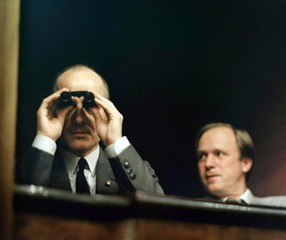 Still, The Lives of Others is affecting in the details: Dreyman (“Lazlo”) and Sieland (“CMS”) are reduced to abstractions by the Stasi’s surveillance regime, with all the messy, conflicted, and emotion-ridden qualities that make them human drained away. (“They presumably have intercourse,” comments Wiesler dryly in his report after one tender moment.) Conversely, Wiesler’s attempts to break free of his own self-imposed leash and sound even the feeblest of barbaric yawps are moving in their own way, be it his sneaking out a dog-eared copy of Brecht from Dreyman’s shelf or renegotiating his interrogation strategy on an eight-year-old in his elevator.
The Lives of Others ends with a coda that at first seems too long but ultimately sounds just the right note: As Auden memorably put it, There is no such thing as the State, and no one exists alone; Hunger allows no choice to the citizen or the police; We must love one another or die. May I, composed like them of Eros and of dust, beleaguered by the same negation and despair, show an affirming flame.
Feeling the Walter-weight.
In a story unfolding last week that I’m behind on posting on, Dubya goes the bipartisan commission route to try to take the sting out of the brewing scandal over mismanagement at Walter Reed (and other military hospitals) that has already resulted in two firings and some contentious congressional hearings. “Good leadership should have taken these steps long ago, without prompting by a series of embarrassing news articles,’ said Sen. Carl M. Levin (D-Mich.), the committee’s chairman[.]”
The Case of the Persecuted Prosecutors.
“‘I’ve always been trained that loyalty is a two-way street,’ Iglesias answered. ‘I started thinking: Why am I protecting these people who not only did me wrong but did wrong to the system for appointing U.S. attorneys?’” The House and Senate Judiciary Committees listen to testimony from eight former U.S. attorneys concerning what appears to be an epidemic of illegal GOP arm-twisting. “The [Justice] department has also acknowledged that Cummins, the Little Rock prosecutor, was asked to resign solely to provide a job for a former aide to presidential adviser Karl Rove.”