Much Support for the Monarchy.

Just as I didn’t have much hankering to see a film about United 93 at first, I’ve been presuming that not much would interest me less than a movie about the aftermath of Princess Diana’s death in 1997. (Obviously, the loss of any relatively young person in a car crash, particularly one as committed to international concerns as Diana was, is tragic. But in all honesty, when I think of the hubbub and hysterics surrounding her untimely death, it reminds me of the “Baby Diego” sequence in Children of Men.) That being said, I’m happy to say that Stephen Frears’ The Queen is, like United 93, a surprisingly good depiction of recent history. Less a paean to “the people’s princess” than a sharp-witted rumination on changing social values and the effect of global “Oprahization” on contemporary politics, The Queen is an intelligent, discerning and enjoyable slice-of-life that’s well worth catching.

As the film begins — after a wink similar to the one opening Marie Antoinette — the young, charming, and recently-elected face of New Britain, Tony Blair (Michael Sheen), ventures to Buckingham Palace with resolutely anti-monarchist wife Cherie (Helen McCrory), in order to request of his sovereign Queen Elizabeth II (Helen Mirren) that he be allowed to form a government. A study in contrasts, the emotive, familiar prime minister and the punctilious, reticent Queen get on less well as exemplars of New and Old England than, say, Peel and Steed. Reared and residing in a bastion of venerable tradition, where faxes are still delivered in a wicker basket and feelings are not discussed, Queen Elizabeth has little patience for Blair’s studied informality and populist bonhomie. But, when tragedy strikes several months later, in the form of Princess Diana’s death at the hands of the loathsome paparazzi, the Crown finds itself soon embroiled in a downward spiral of their own making, as — the Prince of Wales (Alex Jennings) notwithstanding — the royal family shows little inclination to convert their grief into a public display (or to honor someone they’ve come to perceive as an impulsive and manipulative interloper.) And, when England’s people begin to surround Buckingham Palace with wreaths and bouquets that come to seem as menacing as torches and pitchforks, it falls on the prime minister to attempt to instruct the Queen on the vagaries of politics in the Tabloid era, before permanent damage is wrought upon the monarchy.

More than United 93, the film that actually comes to mind when watching The Queen is Nixon. Like Oliver Stone’s film, The Queen attempts to humanize a oft-maligned world figure for whom much of the audience may have little sympathy. Like Nixon, it portrays a government increasingly besieged by its own people, and a bewildered political leader who finds they’ve lost touch with their electorate or subjects (Consider the scene of Nixon at the Lincoln Memorial, or all the perhaps over-the-top talk of “the beast” therein.) And, of course, the Queen’s relationship to the fallen Diana is depicted here much like Nixon’s (and LBJ’s) to John — and later Bobby — Kennedy. This holds true particularly in the later scenes of the film, as Elizabeth is forced to confront the fact that, for all her sacrifices, she’ll never compete with the fallen princess in the public’s esteem.
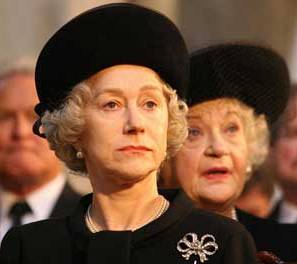
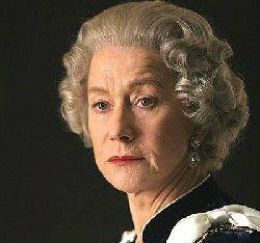
The emotions this sad realization elicits, along with many others in the film, are visible only in the margins of Helen Mirren’s mask of public composure, bringing home the conflict between restraint and immodesty (or, if you’d prefer, suppression and sensitivity) at the center of the film. Mirren, as always, is excellent here, and I’d guess her Oscar is already in the bag: She invests her monarch with grace and dignity even while frumpily walking her dogs down the lane, and rises above the very occasional clunks in the script (The buck stops here, indeed.) And Michael Sheen’s Tony Blair grows on you. At first, he seems off, but eventually you get the sense that he conveys Blair’s more notable qualities rather well: intelligence, boyishness, a way with people, and a potentially problematic penchant for deference. (Indeed, just when it seems the movie’s portrayal of Blair has grown cloying beyond words, Mirren’s Queen puts him in his place, and ties 1997’s hero of Labor to the more troubling Blair of today, one who could and should have more aggressively instructed his American counterpart on the vagaries of leadership in the reality-based world.)

Ney’s Nyet-Nyet.

Federal prosecutors build out their case against Bob Ney, and disclose that the disgraced former GOP rep had possibly shady dealings with Abramoff and DeLay’s Russian connections at Naftasib. “Abramoff’s lobbying team got the congressman to intervene with the U.S. Consulate in Moscow to help resolve a passport issue for the daughter of Abramoff client Alexander Koulakovsky, the e-mails show…A charity sponsored by DeLay received a $1 million check from a London law firm linked to the two. Former charity officials told The Washington Post last year the donation originated with Russian oil and gas executives, and was intended to influence DeLay’s vote on an issue affecting the Russian economy.

Ground Control to Justice Bill.

Newly released — and somewhat controversial — FBI files, dating from the former Chief Justice’s two confirmation battles in 1971 and 1986, disclose that William Rehnquist battled a painkiller addiction in the early ’80s while serving on the Court. “Doctors interviewed by the FBI told agents that when the associate justice stopped taking the drug, he suffered paranoid delusions. One doctor said Rehnquist thought he heard voices outside his hospital room plotting against him and had ‘bizarre ideas and outrageous thoughts,’ including imagining ‘a CIA plot against him’ and ‘seeming to see the design patterns on the hospital curtains change configuration.’ At one point, a doctor told the investigators, Rehnquist went ‘to the lobby in his pajamas in order to try to escape.’

Nixon versus the Diplomats.

Also among the intriguing recent disclosures of the Nixon years are newly released State Department records which reveal further Nixon’s contempt for his Foreign Service. “Just before saying he was going ‘to take the responsibility for cleaning up’ the department, the president told Kissinger on November 13 that he was determined that ‘his one legacy is to ruin the Foreign Service. I mean ruin it — the old Foreign Service — and to build a new one. I’m going to do it.’

Philly Soul.

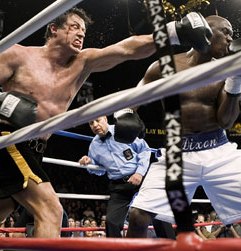
The world ain’t all sunshine and rainbows. It is a very mean and nasty place and it will beat you to your knees and keep you there permanently if you let it. You, me, or nobody is gonna hit as hard as life. But it ain’t how hard you hit; it’s about how hard you can get hit, and keep moving forward.” Perhaps it was the beneficiary of low expectations…Still, Sylvester Stallone’s Rocky Balboa, however fundamentally formulaic at its core, proved a much more satisfying moviegoing experience than the first half of Monday’s double-feature, The Good Shepherd. I’ve never been much more than a casual Rocky fan: I was way too young to appreciate the first two, more nuanced movies when they came out, and have clearer childhood memories of Balboa trouncing cartoon boxing villains Clubber Lang (III) and Ivan Drago (IV) than I do of him going the distance against Apollo Creed. (Still, even when I was eleven, the Italian Stallion singlehandedly winning the Cold War in Rocky IV seemed cheesy, and Rocky V is, of course, best forgotten.)

Nevertheless, more a character study than an 80’s-style action flick, Rocky Balboa is — thankfully — a throwback to the early days of Philly’s finest, when the big lug spent more time just wooing the nerdy-cute gal at the pet store than he did wrestling Hulk Hogan and sorting out geopolitical wrongs. Here, we’re more often than not simply following a lion in — if not winter, than in really late fall — going about his day in the city he loves and searching for one more shining, meaningful moment before twilight beckons. And, I’m forced to admit: By the time Rocky gets his one last shot — the big bout that takes up the final third of the film — it would take a harder heart than mine not to be swept up somewhat by the ride.

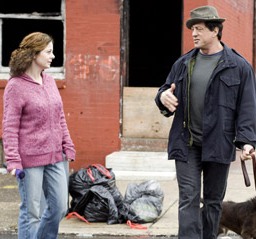
As Rocky Balboa begins, we discover that the Italian Stallion has not only lost most of his money from previous films (Sorry, sports fans, Paulie’s ridiculous robot is seemingly no more) but also his heart and soul, Adrian, who has succumbed to cancer. Clearly still very aggrieved, Rocky spends his days wandering around he and Adrian’s old haunts with the still-vexatious Paulie (Burt Young), trying to establish a connection with his mildly prodigal son (Milo Ventimiglia, a.k.a. Heroes‘ Peter Petrelli), and recounting old war stories to bored patrons at his restaurant. Then, one day after reconnecting with Little Marie (Geraldine Hughes) from the first film (Spider Rico is kicking around too), Rocky gets a hankering to deal with his ghosts by fighting again. “Sometimes I feel like there’s this beast inside me,” he tells Paulie in one of the film’s more affecting monologues. “I’ve got stuff in the basement.” And, as it turns out, the money-hungry managers of the current champ — Mason “The Line” Dixon (Antonio Tarver) — are looking to improve their client’s public profile by setting up a friendly “sparring” exhibition with a still-popular has-been…

You can guess the rest (except perhaps the ending, which I won’t give away here.) So, yes, the film is both predictable and wildly improbable, but somehow, it kinda works. Perhaps it’s because Stallone here seems to emphasize Rocky, aged and bloody but still unbowed, as an exemplar of the Philadelphia spirit, an historic American city that’s taken its share of knocks in recent decades — from deindustrialization to those woeful sports teams — but still keeps on keepin’ on. Or perhaps it’s because Sly, looking more beaten-up, bloated, and wounded than we’re ever accustomed to seeing him, brings a measure of pathos to his tale of one last hurrah just by showing up. Rocky Balboa isn’t one for the ages or anything, but it is very good for what it is — a schmaltzy but well-written and enjoyable piece of uplift and a worthy last outing for one of cinema’s most popular and enduring pugilists. In a surprise upset, the sixth and final round goes to Stallone.

The Ethical Senate.

Meanwhile, over in the newly Democratic Senate: With Wednesday’s House cleaning spurring similar ethics reform in the upper chamber, a progressive dream team of Russ Feingold and Barack Obama unveil the Senate Dems’ ethics reform package, which includes a provision for an independent Office of Public Integrity, a key element of reform which failed 67-30 last year on the GOP’s watch.

Madam Speaker | Fiscal Constraint.

For our daughters and granddaughters, today we have broken the marble ceiling. To our daughters and our granddaughters, the sky is the limit.” On a day marked by celebration and the temporary cooling of partisan rancor, the Speaker Pelosi era officially begins in Washington. And, true to their word, the Democratic House got an early start on their “100 Hours” platform, passing a comprehensive ethics reform package 435-1 on Thursday (right-wing nut-job and former Clinton nemesis Dan Burton was the sole opposing vote) and a “pay-go” commitment to a balanced budget (as well as an end to anonymous earmarks) on Friday. “‘The one thing we can say about George Bush and his economic policy is: “We are forever in your debt,”‘ Rep. Rahm Emanuel (D-Ill.) told his colleagues on the House floor. ‘On day number two, Democrats have said, “Enough is enough with running up the debt of this country. We’re going to put our fiscal house in order.”‘

Musical Chairs for Team Dubya.

In not-unrelated news, the Dubya White House shuffles its deck to make ready for divided government, replacing failed Supreme Court bid Harriet Miers as White House counsel (likely in favor of someone more aggressive, so as to counter Dem subpoenas), kicking national intelligence director Nicholas Negroponte over to State (to be replaced by Vice Admiral Mike McConnell), appointing Thomas D’Agostino as new nuclear chief (the old one, Linton Brooks, seems to have been of the “Brownie” school of management), putting Iraq ambassador Zalmay Khalilzad in John Bolton’s former position at the UN (his job goes to Ryan Crocker), and overhauling their top military team in Iraq. As the WP‘s Dan Froomkin reads the tea leaves, “I see a possible theme: A purge of the unbelievers.”

Ban Ki-Moon (and Spitzer) Rising.

Other important leadership shifts, these in and around New York: Having officially replaced Kofi Annan at the UN earlier this week, new general secretary Ban Ki-Moon cleans house, announces his own team and sets the Darfur crisis as a top priority. And, over in Albany, New York governor (and future presidential contender?) Eliot Spitzer delivers both his first Inaugural [text] and his first State of the State [PDF]: “In an hourlong address that was largely a repudiation of the policies of his predecessor, George E. Pataki, the new governor said he would seek to broadly overhaul the state’s ethics and lobbying rules. He said he would make prekindergarten available to all 4-year-olds by the end of his term, overhaul the public authorities that control most of the state’s debt and make New York more inviting to business by reducing the cost of workers’ compensation.