
“‘The main thing for me is to improve the soccer, to improve the standard, and to be part of history really because I think soccer can be a lot bigger in the U.S.,’ the 31-year-old former England captain said Friday morning on ABC’s ‘Good Morning America.'” I think so too, but is overpaying Becks really the answer? Soccer superstar David Beckham signs with the Los Angeles Galaxy for a cool $250 million.
Month: January 2007
It Takes an Empire.

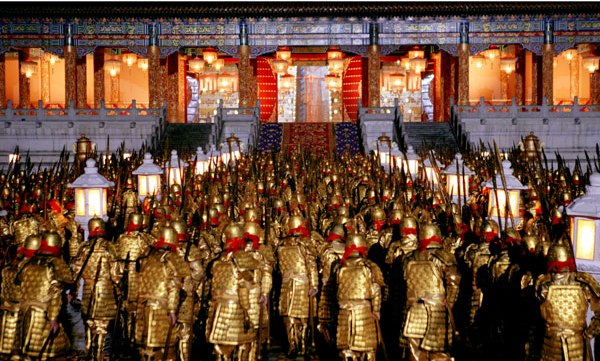
[%@*#, that’s aggravating. Movable Type just ate my entire review. Ok, let’s try this again.] A lush, operatic saga of a cancerous ninth-century family fracas that threatens to topple the Tang Dynasty from within, Zhang Yimou’s Curse of the Golden Flower is the type of film for which the cliche “sumptuous visual feast” was coined. True, this sordid tale of betrayal, corruption, incest, and time-release murder is overwrought to the point of self-parody, and the action sequences — like those in Zhang’s House of Flying Daggers — eventually veer well past rousing to the far corner of preposterous. But, my, is this film gorgeous to look at: From start to finish, Curse of the Golden Flower is an explosion of riotous color. (Particularly after sitting through two hours of Letters from Iwo Jima‘s bleak, monochrome grays, viewing the veritable kaleidoscope on display here felt even more sensuous and indulgent.) Throw in some very watchable performances by Chow Yun-Fat, Gong Li, and others, and Curse comes across to me as the best entrant in Zhang’s recent trilogy of fanciful-historical Chinese epics (That would be Curse, Daggers, and the scarily nationalistic Hero — Fortunately the political subtext is more restrained and ambiguous here. In fact, Curse may even be revolutionary, depending on how you read the film’s final image.)
It is the hour of the rat for the Tang Dynasty, chrysanthemums bloom throughout the Middle Kingdom, and opulence comingles with palace intrigue in the halls of the Forbidden City. For the Emperor (Chow Yun-Fat, both fierce and serene), in his Divine wisdom, has seen fit to slowly and secretly poison his Empress (Gong Yi, equally good), by means of a deathly black fungus added to her daily medicine. The Empress, meanwhile, strains to rekindle her romance with the Emperor’s first son (by a previous marriage), the Crown Prince Wan (Liu Ye), but he only has eyes for a fetching maid (Li Man) in the imperial employ. (In fact, she is the daughter of the doctor administering the poison.) And also residing in this increasingly broke down palace are the Princes Jai (Jay Chou) and Yu (Qin Junjie), both of whom discover they have their own roles to play in the schemes of their feuding parents, particularly after the ailing Empress weaves a plot of vengeance to coincide with the coming festival…
Also milling about the Forbidden City is a cast of hundreds: the cooks, maids, laborers, soldiers, ninjas (Yes, this film has ninjas, or at least their Chinese equivalent), and ladies-in-waiting that make up the infrastructure undergirding the Tangs’ divine rule. Zhang goes out of his way here to emphasize the sheer amount of sweat and toil expected of this teeming support staff for even the most mundane task — It takes at least four servants to administer the Queen’s medicine and considerably more to cart the Emperor to and fro. Yet, Zhang seems to suggest, these people are as much part of the story as the resentful royals. They are the props of the extravagant ritual, rigid hierarchy, and striking beauty that characterize the Tang’s rule, and they are ennobled by knowing and playing their appropriate role in this imperial order. Whether or not you agree with this sentiment (and Zhang himself seems to cast doubt on it by the final shot), it does make for several breathtaking scenes of elaborate ceremony throughout the film.
And, yes, some of these are battles. To be honest, both Hero and House probably exhibited better fight choreography. If you come to Curse expecting a martial arts extravaganza akin to those films, you may well leave disappointed. I found the final Helms’ Deepish “silver versus gold” sequence to be too bloodthirsty (beheading prisoners and such), too unrealistic (here, more than anyone else in the film, physics don’t apply) and too obviously CGI for my taste. That being said, there are a few notable melees interspersed throughout the picture, most of them involving the black-clad, scythe-wielding “Flying Monkey”ish ninjas of the Imperial Army, who tend to swoop down from above and bury their scythes in the nearest possible revolutionary with extraordinary aplomb. (Sigh. Only one movie after Iwo Jima, and war and violence are already being made to look artful again.)
King (of the World) and Avatar.
“The Banshees and the other creatures are going to be about 90% or 95% animated. And with the humanoids hopefully we’re going to be coming down to 95% capture with the exception of ears and like I said clothing and hair and stuff like that.” I’m behind on this one — Sorry, I’ve been saving up links to space out the flurry of movie reviews, and then overestimating how much I can actually get written on a given day — but James Cameron has announced more details about Avatar (not to be confused with M. Night Shyamalan’s Avatar, which I couldn’t case less about) and granted AICN’s Harry Knowles an extended interview on the performance-capture project. Set for a 2009 release, the film will “star” Sam Worthington (recently in the Aussie Macbeth update) and Zoe Saldana (late of Pirates of the Caribbean II.)
Caribbean Blue.
Since I just mentioned Pirates 2, which is a film I sadly kinda hated, I should perhaps note that the promotional materials for Pirates of the Caribbean III: At World’s End are now online, and they include a decent look at Chow Yun-Fat in samurai-pirate regalia. Why do I get the sense I’ll be seeing this despite myself?

The War of Middle Earth.
“I don’t want to work with that guy anymore. Why would I? So the answer is he will never make any movie with New Line Cinema again while I’m still working for the company.” More troubling news for The Hobbit: In an interview with Sci-Fi Wire, New Line president Robert Shaye lays into Peter Jackson over the outstanding lawsuit filed by Wingnut films over ascertaining LotR revenues. (PJ’s response is here, and I’m inclined to agree with him. What reason would New Line have to hide the books, unless they’ve been practicing shady math?)
The Starbuck Stops Here?
“It’s a fundamental and permanent change in the makeup of the show’s cast and of the show itself and how the show operates and what the show is about. It’s a very dramatic change of direction.” Speaking of Sci-Fi, the Chicago Tribune publishes a revealing interview with Battlestar Galactica creators Ron Moore and David Eick on what’s to come for the rest of Season 3. The article also includes this pic of what potentially may be the Final Five, in which some eagle-eyed fanboys have adduced a significant spoiler… (More spoiler-ish pics here.)

Lookout Below.
Brick‘s Joseph Gordon-Levitt inadvertently gets caught up in a bank heist in the new trailer for Scott Frank’s The Lookout (a.ka. Memento meets Inside Man?), also starring Jeff Daniels (back with Squid and the Whale beard) and the future Mrs. Borat, Isla Fisher.
The Man with the Golden Gun (and One Red Shoe.)
Also (sorta) in the trailer bin, Tom Hanks. Is. Bond. (By way of my sister Tessa.)
Letters Never Sent.
 While I thought most critics lavished too much praise on Pan’s Labyrinth, the very similar swells of appreciation for Clint Eastwood’s Letters from Iwo Jima are, surprisingly, much closer to the mark. Eastwood’s first crack at Iwo Jima in 2006, Flags of our Fathers, was to my mind a well-meaning dog, one made particularly lousy by the heavy-handed fingerprints of Paul Haggis all over the film. But (perhaps due to the different screenwriter, Iris Yamashita), Letters is really something quite remarkable. A mournful, occasionally shocking testament to the inhumanity and absurdities attending war, and a elegiac dirge for those caught in its grip, even on the other side of the conflict, Letters from Iwo Jima is an impressive — even at times breathtaking — siege movie. And strangely enough, elements that seemed trite or intrusive in Flags — the desaturated landscape, the minimalist piano score — are truly haunting and evocative here. In fact, Letters from Iwo Jima is so good it even makes Flags of our Fathers seem like a better movie just by association, which, trust me, is no small feat.
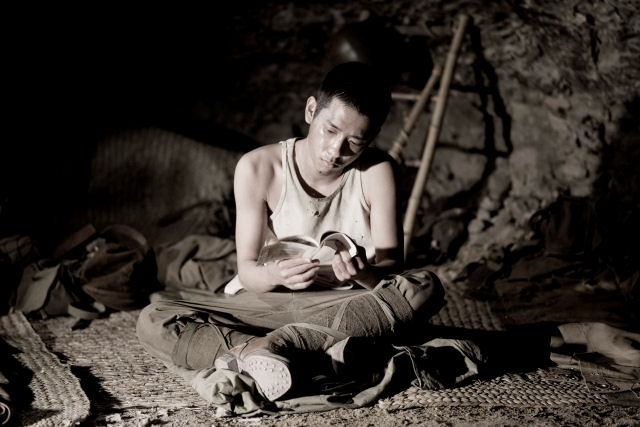 As you probably know by now, Letters from Iwo Jima follows the famous World War II battle, ostensibly depicted in Flags, from the Japanese side. Here, nobody cares about artfully raised flags or the Ballad of Ira Hayes — the emphasis instead is on honor and survival. General Tadamichi Kuribayashi (Ken Watanabe, as captivating here as he was in The Last Samurai) has been ordered to lead the defense of the island against the Americans. To this task, he fully devotes himself, despite fond memories of his earlier days on US soil. But it only takes a few walks around Mt. Suribachi for Kuribayashi to figure out it’s pretty much a no-win scenario — the Americans are too many, too productive, and too strong. And once word leaks out that the Japanese fleet has been broken at Leyte Gulf, Kuribayashi and his men — most notably friendly grunt Saigo (Kazunari Ninomiya), and former Kempetai Shimizu (Ryo Kase) — must slowly come to grips with the fact that they’re not digging cavern defenses so much as their own tomb…a tomb in which many Japanese officers, and not least the headquarters on the homeland, will expect them to die with honor.
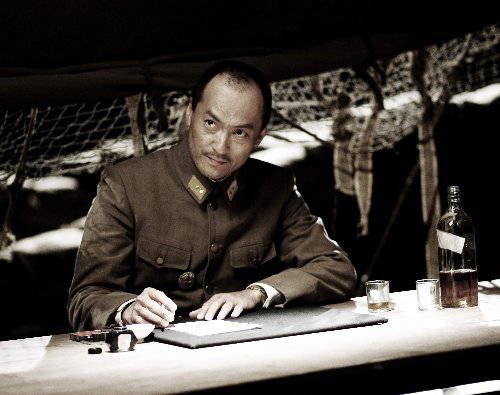 What’s particularly surprising here is how unafraid Eastwood is to invert the usual sympathies of a World War II film. It’s not just that the Japanese are the “good guys” here — True, Letters dramatizes the soldiers’ plight by portraying them, particularly Saigo, as just like our fun-loving GI’s at heart. But it also doesn’t shy away from examining a cultural emphasis on dying well that seems completely foreign to the American mind. And, although a wounded American serviceman shows up later in the film, for the most part the US forces are — surprisingly — portrayed here like something out of The Empire Strikes Back, all gleaming, remorseless battleships and Fiery Death from Above. (Some have argued that Eastwood elides over Japanese atrocities in this film, but I’m not sure that’s really fair, unless I somehow just missed the Dresden firebombing subplot in Saving Private Ryan. This is not to say that all war crimes are equivalent or that both sides are equally guilty (although Lord knows it got ugly) — that gets into a moral calculus well outside the bounds of this review — only that Letters seems more interested in portraying war itself as an atrocity, and that enough reference is made to ugly tactics (aiming at medics, for example) that the film doesn’t feel to me like a whitewash.)
The sobering truth at the heart of the grim, moving Letters from Iwo Jima is captured in its penultimate image. (Alas, like too many WWII films, Eastwood opts for an unnecessary contemporary bookend, but it’s not as distracting as the Greatest Generation stuff in Flags. In fact, you might argue that it plays very well off those scenes, in depicting what little survives the war on the Japanese side.) I won’t give it away here…suffice to say that Letters makes clear that War is a demon that rips lives apart and rends men asunder, no matter what side you’re on or for what reasons. Regardless of race, creed, nationality, or ideology, all who invoke its wrath will eventually come to taste tragedy.
Fair Enough?
In a bit of happy news, Sen. Tim Johnson (D-SD), late with an AVM, has his condition upgraded from critical to fair. “The senator’s doctors said last week that Johnson was improving but still needed a ventilator at night to help him breathe…His long-term prognosis is unclear. He has been responsive to his family and physicians, following commands, squeezing his wife’s hand and understanding speech.“