It’s the End of the World As We Know It?

“So, here we are. The two major powers in this confrontation are led by blunderers; the provocateur is a chronic miscalculator. It doesn’t look good.” Oh, so there‘s the WMD: As John Bolton pushes for aggressive sanctions at the UN against the Kim Jong-Il regime, Slate‘s Fred Kaplan parses several ugly scenarios that could unfold after North Korea’s nuclear gamble on Monday (the same day, coincidentally, that South Korean Ban Ki-moon won official Security Council backing to replace Kofi Annan. Looks like he’ll be working overtime right out of the box.) By the way, if you’re keeping score at home, Dubya & co. now seem to have grievously mishandled all three prongs of the “axis of evil” trifecta. Sigh. That’s great, it starts with an earthquake

And I feel fine.

One small piece of consolation in this increasingly dark, troubled world: A new post-Foley Gallup poll puts the GOP in an absolute freefall: “Democrats had a 23-point lead over Republicans in every group of people questioned — likely voters, registered voters and adults — on which party’s House candidate would get their vote. That’s double the lead Republicans had a month before they seized control of Congress in 1994 and the Democrats’ largest advantage among registered voters since 1978.” Moreover, two other polls by CBS News/New York Times and ABC News/Washington Post confirm that an electoral rout may now be in the making.

Bumpy Departure.


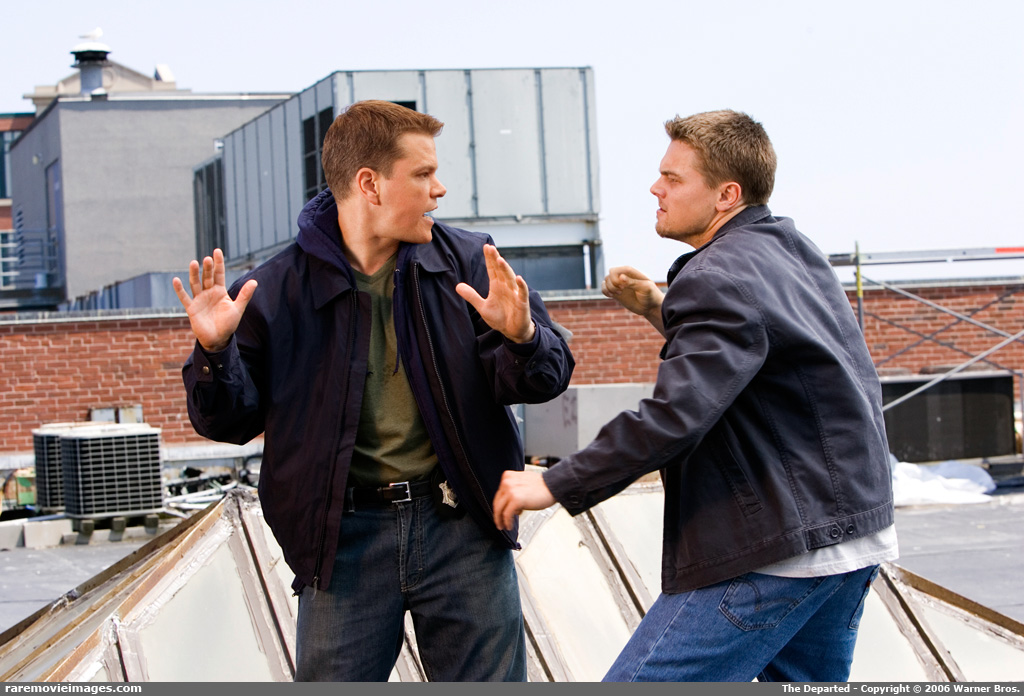
As far as remakes go, The Departed, Martin Scorsese’s sprawling, overstuffed Boston-area reinterpretation of Andy Lau and Alan Mak’s Infernal Affairs, is by no means an embarrassment. Packed with likable actors delivering quality performances (another hambone turn by Jack Nicholson notwithstanding), it’s a breezy and enjoyable two and a half hours of cinema, and it hits most of the beats of the original decently well. (Maybe too well. A little more deviation from IA might’ve helped in the suspense department.) Still, I left the theater somewhat disappointed, and am a bit surprised by the critical acclaim Departed is getting. For all the sleek direction, actorly firepower, and Mamet-ish wit on display here can’t disguise the fact that Infernal Affairs was a clearly better film — leaner and more nuanced, more elegiac and resonant. Lacking the emotional power of the original, The Departed basically just feels like a well-crafted but hollow genre exercise (that is, when it doesn’t feel like a Nicholson stunt.) And, as far as well-crafted genre exercises go, I think I might’ve preferred Inside Man.

The central plot of both films is at once delightfully simple — cop plays robber, robber plays cop — and devilishly complicated. Here, two Southie graduates of the Massachusetts State Police Academy go to work for opposite sides of the law: Bright young overachiever Colin Sullivan (Matt Damon) takes a gig in a top police investigation unit aimed at taking down nefarious crime kingpin Frank Costello (a.k.a. Whitey Bulger a.k.a. The Joker), while troubled screw-up Billy Costigan (Leonardo di Caprio) finds himself, after a stint in the joint, hired muscle in Costello’s organization. But all is not as it seems: As it turns out, Sullivan the cop — bought off by a bag of groceries a few decades earlier — actually works for Costello as a mole on the force, while Costigan the robber has gone deep undercover at the behest of BPD detectives Queenan (Martin Sheen, avuncular and presidential) and Dignam (Mark Wahlberg, aggro and amusing). As it becomes patently clear to both sides of the game that each has a rat in the house, Sullivan and Costello work to flush out their opposite before they get busted (or, in Costello’s case, dismembered.) And, complicating the situation even further (and in a departure from Infernal Affairs), these two nemeses also unknowingly share the love of the same woman, an alluring police shrink (Vera Farmiga) who tends to make really poor life decisions.

All of this is executed competently enough. Scorsese keeps the wheels turning and the tension up throughout, and The Departed benefits from many excellent performances around the margins: Both Wahlberg (easily the most comfortable with the Boston accent, for obvious reasons) and particularly Alec Baldwin (as a grizzled police detective, one-half his character in Glengarry Glen Ross, one-half Sgt. Jay Landsman) are laugh-out loud funny at times, while David O’Hara and Sexy Beast‘s Ray Winstone add sinister depths to Costello’s criminal outfit. And, while most of Mystic River felt more plausible to me, the Boston locale gives The Departed some strong local color that feels fresh and different from the Hong Kong of Internal Affairs. (I particularly liked some of the Irish witticisms. I’d never heard the Freud quote: “This is one race of people for whom psychoanalysis is of no use whatsoever.” And I enjoyed Sullivan’s warning to his psychiatrist girlfriend late in the film, something along the lines of “If this isn’t working, you need to get out. I’m Irish. Something could be wrong, and I’d spend the rest of my life just dealing with it.“)

Both Leonardo di Caprio and Matt Damon do high-quality work too, but here some of my issues with the film emerge. As played by the charismatic Tony Leung of Hero, In the Mood for Love, and 2046, the undercover cop character in Internal Affairs is a resigned, world-weary sort, a guy who seems to carry reservoirs of inexpressible sorrow with him everywhere he goes. But, here, di Caprio is basically a pill-popping panic attack for two hours, cringing and sweating his way through every scene. Fine, that’s a stylistic choice: More problematic is Damon’s character, who’s become considerably less interesting than the conflicted cop played by Andy Lau (of House of Flying Daggers) in the original. For some reason, he’s been stripped down and rendered a much more conventional villain. Damon does what he can, but I preferred the subtler, more pained motivations of Lau’s mole than I do the unctuous, take-no-prisoners careerism they’ve saddled Damon with here.

And then there’s Jack. Nicholson has put in some extraordinary performances in his time, but, as someone put it in another comment thread, he’s been coasting like Pacino for a couple of decades now. And, for some ungodly reason, Scorsese gave Nicholson free rein here to act as crazy as he wants. (Yep, the dildo idea was his.) As a result, Nicholson can’t stop leering and preening to the point of distraction. Whether it be making rat faces, covering his arms in splatterhouse gore, coking out with two prostitutes in the Red Room from Twin Peaks, or generally just acting like he’s seated courtside at the Staples Center rather than running a crime operation, Nicholson just doesn’t work here. Wildly over the top throughout, he’s like a refugee from a sillier, stupider film, and he too often makes The Departed feel little more than a Marty-directs-Jack! casting stunt.

Elephant’s End.

“Every revolution begins with the power of an idea and ends when clinging to power is the only idea left. The epitaph for the movement that started when Newt Gingrich and his forces rose from the back bench of the House chamber in 1994 may well have been written last week in the same medium that incubated it: talk radio.” As Foleygate continues to conflagrate and the FBI looks for answers, a TIME cover story wonders if the Republican Revolution of 1994 is dead. Yep.

Cut the Crap.

“The cut-and-run phrase is an effective political weapon…It is also a very dumb phrase…As one Republican congressman put it recently: ‘Reality has been suspended for a moment. Republicans cannot speak out publicly on this issue right now.‘” With even Republicans making dour assessments of Baghdad these days, Slate‘s John Dickerson makes the obvious points against Dubya for the “cut-and-run” garbage he indulged in last week.

Time Check.

“1985’s a problem for people. The Cold War’s a problem for people. But these are things I’ve been trying to [tell people] would be cool. I like that Richard Nixon is the president in it. I think that’s important. Those kinds of things tell you exactly what kind of movie this is – it’s not Fantastic Four, you know.” 300 director Zack Snyder offers a brief update on the current state of CWatchmen.

Foley Reverberates.

“The social conservatives are frustrated with what’s going on…We have heard disappointment and disenchantment. The level of commitment isn’t as fierce as it ought to be.” Another Foleygate update: As another GOP staffer backs up Kirk Fordham’s account of telling Hastert about Foley in 2003, the NYT reports that the scandal has put at least five more GOP House seats in play, and gay Republicans begin to fear they’ll end up the scapegoats of it all. “I’m just waiting for someone in a position of authority to make this a gay issue.Update: With new revelations from Representive Jim Kolbe (R-AZ), the Foley-clock moves back to 2000.

Going to the carnival.

So, my sister, her boyfriend, and I went to check out The Times They Are A-Changin’, the new Twyla Tharp-choreographed reimagining of famous Bob Dylan songs, last Thursday (with, as a star-gazing aside, some heavy-hitters in attendance: Annie Leibowitz sat directly in front of me, and Tharp herself sat directly behind. Yes, I’m a celebrity hound.) And the verdict? Well, first let me say, that — some early dabbling in community-theater notwithstanding — I’m really not much of a musical guy. I tend to find the American Idol-ish histrionics of Broadway singing really distracting, and particularly when the song in question is something like “Masters of War.” Nor have I seen Moving Out, Mamma Mia!, Ring of Fire, Almost Heaven or any of the other “Broadway Karaoke” shows that currently seem to be the rage, so I can’t really compare it to any of the others — I was really more interested to see some intriguing interpretations of Dylan than I was to partake in a group sing-a-long (which, thankfully, Times is not.) With all that said, I found Times to be…kinda hit-or-miss. While some of the visions here do their source material justice in memorable fashion, others fall flat or just seem ill-conceived. And, while the circus acrobatics on display are amazingly well-performed and at times mesmerizing, too many numbers slip into the same dark carnival-of-the-absurd pattern. The cast works hard, but surely, when you get down to it, there is more to Dylan’s oeuvre than just aggro carny folk.

To its credit, Times samples songs from across Dylan’s career, from the hoary (“The Times They-Are A Changin’,” “Blowing in the Wind“) to the obscure (“Man Gave Names to All the Animals,” “Please, Mrs. Henry“), through the lean years (“I Believe in You,” “Dignity“) and up to the recent critical revival (“Not Dark Yet,” “Summer Days.”) Set in a traveling circus run by the vicious, heavy-handed Captain Ahrab (Thom Sesma) — a character from one of Dylan’s great American fables,”Bob Dylan’s 115th Dream,” not included — the play basically centers around a love triangle among Ahrab, his son Coyote (Michael Arden), and the lady Cleo (Lisa Brescia), one of the circus performers. Through their story — and the larger tale of a power struggle over the circus — are refracted these thirty or so Dylan tunes, strung togther in haphazard but decently compelling fashion.

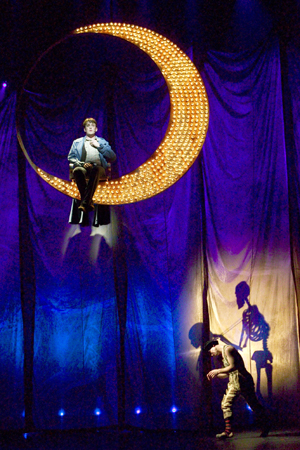
I’d like to say there’s a formula for when a song works and when it doesn’t, but it doesn’t go over like that. One of the two best numbers, “Simple Twist of Fate” (the only cut from Blood on the Tracks here), is played basically straight. Alone in spotlight, Ahrab sings wistfully in the foreground (as seen at left) while the younger couple cavorts behind him, a haunting memory. “He woke up, the room was bare. He didn’t see her anywhere. He told himself he didn’t care, pushed the window open wide. Felt an emptiness inside, to which he just could not relate.” The bleak, melancholic staging matches the song perfectly, and Ahrab/Sesma channels both its poetry and its pain.

But, in the other most successful number, “Mr. Tambourine Man” (a song I can usually take or leave), Tharp & co. have taken a tune that’s ostensibly about a drug deal and just ran with it. Now, it’s a gripping, Bergmanesque dance of death, with one of the sadder clowns (Charlie Neshyba-Hodges) holding center stage as the ensemble circles around him in black, recalling the doomed pilgrims of The Seventh Seal. Obviously, Tharp isn’t the first to read “Tambourine Man” as a disquisition on mortality. (“I’m ready to go anywhere, I’m ready for to fade…into my own parade, cast your dancing spell my way, I promise to go under it.“) Nevertheless, the staging both feels innovative and cuts close to the bone of the song in surprising fashion.

There are other good moments scattered throughout the show, although few that hold their power over the course of an entire track: For example, a contortionist writhes horribly on a hospital bed during the “Dr. Filth” passage of “Desolation Row,” flashlights whirl and twirl (held by people brandishing them vaguely like tusken raiders) during “Knocking on Heaven’s Door“, the cast memorably get their drink on for “Please, Mrs. Henry,” and one clown reenacts Dylan’s “Subterranean” signage during the latter half of “Like a Rolling Stone.”

But, when a song’s off, it’s pretty off. The most obvious offenders are “The Times They Are A-Changin’,” “Blowing in the Wind,” and arguably “Lay, Lady, Lay,” all of which are performed in a deadly earnest Broadway patter that just stop the show dead. (This is particularly unfortunate in the case of the first one, since that’s how the show begins.) But, there are other problems. The bizarre welcome-to-the-carnival-of-beasties routine works well for “Desolation Row” (since, after all, “The circus is in town“) and maybe even for other rousing numbers such as “Like a Rolling Stone.” But, it’s overdone — in “Highway 61 Revisited,” “Everything is Broken,” “Gotta Serve Somebody,” “Rainy Day Women #12 & 35” — to the point that the musical numbers become indistinguishable. (“Masters of War” also falls somewhat into this pattern — I liked it better than most, but was reminded more of ABT’s splendid recent revival of “The Green Table,” which captured the same sentiment better.)

And, sometimes, in my humble opinion, the attempted interpretation falls flat on its face. I thought turning “Not Dark Yet,” Dylan’s gloomy but resigned rumination on death around the corner, into a rage-against-the-dying-of-the-light completely misses the point of the song, which is that he’s given up and given in to the coming darkness. (“I’ve been down on the bottom of a world full of lies. I ain’t looking for nothing in anyone’s eyes.“)

Most egregious in this regard is what’s been done to “Don’t Think Twice, It’s Alright.” Perhaps because it remains such a personal song — a song about two people rather than a generation — I’d say it’s aged much better than almost all of the other hugely popular early-Dylan standards (“Blowing in the Wind,” “The Times They Are A-Changin’,” “A Hard Rain’s A-Gonna Fall.”) In fact, I might go so far as to say that “Don’t Think Twice” may just be the quintessential Dylan break-up song in a career full of them (although now that I write that…Blonde on Blonde, Blood on the Tracks…ok, never mind. That’s too bold a statement.) At any rate, here, all the complexity of competing emotions that drives the track — “I ain’t sayin’ you treated me unkind, you could have done better but I don’t mind, you just kinda wasted my precious time” — is wasted, as it’s become, inexplicably, a number sung by a woman to her overly eager dog. (Although I will concede that the canine in question — I believe it was Jason McDole — was convincingly and creepily Berkeley-like.)

In sum, A Times They Are A-Changin’ is at times engaging, and may be worth catching if you have a hankering for the carnivalesque, if you’re a Dylan completist, or if you have a higher tolerance for showtune renditions than I do. But, as an exploration of Dylanalia, I found the show too narrowly circumscribed within its three-ring circus, and ultimately unsatisfying. (Then again, in the play’s defense, I didn’t think much of Masked and Anonymous either, so perhaps I’m just ornery about such things.)

Casino Jack and Runaround Sue.

As a former Abramoff assistant, Ralston played intermediary between the lobbyist and Rove. The congressional report found 66 Abramoff contacts with the White House, more than half of them with Ralston. In addition, Abramoff’s lobbying colleagues contacted Ralston 69 times.” The Casino Jack affair claims another White House victim in Rove deputy Susan Ralston, who, it was recently discovered in a House report, made the mistake of accepting Abramoff swag — choice tickets and such — without paying for it. Illegal, no doubt, but somehow I suspect her procuring courtside Wizard tix is the least of the Abramoff-related corruption going on in Karl’s outfit.

Dark Star.

“[I]n keeping with the show’s ominous tone, instead of quick resolutions or merciful diversions, the darkness reaches a palpable extreme during the premiere of the third season…The uninitiated may continue to write off ‘Battlestar Galactica‘ as the remake of a mediocre show, or as the domain of science fiction fans alone, but those who’ve watched the show more than once or twice know better.” Reminder: As noted a week ago, Battlestar Galactica returns tonight. Right now, Season 3 is pulling a 93 over at Metacritic, who call it “the second-best show on television.”