
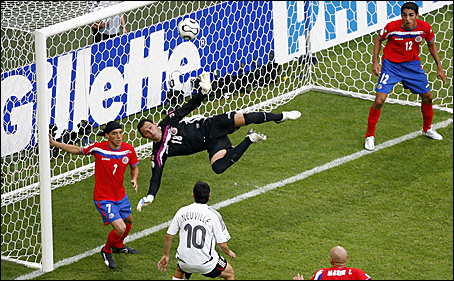
 As if the Dallas-Miami NBA Finals (ok, I was way off) weren’t sports bliss enough ’round these parts, the 2006 World Cup has begun, with host Germany defeating Costa Rica 4-2 and Ecuador besting Poland 2-0 on Day 1. Alas, since I have to maximize my research time while I’m briefly back in the 202, and since the Manuscript Reading Room of the Library of Congress aggravatingly keeps bankers’ hours (and charge $0.20 a photocopy, but that’s a whole ‘nother rant), it looks like I’ll be missing much of the first round. But I promise to make it up on the back end.
Month: June 2006
Zarqawi Zapped.
I was traveling yesterday during the big news: With the aid of cellphone surveillance and an Al Qaeda informer who suggested tracking “spiritual adviser” Sheikh Abd al-Rahman, the US military dropped two 500-lb bombs on Abu Musab al-Zarqawi, the leading Iraq insurgent (and Al Qaeda poster boy for the administration.) Undoubtedly good news for our efforts in Iraq (and, lord knows, Dubya needed some good news in the worst way, particularly in the wake of Haditha.) Still, this big kill obviously doesn’t answer the big questions about Iraq’s stability, or our continued involvement in the region: “‘The immediate aftermath of this will probably be an upsurge of violence’ as Sunni insurgents hurry to show that Zarqawi’s killing has not broken the resistance, said Michael Clarke, an expert on terrorism at the International Policy Institute of King’s College London. ‘In the medium term, in the next month or two, it will probably help to downgrade sectarianism,’ Clarke said by telephone. ‘But the dynamic of sectarian violence is probably past the point of no return.’” And, of course, while this strike will hopefully be a stunning blow to Al Qaeda in Iraq, what of the original Al Qaeda in Afghanistan and around the world? We’re nearing five years since 9/11, and Osama’s still out there…
Spirit of 93.
 Whether or not the world really needed a film about the events that took place on United Flight 93 the morning of September 11, 2001 is, I suppose, still an open question. I can see both sides of the argument: that it’s too soon for a movie about 9/11 and that our current involvement in the war on terror demands we come to terms with what happened that day. (As my father pointed out, the WWII generation saw plenty of war flicks come out while the conflict still raged in Europe and the Pacific.) For my own part, even despite the stellar reviews for Paul Greengrass’ film, it took me a few weeks to crank up the nerve to sit through a movie that I figured would be at best chilling and heart-rending and at worst deeply exploitative and repellent. That being said, having run the gauntlet earlier this week, I can now happily report that United 93 is magnificent, and arguably the best possible film that could’ve been made about this story. Both harrowing and humane, it’s the movie of the year so far.
United 93, like 9/11, begins like any other day. For most of the first third of the film (the opening scenes, where we watch the four terrorists make their final prayers and preparations, notwithstanding) we simply follow people beginning their work day: air traffic controllers look at the weather and discuss possible delays, pilots make small-talk on their way to the cockpit, flight attendants prepare the cabin, and sleepy, anonymous passengers sit around Newark airport, making phone calls or waiting with blank, thousand-yard-stares for their turn to board. It looks exactly like every single airport terminal you’ve ever seen, and, if you had no sense of what’s to come next, you might be deadly bored by all this reveling in mundanity. But, there’s a method to Greengrass’s madness — not only do these early scenes root the film in our world (as well as foster some sickening suspense — we’re obviously waiting for the other shoe to drop), but they take us back to what Karl Rove might call a “pre-9/11 mentality.”
It’s no small testament to the film’s intricate set-up that, when quintessentially Bostonian and New Yorker ATC guys start noticing some planes acting quirky, we sense their palpable confusion even though we know exactly what’s going on, and — when the second plane hits the World Trade Center (which is never shown, except on CNN or in long shots from the Newark control tower) — we feel as shocked as they do, all over again. From there, the film’s second act involves civilian and military air traffic officials (some of whom are played by the real people involved) struggling to make sense of a increasingly horrifying situation for which everyone was totally unprepared. ATC men feverishly watch the wrong planes for signs of a hijacking, FAA authorities put together a board of possible suspect flights and try to track down an AWOL military attache for some answers, a plane that was thought destroyed pops up again on the radar dangerously close to Washington, unarmed fighters (the best anyone could find on short notice) scramble in the wrong direction over the ocean, and NORAD waits desperately for the presidential authorization to fire on hijacked airliners, to no avail. (Think My Pet Goat.)
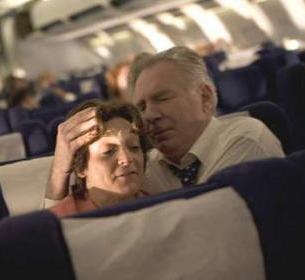 And, in the meantime, United 93 begins its own hellish journey, as the four terrorists on that plane (who, to Greengrass’ credit, are portrayed as multifaceted as they could be, given their vile plan), after some silent soul-searching, spring into action: They take over the cockpit, scare into submission the passengers (all of whom are played by relative unknowns, although some — such as David Rasche of Sledge Hammer — look vaguely familiar), and set a course for the Capitol. Thrust to the back of the plane by a “bomb”-carrying hijacker, having little-to-no sense of what’s going on in the cockpit, and wracked with fear, grief, and confusion, the passengers of United 93 — operating with even less knowledge than the people on the ground — eventually piece enough to discover that they must act. This all takes place in real time, and isn’t played as cheap film heroics in the slightest. Like everything else in United 93, it all feels terrifyingly real, making the passengers’ final, collective, desperate lunge for survival one of the most visceral and cathartic movie sequences in years — it, like the final shot, will linger in your memory for days to come.
In short, United 93 is undeniably hard to watch at times, and I can see why many folks out there would steer clear of it like the plague. Still, if you feel like you can handle the subject matter, United 93 is a must-see film. While it doesn’t even really attempt to offer a broader perspective on the events of 9/11, it’s hard to imagine a movie that could reconstruct the emotional experience of that day as faithfully and without cynicism or exploitation as this one.
Hofstadter’s Political Tradition.
“Like the late John Kenneth Galbraith, Hofstadter has been faulted for leaving behind no coherent ‘school’ of history, no set of disciples. But for a man who once said to Foner, ‘I’m not a teacher, I’m a writer,’ to have tutored such a splendid variety of historians shows that he imbued his students with something more precious than the ability to write history his way. He taught them to write history their way.” On the eve of a new biography of the hallowed Columbia prof, Slate‘s David Greenberg ruminates on Richard Hofstadter.
Country Time.
Woody and Milton, meet Walter and the Dude: Woody Harrelson and Stephen Root join No Country for Old Men, the forthcoming Coen flick starring Tommy Lee Jones and Javier Bardem.
Special Agent Bimmler?
“The CIA based its decisions about using former SS men or unreconstructed Nazis solely on operational considerations…Hiring these tainted individuals brought little other than operational problems and moral confusion to our government’s intelligence community.” New documents unearthed by UVa historian Timothy Naftali make clear the Cold War-era CIA had no qualms about using former Nazi assets, and even neglected to flush out infamous war criminal Adolf Eichmann from his hiding place in Argentina after being tipped off about his location. For shame.
Junket Dogs.
“The forms show that about 2,300 trips cost $5,000 or more. At least 500 cost $10,000 or more, 16 cost $25,000 or more, and the cost of one exceeded $30,000. There were $500-a-night hotel rooms, $25,000 corporate jet rides and other extravagant perks. Almost three-quarters of all trips were taken by aides, who often influence how their bosses vote, negotiate in committee and interact with other government officials. All told, the travelers were away from Washington for a minimum of 81,000 days — a combined 222 years.” A new report by the Center for Public Integrity scrutinizes the massive epidemic of congressional boondoggles, and, folks, it ain’t pretty: “Offices that accepted more than $300,000 worth of trips include (in alphabetical order), Rep. Barton (R-TX), Rep. Roy Blunt (R-Miss) Rep. John Boehner (R-OH), Rep. Tom Delay (R-TX), and Speaker Hastert (R-IL).“
Mona Lisa Frown.
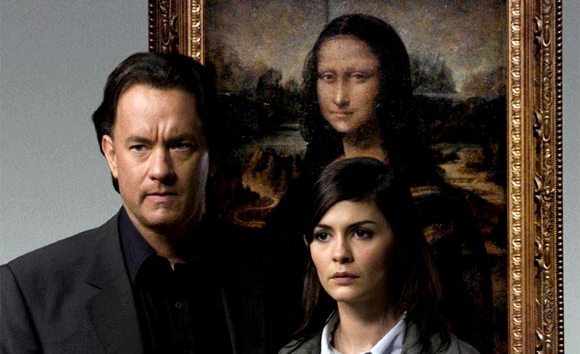
So, I was one of the minority of people out there who had not already read Dan Brown’s The Da Vinci Code when I ventured into the theater last week for a look-see at the film version (although various people had filled me in on most of the major plot points over the years.) This was partly because I had been told a few times that the novel read like a piece of cinema anyway, so I figured that, contrary to my usual m.o., I’d just wait for the movie. Well, unfortunately, Ron Howard’s film plays at best like a book-on-tape, one that might’ve made for a good airplane listen if the people involved hadn’t taken this enterprise so seriously. As it is, unless you relish usually likable actors spouting forth clunky, Akiva Goldman-penned chunks of exposition at you for two and half hours, leave this Code undeciphered.
Like I said, I’m really late to this party, so you probably don’t need me to summarize the basic gist here. In any case, world-renowned symbologist Robert Langdon (Tom Hanks), a Harvard professor prone to monologuing and/or gasping in awe when confronted with ancient relics (thank goodness, or otherwise he’d have nothing to do here) is thrust into a murder mystery after a colleague is found dead at the Louvre, his body bloodied by his own hand and laid out like Leonardo da Vinci’s Vitruvian Man. (As we saw in one of the movie’s creepier scenes (also in the trailer), this fellow was killed — under the watchful eyes of countless mournful Madonnas — by the albino monk Silas, an operative of Opus Dei with some serious body issues.) Soon, with the aid of the dead man’s painterly granddaughter, Sophie (Audrey Tautou), Langdon embarks on a quest to uncover the meaning behind the man’s murder, and, while puzzling and ciphering away, inadvertently stumbles onto a two-thousand-year-old conspiracy involving the divinity of Jesus and the Holy Grail, one that certain conspiring cardinals (Alfred Molina) and their pet monks will kill to keep under wraps…
That’s the upshot, and, as you can see, this has all the makings for a decent potboiler. And, at times, watching Hanks and Tautou puzzle away or seeing the film flashback to the Cecil B. DeMille days, one gets the sense that the Da Vinci Code is probably a thoroughly enjoyable beach book. But, as a film — or at least as this ponderous, too weighty-by-half film — it’s a total non-starter. Howard, Hanks, and Tautou can’t seem to stop treating this movie as an epic, when what it really needed was a slapdash of Raiders of the Lost Ark tongue-in-cheek. (In fact, I thought Nicolas Cage’s campy Da Vinci knock-off National Treasure came closer to the unapologetic B-movie tone needed here.) On the bright side, Ian McKellen (as a wry Grail historian, gleefully chewing his way through yet another bad summer movie), Molina (himself an Ark alumnus), and — briefly — Jurgen Prochnow (as a shifty Swiss banker) seem to have a better sense of the proceedings here, and they add some much-needed levity and narrative kick whenever they’re onscreen. Still, their best efforts aren’t enough to recommend Da Vinci, a film that needed less clumsy exposition and a jauntier sense of fun throughout. As it is, The Da Vinci Code is a rather staid canvas.
Spineless Specter, Redux.
“‘You have given up the store,’ complained Sen. Richard Durbin, D-Ill., in denouncing the move. ‘You’re just walking away.‘” Playing true to form, Arlen Specter folds yet again and reverses his earlier promise to make phone companies testify about their role in the NSA’s recent data-mining. “The senator from Pennsylvania acknowledged his reversal was forced upon him by his Republican colleagues in a private session prior to the afternoon hearing.”
Swearingen cuts a deal.
“If I bleat when I speak, it’s because I’ve just been fleeced.” A la Farscape, Deadwood will get two two-hour specials to close out the story after Season 3 (which begins on Sunday.) Four hours? Well, ok, better than nothing, I suppose. Some ancient Italian maxim fits our situation, whose particulars escape me.