 Big doings for a Monday morning: Through a fortuitous series of events and two hours of toe-freezing waiting outside, I just got back from a critic’s showing of Peter Jackson’s King Kong over at the Loews on 68th St. (As an aside, the screening was run terribly– From the color-coded seating to the random security lines, everything was organized just enough to unnecessarily complicate everything and to reward bad behavior.) But let’s get down to brass tacks here: How much for the ape? Well, in essence PJ’s King Kong is the Mother of All B-Films — the Skull Island action sequences are spectacular, Kong’s adventures in New York seem appropriately mythic, the special effects throughout (particularly the Great Ape himself) are mind-blowing…Without a doubt, Kong is one of the best movies I’ve seen this year. That being said, I’d be lying if I didn’t admit that the film has some serious pacing problems, particularly in the first hour, and at times I thought it seemed almost too reverent of its source material. At the very least, Kong, while definitely a Wonder of the World and no mistake, could have benefited from some minor grooming.
Fortunately, many of the most glaring missteps in Kong occur relatively early on. The film begins very auspiciously with a choice montage of Depression-Era New York, during which we’re introduced to beautiful young vaudevillian Ann Darrow (Naomi Watts) and, soon thereafter, director-on-the-make Carl Denham (Jack Black) and his long-suffering assistant (Colin Hanks). From here throughout, both Watts and Black are excellent — One would never think Watts was interacting with anything less than a grotesquely large primate in the scenes to come, and Black is surprisingly good and unobtrusive as Denham, even if there are a few too many shots of him…slowly…turning…to look at…something huge, amazing, and/or ghastly.
 That being said, after the opening, the film slows to a crawl for a good 30-40 minutes, as Denham, Darrow, & co. wend their way to Skull Island about the S.S. Venture. Frankly, I was reminded a lot of the first hour of The Matrix Reloaded during this sequence — There’s nothing as flat-out embarrassing as the Bacardi Silver rave here, but there is a lot of hamfisted expository dialogue masking as character development. Particularly egregious in this regard is everything involving the ship’s First Mate (Evan Parke) and a young stowaway (Jamie Bell) he’s taken under his wing. Frankly, this whole subplot is a mistake — It’s laden with stilted groaners (the digression on Joseph Conrad’s Heart of Darkness, for example) and comes off as cliche-ridden as the tough general and his fresh-faced recruit in that other Matrix film.
Fortunately, right around the time the Venture loses steam, the film starts picking some up. The run-in with the natives is rather creepy in PJ fashion, although, once again, it could use some tightening — We only need one slo-mo Bad Taste-ish zoom to a human skull and one frightening Zombified Skull Islander in the throes of an epileptic seizure…but PJ gives us four or five of each. Still, when Kong first rumbles out of the jungle to acquire his new sacrificial plaything, the film starts to gather the hurtling momentum that’ll characterize most of the rest of its run.
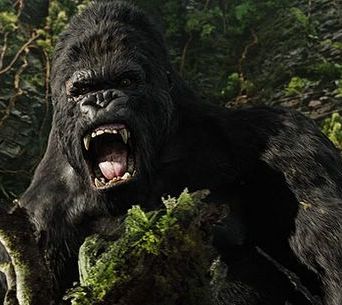 And, indeed, the rollicking next hour of the film is, for the most part, Jurassic Park on ‘roids. Throughout the Skull Island tour (which includes many death-defying stops and Shelob-esque reveals), Peter Jackson and the WETA gang really let their freak flag fly, and the fun here is infectious. This is a monster movie maven at the top of his game, and some of the sequences here — most notably Kong vs three T-Rexes — are jaw-droppingly (or jaw-rippingly, as the case may be) spectacular. I don’t want to give away some of the twists and turns in this middle chapter…but, if you’re not really enjoying the heck out of this hour of the film (even despite some of the less-plausible deux-ex-machinas involved), I’m not sure why you went to see Kong in the first place.
Of course, the story returns to New York in the final hour, when Denham brings his newly-acquired Eighth Wonder of the World to the Great White Way. (Look for the now somewhat-unfortunate cameo by Howard Shore, doing what he might well have done best…To be honest, the James Newton Howard score sounded mostly like incidental music. If there was a “Kong theme,” I didn’t catch it on first viewing.) And, at this point, the film forsakes the mayhem of its middle hour to bask in the Gothic-in-Gotham resonance of the Kong mythos. There are some really beautiful moments here in the final act, although I do have some quibbles: The timing of night and day makes very little sense, and streets seem to clear of fear-stricken bystanders at the most opportune times for Kong and his ladyfriend. (Then again, we are talking about a 25-foot ape here, so perhaps I should just shut up and suspend the disbelief.) Also, there’s a scene in Central Park here that I expect will divide audiences — particularly fanboy audiences — down the middle. I found it somewhat touching, but I also couldn’t help imagining Kong & Ann visiting Coney Island and/or partaking of a Gray’s Papaya while they’re at it. “Something tells me I’m into something good…”
And, then, of course, we end atop the Empire State. At this point, you’re either with the movie or you’re not, and I was definitely moved by Kong’s last act. That being said, I can also see the argument that some folks made of Return of the King being made here…the last few scenes are exquisite and heartfelt, but they’re also just ever-so-slightly redundant. You can forgive PJ being a trifle indulgent here, I think — this is the big payoff, not only the culmination of a three-hour viewing experience but the most memorable moment in his favorite movie of all time. That being said, I have to admit that at a certain point, as the biplanes went around for yet another pass and Kong looked increasingly miserable, that the horrible cynic in me noted this was somewhat akin to watching a remake of Citizen Kane with a fifteen-minute sled scene.
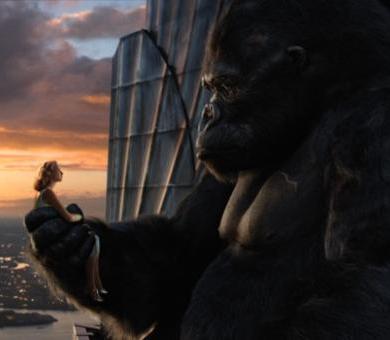 I was also somewhat reminded of Old Yeller in the closing moments, which — it must be said — speaks for how amazing PJ, WETA, and Andy Serkis’ King Kong turned out to be. In fact, this even far outshines their amazing work on Gollum — At no point did I find myself questioning the reality of this Kong, even in the midst of some severe Tyrannosaurus Rex bashing. The Dian Fossey gloss on the relationship between Darrow & Kong helped too — In perhaps the cleverest update of the old Kong, Darrow utilizes a very unique set of skills to bond with the Great Ape. And it’s those scenes — and their other quiet moments together — that are the most memorable aspects of this Kong, which is no small feat given the action flourishes of the second act.
In sum, King Kong is an amazing film, and easily one of the best movies of this year. But, to be fair, it’s also undeniably too indulgent at times, and I think it ultimately fails to achieve the transcendent heights of the Rings trilogy. (But I’ll freely admit to having more of an emotional investment in Tolkien than I do in the original Kong.) At the very least, it’s definitely worth seeing, not only as a world-class monster movie but also as a worthy retelling of one of the cinema’s greatest stories.