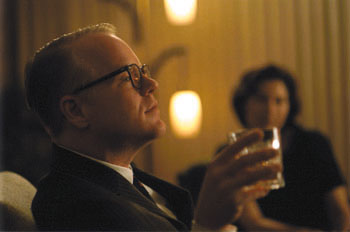
“Saddam is gone. It’s a good thing, but I don’t agree with what was done. It was a big mistake. The American government made several errors … one of which is how easy it would be to get rid of Saddam and how hard it would be to unite the country.” On the day after the GOP-controlled Senate tightened the reins on Dubya, President Clinton reasserts his contempt for this administration’s rank amateurism in Iraq and the Middle East.
Month: November 2005
We don’t torture…they do.
Another week, another secret torture center…anyone else sensing a pattern? Tensions in Iraq simmer to a boil as a secret prison holding 173 Sunnis is uncovered in Baghdad. “The discovery…created a new aura of crisis for American officials and Iraqi politicians who hold power in the Shiite-led transitional government. For many Iraqis, the episode carried heavy overtones of the brutality associated with Saddam Hussein and his Sunni-dominated government.“
Whatsmore, the head of the Badr Organization, a Shiite militia suspected of pulling the strings and wielding the implements in this center, says: “This bunker is run by the Interior Ministry, the Americans are there every day.” Whether or not that’s true (and for the love of Pete, let’s hope not), it’s obvious that recent events, from Abu Ghraib to the Frist-sanctioned CIA black sites to the al-Jamadi murder, have seriously damaged our credibility as opponents of torture, in this prison and around the world.
IV for V.
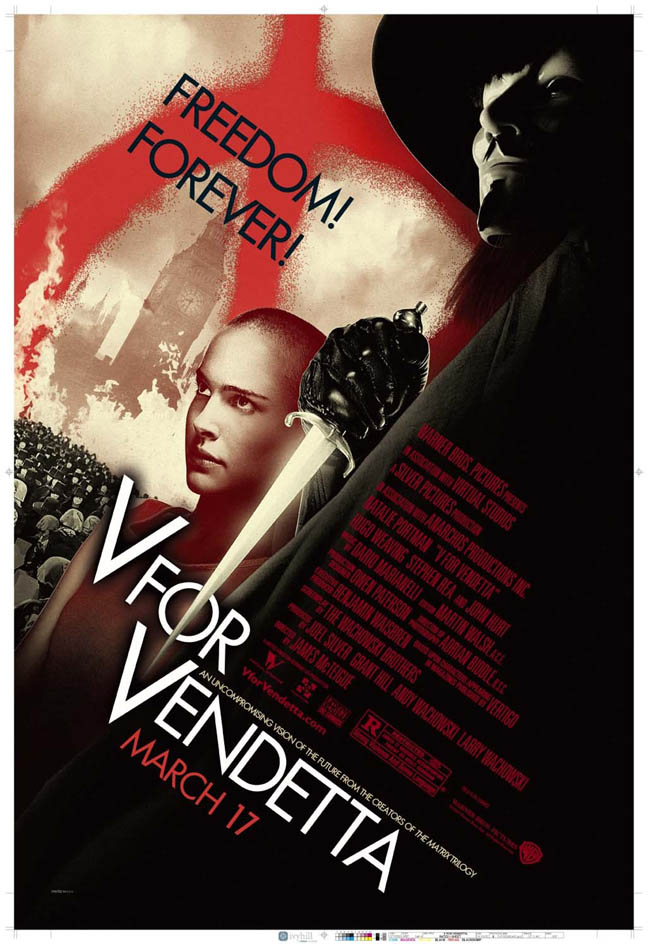 Remember, remember, the…17th of March? Guy Fawkes teams up with St. Patrick this year as the ad blitz begins for the rescheduled V for Vendetta. Here’s one of four new teaser posters, with the rest to be released sometime today. Update: The others are here, here and here.
Slick.
Well, I guess that explains why the GOP didn’t swear ’em in. The Post obtains a smoking gun document that proves, contrary to their statements last week, big-time oil executives met with Cheney’s energy task force to determine the nation’s energy policy in 2001. No big surprise there — While Cheney has been trying to hide records of the meetings for years, we’ve known that 62 of 63 members of the task force had ties to the coal, nuclear, or oil industries, with nary an environmental group in sight. Plus, it was clear at the time that the final energy plan was tailored by Enron for Enron, and their ilk. Still, this does mean that Big Oil lied bald-faced to Congress (and specifically Sen. Frank Lautenberg, who asked them about this directly.) And, while perjury’s not on the table, “a person can be fined or imprisoned for up to five years for making ‘any materially false, fictitious or fraudulent statement or representation’ to Congress.”
All the President’s Men.
Washington Post editor Bob Woodward testifies to the Fitzgerald grand jury about a third senior White House official involved in disclosing the identity of Valerie Plame, besides Libby and Rove. (Woodward’s statement.) This means Libby likely wasn’t the first to leak Plame’s identity, but the new info has no bearing on his perjury or obstruction of justice indictments.
For Woodward’s part, his statement and public comments about the case alternate between high dudgeon (“It was the first time in 35 years as a reporter that I have been asked to provide information to a grand jury”) and open ridicule (“When I think all of the facts come out in this case, it’s going to be laughable because the consequences are not that great.“) Mostly, he just seems cranky that he — award-winning journalist Bob Woodward! — was forced to take time away from another puff piece book on Dubya to testify about a felony in the White House. But this isn’t news. Frankly, Woodward has been embarrassing his legacy for years…almost any of his talking-head stints on Larry King illustrate that. Since at least the early Clinton years, he’s been more desirous of maintaining his high profile and insider status than in promoting good journalism or good government. (And in that, he’s reflected the trajectory of many in the newsmedia.) Update: The Post is somewhat irked.
Six in the City.

A Turning Point in the Senate?
Wary of increasing public opposition to the Iraq war and spurred to action by a Democratic amendment advocating a specific timetable for withdrawal, Senate Republicans craft legislation calling for an Iraq exit strategy. “On the Iraq resolutions, the Democratic and Republican proposals say that ‘2006 should be a period of significant transition to full Iraqi sovereignty, with Iraqi security forces taking the lead for the security of a free and sovereign Iraq, thereby creating the conditions for the phased redeployment of United States forces from Iraq’…The White House is also directed ‘to explain to Congress and the American people its strategy for the successful completion of the mission in Iraq.'” Unfortunately, with the exception of quarterly reports to Congress on the war effort, the language of the proposal is not binding. Update: It passes, 98-0 (Lamar Alexander and Governor Corzine didn’t vote.)
Indiana vs. Identity Theft.
Armed only with his trusty Finger of Death and a deep, abiding love for his family, Security specialist Harrison Ford faces off against evil Paul Bettany in the highly spoileriffic trailer for Firewall, also starring Virginia Madsen, Robert Patrick, and Alan Arkin. I’m rooting for a Ford comeback one of these days, but this warmed-over retread of other Ford films doesn’t look to be the start of it.
Read ’em and weep.
“I am particularly proud of my contributions in recent cases in which the government argued…that the Constitution does not protect a right to an abortion.” An unearthed 1985 job application by Sam Alito is chock-full of scary quotes by the Justice-nominee. “In the document, Alito said he drew inspiration from the ‘writings of William F. Buckley, Jr., The National Review and Barry Goldwater’s 1964 campaign.‘ ‘In college, I developed a deep interest in constitutional law, motivated in large part by disagreement with Warren Court decisions, particularly in the areas of criminal procedure, the Establishment Clause and reapportionment,’ he said.”
The Truman Show.
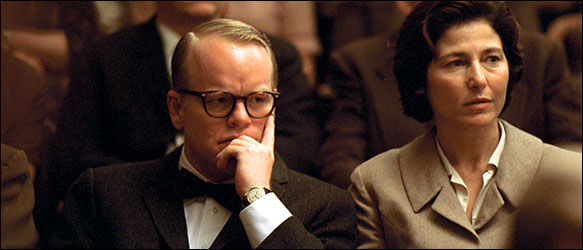
“Ever since I was a child, folks have thought they had me pegged, because of the way I am, the way I talk. And they’re always wrong.” Capote, starring Philip Seymour Hoffman, is a somber and compelling character study of the eponymous author, during the six years he spent in Kansas researching his renowned “non-fiction novel” of true crime, In Cold Blood. It’s a slow-moving film, but a memorable one. I don’t think I’d want to sit through it again anytime soon, but I do expect it’ll be on the short list for Best Actor nods come awards time.
To be honest, I have no memory or sense at all of Truman Capote, so I can only assume that Hoffman’s performance here, with his fey, lilting voice and precise, carefully-constructed mannerisms, is of a piece with the real author. Regardless, Hoffman’s Capote cuts a complex and striking figure that’s hard to take your eyes from — He’s at once vainglorious and needy, extroverted and remote, compassionate and manipulative, convivial and detestable. Intrigued by a newsclipping of four brutal 1959 murders, he and childhood friend Harper Lee (Catherine Keener) venture to the stark landscape of Holcolmb, Kansas, to investigate. Capote soon realizes that that story of the murders could make for a new kind of novel. But, as he comes to befriend the killers — most notably Perry Edward Smith (Clifton Collins, Jr.) — he also discovers that the problem with writing a non-fiction novel is that the characters have lives of their own, and events may not follow the path you necessarily intend.
This is Hoffman’s film through-and-through, and, like I said (sorry, David Strathairn), I expect that he’ll be a tough act to beat come awards season. Still, Capote is also anchored by a strong sense of place and by many fine supporting performances — most notably Collins and Keener — but also Chris Cooper, Bruce Greenwood, Bob Balaban, and The Wire‘s Amy Ryan. Strangely enough, Capote also bookends nicely with last week’s Jarhead, and crystallizes some of my problems with that film. While we were supposed to feel for Pvt. Swofford’s predicament that he’s gone to war and (sniff) can’t actually kill anybody, this film shows the devastating emotional consequences of a not-unrelated predicament — Capote can’t finish his work of genius until “the story ends,” so to speak. And, as Hoffman emphatically illustrates by the end of this powerful film, “More tears are shed over answered prayers than unanswered ones.”