
Only four more years until Election Day 2008, so it must be time for possible contenders to start drumming up some cash. As such, maverick Senator Chuck Hagel of Nebraska contemplates a 2008 bid for the GOP (He seems a decent, rational fellow, which means he’d undoubtedly have a McCain problem in the primary), while some Dems start thinking about Gov. Mark Warner of Virginia.
Month: November 2004
Bigmouth Strikes Again.
“Sweetness, I was only joking…” Arlen Specter learns the hard way that it doesn’t pay to get in the way of Dubya’s shiny, new evangelical steamroller, and will now have to prostrate himself before Catkiller Frist and the loony Right to keep his Senate Judiciary Chairmanship. In the inimitable words of Lando Calrissian, this deal’s getting worse all the time…
Imperial Hubris.
“‘The agency is being purged on instructions from the White House,’ said a former senior CIA official…’Goss was given instructions…to get rid of those soft leakers and liberal Democrats.’” Newsday reports that the recent spate of resignations at the CIA is no accident, but rather a direct attempt by the Bushies to cleanse the agency of their enemies. Great…now I feel much safer.
Code to Perdition.
Forrest Gump battles Opus Dei as Tom Hanks takes the lead in The Da Vinci Code, coming soon to a theater near you from Ron Howard and Brian Glazer (Apollo 13, A Beautiful Mind.) I haven’t read the book, so I can’t really vouch for the casting…but I presume this movie would make ridiculous bank with or without Hanks anyway.
Detroit Red.
The trailer for the Assault on Precinct 13 remake, with Ethan Hawke, Lawrence Fishburne, Brian Dennehy, Ja Rule, Maria Bello, John Leguizamo, Drea De Matteo, and Gabriel Byrne as the Big Bad, is now online. It’s a bit depressing to see Tom Reagan of Miller’s Crossing clearly in the “Paying the Bills” phase of his career, but I guess you could argue it was already in full swing by 1999’s End of Days, versus the Governator.
Masters of Fear.
“But there’s one thing I know, though I’m younger than you — Even Jesus would never forgive what you do.” By way of a friend of mine (and in a striking confluence of the music and civil liberties posts earlier today), a high school band in Colorado — Coalition of the Willing — has the Secret Service sicced on them for practicing Bob Dylan’s “Masters of War.” Hmm…I’ve been known to belt that one quite loudly in the occasional times I plug in around here (It’s basically A-minor throughout.) I guess I’d better begin with a disclaimer from now on to assuage the neighbors.
Don’t Panic!
This is the way the world ends, this is the way the world ends, this is the way the world ends. Not with a bang but…Vogon poetry? The brief teaser for Hitchhiker’s Guide to the Galaxy, rumored since Comicon, is now freely available online. Be sure to check out the production slideshow, which shows off the splendid designs of Marvin the Paranoid Android and the Heart of Gold. Oh, and don’t forget your towel. Update: More production art here.
Incredible Journey.
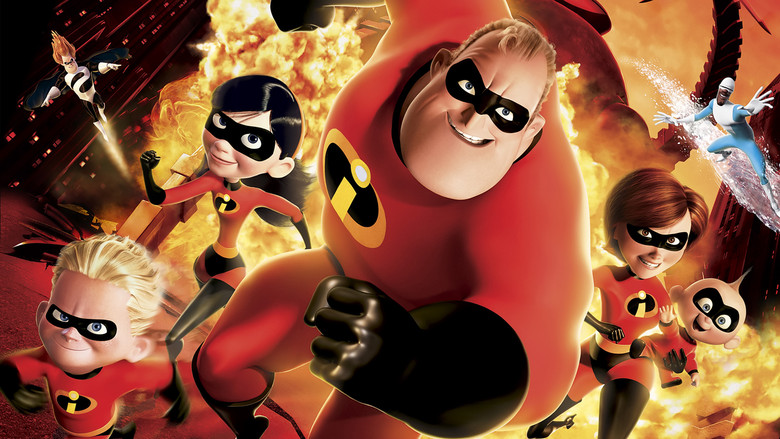
Well, the folks making next summer’s Fantastic Four film must be having a really bad couple of weeks. ‘Cause it’s hard to see how they can even close to topping the energy and fun of Brad Bird’s The Incredibles, Pixar’s new gold standard (and here I thought Toy Story 2 was going to hold that honor for some time to come.) More a film for comic fans than for little kids, The Incredibles is an inventive, madcap romp through superhero tropes that gives Spiderman 2 a serious run for its money as the best comic book film of 2004.
I must say, I was surprised right off the bat at how PG the film turned out to be. This is a darker film than most previous Pixar forays, with a surprisingly high body count and some mordant sight gags in the mix (for example, the montage explaining the trouble with capes). Whatsmore, Mr. Incredible’s most potent villain turns out to be existential ennui at the workplace, which seems as if it might fly right over the heads of the Finding Nemo age demographic.
Their loss, our gain. The Incredibles is a consistently clever ride, right down to the details. The writers and production designers have not only designed robots, ships, and a evil fortress that breathe originality while still paying homage to classic icons (Not unlike Brad Bird’s The Iron Giant in that regard — so take that, Sky Captain.) They’ve also come up with unique applications and situations for some of the hoariest superpowers going (strength, elasticity, speed, etc…Elastigirl’s break-in to Syndrome’s lair stands out as a particular highlight.)
The only real misstep in the film, aside from it feeling maybe 10-15 minutes too long (and, arguably, the Ayn Randish subtext), is the Brad Bird-voiced Edna Mode, who seems like some unholy cross between Vera Wang and Joan Rivers and comes off as somewhat embarrassing and misconceived. Better thought out is Mr. Incredible’s McNamara-esque boss and the “Issue No. 2” villain, The Underminer, whom I very much look forward to in the sequel. But, look, here I am monologuing again…To sum up, as the sinister mime Bomb Voyage might put it, “C’est incroyable!”
Desolation Row.
For the historians and Dylanologists out there (or for those wondering why Dylan would contribute a new song to a flat-out stinker like Gods and Generals), here’s another intriguing passage from Bob Dylan’s Chronicles, on his early days in the archives as a Civil War enthusiast. (Besides Clausewitz, he also professes an admiration for Reconstruction-era Republican Thaddeus Stevens, who “championed the weak” and “made a big impression on me,” in a separate passage. (Chronicles, p. 40))
“I couldn’t exactly put in words what I was looking for, but I began searching in principle for it, over at the New York Public Library, a monumental building with marble floors and walls, vacuous and spacious caverns, vaulted ceiling. A building that radiates triumph and glory when you walk inside. In one of the upstairs reading rooms I started reading articles in newspapers on microfilm from 1855 to about 1865 to see what daily life was like. I wasn’t so much interested in the issues as intrigued by the language and rhetoric of the times. Newspapers like the Chicago Tribune, the Brooklyn Daily Times, and the Pennsylvania Freeman. Others, too, like the Memphis Daily Eagle, the Savannah Daily Herald, and Cincinnati Enquirer.
It wasn’t like it was another world, but the same one only with more urgency, and the issue of slavery wasn’t the only concern. There were news items about reform movements, antigambling leagues, rising crime, child labor, temperance, slave-wage factories, loyalty oaths and religious revivals. You get the feeling that the newspapers themselves could explode and lightning will burn and everybody will perish. Everybody uses the same God, quotes the same Bible and law and literature. Plantation slavecrats of Virginia are accused of breeding and selling their own children. In the Northern cities, there’s a lot of discontent and debt is piled high and seems out of control.
The plantation aristocracy run their plantations like city-states. They are like the Roman republic where an elite group of characters rule supposedly for the good of all. They’ve got sawmills, gristmills, distilleries, country stores, et cetera. Every state of mind opposed by another…Christian piety and weird mind philosophies turned on their heads. Fiery orators, like William Lloyd Garrison, a conspicuous abolitionist from Boston who even has his own newspaper. There are riots in Memphis and in New Orleans. There’s a riot in New York where two hundred people are killed outside of the Metropolitan Opera House because an English actor has taken the place of an American one. [Sic — 23 dead. Bob’s probably conflating the 1849 Astor Riot with the 1863 Draft Riots.] Anti-slave labor advocates inflaming crowds in Cincinnati, Buffalo, and Cleveland that, if the Southern states are allowed to rule, the Northern factory owners would then be forced to use slaves as free laborers. This causes riots, too.
Lincoln comes into the picture in the 1850s. He is referred to in the Northern press as a baboon or giraffe, and there were a lot of caricatures of him. Nobody takes him seriously. It’s impossible to conceive that he would become the father figure that he is today. You wonder how people so united by geography and religious ideals could become such bitter enemies. After a while you become aware of nothing but a culture of feeling, of black days, of schism, evil for evil, the common destiny of the human being getting thrown off course. It’s all one long funeral song, but there’s a certain imperfection in the themes, an ideology of high abstraction, a lot of epic, bearded characters, exalted men who are not necessarily good.
No one single idea keeps you contented for too long. It’s hard to find any of the neoclassical virtues, either. All that rhetoric about chivalry and honor — that must have been added later. Even the Southern womanhood thing. It’s a shame what happened to the women. Most of them were abandoned to starve on farms with their children, unprotected and left to fend for themselves as victims to the elements. The suffering is endless, and the punishment is going to be forever. It’s all so unrealistic, grandiose, and sanctimonious at the same time.
There was a difference in the concept of time, too. In the South, people lived their lives with sun-up, high noon, sun-set, spring, summer. In the North, people lived by the clock. The factory stroke, whistles and bells, Northerners had to “be on time.” In some ways the Civil War would be a battle between two kinds of time. Abolition of slavery didn’t even seem to be an issue when the first shots were fired at Fort Sumter. [Sic! Tell that to John Brown or Alexander Stephens. To be fair, though, elsewhere in Chronicles (pp. 74, 76), Dylan notes other theories for the war’s coming.]
It all makes you feel creepy. The age that I was living in didn’t resemble this age, but yet it did in some mysterious and traditional way. Not just a little bit, but a lot. There was a broad spectrum and commonwealth that I was living upon, and the basic psychology of that life was every bit a part of it. If you turned the light towards it, you could see the full complexity of human nature. Back there, America was put on the cross, died, and was resurrected. There was nothing synthetic about it. The godawful truth of that would be the all-encompassing template behind everything that I would write.
I crammed my head full as of much of this stuff as I could stand and locked it away in my mind out of sight, left it alone. Figured I could send a truck back for it later.” {Chronicles, pp. 84-86 — emphasis and paragraph breaks mine.)
Portending the Nine.
“Indeed, former administration officials say all of the names on Mr. Bush’s short list for the Supreme Court are considered strict constructionists who are closer to Justice Scalia than to Justice O’Connor.” The New York Times tries to figure out if Dubya can actually remake the Supreme Court along “strict constructionist” lines as feared and concludes that, yeah, he probably can.