13 more soldiers dead in Iraq since yesterday, a looming $2.29 trillion deficit over the next ten years…I mean, really, what’s it going to take to persuade people that Amateur Hour in the White House needs to end?
Month: September 2004
It Really Tide the Room Together.
Jeff Bridges joins the cast of Terry Gilliam’s next film after The Brothers Grimm, Tideland.
Because He Says So.
“Don’t listen to the filter, or the facts — listen to the words.” By way of One Good Move and The Daily Show, the RNC Campaign Film George W. Bush: Words Speak Louder than Actions. It’s been making the rounds for a couple of days now, but still, this is a must-watch. (And there’s a transcript at Trenchant.)
All Along the Watchtower.
The International Space Station is soon slated to pick up a princely view.
Culture Shock.

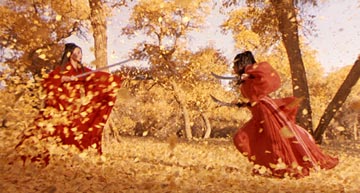
With the movie situation for the next few months looking somewhat grim, I went to see Zhang Yimou’s Hero yesterday with high hopes. But, like a maddening Zen parable, Hero left me of divided mind. Well worth seeing for its colorful meditations on swordplay, music, calligraphy, and story-telling, the film fumbles the sword something fierce when it starts dabbling in political economy…so much so that it basically completely took me out of the movie. Alas, what had started as a very worthy successor to Crouching Tiger, Hidden Dragon ended as an almost laughable exercise in knee-jerk ultra-nationalism. As such, it’s hard not to discuss Hero without resorting to massive spoilers, so here goes.
For much of its running time, Hero is a strikingly kinetic and poetic piece of work that lulls you in with its languid rhythm and sensual colors. As you may or may not know from the ads, a nameless warrior (Jet Li) comes before the rightly paranoid Emperor Qin (a very good Chen Daoming) to tell him of how he managed to eliminate the province’s three most dangerous assassins (an all-star line-up of Donnie Yen, Maggie Cheung, and Tony Leung, with the lovely Zhang Ziyi thrown in to boot.) But, faster than you can say Swift Boat, the Emperor tells Nameless he’s full of it, and offers his own explanation for recent acts of heroism, which are further revised as the film goes forth.
As I said, these various retellings move slowly — even despite the fighting — but with purpose, and are made distinct from one another through color shifts that are at once exquisite and bewitching. But, eventually we come to the end of the story, and therein the problem lies. For, as it turns out, the moral that undergirds our recent contemplations is a pretty reprehensible one (and one you’d think might have been re-evaluated in light of the last century): Namely, that brutal, despicable tyrants must be allowed their cruelties and massacres for the sake of the State.
When this Machiavellian might-makes-right proposition was first uttered by the characters, I thought perhaps I was misreading what was going on. But, no, they go through with it, and almost all of the major characters we’ve been following take a dive in varying fits of nationalistic self-sacrifice, so that the Emperor Qin can gloriously maim, loot, and murder his way into uniting the Middle Kingdom. And, thus the film concludes with the glaring contradiction (pointed out by my friend Jeremy) of mooning over lovers to-be-reunited in “a place without borders” while extolling The Great Wall, still probably the most impressive border every built by humankind.
In sum, Hero is a sumptuous visual feast that’s operating several levels above most schlocky American action pics (including the recent Kill Bills of its US “presenter.”) But the underlying moral sensibility of the final moments is so repellent that it seriously detracts from the film. Call me an incurable Western individualist, but if excusing the crimes of one’s leader for the sake of the (Mother, Father, etc.)Land is heroism, then I’m with Tina Turner. Take it elsewhere, Raggedy Man.
The Rich Get Richer.
Not content with the elements of freak-show conservatism in his acceptance speech or the flattening effect of Dubya’s giveaways to the rich in recent years, Dubya is now threatening an official flat tax (not unlike the one imposed by fiat on Iraq last November.) As even Phil Gramm attested eight years ago, “It’s not fair to say that people who work with their head or with their hands ought to pay taxes, but people who earn their living with their capital ought not to.”
From the White Horse to the White House.
The fallout from the forthcoming and much-awaited Kitty Kelley book on the Bushes breaks on Drudge today, with Kelley exposing a new twist on what has basically amounted to an open secret: In the book, Kelley “quotes…former sister-in-law Sharon Bush who claims: ‘Bush did coke at Camp David when his father was President, and not just once either.’ Other acquaintances allege that as a 26-year-old National Guard, Bush ‘liked to sneak out back for a joint or into the bathroom for a line of cocaine.’” Again, not surprising, given other stories, previous rumors, and Dubya’s nervous habit of incessant sniffling, but it’s nice to see heroic Bush’s wastrel years finally get some play. Perhaps the media will manage to put two and two together.
A Nightmare in November.
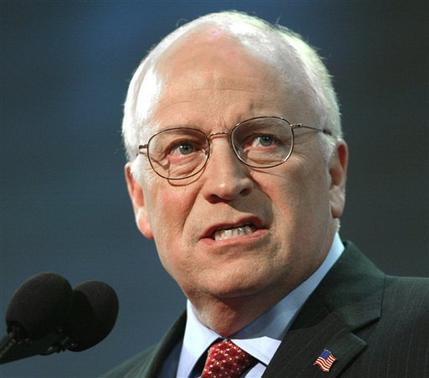
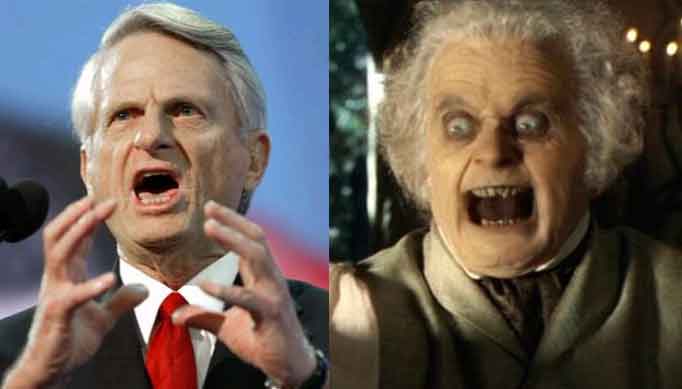
I also found this grisly pic of Angry Cheney on Looka (and Eschaton), and it reminded me of something that I couldn’t quite put my finger on. But, while walking Berkeley this evening, it came to me. In fact, I think I might just have figured out the inspiration behind Karl Rove’s whole two-faced strategy:
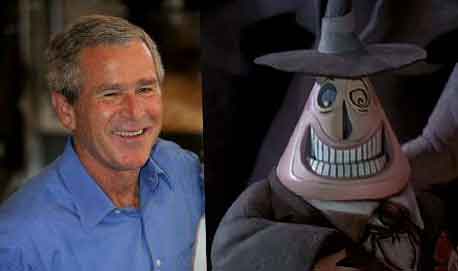
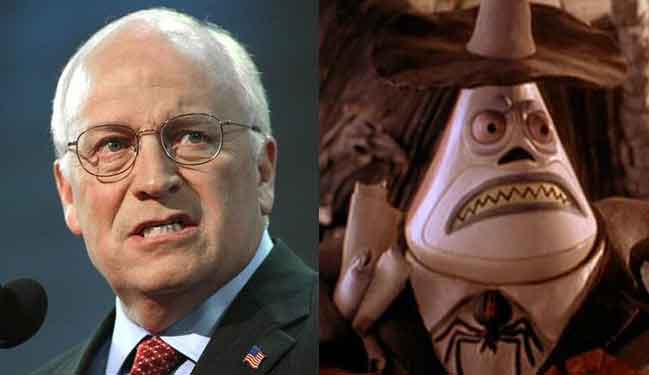
And, just to round out the meme…
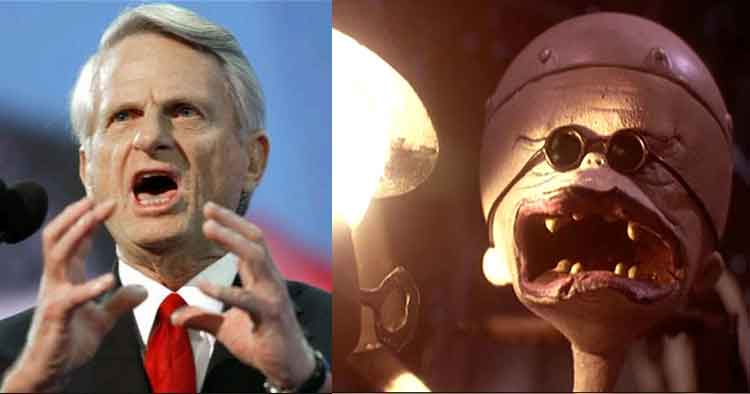
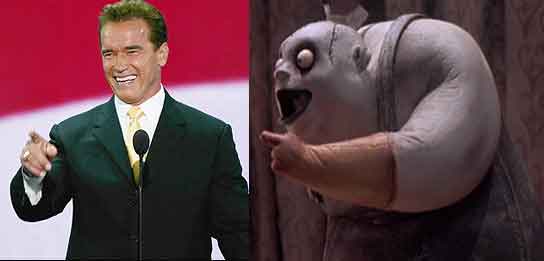
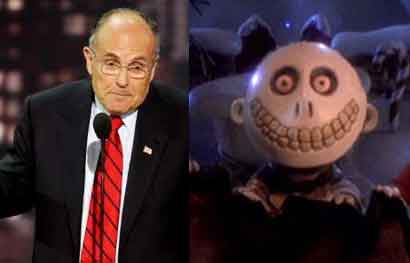
(Pics via HalloweenTown. And a similar take on the Zellout can be found here, also via Eschaton.) Update: The Zellout also brought to mind this, but I ultimately thought it was a disservice to poor Bilbo. He wasn’t that far gone in Rivendell.
Colonial Canines, Political Pooches.
The Post‘s Jonathan Yardley reviews A Dog’s History of America.
Take a Bullet, Get no Ballot.
By way of Looka and the NY Times editorial page, the Defense Department is trying to deny soldiers the secret ballot, and guess who they’re giving the votes to? “Omega Technologies is not an acceptable choice to run the program. Its chief executive, Patricia Williams, has donated $6,600 in this election cycle to the National Republican Congressional Committee, and serves on the committee’s Business Advisory Council. And while everything about the conduct of elections should be open to public scrutiny, Omega is far too secretive.“