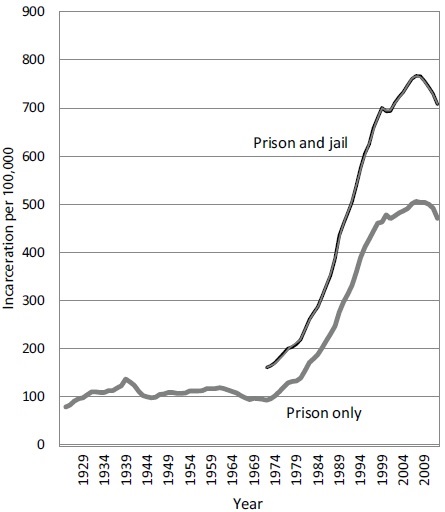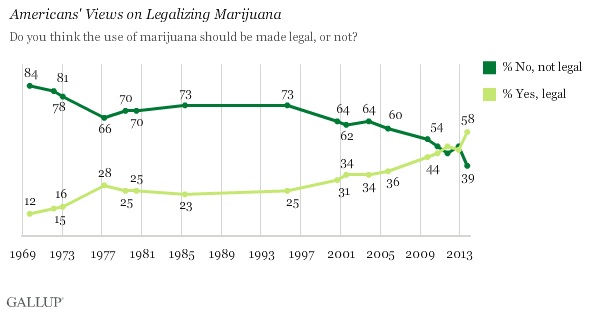

More fruits from Californication: With public support for legalizing marijuana over 50% for the first time, and a new documentary, The House I Live In, once again calling attention to the many cruel absurdities of the Drug War — $1 trillion spent, 2.2 million in prison — signs suggest the ill-advised War on Drugs may finally be receding as a sacrosanct institution in Washington.
“For decades, the politics of the drug war were straightforward: Being tough could help at the polls and came with no political downside; being open to reform had few advantages, but would be used against a candidate on the campaign trail. That calculation is no longer so simple.”

Our culture veers even closer to self-parody upon the news that Florida Atlantic University will name its stadium after a private prison conglomerate. “GEO Group reported revenues in excess of $1.6 billion in 2011, income generated mostly from state and federal prisons and detention centers for illegal immigrants.”
What the?! Honestly, how shameful is it that we ostensible lovers of freedom — mainly on account of our ridiculous incarceration rates (for anything other than white-collar crimes) — not only have a private, for-profit prison industry flourishing in our country — one that routinely maintains substandard prisons and undercuts workers’ wages by outsourcing their captive labor force — but that we’re sufficiently unembarrassed about it to start naming stadiums after them? Pathetic.
Update: FAU students make their displeasure known.


I saw this a few weeks ago, and Follow me Here reminded me of it: As we pass the fortieth anniversary of the failed war on drugs, Wire creator David Simon makes a deal with Attorney General Eric Holder: End the drug war for a Wire season six. As if there weren’t already enough good reasons to do so, S6 would be the cherry on top.

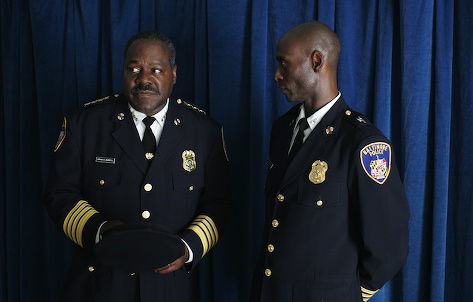
I’ve been meaning to blog this for a few days, via Genehack: After the show is harangued by Baltimore’s current police commissioner, the consistently take-no-guff David Simon sticks up for his creation, The Wire. “As citizens using a fictional narrative as a means of arguing different priorities or policies, those who created and worked on The Wire have dissented.“
“Our nearly century-long experiment in banning marijuana has failed as abysmally as Prohibition did, and California may now be pioneering a saner approach.” In very related news, the NYT’s Nick Kristof makes a case for Prop 19. “One advantage of our federal system is that when we have a failed policy, we can grope for improvements by experimenting at the state level. I hope California will lead the way on Tuesday by legalizing marijuana.” (Note also the example of Portugal, as studied by Glenn Greenwald.)
“It’s one thing to recognize capitalism for the powerful economic tool it is and to acknowledge that, for better or for worse, we’re stuck with it and, hey, thank God we have it. There’s not a lot else that can produce mass wealth with the dexterity that capitalism can. But to mistake it for a social framework is an incredible intellectual corruption and it’s one that the West has accepted as a given since 1980–since Reagan…People paid a much higher tax rate when Eisenhower was president, a much higher tax rate for the benefit of society, and all of us had more of a sense that we were included.“
By way of DYFL, Vice Magazine publishes an extended interview with David Simon on The Wire Treme, writing, political economy, health care reform, and other important matters. “Of course it’s socialism. These ignorant motherf**kers. What do they think group insurance is, other than socialism? Just the idea of buying group insurance! If socialism is a taint that you cannot abide by, then, goddamn it, you shouldn’t be in any group insurance policy.“
“‘There are only two possibilities here,’ Mr. Webb said in introducing his bill, noting that America imprisons so many more people than other countries. ‘Either we have the most evil people on earth living in the United States, or we are doing something dramatically wrong in terms of how we approach the issue of criminal justice.‘”
In his latest column, the NYT’s Nicholas Kristof makes the case anew for comprehensive criminal justice reform. “[O]ver all, in a time of limited resources, we’re overinvesting in prisons and underinvesting in schools. Indeed, education spending may reduce the need for incarceration…Above all, it’s time for a rethink of our drug policy.” (Via Sententiae.)
“‘The commission could be the most ambitious attempt to re-examine and reform the criminal justice system since the 1960s,’ said Mark Mauer, executive director of the Sentencing Project, a nonprofit group that supports reducing incarceration rates. ‘It is a huge undertaking,’ he said.” As he promised a few months ago, Sen. Jim Webb begins the push for a bipartisan commission on prison reform. (Webb’s effort drew particular kudos from Salon‘s Glenn Greenwald this morning.)
Speaking of which, count me among the many (like Greenwald) who found Obama’s glib answer on drug decriminalization during the online town hall the other day to be too smug and snickering by half. People are spending their lives in prison for basically harmless behavior that he — and countless other tsk-tsking political elites — engaged in. That’s not really something to chuckle about.
That being said, it’s obvious that, with everything else going on, Obama has nowhere near the political capital he would need to deal with this sort of thing right now, even if he does possess the inclination. But, Webb’s proposed commission might be exactly the sort of body that could grant Obama the cover he needs to get serious about drug and prison reform. In fact, other than punting on a popular issue like social security, which prison reform emphatically isn’t, that’s pretty much the sole purpose of a bipartisan commission.
Update: In very related news, NY Gov. David Paterson announces a deal has been struck to soften NY’s draconian Rockefeller drug laws and get rid of many mandatory minimums. “‘Since 1973, New York has had the harshest drug laws in the country, and they have simply not worked,’ Paterson said Friday in a radio interview.”
“‘I feel very strongly we have a co-responsibility,’ Clinton told reporters accompanying her to Mexico City a day after the Obama administration said it would send more money, technology and manpower to secure the Southwestern frontier and help Mexico battle the cartels.” During a visit to our ailing neighbor, Secretary of State Clinton admits American culpability in the exacerbating of Mexico’s drug war. “‘Our insatiable demand for illegal drugs fuels the drug trade,’ she said. ‘Our inability to prevent weapons from being illegally smuggled across the border to arm these criminals causes the deaths of police officers, soldiers and civilians… Clearly, what we have been doing has not worked and it is unfair for our incapacity… to be creating a situation where people are holding the Mexican government and people responsible,’ she said.’That’s not right.’“
Well, cheers to Sec. Clinton for being honest about some of the causes of Mexico’s escalating drug violence. Still, in pledging tighter borders, more troops, yadda yadda yadda, she and the administration are still dancing around one of the more obvious solutions to the problem.
“I think you can be a law-and-order leader and still understand that the criminal justice system as we understand it today is broken, unfair, locking up the wrong people in many cases and not locking up the right person in many cases.” In an auspicious sign for 2009, Sen. Jim Webb (D-VA) announces he’ll be taking at stab at criminal justice and prison reform in the coming year. “Webb aims much of his criticism at enforcement efforts that he says too often target low-level drug offenders and parole violators, rather than those who perpetrate violence, such as gang members. He also blames policies that strip felons of citizenship rights and can hinder their chances of finding a job after release.“
It sounds like he’s on the right track, and bully to Sen. Webb for even taking this issue — normally not one that brings in the votes — on. (Let’s hope Webb knows his Wire.)
Of course, a lot of headway could be made if we just started taking a saner approach to drugs in this country, i.e. unclogging the justice system of non-violent drug offenders and doing away with mandatory minimums. From there, I hope Sen. Webb sets his sights on the shameful and grotesque private, for-profit prison industry that has sprouted here in America. I for one believe running an unsafe, substandard prison and getting rich by outsourcing your supply of “captive” laborers to corporations that don’t want to pay market wages is much more immoral and criminal behavior than getting high in some fashion and being unlucky (and/or black) enough to get caught. And I don’t think I’m in the minority in this assessment anymore.
“What the drugs themselves have not destroyed, the warfare against them has. And what once began, perhaps, as a battle against dangerous substances long ago transformed itself into a venal war on our underclass. Since declaring war on drugs nearly 40 years ago, we’ve been demonizing our most desperate citizens, isolating and incarcerating them and otherwise denying them a role in the American collective. All to no purpose. The prison population doubles and doubles again; the drugs remain.“
On the eve of the final episode, the writers of The Wire — Simon, Burns, Lehane, Pelecanos, and Price — argue in favor of jury nullification as an act of civil disobedience against America’s failed drug war. “If some few episodes of a television entertainment have caused others to reflect on the war zones we have created in our cities and the human beings stranded there, we ask that those people might also consider their conscience. And when the lawyers or the judge or your fellow jurors seek explanation, think for a moment on Bubbles or Bodie or Wallace. And remember that the lives being held in the balance aren’t fictional.“
One of the staples of the failed drug war, mandatory minimums take two substantial hits as the Supreme Court decides 7-2 in favor of judicial discretion in a pair of drug cases, Kimbrough v. U.S. and Gall v. U.S. “Justices Clarence Thomas and Samuel A. Alito Jr. dissented in both cases.”
“This final season of the show, Simon told me, will be about ‘perception versus reality’ — in particular, what kind of reality newspapers can capture and what they can’t. Newspapers across the country are shrinking, laying off beat reporters who understood their turf. More important, Simon believes, newspapers are fundamentally not equipped to convey certain kinds of complex truths. Instead, they focus on scandals — stories that have a clean moral. ‘It’s like, Find the eight-hundred-dollar toilet seat, find the contractor who’s double-billing,’ Simon said at one point. ‘That’s their bread and butter. Systemic societal failure that has multiple problems — newspapers are not designed to understand it.“
A huge find by way of Chris at Do You Feel Loved?: Margaret Talbot offers a long-form New Yorker profile on David Simon and The Wire. (If you haven’t yet seen Season 4, I recommend bookmarking this for now — it gives away many of S4′s major beats.) There’s also a good deal of spoilerish information on what to expect from Season 5, what David Simon wants to do next, and who’s singing this season’s version of “Way Down in the Hole.” (I’ll give that one away…Bubbles’ sponsor, Steve Earle — listen here.) “Simon makes it clear that the show’s ambitions were grand. ‘”The Wire” is dissent,’ he says. ‘It is perhaps the only storytelling on television that overtly suggests that our political and economic and social constructs are no longer viable, that our leadership has failed us relentlessly, and that no, we are not going to be all right.’”
“‘Conservatives got everything they could reasonably have hoped for out of the term,’ said Thomas C. Goldstein, a Washington lawyer who specializes in Supreme Court litigation.” Proving the crucial importance of the Alito-O’Connor switch (and, I’ll continue to maintain as my answer to Emily Bazelon’s line of questioning, the 2004 election), the Roberts Court flexed its muscle in depressing fashion this week, voting 5-4 (as feared) not only to gut the McCain-Feingold act in the name of “free speech” but also — seriously, no lie — to partially roll back Brown v. Board of Education. (In another well-reported case, the majority’s inordinate fear of bongs trumped this stalwart commitment to free speech.) So, if you’re keeping score, Roberts, Alito, Scalia, Thomas, and Kennedy came down like this: money good, corruption good, drug hysteria good; clean politics bad, youthful irony bad, integration bad. Oh, wonderful. Suddenly, the announcement that the Court will take a look at the Guantanamo cases doesn’t sound so appetizing. Update: Slate‘s slate of legal observers discuss.
“Given the State Department’s $32 billion budget, an additional $1 million for food hardly ranks as a major scandal. But this tangled tale of how an Alaskan tribal company ended up in a South American tropical forest sheds an illuminating spotlight on the often-secretive world of federal contracting, an area of government rife with abuse and poor oversight.” Our government in action: Salon‘s Michael Scherer explains how Alaskan Eskimos won a no-bid contract to feed cocaine-fighting Bolivians, with the help of Senator “Bridge to Nowhere,” Ted Stevens. Here’s a hint: Halliburton is involved.
HBO’s The Wire, lauded around these parts many times over, will be shown from the beginning on BET starting tomorrow night at 9pm. Personally, I’d recommend renting (or buying) the DVDs, so as to avoid commercials and see the episodes uncut (and to allow for the indulgence of binge-watching, which may well become the norm in your household by the end of Season 1.) But, if for some reason you can’t be bothered, BET’s the place to be tomorrow night.
Newly released — and somewhat controversial — FBI files, dating from the former Chief Justice’s two confirmation battles in 1971 and 1986, disclose that William Rehnquist battled a painkiller addiction in the early ’80s while serving on the Court. “Doctors interviewed by the FBI told agents that when the associate justice stopped taking the drug, he suffered paranoid delusions. One doctor said Rehnquist thought he heard voices outside his hospital room plotting against him and had ‘bizarre ideas and outrageous thoughts,’ including imagining ‘a CIA plot against him’ and ‘seeming to see the design patterns on the hospital curtains change configuration.’ At one point, a doctor told the investigators, Rehnquist went ‘to the lobby in his pajamas in order to try to escape.’“
Regarding ballot initiatives, it was a bad night for same-sex marriage and marijuana decriminalization. Still, there’s cause for hope around the country in the six state minimum-wage hikes that passed, as well as the repudiation of the stringent abortion law in South Dakota (Justice Kennedy: take note.) Speaking of the Court, its eminent domain decision of last year took a beating in nine states, although California, Idaho, and Washington thankfully repudiated stronger measures that would effectively hobble any kind of federal land regulation.
That font of compassion for drug addicts, Rush Limbaugh, cuts a deal with prosecutors, copping to a lesser charge of prescription fraud that will be stricken from his record should he stay in rehab for 18 months. “A spokesman for the state’s attorney’s office, Mike Edmondson, said the agreement dropping the charge is ‘standard for first-time offenders who admit their addiction.‘” Well it wouldn’t be if Rush had anything to say about it…
“This is certainly not the first time that politics has trumped science at the FDA. Another recent example: the agency’s decision to block over-the-counter availability for emergency contraceptives in the face of overwhelming evidence that the treatment is safe and effective…From my standpoint as a doctor, the question is this: What do you do when federal agencies become so politicized that their recommendations can’t necessarily be trusted?” In Slate, pediatrician Sydney Spiesel begins to doubt the FDA’s credibility these days, particularly after their recent and apparently blatantly political decision against medicinal marijuana. “Marijuana as a medicine — whatever its risk and benefits are eventually determined to be — may turn out to be much less important than the question of whether we can count on agencies like the FDA to be honest in their dealings.”
“Secretary Rumsfeld’s energetic and steady leadership is exactly what is needed at this critical period. He has my full support and deepest appreciation.” In response to the growing calls for Rumsfeld’s resignation among retired top brass, Dubya chooses instead, as per his usual M.O., to hug Rummy tighter to his breast. (full text.) And, in related news, Salon‘s Michael Scherer and Mark Benjamin argue that Rumsfeld was “personally involved” in at least one questionable interrogation at Gitmo in 2002.
A defeat for medicinal weed is a victory for federal authority under the Interstate Commerce Clause in today’s 6-3 Supreme Court ruling upholding federal laws against marijuana. Wrote John Paul Stevens in the majority opinion, “[t]he Controlled Substances Act is a valid exercise of federal power, even as applied to the troubling facts of this case.” (The losing side consisted of Justices O’Connor, Rehnquist, and Thomas.) This is a tough one. I think prosecutions of sick people seeking medicinal marijuana to alleviate their daily miseries are grotesquely ill-conceived, but, then again, I’m not for rolling back federal power to pre-Civil War levels, either. And, for what it’s worth, “some lawyers who have followed the controversy closely predicted that the ruling, while disappointing, would not bring sweeping changes, since most marijuana prosecutions are undertaken by state and local officials rather than federal authorities.“
Despite what Sharon Bush is saying now, the NY Daily News declares it has spoken to “an unimpeachable source” who can confirm her earlier declaration of Dubya coking up at Camp David. As Drudge might say, developing…

Based on new information unveiled during last night’s 60 Minutes II, the big papers delve further into Dubya’s AWOL shenanigans. Apparently, not only was Dubya suspended from flying due to his missed physical (which we already knew), but he blatantly ignored a direct order from his commanding officer (Col. Jerry Killian, now deceased) to report for a medical examination. (Killian complained in a private letter, heretofore unreleased, that Dubya was “talking to someone upstairs” to get out of it.) Nor, as the Boston Globe noted yesterday, was Dubya — pictured at right wearing a ribbon he apparently never earned — ever called to active duty or otherwise punished for this insubordination, or for any of his later lapses (such as not showing up for reserve duty in either Alabama or Massachusetts, as ordered.) “‘It appears that no one wanted to hold him accountable,’ said retired Major General Paul A. Weaver Jr., who retired in 2002 as the Pentagon’s director of the Air National Guard.” Yeah, what else is new?
Meanwhile, on the drug front, Sharon Bush is now trying to back away from her comments to Kitty Kelley on Dubya’s alleged cocaine binging at Camp David. But, Doubleday is standing by the charge – in fact, they’ve got written notes and two witnesses (Kelley and her publisher) to verify Bush’s original statement. Good for them…I would think Doubleday has planned very carefully for exactly this sort of thing prior to going public with any allegations from The Family.
Now, with the further details about Dubya’s disappearance and the extent of his alleged coke habit each gaining notoriety in separate news channels, how much longer will it take before the major media outlets are forced to comment on the obvious drug test angle connecting the two threads? One has to wonder if the GOP strategy gurus are starting to rethink their not-so-Swift-Boat decision to put Vietnam in play.
As Kerry readies for the big fight ahead, the GOP starts getting real ugly, with doctored Hanoi Jane photos and Drudge-inspired, Murdoch-driven tales of a possible extra-marital dalliance. Yep, the GOP sure loves them the adultery card, but I don’t think that dog will hunt this time around…not after the impeachment fiasco. Update: The accused woman says drop it, already, and Drudge — without apologizing for slandering her or Kerry — changes his tune about the alleged affair.
On the flip side of the card, Dubya’s Document Dump answers few questions about his guard duty, and reports are now surfacing of National Guard documents destroyed by Governor Bush’s people in 1997. And then, of course, there’s the matter of that skipped drug test…
The LA Times relates the sad story of Ansar Mahmood, who has paid a heavy price for being a Muslim in America after 9/11. In not-unrelated news, Ashcroft cracks down on lenient sentencing. Perhaps they’ll reconsider his nephew’s drug bust, then.
The Boston Globe sheds a little light into the dark corridors of oppo research. Of course we already know Dubya was a alcoholic cokehead who went AWOL for a year to escape a drug test and had so little sense that he’d drive around drunk…and we still elected him for four years. So skeletons in the closet just ain’t what they used to be.
Good riddance, Nick and Norm. In what alcoholics commonly refer to as a “moment of clarity,” the ONDCP thankfully gives up on their controversial and often misleading drugs-and-terror ad campaign. Perhaps the admin’s drug warriors have figured out what Dubya can’t seem to recognize – some arguments have to be made without resort to 9-11. Or perhaps the ad gurus finally figured out the simple error in their twisted logic: No prohibition, no inflated drug profits. Not that complicated. Update: Medley offers a concise summary of recent developments – Instead of reducing ineffective spending, [ONDCP] is eliminating the research that shows its spending is ineffective. Brilliant.
If our new Ministry of Information is run with half the honesty and integrity of our ONDCP, it looks like everything will end up just swimmingly. Turns out Dubya’s drug czar grossly misrepresented marijuana potency several times in order to help bury the recent Nevada referendum.
Salon delves into the case of Noelle Bush before Florida’s courts. Who would’ve guessed that a Governor’s daughter would receive special treatment, or that GOP lawmakers would prescribe different rules for the masses than they would their own family members?
The bid to allow recreational marijuana use in Nevada gains steam, prompting much gnashing of teeth at the ONDCP.
Giving new meaning to the term “War on Drugs,” the Air Force is giving pilots uppers and downers for bombing raids. If it’s anything stronger than a Red Bull, it’s probably not a good idea, as no doubt many Afghan civilians can attest. (Via Genehack.)
Noelle Bush gets rehab, the poor and black get hard time. Salon surveys the coalition to overturn NY’s Rockefeller laws. (Via Quiddity.)
Bob Herbert takes aim at the Rockefeller drug laws, now almost thirty years old. The ethnic differentials in the enforcement of the drug laws are extraordinary. While there is wide use of illegal drugs across the ethnic spectrum, including among whites, 94 percent of the people doing time for drug offenses in the state of New York are black or Hispanic. Indeed, according to one of the laws’ original sponsors, “New York now sends more African-American and Latino men to prison each year than it graduates from its state colleges and universities.”
In a burst of common sense the likes of which we’re probably not going to see Stateside for some time to come (except maybe in Nevada), Britain relaxes its cannabis laws to focus on more dangerous drugs.
So much for Independence Day. “The majority opinion in Earls reflects some of the worst results-based decision-making we’ve seen since Bush v. Gore. And like Bush v. Gore, it is rooted in panic, expediency, and a twisting of prior precedent to fit the facts.” Dahlia Lithwick excoriates the Supreme Court for their recent decision to force urine tests on high school kids.