
Update…But Not Today.
Haunting the Web Since 1999

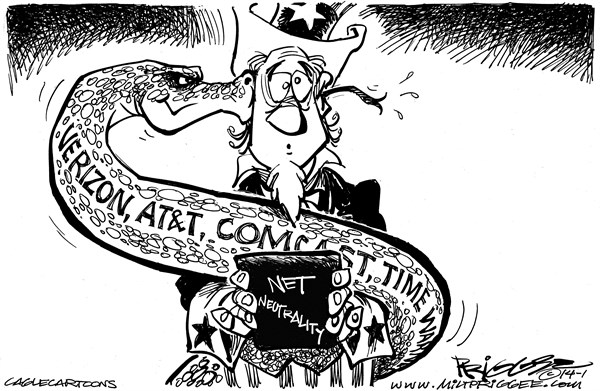
To be clear, Obama’s FCC, under both Julius Genachowski and now Tom Wheeler, has been completely chicken-shit on this issue from Jump Street. The answer is and has always been to reclassify ISPs as telecommunications services, which they obviously are. But, instead, Genachowski tried to placate the Comcasts of the world and split the baby on this issue in 2010. The result was so ridiculous that the Court rejected his entire plan, and now Wheeler — a former cable lobbyist — is completing the cave.
This also counts as a(nother) blatant and egregious broken promise from President Obama — one so bad that Nancy Pelosi has already broken ranks. Here’s Obama in 2007: “‘The answer is yes, I am a strong supporter of Net neutrality.’…Obama added that companies like Google may not have gotten started without a ‘level playing field’ and pledged to make sure Net neutrality ‘is the principle that my FCC commissioners are applying as we move forward.'” (Cartoon by Cagle.)
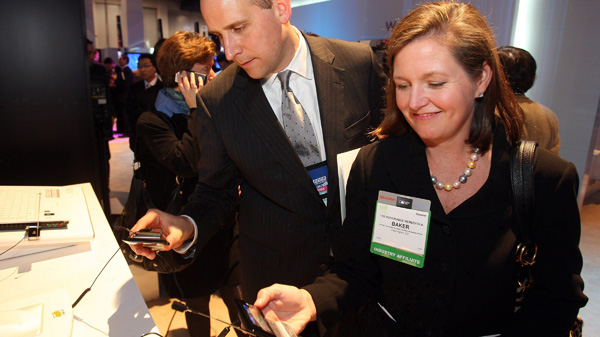
Democracy in action: Soon after working to get the Comcast-NBC merger approved at the FCC, Republican commissioner Meredith Attwell Baker steps down to become a senior VP of the merged company. “At the time, Baker objected to FCC attempts to impose conditions on the deal and argued that the ‘complex and significant transaction’ could ‘bring exciting benefits to consumers that outweigh potential harms.‘”
One small silver lining amid the sordidness here: The merger was approved in mid-January, and it’s now early May. So this sweetheart deal actually marks the fastest that Comcast has ever managed to service one of its customers.
“The message: the FCC Chairman caved to the most powerful interests and is adopting a rule that may end the Internet’s historic openness to all software and content as a level playing field. This will undermine the Internet’s role in as an engine of economic innovation and democratic participation. The rule was written by and for the giants like AT&T, Verizon, and Comcast, who are cheering the rule. And the FCC Chairman is trying to fool the public into believing they should thank him.“
After earlier explaining why the FCC’s compromise(d) stance was “garbage”, Marvin Ammori laments Julius Genachowski’s sad sell-out on net neutrality. While the president is claiming victory here — it does, after all, follow the “solomonic or moronic” splitting-the-baby approach he likes to bring to every issue — everything you need to know about it is summed up in one sentence in Wired: “There was one group, however, which seemed content with the new rules: the nation’s cable and telecommunications companies, including AT&T, Comcast and Verizon.“
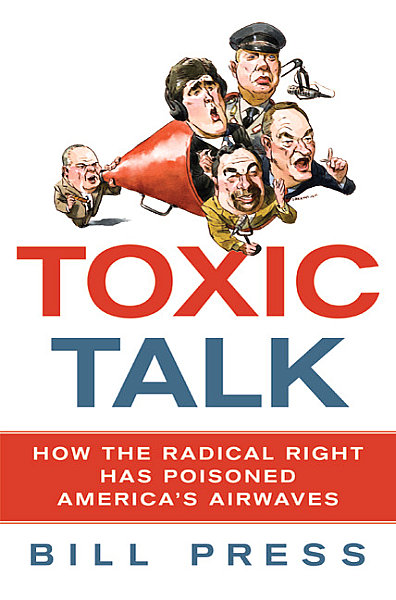 “Ever since 1987 and the end of the Fairness Doctrine, which freed station owners from having to provide any balance on the air, conservatives have dominated talk radio. To the point where today, according to a 2007 report of the Center for American Progress, there are at least 10 hours of right-wing talk for every one hour of progressive talk. And that’s a real problem. Not simply because this torrent of hate is unpleasant for most people to listen to. But because it also debases the level of political discourse in this country, at a time when we need it the most.“
Personal plug: Bill Press’ Toxic Talk: How the Radical Right Has Poisoned America’s Airwaves, which I worked on in a research and editing capacity last year, is hitting bookstores today. (As longtime readers may remember, this is our fifth book together, along with Spin This (2001), Bush Must Go (2004), How the Republicans Stole Christmas (2005), and Trainwreck (2008).) In any case, I suspect regular readers here — all ten of you! — should be sympathetic to its central thesis: Right-wing talk radio is bad for our politics and for our country. (And hat-tip to Media Matters, a key resource for this book, for watchdogging these blustery carnival barkers on a full-time basis.)
While the Big ISPs begin to mount their counter-offensive, the usual blatherers on the Right are, naturally, decrying the decision as Phase 2 in the administration’s socialist-cryptofascist takeover to take over all things good and wonderful. Suffice to say, they don’t seem to understand the issue or the Internet very well. (Also, this is really a side matter, but, regarding the highly goofy “Big Guvmint is taking over the Internet!” meme: This is completely and utterly not true in any way. But, just so we all have the history straight: Big Guvmint created the Internet. If you haven’t heard of DARPA or J.C. Licklider, think Al Gore.)
“The response from Net Neutrality opponents has been fast and furious — but short on facts. The arguments and rhetoric being pushed by the phone and cable industry mostly consist of long-discredited arguments and myths…this policy debate must be bound by facts and reality, not by misdirection and discredited falsehoods.” The Free Press‘s S. Derek Turner refutes ten lousy arguments against Net Neutrality (PDF).
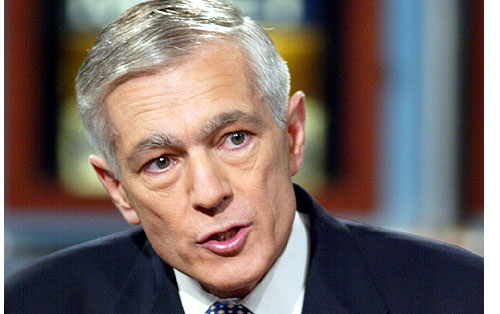
“‘As he’s said many times before, Senator Obama honors and respects Senator McCain’s service, and of course he rejects yesterday’s statement by General Clark,’ Obama spokesman Bill Burton said in a statement.” So…I guess Wes Clark won’t be the veep. For some ill-defined reason, the Obama campaign sees fit to throw the general under the bus because Clark, a guy I run hot and cold on, simply stated the obvious. Getting shot down over Vietnam, however ostensibly character-building, in no way constitutes executive experience: “I certainly honor his service as a prisoner of war. He was a hero to me and to hundreds of thousands and millions of others in the armed forces as a prisoner of war. And he has traveled all over the world. But he hasn’t held executive responsibility…I don’t think riding in a fighter plane and getting shot down is a qualification to be president.”
Said Obama in Independence today: “McCain had ‘endured physical torment in service to our country’ and ‘no one should ever devalue that service, especially for the sake of a political campaign, and that goes for supporters on both sides.’” Fair enough, but that wasn’t at all what Clark was doing. McCain’s basically getting away with the same sort of resume inflation as Sen. Clinton did in the primaries, and Clark — a five-star general who knows what he’s talking about — called him on it.
One could argue that there’s a method to this move by the Obama campaign, but even that theory suggests a certain ugly political opportunism at work. (One could also argue karma had some part to play in all this, since Clark earlier jumped all over Samantha Powers’ gaffe during the primaries.) Nonetheless, between this, the Senator’s switchback on telecom immunity (which I discussed in the comments here), and various other recent triangulations, the Obama campaign has had a pretty lousy week. I don’t know if it’s the recent influx of “veteran” hands, an attempt to beat back the National Journal liberal label, or just an early-summer malaise, but that sickly-sweet smell of Old-School Dem Politics is lingering in the air. Get it together, y’all. I know the polls look good, but this defensive-minded playing-not-to-lose is assuredly not the way to go.
Update: “I’ve said this for some weeks now, they’ve been repeated many times.” Clark sticks to his guns, and Webb has his back. Meanwhile, Salon‘s Glenn Greenwald makes the case against Obama’s last two weeks: “There is no question, at least to me, that having Obama beat McCain is vitally important…[but] his election is less likely, not more likely, the more homage he pays to these these tired, status-quo-perpetuating Beltway pieties.“
Update II: Obama clarifies on Clark: “I don’t think that General Clark you know had the same intent as the swift boat ads that we saw four years ago, I reject that analogy…I think in at least one publication was reported that my comments yesterday about Senator McCain were in a response to General Clark. I think my staff will confirm that that was in a draft of that speech that I had written two months ago.”
Update III: Fred Kaplan has a theory about Clark v. McCain: Grunts are from Mars, Flyboys are from Venus.
“In the lower courts, according to a study Professor Long published in the Washington & Lee Law Review last year, Mr. Dylan is by far the most cited songwriter. He has been quoted in 26 opinions. Paul Simon is next, with 8 (12 if you count those attributed to Simon & Garfunkel). Bruce Springsteen has 5.“
With great lawyers, you have discussed lepers and crooks: By way of Ted at the Late Adopter, the NYT examines Chief Justice Roberts’ use of Dylan in court opinions. “Mr. Dylan has only once before been cited as an authority on Article III standing, which concerns who can bring a lawsuit in federal court…The larger objection is that the citation is not true to the original point Mr. Dylan was making, which was about the freedom that having nothing conveys and not about who may sue a phone company.”
While the NYT’s botched bombshell involving Maverick and Iseman has thus far only seemed to help Sen. McCain to make nice with his unreconstructed right flank, the WP posts an A1 follow-up showing how the story may bite McCain yet. To wit, his campaign is completely dominated by lobbyists. “[W]hen McCain huddled with his closest advisers at his rustic Arizona cabin last weekend to map out his presidential campaign, virtually every one was part of the Washington lobbying culture he has long decried.“
Meanwhile, concerning the “other” McCain scandal at the moment, the Republican head of the FEC, David Mason, comes down against McCain’s attempted gaming of the public financing system, and argues he can’t duck out of public financing now. “‘This is serious,’ agreed Republican election lawyer Jan Baran. Ignoring the matter on the grounds that the FEC lacks a quorum, Baran said, ‘is like saying you’re going to break into houses because the sheriff is out of town.’”
Update: Newsweek‘s Mike Isikoff, one of the also-rans for the Iseman scoop, pokes a hole in McCain’s denial. Regarding the Paxson letters to the FCC, McCain said yesterday that ““No representative of Paxson or Alcalde & Fay personally asked Senator McCain to send a letter to the FCC.” The problem? This contradicts a sworn deposition by McCain taken in 2002, when McCain said: “I was contacted by Mr. Paxson on this issue.” D’oh!
Update 2: Now, Paxson says he met with the Senator, despite McCain’s statement to the contrary. “Paxson also recalled that his lobbyist, Vicki Iseman, attended the meeting in McCain’s office and that Iseman helped arrange the meeting. ‘Was Vicki there? Probably,’ Paxson said in an interview with The Washington Post today. ‘The woman was a professional. She was good. She could get us meetings.’“