
By utilizing (as I understand it) the transitive properties of quantum entanglement, scientists in Israel manage to link two photons that never exist at the same time. “It’s really neat because it shows more or less that quantum events are outside our everyday notions of space and time…This sort of thing opens up people’s minds and suddenly somebody has an idea to use it in quantum computing or something.”

Of late, astronomers have been finding new planets all the time, including one right in our cosmic backyard. Still, these two seem special: NASA has found two of the most Earth-like planets yet in Kepler 62f and Kepler 62e, 1200 light years away.
“The Kepler 62 system resembles our own solar system, which also has two habitable planets: Earth and Mars, which once had water and would still be habitable today if it were more massive and had been able to hang onto its primordial atmosphere.”

There are older things than Orcs in the deep places of the world: Symmetry Magazine checks in with the Cryogenic Dark Matter Search experiment happening a mile beneath Minnesota. As I’ve mentioned before, I came close to spending a summer in high school standing around a similar underground science project, searching for neutrinos. “The year 2013 should be an interesting one in the search for dark matter.”

Hey neighbor: Astronomers find an Earth-like planet just next door in Alpha Centauri, the nearest star system to our sun. “Indeed, Alpha Centauri Bb is the first planet with an earth-like mass ever found orbiting a sun-like star.” That being said, prospects for life — or colonization — seem, for the time being, remote. “Unfortunately for any hope of finding life on this world, it orbits only about four million miles away…This would make Alpha Centauri B more than twenty times larger in the planet’s sky than the sun is here on earth…and more than 500 times brighter and hotter.”

A NASA/JPL simulation of Titan’s atmosphere suggests a chaotic chemical brew conducive to life on Saturn’s most interesting moon. “Now we know that sunlight in the Titan lower atmosphere can kick-start more complex organic chemistry in liquids and solids rather than just in gases.” (Titan image via this 2011 post.)

This came out while I was in Seattle and I’ve been meaning to catch up: By measuring the cosmic background radiation still extant from the Big Bang, the ESA’s Planck satellite gives us our most detailed map of the universe yet.
“[T]he new satellite data underscored the existence of puzzling anomalies that may yet lead theorists back to the drawing board. The universe appears to be slightly lumpier, with bigger and more hot and cold spots in the northern half of the sky as seen from Earth than toward the south, for example. And there is a large, unexplained cool spot in the northern hemisphere.”
I find these maps particularly fascinating because, as I said when NASA’s WMAP returned its data in 2003 (and here in 2002), I spent the summer of 1992 poring over the original COBE DMR version of this map for my high school senior thesis, in order to determine whether the radiation exhibited a fractal distribution. (And, honestly, how early 90′s is that?)
“‘A.M.S. has confirmed with exquisite precision and to high energy one of the most exciting mysteries in astrophysics and particle physics,’ said Justin Vandenbroucke, of the University of Wisconsin and Stanford’s SLAC National Accelerator Laboratory.” In related news, NASA’s recently-installed Alpha Magnetic Spectrometer on the ISS is helping physicists and cosmologists get to the bottom of the dark matter mystery.
The A.M.S. has “confirmed previous reports that local interstellar space is crackling with an unexplained abundance of high energy particles, especially positrons, the antimatter version of the familiar electrons that constitute electricity and chemistry…’Over the coming months, A.M.S. will be able to tell us conclusively whether these positrons are a signal for dark matter, or whether they have some other origin.’“

James Fallows speaks with Space Adventures co-founder Eric Anderson on the coming age of space colonization. “One key to making all this happen is that we need to use the resources of space to help us colonize space…The near-Earth asteroids, which are very, very close to the Earth, are filled with resources that would be useful for people wanting to go to Mars, or anywhere else in the solar system. They contain precious resources like water, rocket fuel, strategic metals.”
Along the same lines, and from last June, a Dutch company called Mars One has a very specific timetable in place for Mars colonization. “Lansdorp plans to send another couple of adventurous astronauts to join the colony every two years, but the idea is that no one gets a return journey. This is a permanent base, a Plymouth Rock in an entirely new world that will begin the long, slow and painstaking process of terraforming it.” The first four colonists, set to leave Earth in 2023, will be chosen this year.
Update: So far, it seems, the Mars One project has received 40,000 applications.

It’s been out in the fringe territories for a few years, but apparently now it’s official: Voyager I has left the Solar System. “We’re in a new region. And everything we’re measuring is different and exciting.”
Update: Belay that- NASA’s Voyager team says hold the champagne: “In December 2012, the Voyager science team reported that Voyager 1 is within a new region called ‘the magnetic highway’ where energetic particles changed dramatically. A change in the direction of the magnetic field is the last critical indicator of reaching interstellar space and that change of direction has not yet been observed.”

As CERN in Switzerland becomes the new frontier in particle discoveries, physicists worry the United States is falling behind. “How such efforts will fare in this age of sequestration and federal cutbacks is unknown, he admitted, but particle physics has produced important spinoffs into medicine, including imaging devices and beams to treat cancer, and in materials science.”

Well, at least one branch of our government is well-funded enough to take on these sorts of projects, I guess. Too bad the research is classified and likely highly iffy. Consider, similarly, the two “other” Hubbles found lying around in a Pentagon warehouse last year. “[S]top and think about this for a moment. The Department of Defense has the kind of funding needed — hundred of millions to billions of dollars, presumably — to build not one, but two, Hubble-like optical telescopes and then never use them.”

Consider this a wake-up call. This is one more reason why we need to invest in our space program — because, right now, we are playing chicken with the universe. That deadly asteroid might not hit tomorrow, or even in 2106. But the danger is real. As author Larry Niven put it, “the dinosaurs became extinct because they didn’t have a space program. And if we become extinct because we don’t have a space program, it’ll serve us right!”


Atoms or systems into ruin hurl’d, And now a bubble burst, and now a world. And if the asteroids don’t get us, there’s always the chance that an alternate universe might pop and destroy everything, a la Richard Grant in How to Get Ahead in Advertising. “The problem, says Lykken, is the potential for vacuum instability — a phenomenon that could spawn an all-consuming alternate universe within our own.”
Not as pressing as asteroids, however — this event, if current calculations hold up, is most likely to happen round the End of the Universe anyway, so be sure to get a table by the window.

Data from Kepler’s Space Telescope suggests that an estimated 6% of red dwarf stars have planets in the habitable zone, meaning, statistically, we are basically surrounded by inhabitable worlds. “Our Sun is surrounded by a swarm of red dwarf stars. About 75 percent of the closest stars are red dwarfs.”

Popular Science previews the flight of NASA’s Sunjammer, set for launch in 2014. “The destination for Sunjammer is the Earth-Sun Lagrange Point 1, a gravitationally stable spot way out there between us and our nearest star…Sunjammer will be carrying the cremated remains of various individuals, including Star Trek creator Gene Roddenberry and his wife Majel Barrett Roddenberry.”

An auspicious site for New Rome: Seven hills on Mars are named after the fallen astronauts of Columbia. “Spirit would go on to spend several years exploring the Columbia Hills until, struggling in the Martian soil, it would finally cease to function in 2010. Which — striving and striving, until you can strive no more — seems an appropriate tribute to seven people who gave their lives so that the rest of us might forge ahead.”


Just re-reading The Forever War at the moment, so this seems very apropos. io9 looks into the recent possible breakthrough on a functioning warp drive. “Mathematically, the field equations predict that this is possible, but it remains to be seen if we could ever reduce this to practice.“
Of course, while mathematicians might have gotten around the “ridiculous amounts of energy required” problem, there’s now the new issue of ridiculous amounts of energy expended — in a lethal frontward cone. “When the Alcubierre-driven ship decelerates from superluminal speed, the particles its bubble has gathered are released in energetic outbursts. In the case of forward-facing particles the outburst can be very energetic — enough to destroy anyone at the destination directly in front of the ship. ‘Any people at the destination,’ the team’s paper concludes, ‘would be gamma ray and high energy particle blasted into oblivion due to the extreme blueshifts for [forward] region particles.’”
“‘The ticket price needs to be low enough that most people in advanced countries, in their mid-forties or something like that, could put together enough money to make the trip,’ he said, comparing the purchase to buying a house in California.”
If you’d prefer to stay within system instead, SpaceX founder Elon Musk sets the cost of a one-way ticket to Mars at $500,000. “‘Some money has to be spent on establishing a base on Mars. It’s about getting the basic fundamentals in place,’ Musk said. ‘That was true of the English colonies [in the Americas]; it took a significant expense to get things started. But once there are regular Mars flights, you can get the cost down to half a million dollars for someone to move to Mars. Then I think there are enough people who would buy that to have it be a reasonable business case.” Start saving up, y’all — Get there before the religious zealots, er, Pilgrims, move in. Update: More details on Musk’s proposal.

Astronomers discover rogue planet CFBDSIR2149 a mere 75 light years away — not to be confused with Melancholia, of course, which is hiding behind the sun and will soon ruin weddings and kill us all in slow motion.
“Under the agency’s procedures, the box should not have been opened without knowledge of a NASA scientist who is responsible for guarding Mars against contamination from Earth. But Planetary Protection Officer Catharine Conley wasn’t consulted. ‘They shouldn’t have done it without telling me,’ she said. ‘It is not responsible for us not to follow our own rules.’“
It seems NASA’s Curiosity may have inadvertently brought Terran microbes along with it, which could become hugely significant if the robot encounters water, in which case they become either the potential seeds of new life on Mars and/or the 21st-century equivalent of the smallpox blanket. Er…oops.
Meanwhile, while we’re bringing life to Mars, Jupiter may have once again protected us from a Deep Impact/Melancholia-like disaster. “This is the third time since 2009 amateur astronomers have witnessed an impact flash on Jupiter. The massive gas giant, which exerts considerable gravitational pull, is something of a cosmic whipping boy in our solar system, regularly shielding inner planets like Earth from potential collisions.” So, if you’re keeping score at home, that’s Jupiter 3, Bruce Willis 1.

The Land of Chocolate? Astronomers find sugar molecules orbiting young star IRAS 16293-2422, 400 light years away. “‘A big question is: how complex can these molecules become before they are incorporated into new planets?’ Jørgensen said. “This could tell us something about how life might arise elsewhere, and ALMA observations are going to be vital to unravel this mystery.’”

In the wake of Neil Armstrong’s passing, The New Statesman‘s Alex Hern makes the case for moving in the direction of a space elevator. The political argument aside, serious forays into space are clearly hindered by the prohibitive costs of leaving orbit more than anything else. If we are going to get serious about this, a space elevator is a technology that’s worth looking into. Right now, only Japan is on the case.

By way of Eric of Kestrel’s Nest, our radio telescopes find signs of life on Mars…us. Hey, at least the system works. Although, does anyone else have a problem with UNC-Chapel Hill calling their robotic telescope network SKYNET? Inviting calamity, I say.

Commander Neil Armstrong, the pioneer who took the first step on extra-terrestrial soil and towards our ultimate destiny, 1930-2012. “The important achievement of Apollo was demonstrating that humanity is not forever chained to this planet…our opportunities are unlimited.“


Until now. NASA uses crowdsourcing to unveil “Hubble’s hidden treasures”. The impressive pic above is “NGC 1763, part of the N11 star-forming region in the Large Magellanic Cloud,” submitted by one Josh Lake.
And we know exactly whose fault it is. In response to the 35-year-old “WOW signal“, we the people of Earth have apparently chosen as our herald Stephen Colbert, whose response above will be broadcast in the direction of its origin by National Geographic via the Arecibo radio telescope.
Hrm….isn’t the Mighty Colbert a bit too droll for alien intelligences? I fear this will set off a Douglas Adams-style miscommunication that will end very badly for all parties involved. Second, why would any alien race be able to make sense of Prometheus? There was no sense there to be had.

“These findings provide new insight into how the most massive galaxies in the Universe may have acquired their stars,’ said Michael McDonald, a scientist with the Massachusetts Institute of Technology (MIT), who led the study…’Our current understanding is that these massive galaxies assemble via mergers with smaller galaxies, but in this one cluster it looks like cooling-induced starbursts may be an equally important process.’“
Take that, Ed McMahon and Simon Cowell: Astronomers identify a galaxy cluster that is spewing out 3820 new stars a year, the fastest rate in the known universe. “Comparatively, the Milky Way forms stars at an average rate of just one solar mass (one star equal in mass to Earth’s Sun) per year. Other galaxies form an average of one star every 20 years.“

“The results were a big surprise. ‘We were shocked,’ says Kuhn. The sun doesn’t bulge much at all. It is 1.4m kilometres across, but the difference between its diameter at the equator and between the poles is only 10 kilometres.” Meanwhile closer to home, after fifty years of effort, astronomers conclude that our sun is the “most perfectly round natural object known in the universe.…Scaled to the size of a beachball, that difference is less than the width of a human hair.“


Moreover, just today scientists announced the discovery of two Earth-sized planets — Kepler 20e and Kepler 20f. “‘For the first time, we’ve crossed the threshold of finding Earth-size worlds,’ Torres says. ‘The next step is having an Earth-size planet in the habitable zone.’” And apparently Kepler 20f may have once had water, not unlike a planet closer to home…
“This is the single most bullet-proof observation that I can think of that we’ve made this entire mission regarding the liquid water.” Something to consider if we don’t manage to tackle global warming by 2006 — the prior existence of water on Mars is further confirmed through a trail of gypsum left within an ancient rock. “Both the chemistry and the structure ‘just scream water,’ Squyres added.“
And, on a grander scale, astronomers have begun to uncover supermassive black holes (no, not those ones) at the centers of galaxies. These are “the biggest, baddest black holes yet found in the universe, abyssal yawns 10 times the size of our solar system into which billions of Suns have vanished like a guilty thought.” In other words, plenty of room for Maximillian Schell to get lost in there…Tread carefully.


As broke everywhere last week, CERN appears to find evidence of neutrinos moving faster than light(!) — time travel possible which would, well, basically rewrite the laws of physics and make. (See what I did there? Anyway, kind of a big deal!)
Fermilab is currently trying to reproduce the results, but for now, the scientific community is, shall we say, skeptical. “Extraordinary claims require extraordinary evidence. I think it will be perceived in retrospect as an embarrassment that this claim received so much publicity–the inevitable consequence of posting a preprint on the Web.“
Update: Sorry, aspiring Marty McFlys: As expected, rumors of relativity’s demise have been greatly exaggerated. Here’s the rub: “[T]he distance that the neutrinos had to travel in their reference frame is longer than the distance that the neutrinos had to travel in our reference frame, because in our reference frame, the detector was moving towards the source.” Thus, thte experiment “helps to reinforce relativity rather than question it.”

Gliese 581g, meet HD85512b. Among the 50 new planets astronomers announced on Monday is a “Super-Earth” that lies within the inhabitable zone and could hold water. “The new super-Earth is 3.5 times the mass of Earth.“
And, how are we going to get there, you ask? While DARPA works its mojo, NASA announces its most recent plans for a successor to the Shuttle: A new Space Launch System. “Administration officials said the new rocket system…would be the most formidable launch system deployed since the Saturn V…The new rocket coupled with a deep-space crew capsule already under development should enable an un-crewed test flight of the exploration system in 2017 and a crewed test flight by 2021, officials said.” If history is any guide, you’ll probably want to tack a few years on to those dates.
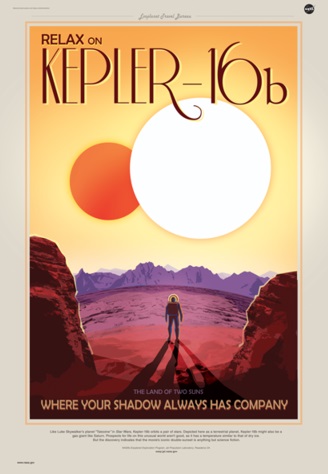
While we wait, here’s another interesting cosmic find to ponder: Astronomers have found an honest-to-goodness twin-sunned Tatooine in Kepler 16b, 200 light years away. “‘This is an example of another planetary system, a completely different type that no one’s ever seen before,’ Doyle said. ‘That’s why people are making a big deal out of this.’“


From the folks who brought you the Internet, DARPA announces the 100-Year Starship Study, offering $500,000 in seed money to whomever comes up with the best plan for developing the technology needed for interstellar travel. “To stimulate discussion on the research possibilities, DARPA officials will hold a symposium that brings together astrophysicists, engineers and even sci-fi writers so they can brainstorm what it would take to make this starship enterprise a success.“


Propaganda or no, a fully-armed and operational battle station would seem to be approaching Saturn’s moon of Titan in this breathtaking image by Gordan Ugarkovic, taken from data by the Cassini spacecraft. “Spacecraft and observatories store their images on hard drives, and anyone with access and the knowledge of how to process that data — no simple task, I assure you! — can use it to do their own work.“

European astronomers find the farthest quasar yet discovered, 12.9 billion light years away and dating to only 770 million years after the Big Bang. “This brilliant beacon, powered by a black hole with a mass two billion times that of the Sun, is by far the brightest object yet discovered in the early Universe.“