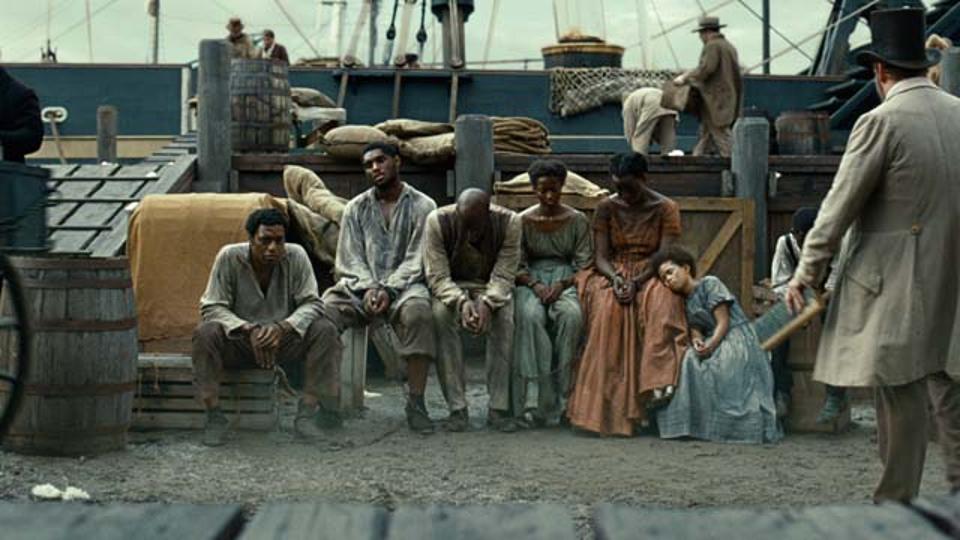
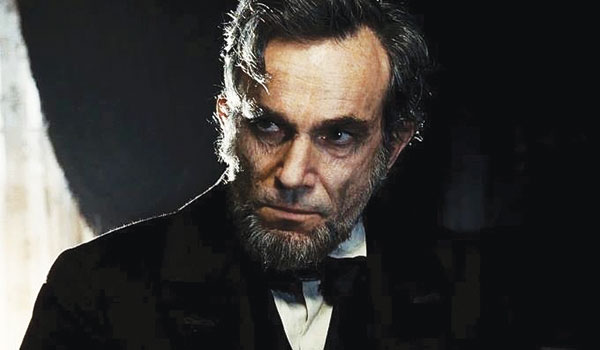
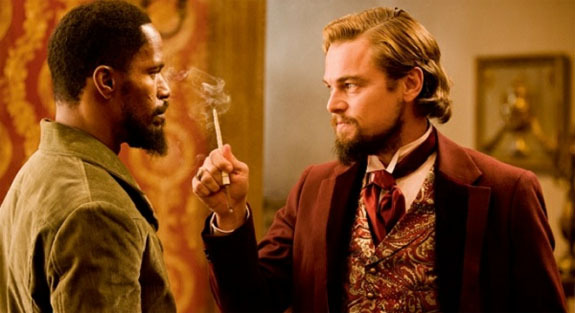
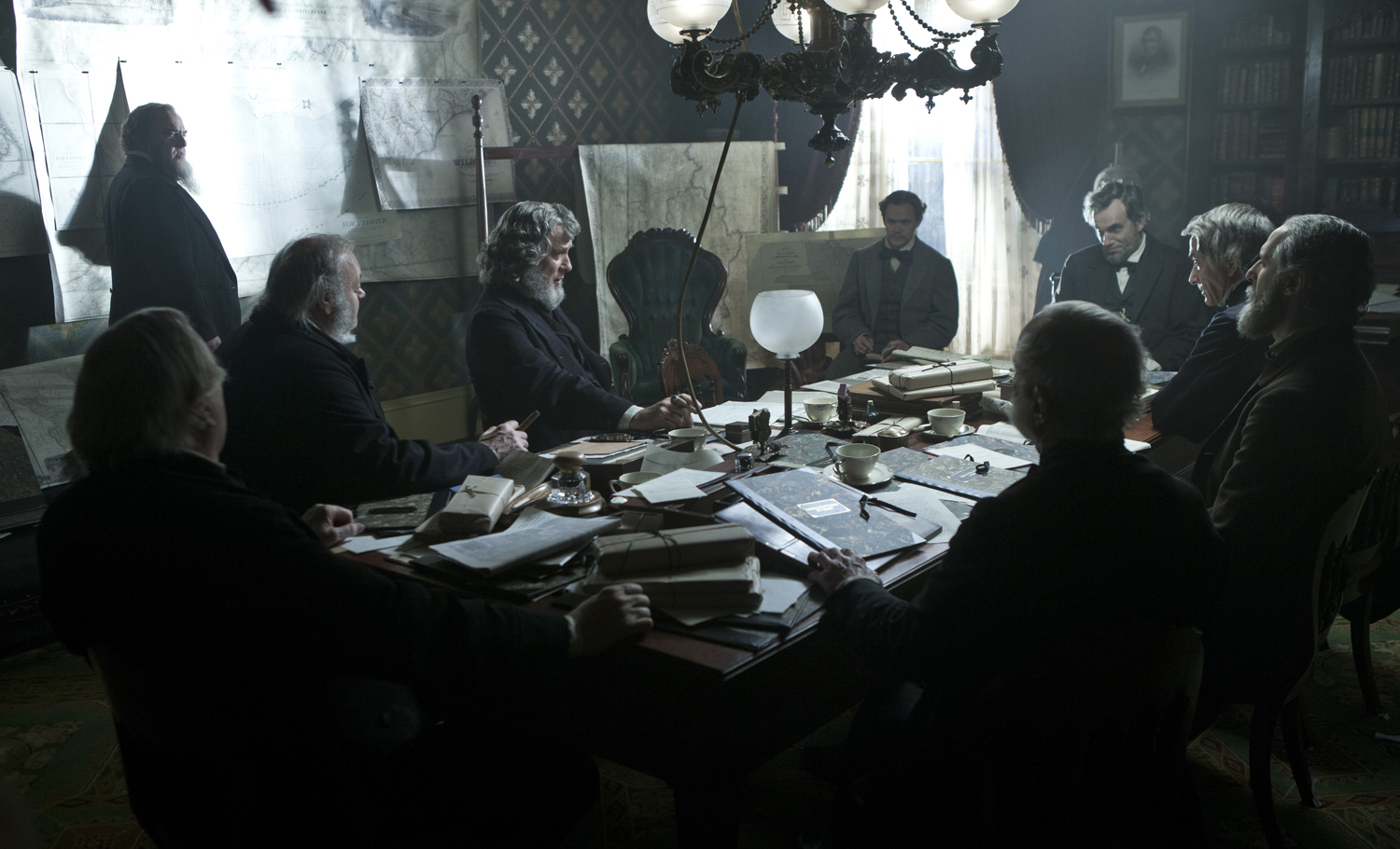
Historian Eric Foner, who knows of what he speaks, fact-checks Steven Spielberg and Tony Kushner’s Lincoln. I enjoyed the film quite a bit, and would recommend it to all comers, particularly Daniel Day Lewis’s typically amazing performance. That being said, I thought the excessive emphasis on the virtues of compromise in this story was fundamentally wrongheaded.
For one, the death of slavery would never have reached the House floor were it not for several decades of uncompromising agitation by abolitionists. “On this subject, I do not wish to think, or speak, or write, with moderation. No! no! Tell a man whose house is on fire, to give a moderate alarm; tell him to moderately rescue his wife from the hand of the ravisher; tell the mother to gradually extricate her babe from the fire into which it has fallen; — but urge me not to use moderation in a cause like the present. I am in earnest — I will not equivocate — I will not excuse — I will not retreat a single inch — AND I WILL BE HEARD.” As many of y’all know, that’s William Lloyd Garrison in 1831, giving one of the most definitive statements against compromising with an evil like slavery. Point being, compromise didn’t end slavery in America — an abject refusal to compromise did.

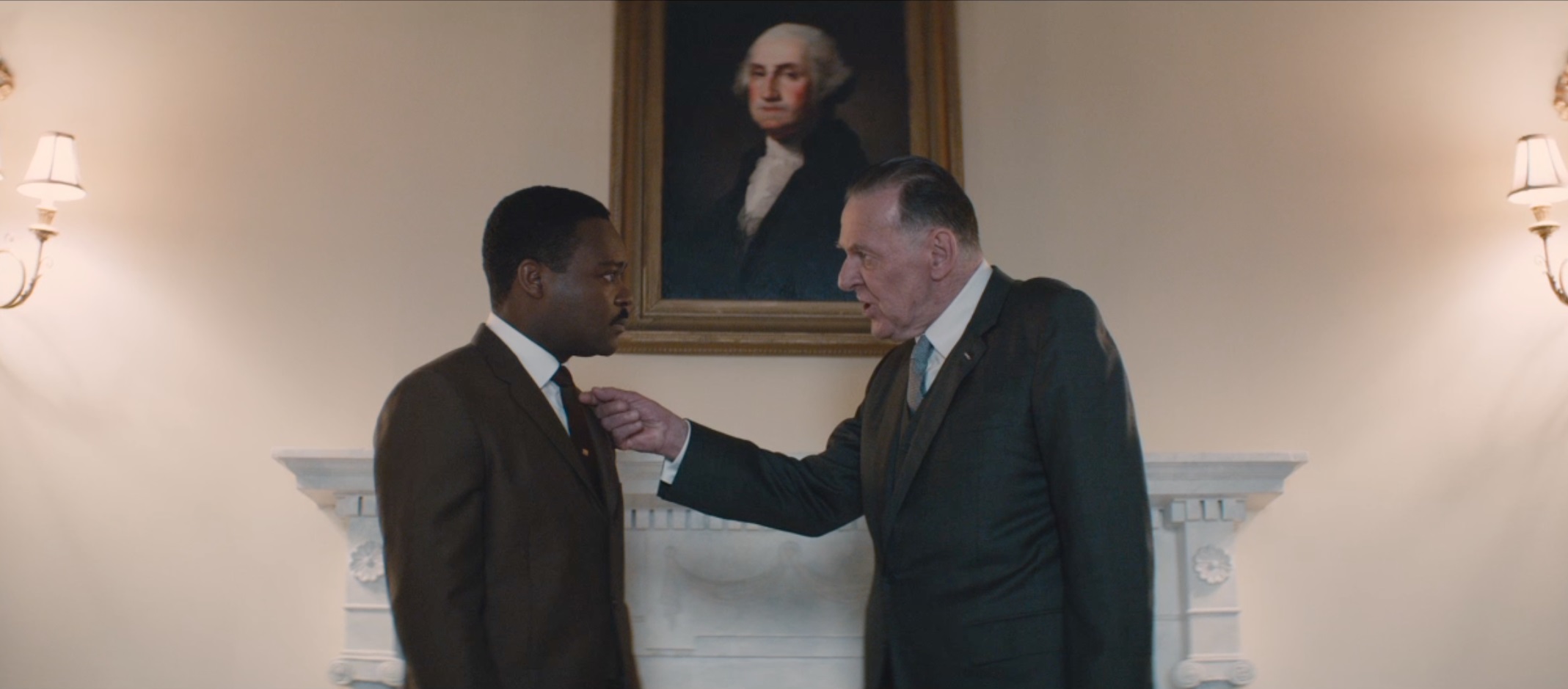
For another, as Foner notes, Lincoln had the votes in the next Congress — so there was no real need to compromise in this situation in any case. And besides, is it really a heroic moment for Thaddeus Stevens to be downplaying his commitment on the House floor to basic human equality? Surely, misleading the public about one’s true beliefs in congressional debate is not something we should be applauding. Nor does Washington, now or then, need any more erstwhile reformers who think the right thing to do when confronted with a stand on fundamental principle is to obfuscate and capitulate.
Of course, this nation was founded on compromise — some of them quite repellent, like the Three-Fifths — and the United States wouldn’t exist without it. And at other times, intransigence on principle has lost battles that compromise would clearly have won, such as the stubbornness of Woodrow Wilson dooming the League of Nations to defeat in 1919 and 1920, But the problem with this — mostly contemporary — emphasis on compromise is that it leads the filmmakers to a flawed understanding of the history of this period.
However much research Tony Kushner did on Lincoln here — and the film is indeed very well-written — it’s unfortunately quite clear that he doesn’t know jack about what came after the War. Here’s what he said to NPR on the subject:
“I think that what Lincoln was doing at the end of war was a very, very smart thing. And it is maybe one of the great tragedies of American history that people didn’t take him literally after he was murdered. The inability to forgive and to reconcile with the South in a really decent and humane way, without any question, was one of the causes of the kind of resentment and perpetuation of alienation and bitterness that led to the quote-unquote ‘noble cause,’ and the rise of the Klan and Southern self-protection societies. The abuse of the South after they were defeated was a catastrophe, and helped lead to just unimaginable, untellable human suffering.’”
This, I’m sorry to say, is nonsense. Here, Kushner is blithely reciting a century-old popular myth, perpetuated by the Dunning School and D.W. Griffith, that isn’t just anachronistic and wrong. It’s been widely discredited, by some of the very same authors the film cites as sources.
The noble cause and the Klan did not arise because the North was mean to the former Confederate states. They arose because many in the South refused to accord African-Americans the basic civil liberties for which the war had ultimately been fought. To “forgive and reconcile with the South” would mean acceding to the disfranchisement and general abuse that many whites desired to levy upon African-Americans in the former Confederacy. Indeed, when Kushner’s desired move to “forgive and reconcile with the South” came with the end of Reconstruction in 1877, it was followed relatively soon thereafter by the emergence of Jim Crow. In short, Kushner’s argument here is pure wishful thinking, and it has been exposed as bunk by the last 40-some-odd years of Civil War and Reconstruction histories.
TL;DR: Lincoln is an entertaining and worthwhile film, but, then as now, compromise can be overrated. (Kushner quote via Tropics of Meta.) Update: More from Foner.

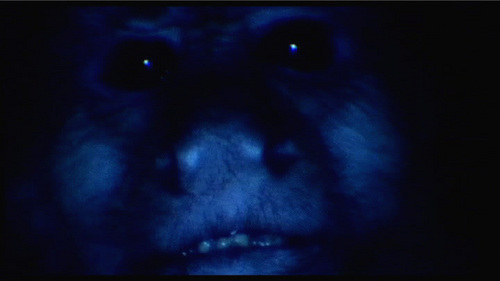
Twenty years after its opening, Grantland‘s Alex Pappademas takes another look at Twin Peaks: Fire Walk With Me. I never understood the hate this film received. (Then again, I also liked Peaks’ much-maligned second season.) Sure, it’s a bit all over the place, but there are impressionistic moments in Fire Walk With Me — the trapped Leland monkey, the picture-within-a-picture, the phantom Bowie — that still frighten me for reasons I find impossible to explain, much in the same way some of the third act bizarroland suicide stuff in Mulholland Drive — the blue box, the creepy homeless guy, the little tourists — seems to bypass my brain completely and just frazzles my spinal cord. And what’s not to like about Special Agent Chet Desmond?

Don’t get me wrong — The Artist is a very enjoyable evening at the movies, and it’s an airier, sweeter, and less didactic love letter to an earlier era of cinema than was Scorsese’s occasionally-ponderous Hugo. But there’s not much there there. Aside from the occasional po-mo in-joke, this is a 1920′s film through and through, one that borrows the storytelling conventions and acting styles of the silent film era (and much of its story from a later production, Singing in the Rain.) In other words, it’s pretty much just a gimmick. An entertaining one, sure, but a gimmick nonetheless.
As far as the story goes, the year is 1927, and silent film actor George Valentin (an appealing, Gable-esque Jean Dujardin) is king of the hill, top of the heap. His Tintin-like adventure serials — Tintin-like in that his sidekick is a scene-stealing pup (Uggie) — are the draw in Tinseltown. And he is always surrounded by young admirers, including Peppy Miller (Berenice Bejo, also appealing), a leggy ingenue with a lopsided grin who’s got the moves like Rogers (the moves like Rogers, the moooooooooves like Rogers) and who is struggling to break into the picture business. From their very first meet-cute, George takes to Peppy like Fatty Arbuckle to gin — much to the consternation of his wife (Penelope Ann Miller) — but unfortunately their stars are moving in different directions.
Y’see, through the miracle of modern technology, films are now becoming “talkies” — an innovation that creates an opportunity for America’s New Sweetheart, Peppy, but leaves George just a dimming artifact of the past: His broad facial tics and gesticulations begin to look utterly ridiculous in an era of sound, and even the remarkable shenanigans of his faithful Jack Russell companion can’t put his movies over the top. In short, the country’s tastes are changing, there’s not much room for silent film waggery any longer, and hastening George’s descent is the small matter of the Great Depression. What’s a broken down old film star to do?
Well, he could handle the situation with grace and let Peppy have her turn in the spotlight — but I suppose that’s a contemporary way of thinking. Here, George — shown to be an egotistical sort from the start — becomes an increasingly self-destructive drunk who heedlessly shuns the friendship and charity of those around him. (I didn’t get his behavior in the last act at all, to be honest.) But, really, this isn’t a modern character study — It’s a 1920′s lark, and taken as such, it’s a simple, fun night at the movies. Go in with suitably low expectations and you should have a grand ole time.
In the end, I’m not quite sure where all the Best Picture talk is coming from — Is it the annual Weinstein steamroller at work? is it critics falling for a movie that rewards their knowledge of film lore? Hollywood types relishing a tale of, well, Hollywood types? Or is it just a function of the relatively weak year at the cinema? Whatever the case, I wouldn’t put it nearly that high on my own 2011 list. Nonetheless, The Artist does signify the emergence of a major talent who should become a star in this business. I refer, of course, to far away the best thing in the film — Uggie. Best Picture? Perhaps not. But, c’mon y’all, Consider Uggie. We all know he made this movie work.


Perhaps because it clearly has autobiographical qualities, Young Adult is also Cody’s most adult work so far — her Jackie Brown, as it were. Gone are the wall-to-wall witticisms of Juno and Jennifer, although Charlize Theron (really excellent here) still makes a worthy neologism of “Kentaco Hut” (i.e. one of those Taco Bell/KFC/Pizza Hut three-for-one deals found in the contemporary strip mall) and Patton Oswalt’s character still finds time to squeeze in Star Wars references and Betty Friedan and Sylvia Plath jokes. And, unlike Juno and Up in the Air, this film has a more ragged and lived-in quality than Reitman’s prior films. Rather than oversweetening the product as usual, his tendency towards the glib works to leaven the real bitterness at the heart of this movie.
The end result is a smart, well-written character study of one rather awful Minnesotan, Mavis Gray (Theron), who, having reached the grim age of 37 (iknorite!), journeys back to her hometown to woo her now-married-with-child ex-boyfriend (Patrick Wilson). Formerly the Queen Bee of her high school, and now a divorced ghostwriter of Sweet Valley High-ish YA fiction in Minneapolis, Mavis is — unfortunately for the hapless denizens of Mercury, Minnesota — also a primping, egotistical, and self-absorbed neurotic, who is, more often than not, three sheets to the wind. Nonetheless, she is determined to use all of her wiles to force the Road Not Taken into existence and save her dopey ex from a dismal life of marriage-with-children in the provinces, whether he likes it or not. (Unwavering determination: Great and often rewarded in rom-coms; sad and stalkerish in real-life.)

In other words, like Noah Baumbach’s Margot at the Wedding and Greenberg and Larry David’s Curb Your Enthusiasm — this is one of those comedies where you spend most of the film watching a truly lousy person navigate normal social situations and squirming as their horrible natural tendencies exhibit themselves. Since it’s so popular these days, you probably already know your tolerance for this Theater of the Socially Awkward sort of thing: I myself kinda dig it. (Also along to witness the slowly unfolding train wreck is comic Patton Oswalt, playing the amiable nerd who held the locker next to Mavis back in the day and who was, of course, completely invisible to her.)
Unfortunately, Young Adult doesn’t quite stick the landing: The film loses purpose after the climax of Mavis’ gambit, twenty minutes or so before the end of the picture, and an attempt at a late-in-the-game twist — it involves a conversation Mavis has with Hot Tub Time Machine‘s Collette Wolfe — just feels like (more) screw-you score-settling by Cody. Still, for the most part, this is a dark and well-observed film that doesn’t overstay its welcome and makes for some enjoyable counter-programming in the recent sea of holiday blockbusters. Just don’t let Mavis move next door to you or anything.


Next on the docket is what turned out to be my b-day film this year, Steven Spielberg’s old-fashioned weeper War Horse, a.k.a. Saving Private Ryan meets The Black Stallion. In short, despite some first act hiccups, War Horse is a solidly engaging film. True, it plays some rather easy chords in order to derive its suspense and emotional power — namely, Animals-in-Peril and People-Saying-Farewell-to-Their-Trusty-Equine-Companions. And the scenes here of World War I are considerably more stagy and less resonant than Spielberg’s re-creations of WWII in Ryan. (Paths of Glory and All Quiet on the Western Front aren’t in any danger of being upstaged here.) But, perhaps due in part to its steadfastly old-school movie traditionalism, War Horse goes to work on you after awhile. It’s a simple tale of a boy, a horse, and the Great War that came between them, elegantly told.
That being said, War Horse doesn’t really find its footing until it leaves the rather twee English countryside and heads off to the Continent for the great conflagration. In fact, the first forty minutes or so are something of a Spielbergian schmaltzfest, as a poor lad (Jeremy Irvine) tries to get his noble and spirited young horse Joey to take to the plow and save the family farm. Joey was acquired by this desperate bunch — the Narracotts by name — when the drunken pater familias (Peter Mullan), a veteran of the Boer War, overpaid for him in a moment of liquid courage bidding against the local landlord (David Thewlis). And so, to stop said landlord from exacting his revenge, young Albert Narracott must coax and train Joey to do farm work meant for a much sturdier beast — skills that may come in handy in the battlefield a few years hence.
With Thewlis twirling his moustache as Mullan and Ma Narracott Emily Watson — humble, decent folk, both — fret about losing the farm, the first act of War Horse feels like one ginormous and schmaltzy cliche, especially coming from this director. (Hey, Joey! Why the long Spielberg face?) But when Tom Hiddleston (i.e. Loki of Thor) shows up as a dashing young military man — i.e. exactly the sort of naive, well-meaning fellow who perished by the millions in WWI — and takes the reins of our stallion protagonist, War Horse begins to gather momentum.
Under the command of Benedict Cumberbatch (late of Tinker), Joey and his new rider venture off to the Great War. But — as WWI vet J.R.R.Tolkien intimates with the last ride of the Rohirrim in Return of the King (and see also Faramir’s doomed assault on Osgiliath in PJ’s film version), World War I is a conflict where old-school cavalry charges are tantamount to organized suicide. The Civil War had Gatling guns and the Franco-Prussian War mitrailleuses, but, by 1914, the Germans have enthusiastically adopted honest-to-goodness machine guns, and the battlefield is no place for a horse anymore.
And so the rest of the movie is a Red Violin-type tale where we follow Joey’s misadventures as he passes variously through English, German, and French hands over the course of an increasingly horrible and dehumanizing (dehorseizing?) bloodbath of a war. (Among those who cross Joey’s path are A Prophet‘s Niel Arestrup, The Conspirator‘s Toby Kebbel, Sherlock‘s Eddie Marsan, and soon-to-be-Davos Seaworth Liam Cunningham.) And, while the last few Gone with the Wind-laden moments struck the wrong tone with me — after the trenches, it’s a bit late in the day to make military service seem poetic — War Horse for the most part gots its hooks in me over its run. You will believe a horse can war.


For starters, with the exception of a Nine Inch Nails-y music video credit sequence (set to that ultra-catchy cover of “Immigrant Song” from the teaser), this film is no different in tone or content than, nor does it improve on, the Swedish version that came out all of two years ago. (Ironically, that film’s two stars, Noomi Rapace and Michael Nyqvist, are also on-screen this weekend in Sherlock and MI: Ghost Protocol respectively.) To be honest, I don’t even know why Fincher bothered to make this film, except for the paycheck: He already covered this sort of ground in Se7en, and went well beyond it with Zodiac. And even Matt Reeves’ Let Me In was further afield from Tomas Alfredson’s Let the Right One In than this is to Niels Arden Oplev’s 2009 film.
If anything, Oplev’s 2009 version was more elegant in many ways. You definitely don’t need to see them both. There, the clues snapped together better as the story progressed — Here, it’s occasionally unclear how our two intrepid investigators, Lizabeth Salander (Mara) and Mikael Blomkvist (Daniel Craig) have made the intuitive leaps they have. There, the post-case coda was briskly covered — Here, the extended ending approaches Return of the King-levels. And, perhaps most importantly, in the 2009 film, there was more than one bleedin’ suspect in the movie. Here, even without the obvious casting tell, the eventual murderer is pretty much the only person we meet over the course of the investigation. (Fincher should’ve paid Willem DaFoe and Christopher Walken just to show up and skulk around.)
Now, in my Let Me In review, I was rather tolerant of that film being a note-for-note remake of the Swedish version, while here, not so much. What’s the difference? Well, for me, it’s mainly because Let the Right One In was a novel take on the teenage vampire story, i.e. a story worth telling. But both versions of Dragon Tattoo are, in my humble opinion, puerile, sadistic trash. Honestly, what does it say about us that this brutal, rapey, not-particularly-interesting revenge-pr0n thriller was the #1 best-selling book in America for many moons? The only interesting subtext here is of buried secrets festering rot, which registers in both the national history of Sweden (who, as a neutral nation, had its share of Nazi sympathizers during the war) and the personal history of the author (who apparently wrote these books as penance for ignoring a horrible crime.) Otherwise, I find these films to be ultra-violent, serial-killer crapola.
And speaking of indications of how screwed up we are as a country, why was Steve McQueen’s Shame rated NC-17 if this movie got an R? Shame had a lot of consensual (if pained), not-very-appetizingly-filmed sex, and, ok, full-frontal nudity from Michael Fassbender and Carey Mulligan. (Yes, Virginia, adults have mommy and daddy parts). Meanwhile, this movie has beatings, murder, rapes, torture, eviscerations, disembowelments, Stellan Skarsgard…oh, heck, let’s just give it an R. Honestly, the MPAA’s priorities are nothing short of bizarre. (I’m not advocating censorship of this film — Bring the kids if you’re so inclined. It’s the ridiculously messed-up priorities that rankle.)
I’ll concede that, in general, I find serial-killer movies to be abominably stupid. (They’re not even frightening. In that regard, I much prefer supernatural horror. Other than Silence of the Lambs, American Psycho, Zodiac, the original Vanishing, and, if you want to count it, A Clockwork Orange, I can’t even think of any films in the serial killer genre I like.) So if the Dragon Tattoo books were your cup of tea, but not so much so that you didn’t bother to catch the Swedish movie, then perhaps you’ll find The Girl with the Dragon Tattoo worthwhile. The movie is definitely competently directed and made — Fincher isn’t going to put out bad product. But I found this an unnecessary remake of a grotesque and ludicrous story in the first place, and I’m kinda annoyed with myself for spending money on it.


Point being, I had a different reaction to this film than I’m guessing those unfamiliar with the world of Tintin will. Even notwithstanding the joy of seeing these beloved characters come to life, The Secret of the Unicorn is filled with easter eggs for Tintin-o-philes. Our hero (Jamie Bell) has nods to Cigars of the Pharaoah, The Black Island, and King Ottokar’s Sceptre on his wall. Later we encounter a crab with golden claws, a zero-G nod to Explorers on the Moon, and, as the villain’s “secret weapon,” a cameo by one of Captain Haddock’s (Andy Serkis) more amusing adversaries. And, in the background, Spielberg and Jackson are constantly recreating sight-gags from various Tintin adventures — say, Snowy digging up a ginormous bone in the desert –that continually conjured up ancient memories of childhood laughs within me. If you like Tintin, you’ll almost assuredly have a good time here.
And if you don’t know Belgium’s most famous boy journalist from a hole in the ground? Well, that’s a stickier wicket. The exquistely craftted chase scenes are reasonably engaging, if ever so slightly repetitive, on their own. (And a shout-out to John Williams’ score, which could be my favorite work of his in at least a decade.) But if you don’t know anything about these characters already, I’m not sure you’ll find much of a rooting interest here. For better or for worse, this is pretty clearly a film by Tintin fans for Tintin fans. (If anything, I sometimes wish they’d hewed even closer to the books. Some of the setpieces — say, Haddock and the bad guy (Daniel Craig) dueling with construction cranes — felt like generic action-spectacle filler. I’d rather have seen Tintin do more detective work.)
But, whether you’re new to Tintin or a veteran hand, I’m happy to report that the motion-capture animation here is the most impressive I’ve ever seen — no dead eyes to speak of here. I actually thought the animation Zemeckis’s Beowulf was reasonably well-done back in 2007, but this is better by an order of magnitude. (It helps that Spielberg and Jackson have forgone the uncanny valley by going for a Herge-plus look.) In fact, the two things I was most afraid of not working going in — the motion-capture animation and Snowy — are probably the two highlights of the film. (Tintin’s faithful companion is a scene-stealer through and through.) Conversely, the character who I thought would be an easy slam dunk, Captain Haddock, actually grows somewhat tiresome over the course of the movie. (The swearing plays, but all the alcoholic tendencies that are funny on paper begin to grate in three dimensions.)
Speaking of three dimensions, I caught this in 3D, but I’m not sure it really added much to the experience — especially when you factor in that a 3D movie ticket now costs all of $15.50(!) here in the District. I know I recently hated on the 3D push in my Hugo review, but, still, that price for one ticket to a 100 minute film is verging on the ridiculous. My advice: Take your kids to Tintin, but spend 2D money, and use the savings to buy them one of the books.


Unfortunately, there’s not a whit of Cronenberg’s usual weirdness to be found here, and the film, while harmless enough in its own right, suffers terribly from the missed opportunity. After all, this isn’t David Lynch making The Straight Story. Here we have the father of psychoanalysis, who became a world-historical figure mainly by reducing everyone to an unverifiable gaggle of repressed sexual impulses, going toe-to-toe with one of his proteges and the foremost advocate of dream analysis. Not to mention a colleague to them both who hates herself for loving spankings (hey, at least it’s not car crashes.) I mean, could the subject of this film be any more within Cronenberg’s normal wheelhouse? But, for whatever reason, he refuses to indulge his prior inclinations here, and the resulting film is well-mannered and arid. Even when Vincent Cassel shows up in the middle-going as an advocate for the virtues of the unrepressed id, the movie lacks any real charge.
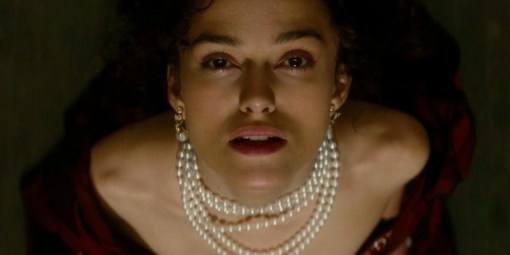
That aside, there’s another major flaw with A Dangerous Method that seems churlish to dwell on, but which would be a problem regardless of the director. Fassbender (who’s been having a good deal of sex onscreen this week) and Mortenson are both very good here — the latter especially seems at ease as the cigar-chomping Freud, a supporting role outside his usual parameters. But, while she may be a wonderful person, Keira Knightley is just a terrible actress. I’ve tried to give her the benefit of the doubt through films like The Jacket. Atonement and Never Let Me Go, but her wayyy-over-the-top, herky-jerky performance here clinches it. (I’ll put it to you, good people: Has Knightley been impressive in anything since her supporting turn in Bend Like It Beckham?) Particularly in the first half-hour when she’s still playing “teh cRazeE,” I just felt embarrassed for her and for poor Fassbender.
“Never repress anything,” Vincent Cassel’s hedonist tells Jung at one point in this film, which may or may not be sound as a life philosophy. All I know is I wish Cronenberg had taken this advice, and that Knightley had thought better of it.


That being said, this movie is a hard nut to crack, and I’m not sure awards time is going to be very kind to this quality production. Not unlike Alfredson’s earlier adaptation of Let the Right One In, Tinker Tailor seeks mainly to capture a mood — here, the daily anxieties, moral compromises, and ethical rot that come with too many years immersed in the spy game. That it succeeds in this endeavor while still telling a cloak-and-dagger tale of byzantine complexity is impressive. But, for all its strengths, Tinker Tailor is a somber and slow-moving piece, and, like the reticient spymaster at its center, it can feel remote at times. At least on a first viewing, I found Tinker more intellectually involving than emotionally engaging, if that makes any sense. (To be fair: As a newbie to the story, I spent much of the movie working hard just to keep up with the plot. Those already familiar with le Carre’s tale may be able to better soak in the picture the first time through.)
Given its languid opening, you wouldn’t think Tinker Tailor Soldier Spy had a exceedingly complex espionage tale to tell. It does. Like Mission Impossible: Ghost Protocol (and here the similarities end), the film begins with a botched job in Budapest: Agent Jim Prideaux (Mark Strong) has been sent by Control (John Hurt), the head of “the Circus” (a.k.a. MI6) to meet with a defecting Hungarian general in order to ascertain the identity of a mole deep within British Intelligence. But the mole gets word of this operation first: Prideux is shot in the back for his troubles, and Control — along with his #2 man, George Smiley (Gary Oldman) — is ousted from the Circus, leaving Scotsman Percy Alleline (Toby Jones) at the head of the unit.
Cut to several months later, and Smiley is secretly brought out of retirement by a political operative (Simon McBurney) to investigate further into the mole. Picking up where the now-deceased Control left off, and with the aid of two junior agents — one from the Circus (Benedict Cumberbatch), one from the field (Tom Hardy) — Smiley must figure out which of MI6′s ringmasters is spilling secrets to the Russians. Is it Alleline, who has an unknown source he wants to peddle to the Americans? The debonair Bill Haydon (Colin Firth), who’s perhaps just a little too hail-fellow-well-met? As a Hungarian emigre, Toby Esterhase (David Dencik) could well know top Soviet officials, and Roy Bland (Ciaran Hinds) keeps his cards close to his vest. Or is it, as Control feared most of all, Smiley himself, and the fox has been put in charge of the henhouse?
So, there are a lot of balls in play, and, even though the movie retains its unforced air, it has to keep the revelations moving at a brisk clip to get through the dense thicket of a plot — which is one of my quibbles with the picture. Why not let the story breathe? According to Colin Firth, the original cut of the film was 3.5 hours (it’s now 127 minutes long) and, while that may be a touch long, it would have been nice to spend a little more time with some of these characters. (Hind’s Roy Bland, for example, basically lives up to his name here — He’s too good an actor to be given this little to do. And as one of Smiley’s lieutenants, Roger Lloyd-Pack, a.k.a. Barty Crouch in Goblet of Fire, seems like he should have more backstory also.)
Surprisingly (to me, at least), it’s the rising generation of thespians that is given more to do here. Tom Hardy’s agent, Ricky Tarr, relives the story of a doomed affair with a beautiful potential defector (Svetlana Khodchenkova), Mark Strong’s Prideaux hides out as a schoolteacher, and Cumberbatch’s Peter Guillam goes deep undercover in the Circus to procure data for the investigation. They are the doers. The older, more dissolute and jaded generation are the watchers, and none more so than the implacable, owl-eyed Smiley himself. As David Edelstein noted and Jim Gordon notwithstanding, Gary Oldman is an actor that usually goes to eleven, so Smiley’s restraint is a bit of an About Schmidt turn for him. But, he’s very good here, especially when he has an interviewee in his grip and begins slowly, inexorably tightening the vise.


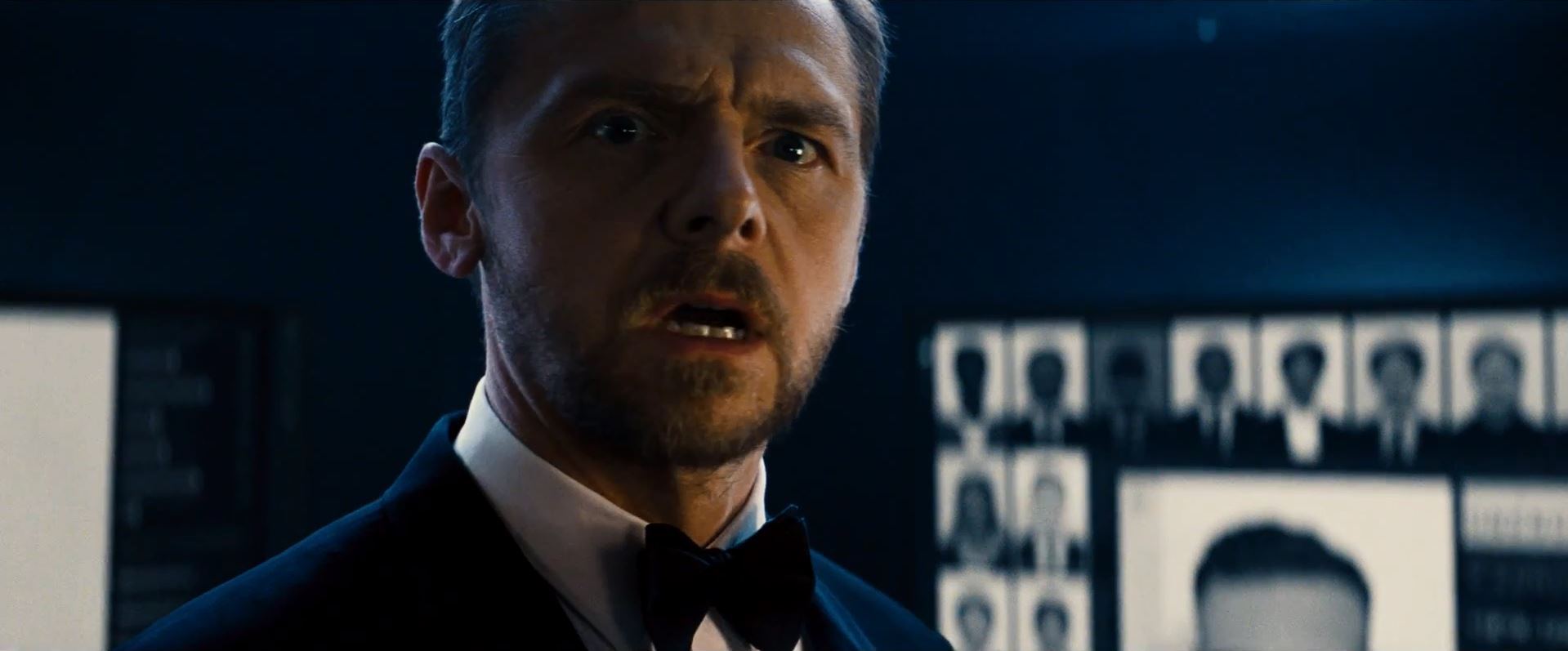
Surprisingly — or perhaps unsurprisingly if you consider that Bird is the brains behind The Iron Giant and The Incredibles — Ghost Protocol is a pretty great action movie. It’s sleek, fluid, involving, and it’s almost unbelievable that this is Bird’s first live-action film. From its opening moments — as two IMF agents (Simon Pegg and Paula Patton) break Ethan Hunt (Cruise) out of a Russian prison — Ghost Protocol moves with a brisk confidence to (almost) the finish. And you’d have to go back fifteen years, to Brian DePalma’s original film, to find an M:I as entertaining. (Quite frankly, this one might even be better. I haven’t seen the first one in awhile.) In short, I can’t speak for Tintin yet, but if you’re an action aficionado at all, this film should get your money this Christmas — especially over Sherlock.
The plot doesn’t really need going over here. As you might expect, there’s an impossible mission, if Ethan Hunt and his team (Pegg, Patton, and eventually presumed future-Cruise replacement Jeremy Renner) choose to accept it — in this case, retrieving Russian launch codes from a deranged bureaucrat (Michael Nyqvist of the Swedish Dragon Tattoo films) hell-bent on global thermonuclear war. To even have a chance of accomplishing it and saving the world, this last remaining IMF team will have to travel to exotic locales, engage in espionage and misdirection, and utilize all the 21st-century tech and derring-do at their disposal. But wiil that be enough? Well, probably, but you never know…
In the end, I have three basic, and minor, nitpicks with Ghost Protocol. First, the third and final act (in India) is just a bit of a letdown after the dizzying heights (literally) of the first two, in Moscow and Dubai — but that speaks to the strength of the first 80 minutes more than anything. Second, Bird & co. occasionally forget to restrain their impulse to turn Simon Pegg’s character into Threepio — all comic relief, all the time. (An understandable inclination, but the humor can still be a bit broad at times.) And, third, the coda of the film — you’ll know it with the inevitable cameo by you-know-who — is just terrible in every way. It feels like it came from the bad Tom Cruise movie everyone feared Ghost Protocol would be. (Fortunately, it’s only five minutes of screen time.)
But other than those minor caveats, this is quite a good film. I would say 2011 has been a mostly disappointing year in movies, except for the fact that several potential schlockfests — Thor, Captain America, Rise of the Planet of the Apes — all happened to come out on the entertaining end. Ghost Protocol continues, and caps, that welcome trend, and goes down as one of the best action movies of the year. Now that he’s finished rehabilitating this once lamentable franchise, let’s hope Brad Bird chooses to accept more impossible missions in the years to come.


When the better-than-expected first movie appeared during Xmas 2009, the Guy Ritchification of Sherlock Holmes seemed like an innovative approach to Arthur Conan Doyle’s mythos, one that found room for 21st century action movie conceits within the material of the original stories. But, perhaps in part because that approach is no longer fresh this time, or perhaps because Stephen Moffat’s team has managed to rejuvenate the character more traditionally on BBC, A Game of Shadows is much less entertaining — I found the first hour almost unwatchable. The best thing you can say about it is that it gets better as it goes along.
A Game of Shadows begins far too frenetically, with Sherlock (Robert Downey Jr.) trying to intercept his love interest from the first film, Irene Adler (Rachel McAdams), as she delivers what very well could be a parcel bomb on orders from the dastardly Professor Moriarty. (Jared Harris, the best thing here by far.) Plenty of worthwhile action movies begin with this sort of in media res setpiece, going back to Raiders of the Lost Ark and including the first film (when Holmes and Watson, iirc, prevent some sort of satanic ritual perpetrated by Mark Strong’s Big Bad.) But here, the tone and pacing feel off from the start, with Ritchie-being-Ritchie, an endlessly mugging Downey, and the bombastic soundtrack all trying to oversell us on the antic mischief at hand.
Game of Shadows continues in this unfortunate vein for most of the next hour, lurching frantically from setpiece to setpiece — Watson’s bachelor party, Watson’s honeymoon on a train, a Roma camp, the Paris Opera — but never establishing any compelling interest in the goings-on. (Along the way they pick up mysterious gypsy Noomi Rapace, who adds very little — although it’s not really her fault.) Seriously, this first half of the film is close-to Van Helsing-bad.
It doesn’t help that Holmes’ powers of deductive ass-kickery only seem to have strengthened during the interstice between films: In terms of extra-sensory fighting style, he might as well be Daredevil at this point. In terms of problem-solving — for example, when he finds that secret door in the Paris catacombs — he’s Professor X, doing more mind-reading than solving puzzles. (Also, despite the fact that he’s meant to be the world’s greatest detective, I’m not sure Holmes asks anyone a single question over the entire course of the movie.)
All that being said, the movie does begin to pick up in the back end — right around the time Holmes and Watson stop by a German munitions factory. (There are still some groaners to be had later. I’m looking at you, epipen.) This is mainly because, for one, all the nameless goons get left behind and the supervillains of the piece, matching our heroes in absurd power, move to the fore: Moriarty seems to have Joker-in-TDK-like levels of prescience, and his #2, Col. Sebastian Moran (Paul Anderson), becomes, for all intent and purposes, Deadshot. For another, the movie wisely borrows dramatic heft from staging its final act at Reichenbach Falls — and, indeed, it’s the battle-of-wits between Holmes and Moriarty atop those fateful falls that makes for the most engaging scene in the film.
Still, it’s a real slog to get to Reichenbach, with only Harris’s mannered malevolence as Moriarty offering any respite for much of the way. (Well, Law’s not bad, either, but by design he takes a back seat to the more manic and off-kilter Downey. And Stephen Fry, in a dream role as Mycroft Holmes, is unfortunately wasted.) Holmes fans will know that the story much of this movie was drawn from, “The Final Problem,” turned out to be not-so-final after all. If A Game of Shadows is what we can expect from the rest of this franchise, here’s hoping this film is more successful at bringing the curtain down on this iteration of Holmes. Mr. Cumberbatch, you are needed.


Here, Fassbender is Brandon Sullivan, an Irish-American Silicon Alley midmanagement type living in Chelsea who fills his empty days watching pr0n at work and his lonely New York nights having meaningless sex with hookers and anonymous strangers. Ok, let me stop there for a second: Awwwww, poor damaged rich guy! Nymphomania is such an underappreciated and overlooked #firstworldproblem! Yes y’all, like The King’s Speech, my empathy meter clicked out early here. It doesn’t help that Sullivan is given no real redeeming qualities to speak of — He’s, quite literally, just a prick. (Plus, as someone who actually lived the “depressed in Gotham” existence, I found it less a Boschian purgatory of carnal pleasure and more like I am Legend, but of course there are millions of stories in the Naked City. YMMV.)
Anyway, Brandon’s life is upended when his needy, inconstant, and equally lacerated sister Sissy (Carey Mulligan, also giving more of herself than the project deserves) shows up at his door. Both Brandon and Sissy were clearly damaged at an early age – A childhood of abuse is intimated through nasty scars and sketchy stories. But while Brandon has an insatiable craving for angry, consequence-free sex (in fact, he can’t perform when on an actual, honest-to-goodness date with a co-worker), Sissy is desperate for emotional attachment. In other words, basically these two are like oil and water, and they’re both cooped up in the same smallish NYC apartment with their respective demons. This will not end well.
So the board is set, but, in all honesty, the pieces don’t do much moving. As in Hunger (and much like Tom Ford’s A Single Man), Steve McQueen seems more interested in creating artistic moments than achieving any kind of narrative momentum. Plot isn’t everything, of course. Character studies are fine. even ones involving mostly static characters. But we don’t learn anything about these two characters except they’re troubled and needy. We need more to hold interest here.
The best of McQueen’s artistic vignettes by far are the bookends of the film, when Brandon hunts for a hookup on the subway and gets caught in a game of eyeball with a possible partner (Lucy Walter). Without dialogue, Fassbender and Walter display a microcosm of conflicting emotions — surprise, lust, shame, guilt — through gazes and body language across a crowded train. But, otherwise, we also have to sit through a lot of filler here, like Fassbender going for a half-mile run to MSG and Mulligan crooning all of “New York, New York” in damaged-siren mode (which conjured grim memories of Georgia.) We have long, uninterrupted scenes of Fassbender and Mulligan fighting like cats and dogs. (Quite frankly, they feel like gimmicks, as did Fassbender and Liam Cunningham’s long and more impressive one-take chat in Hunger.) And we have a good bit of sex, all filmed — with one exception in a hotel room — in the seventh-circle-of-hell fashion of another addiction film, Requiem for a Dream.
In short, I just didn’t buy it. The characters did not ring true to me. I couldn’t see Fassbender (hard, angular) and Mulligan (soft, curvy) as siblings. I found it hard to believe Sullivan could be at once suave enough to pick up anyone he wanted at a club (particularly as compared to his inept boss, James Badge Dale), and yet so unbelievably terrible at small talk on a first date. And McQueen’s third-act decision to have Fassbender’s character, in the midst of an epic bender, wander into a ridiculously sinister gay dungeon in the Meat-Packing District for consummation, carried more than a whiff of homophobia about it. Shame has some powerful performances, and I wouldn’t be surprised to see Fassbender and Mulligan get acting nods here. But the film is all surfaces and very little depth. I left, like its wretched protagonist, unsatisfied.


Word has come down that Frank Oz and some of the other original muppeteers were unhappy with the film, but it’s hard to imagine a more honest and heartfelt tribute coming from Hollywood these days. Say what you will about the Segal-Stoller-Bobin version of The Muppet Show, it doesn’t feel at all like a Disney cash grab. (It’s also considerably more enjoyable than the Muppet book-movies of the nineties, like A Muppet Christmas Carol and Muppet Treasure Island.) And while frankly it’s still a bit jarring to note the changes in Kermit’s inflections and facial expressions since Henson’s passing, if you just think of him as a James Bond figure, now recast as Steve Whitmire, there’s a lot to like in this production.
The movie begins with the Apatowish-feeling introduction of a new muppet, Walter (Peter Linz), and his brother Gary (Jason Segal), two all-American kids growing up in the heartland — Smalltown, to be exact. (I presume Walter was adopted.) For obvious reasons, Walter becomes obsessed with the Muppets at a very early age, and so, when planning a trip to the Big City of Los Angeles with his longtime girlfriend Mary (Amy Adams), Gary — to Mary’s mild consternation — offers to bring his brother along so he can visit the Muppet Studios. So far, so good. But on that fateful visit, Walter discovers that a nefarious oil man, Tex Richman (a hilarious, hip-hoppin’ Chris Cooper), is planning to buy the now-bedraggled studio in two weeks and destroy it, in order to get his hands on all the precious black gold pooled underneath. (In fact, he’s cut a deal with those classic one-percenters, Statler and Waldorf. Maniacal laugh, maniacal laugh.)
Naturally, Walter, Gary, and Mary track down the one-and-only Kermit the Frog — now living alone in a massive mansion bought by the since-estranged Miss Piggy — and inform him of Richman’s evil plan. To save the studio, Walter explains (having seen the contract), the Muppets will need to raise ten million dollars in the next fortnight. How can they do that? I know, let’s put on a show! And so Kermit and the team travel the world (by map) to get the band back together. As it happens, Fozzie has been working the Reno circuit with a tribute act called the Moopets (Dave Grohl, in an Animal costume, on drums.) Gonzo is a plumbing magnate, Bunsen Honeydew’s at CERN, Sam the Eagle at FOX News. But what of the porcine goddess? Can Kermit et al procure the talents of Miss Piggy once again after all these years? And, being optimistic has-beens in a harder, crueler entertainment world (the #1 show these days is Punch Teacher, hosted by Ken Jeong) where are the Muppets going to find some much-needed star wattage for their telethon? Maybe Animal made some friends in rehab…
That’s the basic gist, and for the most part The Muppets moves along with pop, fizzle, and verve — There are one-liners and sight gags piled into every corner of this film, and they usually stay true to the original wry-but-well-meaning Muppet brand of humor. Oh, yes, and there’s musical numbers too, as befitting a new Muppet movie. (They’re contributed by the Ernie of the Conchords, Bret McKenzie, and, even without FotC director Bobin providing the visuals, they’re all very Conchordian. (Consider lines like “a very manly muppet.”) Speaking of the songs, I do have a small quibble in that the humans — Jason Segal and Amy Adams — do almost all of the singing in this film. Shouldn’t the Muppets be taking point on the musical numbers most of the time?
Of course, it’d be hard for any new song to approach the timelessness of “The Rainbow Connection,” — In fact, Kermit and the gang actually sing “The Rainbow Connection” here late in the third act — which brings me to my main issue with The Muppets: It’s a total hipster nostalgia-fest, and it effectively turns the Muppet gang into Rocky Balboa or The Expendables — old, forgotten warhorses out for one more curtain call. Why not just let the Muppets continue on in another grand adventure? Do Mickey Mouse or Bugs Bunny ever worry about their contemporary cachet? Instead, Segal and Stoller have adopted an Almost Famous framing device — Walter’s desire to fit in/hang with his now out-of-date idols — that is almost suffocating at times in its Internet-era emo-hipsterishness. I mean, I grew up on and love the Muppets too, but does this film really have to be about some uber-fan’s feelings about them?
I’ll confess, it wasn’t just that I found the nostalgia cloying at times. More troublesome is the fact that the overwrought nostalgia here is tied to the wrong era. Time and again, this movie makes The Muppets seems like icons of the eighties, which I suppose is when young Segal, Stoller — and I — were into them. Here, Kermit et al sing along to (groan) Starship’s “We Built This City,” released 1985. They get a definitively eighties montage sequence, that is set up as such. Kermit has Cyndi Lauper in his rolodex (and, to be fair, President Carter.) They even have an ’80′s robot — which they continually call ’80′s Robot — driving them around from place to place, and offering people New Coke and Tab to boot.
But the problem is, The Muppets aren’t really products of the eighties at all. They’re seventies creations (and, really, Archie Bunker notwithstanding, isn’t Jim Henson one of the quintessentially seventies television icons?) Following on the beginning of Sesame Street in 1969, the Muppets appeared here and there throughout the early decade — including on Saturday Night Live — and got their own show in 1976, which ran until 1981. For that matter, The Muppet Movie came out in 1979. In 1984 — at best a year or two after what we now think of as “the eighties” coalesced — The Muppets Take Manhattan came out, effectively ending the Muppets’ participation in the decade (the exception being The Muppet Babies animated Saturday morning cartoon, whose theme song is still lodged in my head after all these years.)
The point being, The Muppets not only trafficks too much in nostalgia for my liking. It trafficks in a misplaced nostalgia that has more to do with the generation of the writers than with the actual Muppets themselves. Don’t get me wrong — Segal and Stoller do a lot right, this a very enjoyable evening at the movies, and you’ll be hard-pressed not to leave with a smile on your face. But the rewriting of history rankles — When you get right down to it, Generation Y shouldn’t misappropriate the legacy of Kermit and the gang any more than Tex Richman. Let the Muppets live their own time.


After a brief pre-credit moment of zen with the woman (Patricia Hastie) whose boating accident is the crux of the story, we meet Matt King (George Clooney, very good), a Honolulu attorney with a lot on his plate. His wife is still in a coma several weeks after the incident, and her condition isn’t improving. His younger daughter Scottie (Amara Miller) is more than he knows how to handle (he’s “the backup parent”), and his older daughter Alexandra (Shailene Woodley, a real find) is fast becoming a reprobate at a boarding school on the Big Island. The beautiful parcel of Kauai land his (haole) family has owned for generations is up for sale, and he alone has to choose a buyer — a decision all of his many cousins are watching with keen interest. And, it soon comes out, the woman he has spent his life with, and who he must now help his family and friends say farewell to, has been having an affair with a local real estate agent (Matthew Lillard), and was, in fact, planning to leave him. Life in a Hawaiian paradise? “Paradise,” King tells us in a voiceover early on, “can go f**k itself.”
Like Schmidt and Sideways, most of the rest of the film involves a road trip journey of self-discovery — this time to beautiful Kauai (where, if you’ve ever visited there, Princeville and downtown Hanalei both get their druthers.) Along for the ride is Alexandra’s amiable, dim-witted boyfriend (Nick Krause), and at various times we meet Matt’s take-no-guff father-in-law (Robert Forster), beachbum cousin (Beau Bridges), and the Other Man’s sweet, unknowing wife (Judy Greer). But, unlike say, About Schmidt, where Dermot Mulroney and his family of rednecks were mostly just joke fodder, The Descendants is less sneering and more open-hearted toward its cast of extended characters (even Inconsiderate Cell Phone Man, who shows up as the husband-half of the Kings’ couple-friends.)
Along with best adapted screenplay — this is based on a book by Kaui Hart Hemmings — I would also expect The Descendants to garner Oscar nods for the very naturalistic Woodley and another for Clooney, who maintains his record of quality here. (Does any leading man have a better one? Even his bad films — The Good German, say — are usually interesting failures.) We’ve already seen Clooney suffer existential crises the past two years in Up in the Air and The American, but this one also stands on its own. His King isn’t the hyper-competent individual of those other two films — He’s just a well-meaning guy, who’s been distracted from his life for too long, trying to make the best of a bad hand.

It doesn’t help that Eastwood has yet again opted for the tinkly piano and gray palette that seems to characterize all of his historical pictures. This worked wonders for Letters of Iwo Jima, not so much for Flags of our Fathers and this film. Here, Eastwood has set a story beginning in 1919 — perhaps the most lurid and tumultuous single year for America in the 20th century (I’m only ever-so-slightly biased on this) — and made it look like a drab, washed-out daguerrotype. In that fateful summer, after an anarchist’s bomb blows up the front porch of Attorney General A. Mitchell Palmer’s house in the ritzy West End of Washington (his neighbors, Franklin and Eleanor Roosevelt, had just parked down the street), Hoover is hand-picked to run the new “General Intelligence Division” of the Justice Department that will bring the perpetrators to justice.
With previous experience at the Library of Congress in organizing information, Hoover soon takes on two key assistants in Tolson (Armie Hammer, once again exuding Ivy League entitlement) and personal secretary Helen Gandy (Naomi Watts, who gets the best of the age make-up), and quickly attempts to make a CSI of the GID. Cut to forty years later, and Hoover — now balding, paunchy, and covered in latex — is obsessively snooping on Martin Luther King and making veiled threats to Attorney General Bobby Kennedy about his brother’s sleeping habits. With our two historical poles established, the rest of J. Edgar flits back and forth in time, telling the story of its protagonist as both a young and old man – Other than these two moments, the film spends most of its time, strangely enough, dealing with the kidnapping of the Lindbergh baby. (In 2004, when discussing The Alamo, I noted how fun it is to cast the story of American history with actors. Let me say that Josh Lucas totally works as Charles Lindbergh.)
For the most part, J. Edgar is an innocuous edutainment. But it also has some serious problems, and not just the standard-issue groanworthy biopic tropes like Freudian parent issues overdetermining the subject’s entire life story. (Here, Mom (Judi Dench) is a stern and overbearing sort who forces Hoover to bury his secrets within, even as he’s trying to pry up everyone else’s.) Y’see, it comes out rather late in the third act that Eastwood and screenwriter Dustin Lance Black have attempted to add a Fight Club-ish “unreliable narrator” schtick to the film: The whole time, we’ve been watching Hoover’s sanitized retelling of his own history. But this should-be-huge reveal is underplayed, and thus becomes somewhat buried. And, as a result, people who don’t know anything about the times are going to leave a theater with a very wrongheaded sense of the story.
For example, it’s never mentioned or adequately explained that the 1919 anarchist bombings which open the film only killed two people — one of them the bomber on Palmer’s porch, who either tripped or mis-timed the blast — and that, not unlike recent times, pretty much everything Palmer and Hoover did subsequently in 1919 was a massive overreaction. (Hence, the “Red Scare.”) They show Hoover and a team of G-men knocking down an anarchist printing press in Paterson, New Jersey linked to the bombs, but, with the arguable exception of Emma Goldman’s deportation proceedings at Ellis Island, they don’t show any of the many, many raids that were just glorified fishing expeditions and/or excuses to remove foreign-born potential Communists from American shores.
Similarly, when the film briefly depicts the Centralia Massacre that same year, it shows events in a way that Hoover, and many other Americans, probably saw them — I.W.W. radicals killing patriotic veterans in a turkey shoot. But that depiction does violence to the much more complicated truth of the event, which involved American Legion members deciding first to go march on some radical Wobblies. And you’d never know that the culmination of that day was an I.W.W. member and veteran grabbed from jail by soldiers, beaten, castrated, hung, hung, hung, shot, and shot. Again, Eastwood and Black have written themselves a pass for this, because they hint Hoover is an unreliable narrator at the end of the film. But that lede is buried.
So the history has definite issues, and this same tendency towards whitewashing detracts from the whole film. Granted, given how little we know, the Tolson-Hoover relationship should perhaps be treated with this discretion — although my understanding is they were more conceived of as a couple than this film lets on. (FWIW, Hammer is quite good here despite some unfortunate age-makeup, and a Supporting Actor nod is likely.) But, that aside, and to be blunt about it, sometimes an asshole is just an asshole. One can argue that Hoover had all the reasons in the world to be the way he was — an overbearing mom, a traumatic secret, whathaveyou. But this film spends more time trying to make us feel charitable towards its protagonist than it does putting his behavior in any kind of appropriate context. (For example, why is Hoover obsessed with MLK? Should he be wiretapping him? It’s never really addressed.) Should we feel for J. Edgar, after hearing his story? Perhaps, yes. But we should also leave the theater with a clearer sense of how illegal and often reprehensible his rise to power really was.

At the same time, I found Ides‘ depiction of contemporary politics to be totally theatrical and unrealistic, and its messaging rather muddled. (For a Phillip Seymour Hoffman movie that does get politics right, despite its occasional Sorkinisms, check out Charlie Wilson’s War.) The basic conceit here is All the King’s Men, basically (or, if you’re new-school, Primary Colors) — No man is a hero to his valet and all that, especially in politics. But by having the feet of clay of Clooney’s Obama-esque candidate, Governor Mike Morris of Pennsylvania, here be (yawn…oh, and major spoiler, I guess), in the parlance of politics, a “bimbo eruption,” Ides not only makes itself seem relentlessly dated. It seems to flinch from the problems in contemporary politics that people are actually and justifiably cynical about.
So, now that I’ve spoiled one of the major “twists,” let me roll it back for a moment. It’s the final days of the Ohio Democratic primary, and Governor Morris is in a neck-and-neck race with Senator Ted Pullman of Arkansas (Michael Mantell, not a factor here.) Running the respective campaigns are Hoffman and Paul Giamatti — although, don’t get your hopes up, they have maybe 30 seconds of time together.The kingmaker of the entire race could well be Senator Thompson of North Carolina (Jeffrey Wright), who has recently dropped out and has delegates to spare — although, again, don’t get your hopes up, Wright is here for maybe five minutes tops. And the ace in the hole is Morris’ wunderkind campaign aide, Stephen Meyers (Ryan Gosling). He does…messaging? Voter outreach? It’s totally unclear, and we never see him do anything important. But the film depends on him being considered an amazing and indispensable political genius, so let’s presume he is. (Yes, yes, more Gosling haterade. He’s actually fine here, FWIW.)
In any case, Meyers is apparently such an earth-shattering asset that, one day, the opposition (Giamatti) asks to do lunch in a possible bid to get him to switch sides. But when word of this (totally innocuous) barroom meet leaks to an enterprising NYT reporter (Marisa Tomei), the story threatens to tank Meyers’ relationship with his boss (ok, maybe) and develop into a full-blown, campaign-sinking media sensation (Really? Why? They’re both Dems. And are all Ohio voters meant to be such political junkies that they would devote extreme import to an aide on one campaign having lunch with another? This is an inside-the-Beltway, Lloyd Grove tidbit at best.) And then there’s the complicating matter of Meyers’ new fling, a young and exceedingly friendly campaign intern (Evan Rachel Wood). What was it Chekhov said about comely interns in the first act of a political play…?
So you can basically tell where The Ides of March is going from relatively early on. (If not, every Obama-esque utterance by Morris, who’s a pro-gay-marriage, secular humanist liberal dream candidate, also gives the game away. There’s gotta be something up the man’s sleeve or there’s no movie.) Still, I admired some of Ides‘ visual conceits — for example, having the climactic, idealism-deflating tete-a-tete occur in a hotel kitchen. (In US politics, really horrible idealism-deflating things have happened in hotel kitchens.) And, thanks to its actors and crisp direction, the film mostly sustains an impressive dramatic heft even when the story seems more than a little implausible.
But here’s the trick [back to the big spoiler, if you want out]: So Governor Mike Morris, as its happens, has a failing for the interns. To which I say…Honestly, who cares? This is the sort of thing that destroys your political idealism? We had an impeachment crisis over exactly this issue, and 60% of America shrugged and backed the president at the time. And, ten years after the Bill Clinton era, the sin of his administration that rankles isn’t his dalliances with Monica Lewinsky — It was the final removal of Glass-Steagal, which helped pave the way for the (unpunished) economy-imploding blowout of our times. Similarly,the thousands hitting the bricks for #OWS in various cities right now don’t particularly care who Obama, or anyone else in Washington, is screwing at any given time. They care who they’re screwing over.
And, in the end, the intern problem here is only the icing on the cake. The Ides of March is a film that’s almost entirely about the process of politics — scoops and polls and leaks, campaign managers and endorsements. It has almost nothing to say about the actual content of politics — jobs and schools and taxes. I don’t even remember, other than the aforementioned litany of hot-button cultural issues, any actual, honest-to-goodness questions of political import coming up. One of the main reasons, I’d argue, why the American people are sick-to-death of politics and politicians today, is all the useless, inside-baseball, endless-horse-race media coverage, when all folks really want is a good, well-paying job and a decent school in the neighborhood. In this respect and despite its good intentions, Ides is less a diagnosis of the disease afflicting the body politic and more just another manifestation of the symptoms.


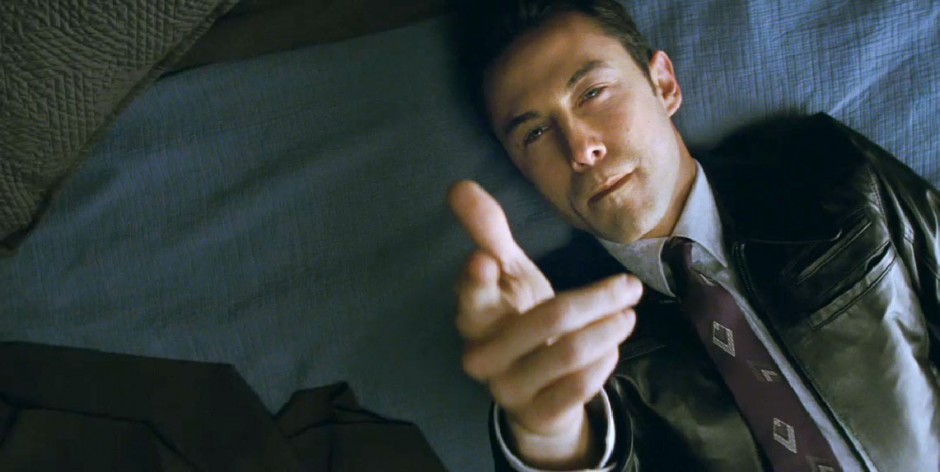
In short, this is a solidly successful attempt at infusing a cancer dramedy with Knocked Up-style Apatowishness — the lowbrow humor, the wry observations, the bromance — and it’s totally fine for what it is. Joseph Gordon-Levitt’s character here is mostly indistinguishable from his turn in (500) Days of Summer — he’s the good guy bad things happen to — and Seth Rogen’s character here is mostly indistinguishable from, well, Seth Rogen. Given this, your mileage may vary.
My main problem with 50/50 is that it telegraphs its characters’ arcs from the beginning. Gordon-Levitt’s original girlfriend, here played by Bryce Dallas Howard, is just a little too unsympathetic from Jump Street — you know she’ll be out the door by Act 2 — while Anna Kendrick’s helpful therapist is so gosh-darned winsome that it’s no surprise she eventually ends up taking her work home with her. 50/50 would’ve been more interesting, I think, if Howard’s character was a reasonably sweet individual who was just overwhelmed by the burdens of the situation. But that’s now how we’re playing it here.
Otherwise, 50/50 has its moments — I particularly liked JGL’s two stoner/chemo buddies, Phillip Baker-Hall and Matt Frewer (getting typecast as a cancer patient?) And, when the film grows darker in its third reel, it feels reasonably well-earned. All in all, 50/50 is a perfectly benign fall date movie.

Less adventurous and more satisfying in its storytelling than Soderbergh’s last major film, 2009′s The Informant!, Contagion basically applies the Traffic technique of several separate, loosely interweaving tales told around the globe (albeit this time with a more subdued color palette) to spin a harrowing chronicle of a possible pandemic. The main reason the film works so well is because Contagion is actually not the end-of-times pestilence thriller the (spoilerish) trailers make it out to be. Rather, and much like David Fincher’s Zodiac, it’s mainly a smart, well-told procedural, and it’s the grounded, matter-of-factness of Contagion that ultimately makes it so frightening.
Contagion telegraphs its unsentimental, take-no-prisoners approach to the story in the first five minutes, when, after returning home to Minneapolis from a business trip to Macau (and a brief layover in Chicago), Gwyneth Paltrow starts having trouble breathing and [minor spoiler] promptly drops dead. Soon, her family (including a low-key, earnest Matt Damon) are in quarantine, and the CDC Director in Atlanta (Lawrence Fishburne) has dispatched an epidemiologist (Kate Winslet) to coordinate with local officials on plans for a possible outbreak. (FWIW, the Minnesota Department of Health is not amused with the film.) But, unfortunately for the world, the barn door is already open: This new MERS-1 virus — part-bat, part-pig — has already been unleashed, and not just in Minneapolis, but in cities all over. (Turns out, Oceans 14 in Macau was a terrible idea.)
As the situation worsens around the world, we start following more individuals on the frontlines in various locales: A CDC researcher (Jennifer Ehle) working to find a cure for this new plague. An academic biologist (Elliot Gould) trying to isolate the virus in San Francisco. A WHO official (Marion Cotillard) and Chinese doctor (Chin Han) looking to discover who was Patient Zero in Macau. Two homeland security suits (Brian Cranston and Enrico Colatoni) sent to determine if this is the work of the terr’ists. A blogger (Jude Law) firmly convinced of government conspiracies and homeopathic wonders. And all the while, even as secrets pass from person to person and fear mutates into panic, the virus continues to spread. Ain’t no Patrick Dempsey monkey gonna solve this one, I’m afraid.
There’re plenty of stars and recognizable faces flitting about this story — some have more to do than others. (The Cotillard subplot seemed a bit unnecessary to me, to be honest, and the Jude Law one is basically just an extended screw-you to the vaccines-cause-autism crowd.) But, as I said, Contagion‘s killer app is its versimilitude. The movie never talks down to its audience, or has its scientists repeating expository information over and over again. (For example, it explains once what a “R-naught” is and assumes you can keep up from there.) It doesn’t have scientists (or Matt Damon, for that matter) running around trying to catch infected monkeys with helicopters — The excitement mostly comes from watching scientists and bureaucrats do their job well. And I liked the fact that, even though no one is safe here, Contagion doesn’t feature some kind of sci-fi-ish, humanity-obliterating virus. It’s a nasty bug with, iirc, a 25% fatality rate — In other words, a more virulent version of the 1918 influenza epidemic — making the story that much more plausible, and scary.
Speaking of scary, I should say that, back in the real world, I’m a pretty sanguine sort about germs, and so I found Contagion more unsettling than anything else. But if you’re at all of the germophobe persuasion, hoo boy — You’re going to have a tough time at this one. From infecteds hacking up a lung on a public bus, to waiters wiping down bar glasses with a dirty rag, to people endlessly and unconsciously touching rails, bannisters, buttons, and each other, Soderbergh does a great job here of intimating that human beings inadvertently leave a slime trail of germy death wherever we go — not the least in movie theaters, exactly like the one you’re sitting in. Point being, [cough, cough], OCD-ish folks will probably want to Netflix this one, instead.


I do wish I’d seen Rise before word leaked out that the movie was surprisingly good, because — going in with higher expectations — I mostly felt like I was just sitting through an extended version of the movie’s trailer. Still, allowing for some iffy science throughout, this sixth Apes film turned out to be a decently smart and engaging evening of late-summer cinema. And as a genre B-movie with a patina of political subtext, I’d say it hits at about the level of the Spierig’s pharmaceutical vampire thriller Daybreakers.
As you probably know by now, Rise of the Planet of the Apes tells the story of Caesar (Andy Serkis), a chimpanzee made extra-smart in the womb by an experimental Alzheimer’s drug concocted by a Dr…oh let’s just call him James Franco. When this project gets shut down — the maternal protectiveness of Caesar’s mom Bright Eyes (wink, wink) is misinterpreted as a hyper-aggressive side effect of the drug — Dr. Franco brings Caesar home to live with him and his ailing father (John Lithgow) instead. There, he is raised, Project Nim-style, by the good doctor and his dad, and cute, ethically-minded zoo veterinarian Caroline (Freida Pinto of Slumdog Millionaire) eventually makes four.
But, as Doctor Caroline perennially intones, one should not tamper with the forces of nature. (Ok, sure. But let’s not overstate the case — or should we have something against pasteurized milk?) And, as Caesar grows older and more leery of playing the pet, his chimp tendencies begins to manifest themselves more and more often. Meanwhile, after showing signs of promise under the original medication, Papa Lithgow’s Alzheimers begins to take hold again. This forces Dr. Franco to experiment with more virulent and aggressive forms of his wonder drug, and makes Lithgow even more feeble and disoriented on a daily basis — and we already know what happens when chimps on this particular drug feel overprotective. One way or another, it’s clearly about to get all Frankenstein up in here.
That gets us to about the end of the first act, which is easily the most conventional and weakest portion of the film — not the least because none of the humans make much of an impression. I’m not a James Franco hater — he was in Freaks & Geeks, after all — and I think he gets way too much grief for slumbering through the Oscars last spring. (What can you do? It’s a thankless gig anyway.) That being said, he does seem sorta disengaged, and even bored, throughout this picture. For her part, Pinto makes even less of an impression — She’s a complete non-entity. And the rest of the humans basically only have one note to play, be it John Lithgow and his dementia or Franco’s boss at the pharmaceutical company (David Oyelowo) twirling his moustache.
All that being said, Rise takes it up a notch in Act II, when Caesar finds himself consigned to San Francisco’s primate prison(?), run by the father-and-son team of Brian Cox and Tom “Draco Malfoy” Felton. (Surprisingly, given his scenery-chewing turns in movies like Troy, Cox underplays it, while Felton is suitably Malfoyish — albeit with a quality American accent.) In this ape Alcatraz, Caesar is thrown head-first into the deep end of chimpanzee society — No more sweaters, college boy! Instead, he must survive the prison yard, learn the power dynamics, and figure out how to befriend the key allies, such as a former circus orangutan and a belligerent ape, he will need to make good his escape.
This isn’t A Prophet, exactly, and to be honest — even with all the impressive WETA work on display here — I could never really suspend my disbelief enough to accept Caesar as a real, honest-to-goodness chimp. (The apes and orangutans work better.) Still, the monkey Shawshank stuff in this middle third of the movie is surprisingly compelling, and it put me in a good mood for the final act, when Rise finally lets its funky-monkey freak flag fly. (I won’t give away what happens here, but like the rest of the narrative, it’s pretty well telegraphed by the trailer.)
My only real complaint, is that I might’ve done more with the Soderberghian ALZ-113 angle here, but I guess one can figure out for themselves what happens next, and/or they were saving that for the sequels. Return of the Rise of the Planet of the Apes, anyone?


In short, Attack the Block is a hoot from start to finish, and it puts those well-heeled Hollywood competitors to shame. At turns funny and frightening, it has the freewheeling, energetic pulse of a Kick-Ass, the unintrusive but real layer of smart sci-fi social commentary that marked District 9, and, in no small part to the sleek Basement Jaxx score, a trip-hop and dub-step cool rivaling that of Hanna or Run Lola Run. Midnight in Paris is probably still my favorite film of 2011 so far, but if there’s any justice, this will be the sleeper hit of the late summer and early fall.
Attack the Block takes place in South London on the evening of Guy Fawkes Day, when fireworks are lighting up the sky and troublemakers are out on the prowl. Trying to get home on this dark night without being harrassed is Sam (Jodie Whittaker), a young nurse new to the high-rise project she now calls home. She doesn’t make it. But before the hooded collection of street toughs who rob her can get away clear, a meteor of some kind suddenly totals a nearby vehicle. (Cue Sio Bibble: This can mean only one thing: Invasion.) While Sam makes a run for it, the gang — really, just a bunch of kids — move to check out what’s left of the car. The obvious ringleader sticks his head deep into the wreckage…
And, a la Harold and Kumar, we now meet our “real” protagonists. Moses (a charismatic John Boyega), the fellow who just entered the car, is not actually Evil Victim #1. Instead, he gets slashed across the face by some kind of space varmint, and so he and the rest of the crew — Pest (Alex Esmail), Jerome (Leeon Davis), Biggz (Simon Howard), and Dennis (Franz Drameh) — hunt down and kill the offending alien. Since nobody knows what it is, they decide to take the corpse to the pad of the local weed dealer (Nick Frost), who’s been known to enjoy stoning out over the National Geographic channel. Problem is, the rest of the very new arrivals to the block don’t take kindly to one of their number being murdered…and they all come a little bit bigger.
That’s basically the set-up, although there are few other characters running around to make things fun: Say, Hi-Hatz (Jumayn Hunter), the Avon Barksdale of this hi-rise, who has atrocious taste in hip-hop. Or Brewis (Luke Treadaway), the loserish grad student who’s just on the block for a resupply. (His funny intro is borrowed from Michael Bolton, except this time it’s to KRS-1′s “Sound of da Police“) Or Probs (Sammy Williams) and Mayhem (Michael Ajao), two gangsta-wannabe nine-year-olds who look up to the older crew. (Memo to Cowboys and Aliens: This is how you do little kids in an alien invasion story. See also: Newt.)
Attack the Block has some very funny moments — “Right now, I feel like going home, locking my door, and playing FIFA!” — and a good bit of stoner humor. But don’t get the wrong impression: This film as a whole is rather dark, and even ruthless at times. (At one point, on his dad’s orders, Dennis takes his cute little dog outdoors to join the team. Spoiler: It lasts about five minutes.) Not knowing much about Attack the Block other than that Nick Frost and the producers of Shaun of the Dead were involved, I expected the film to be jauntier. But it has an edge, alright, and a body count. The monsters here — basically furry gorillas with glow-in-the-dark fangs (or, for those of you in the know, grues) — may be low-fi compared to what we’re used to in these sorts of movies, but they can do some damage, and some rather grisly damage at that.
Which, of course, is part of the fun. As a horror movie, a comedy, and a smart, tightly-plotted thrill ride, Attack the Block succeeds on all fronts. If space aliens and dubstep aren’t your bag, then I guess there’s a chance you might find it all lo-rent and bewildering. Otherwise, this is the purest and most visceral roller-coaster ride of the summer so far, and, barring an absurdly good fall, one of the best films of 2011. Respect.


So, I’m sorry to report, even at this late date, that Cowboys and Aliens is more deadwood than Deadwood. It’s not Wild Wild West bad, I guess, but there’s no narrative urgency to be had here at all. It’s almost sad, really. Some estimable production values are put into service of a total snoozer of a script. And even with all the star power involved — the movie just never finds a spark to get things moving. By 20 minutes in, I had gotten bored with it, and after an hour I was just dutifully waiting for the credits.
So what in blue tarnations happened? Well, laziness abounds here — to take just example, the aliens here are close kin to what we just saw skulking about Super 8. But I expect much of this film’s inertia lies with the fact that, like Green Lantern, Cowboys and Aliens could field an entire pick-up basketball team with its bevy of screenwriters, and the resulting mess shows. Apparently these five (six if you count story credits) souls presumed that, if they just threw enough stock characters at the story, the so-low-its-high concept of cowboys vs. aliens would simply carry the movie. Suffice to say, it doesn’t work out that way.
As the film begins, a man with piercing blue eyes and no memory to speak of (Craig) wakes up in the desert, a photograph of a woman in his hand and a strange metal shackle on his arm. After handily dispatching some would-be bandits, he rides to the nearby watering hole of Absolution, where he soon makes nice with the local preacher (Brown), meets a mysterious and alluring beauty (Olivia Wilde), gets into fisticuffs with the spoiled son (Paul Dano) of local tough guy Colonel Woodrow Dolarhyde (Ford), and discovers from the sheriff (Carradine) that he’s really a ne’er-do-well named Jake Lonergan, and wanted for a stagecoach robbery. Just as this newly-rechristened Lonergan is about to be brought back East in chains to serve hard time, the real trouble begins.
That would be the eponymous aliens, who, out of nowhere, strafe this sleepy Western town and abduct many of its fine, upstanding citizens, including the sheriff, Dolarhyde’s bratty son, and the wife (Ana de la Reguera) of the local saloon proprietor (Rockwell). And so the survivors of this dastardly attack band together to reacquire their kinfolk. Their ace-in-the hole on this mission is Lonergan, whose shackle has a very useful laser cannon within, and who now can kinda sorta remember a previous encounter he and his ladyfriend (Abigail Spencer, a.k.a. Don Draper’s kindergarten squeeze on Mad Men) had with the invaders. But Winning the West back from aliens who enjoy an overwhelming technological superiority is a horse of a different color from fighting indians or poachers. In fact, come to think of it, indians and poachers might come in real handy right about now…
If this synopsis makes it sound like Cowboys and Aliens is a ripping western adventure yarn, well, don’t be fooled, stranger: The result is more than a little dull. It doesn’t help that the movie continually makes lazy Screenwriting 101 (or worse) choices as it goes along. Yes, we do have both a little kid and a dog on this mission, and, yes, the two do form a bond. Yes, Old Man Dolorhyde has some growin’ to do, particularly with regards to his “adopted” Native American son (Adam Beach of Flags of our Fathers), whom he mistreats for no particular reason. So why are the aliens here on Earth in the first place? Er…I dunno…shall we say gold? What’s that you say, Rockwell’s character can’t shoot straight? Hmm, well I sure hope he gets that squared away by the third act!
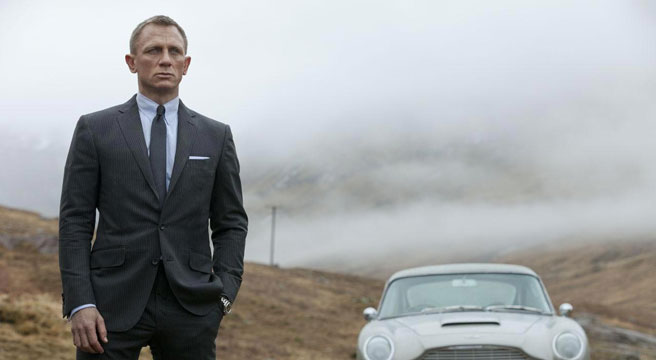
As I said in the favorite movies post yesterday, Rockwell is probably the best thing about Cowboys and Aliens, and the only person who occasionally spins the proceedings here into gold. (His character actor compadres, Carradine and Brown, aren’t given enough to do) For his part, Craig is…well, ok — He does the steely badass thing well enough. But before I saw this, I was thinking of him as Bond and Layer Cake, i.e. a mark of quality. Only as the film rolled did I remember: Oh, yeah, he’s actually in a lot of crap too, like Road to Perdition and The Jacket.
As for Ford, well he’s not bad either, to be honest, and he does seem engaged in the material. But, there’s something off as well — Like Pacino-as-Pacino, DeNiro-being-DeNiro, and Nicholson-doing-Nicholson, he seems to have reached that age where he can only play himself playing a role. Old actors never sour, I guess. They just go meta. (It reminds me of a recent interview with Andy Serkis on playing Gollum again after ten years, and he said it felt like he was doing an impression of himself the whole time. Ford seems trapped in the same feedback loop.)
And Olivia Wilde — well, I want to like her. She seems smart and funny, she’s easy on the eyes, and she’s the niece of lefty writer Alexander Cockburn. But, lordy, when she first wanders into this movie in her calico print settler’s dress, she’s like an Angel of Boring. I can’t tell if it’s completely her fault, but she and her character, both before after her Big Reveal, definitely contribute to the stultifying air permeating this film. Better luck in the next Tron.


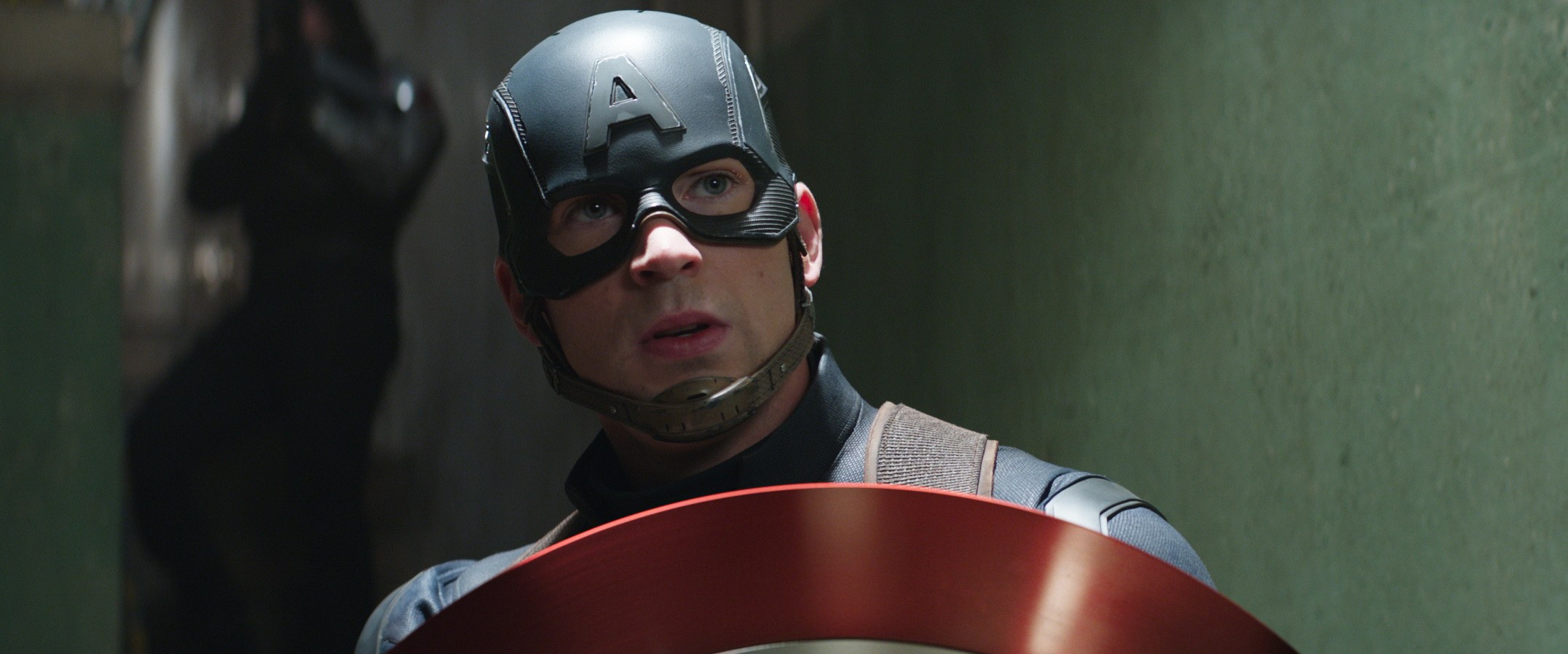
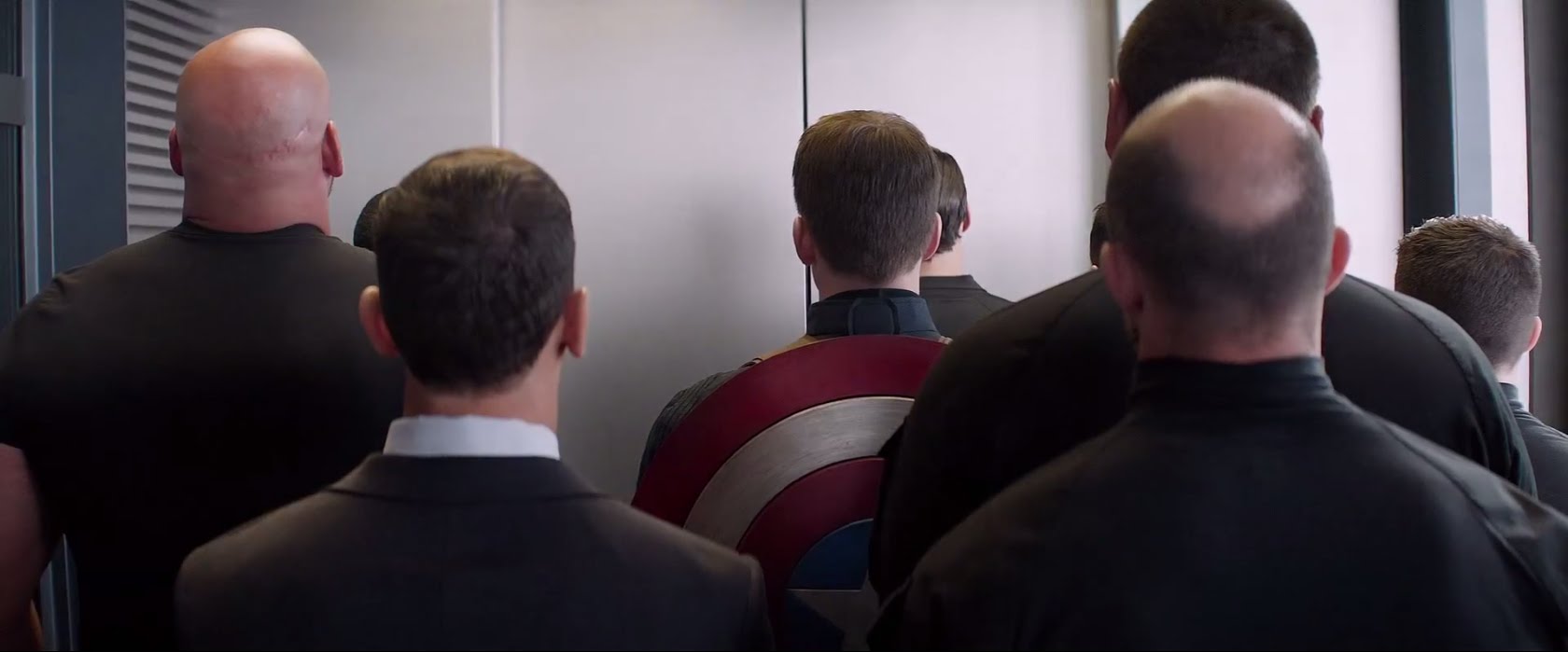
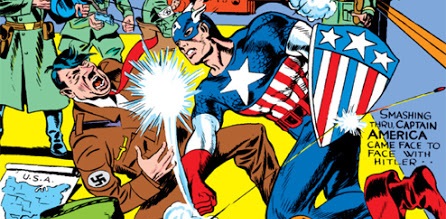
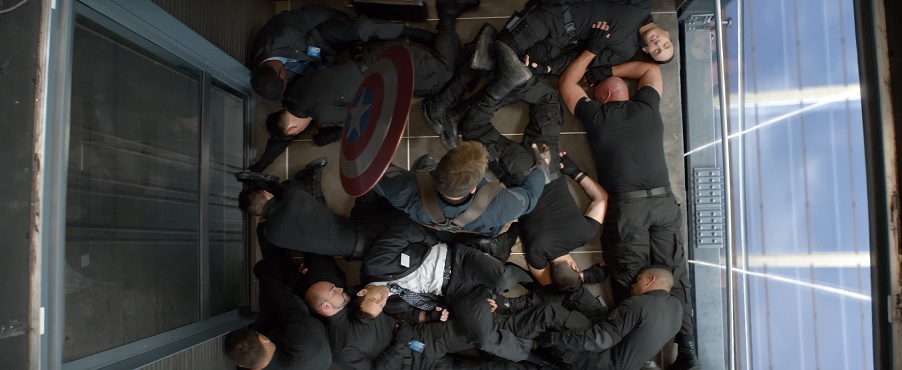
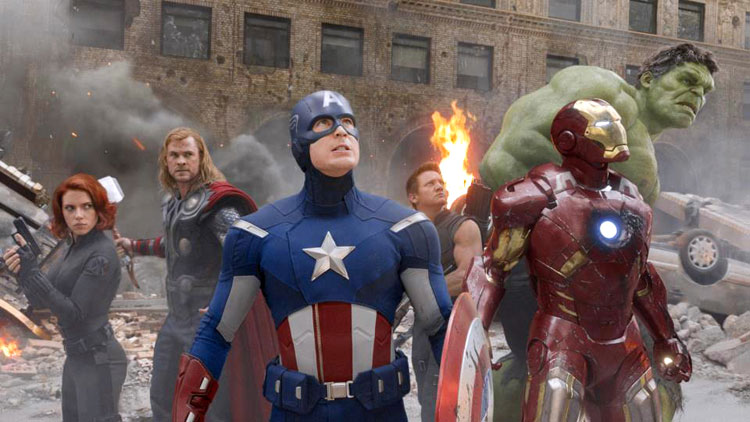
If anything, The First Avenger is more faithful to its titular character, since Johnston, unlike Branagh in Thor, plays this period piece straight, without the likes of Kat Dennings and Clark Gregg providing a security blanket of 21st century irony. Speaking of which, Chris Evans has already shown he exudes star presence in movies like Sunshine and Scott Pilgrim, and he was easily the best thing about otherwise bland comic-book flicks like Fantastic Four and The Losers. But, in the past, he’s always skated by on his snark, and I was worried Steve Rogers might be turned into a self-aware, wisecracking Spiderman sort to accommodate that. But, no, Captain America here is noble, earnest, and maybe a tiny bit dull — exactly as he should be.
In this incarnation as in the original comic, Steve Rogers is a puny kid from Brooklyn whose spirit is willing and flesh is weak: Even as his best friend James “Bucky” Barnes (Sebastian Stans), and seemingly every other able-bodied American male in the borough, head off to fight Hitler and Japan in the Big W-W-I-I, Rogers is rejected from one recruiting office after another for being a tiny, wimpy asthmatic. That is, until a German emigre named Dr. Abraham Erskine (Stanley Tucci) overhears Rogers again trying to serve his country for the umpteenth time. Perhaps, Erskine decides, this brave little man might be the perfect candidate for America’s top-secret Super Soldier program, conveniently headquartered in New York City. (Not to be confused with the Manhattan Project.)
It had better work, since Nazi Germany already has a Super Soldier of its own. That would be Johann Schmidt (Hugo Weaving), a.k.a. The Red Skull, head of Hitler’s deep-science division HYDRA. And, while Hitler wastes time “digging around in the desert” (heh), Schmidt has located the all-powerful Cosmic Cube in Eastern Europe, where it had been under guard by Mr Filch/Walder Frey. Now, with his right-hand man Arnim Zola (Toby Jones), Schmidt threatens to use this powerful device to (wait for it, wait for it) take over the entire world. Can anyone stop his dastardly plan? Anyone, anyone? Rogers?
So, ya, pretty standard set-up, of course. Along the hero’s journey, Captain America suffers through boot camp (led by Tommy Lee Jones, who’s phoning it in but who at least isn’t doing his Two-Face schtick.) He gains a costume, a shield, a squad (the Howling Commandoes), and the attentions of a plucky and beautiful British agent, Peggy Carter (Hayley Atwell of Cassandra’s Dream.) And he learns, more than once, that war isn’t a USO show, and that with great power comes great sacrifice…but let’s save those spoilers for The Avengers.
Speaking of that forthcoming super-team, there’s plenty of chum in the water in The First Avenger for Marvel fans, from Howard Stark (Dominic Cooper here, not Roger Sterling) to the aforementioned Cosmic Cube to a great first shot of Jones’ Zola, which pays homage to his four-color incarnation. When it comes to real, not comic-book, history, however, The First Avenger is obviously a bit fast and loose with the era. Several years before Truman desegregates, the Howling Commandoes are a multiracial brigade, and in fact the entire US Army seems integrated. And while Peggy has to put up with some macho bravado, she still seems unencumbered by the sexism of the period.
Still, given that this is a movie about a guy wrapped in Old Glory who continually punches Hitler in the face, the rose-tinted ahistoricism didn’t bother me all that much. Captain America is a propaganda vehicle by design — arguably the best section in the movie has him being taken on a Flags of our Fathers-style USO tour. And like Superman’s commitment to truth, justice, and the American Way, Cappy has always been more about who we as a nation should be than who we actually are, so I found myself more willing than usual to forgive the film some well-intentioned anachronisms. If anything, I’m glad The First Avenger didn’t choose to make Cap an overly militaristic hero. Instead, he’s a unassuming kid from Brooklyn, given great power, whose patriotism mainly consists of just trying to do the right thing.


Not to overstate the case: This eighth and final film in the Potter series is a quality production, well-made and well-acted throughout, and it’s still a good deal better than Chris Columbus’ flat first two movies. But it just didn’t resonate with me. Even more than the last film, Hallows Part 2 is stuck with dramatizing some of the clunkiest plot elements in the entire series. (Jesus Harry, anyone? And how ’bout that goofy coda?) And by separating out the story into two movies, Hallows Pt. 2 is bereft of much of the connective tissue that makes the Potterverse so engaging. Honestly, if you told me when the book came out that I’d end up preferring the film about the camping half of Hallows, I never would have believed you.
What do I mean by connective tissue? Well, firstly, the killer app of the Harry Potter series, as Laura Miller argued back in the day, was always Hogwarts, and Book 7 sorely missed the rhythms of boarding school life that infused the first six tomes. That was always an obstacle these last two films would have to overcome, and I thought Part One actually did a good job of it. But, as it turns out, the emotional failsafe — especially for the films, where we’ve really seen these kids grow up — was the interactions among the Big Three. And, now that Hallows has been sliced in half, Harry, Ron, and Hermione really don’t have all that much to do with each other here in the back end.
Instead, we have — after a brief adventure in the vaults of Gringotts — the Siege of Hogwarts, which takes up most of the picture. And it’s all very impressive, with its psychic shields, stone soldiers, rampaging ogres and whatnot. But this is all action-fantasy spectacle, and — after Helms Deep, Minas Tirith, and various other besieged redoubts in recent cinema, not particularly engaging spectacle at that. (Also, I guess the idea here is the good guys are buying time for Harry to find the Ravenclaw diadem, but the way the story comes across, all this carnage seems beside the point anyway. Couldn’t all the loss of life have been averted if Snape just took Harry by the pensieve before the Big Battle?)
Speaking of ole Severus, the back half of the film is also burdened by its source material. To be honest, I’d forgotten about many of the things that aggravated me about Deathly Hallows the book, until the story unfolded here once again. I already mentioned the Aslanification of Harry, where he has to now sacrifice himself for Voldemort’s sins to be truly expunged from this world. (See also: Matrix: Revolutions.) Then there’s the conversations with ghosts and the heavenly train depot rendez-vous with Dumbledore (weirdly, also in the third Matrix.)
And then there’s the Snape story, which plays out mostly as expected, but still has the effect of totally cheapening the character of Harry’s real dad. (As it is here, Snape is the unrequited hero, and James Potter is just a bullying prat who happened to marry Lily.) Like I said, a lot of these plot developments seemed to be coming by the end of the series — Severus always seemed like he was deep undercover, and Harry’s lightning scar made sense as the seventh horcrux. But the execution in the book, and subsequently here in the movie, is clumsy.
One more small issue here: Along with Hogwarts itself and the Big Three, the third leg of the stool for the films has been its British Thespian Full Employment program. But, with the exception of Ralph Fiennes’ Serpenthead Voldemort and arguably Maggie Smith as Professor McGonagall, the amazing collection of talent in the bullpens here doesn’t get all that much to do either. Estimable actors like John Hurt and Jim Broadbent have only reaction shots, and even big moments like the death of David Thewlis’ Lupin and Natalia Tena’s Tonks are given short shrift. (FWIW, the only big new actorly add in this last installment is Ciaran Hinds as Alberforth Dumbedore, but he’s virtually unrecognizable underneath his Michael Gambon makeup.)
Again, not to be a total hater — This is a competently-made and even sleek production, and it’s hard to see how David Yates could’ve improved the situation given the constraints of the source material. But, there’s no riff as inspired here as Yates’ Brazilian reconception of the Ministry of Magic in the last film, nor any sequence as transporting as the animated origins of the Hallows we saw last November. Like the book series from whence it came, the last chapter of the Harry Potter films ends with a bit of a plunk.

Hello all. So, yes, it’s been quiet again, and the movie reviews I’m behind on are piling up (I’m three back now, going on five.) In the excuse department, work has been even busier than usual, of late, and, obviously, the political scene has been depressing. So there’s that.
Anyway, in partial recompense, here’s my first entry of a fun meme I saw at Cryptonaut-in-Exile a few weeks ago: “100 Things I Love About My Favorite Movies. The rest will follow in a leisurely fashion at some future point.
Here’s the rules: “Rather than posting your 100 favorite films (which has been done and overdone), you simply post your favorite things about movies…[I]nstead of obsessing over whether the films you put on a list are ‘objectively good enough’ to put on said list, you simply jot down 100 moments/lines/visuals that have made a lasting impression on you or sneak their way into running gags between you and your friends.“
And, so, without further ado and in no particular order:

Walking out of the theater after Beginners, the film that most sprung to mind was Miranda July’s Me and You and Everyone We Know. So I was surprised to discover soon thereafter that July and Mills are actually married. (It’s a good match — they definitely share a worldview.) Here, as in Me and You, Beginners is occasionally charming and soulful in its off-kilter way. But it also too often flirts dangerously with twee to feel really resonant. At least for me, the story would have more power if the characers — particularly its two lovebirds — were less affected.
The more interesting and successful part of Beginners involves the main character — Oliver — remembering his recently deceased father Hal, and the way Hal, after the death of his wife, consciously reinvented his life to be happy. After forty-four years of marriage, he comes out, finds a boyfriend (ER’s Goran Visnjic) and a new social circle, gets active in politics and gay liberation, and takes on new hobbies like house music, movie nights and lighting fireworks. And even when Hal is ultimately diagnosed with terminal cancer, he chooses to maintain his late-in-life joie de vivre. Because for Hal, quite frankly, life’s too short not to be happy.
By contrast, Oliver-in-the-present is paralyzed — with loneliness and self-doubt, wtith the weight of carrying other people’s problems, with the burden of, as he puts it, historical consciousness, and, with well, general sadness. He can’t break out of his funk and be happy, even when happiness — in the form of Melanie Laurent’s Anna — is staring him in the face. The grief over Hal’s demise is debilitating enough, but in fact Oliver’s such a sensitive soul that he can’t even bring himself to leave his dad’s Jack Russell, Arthur (who “speaks” in subtitles and more often then not steals his scenes), alone at home. Can Oliver find a way to overcome his emotional obstacles, take a page from his father (and free-wheeling mom (Mary Page Keller), whom we meet in flashback), and grab the reins of his life? Let’s hope so. Neither love nor pixieish yet similarly depressive significant others tend to come round every day.
This relationship side is where Beginners started to rankle. MacGregor and Laurent make for a cute couple (and Ewan’s been working on his American accent — he sounds much better than usual.) But, even allowing for the traditional meet-cute (in this case, at a costume party — he’s Sigmund Freud, she’s a mute Charlie Chaplin), far too many of their interactions together are based on outright quirkiness. When they get in the car, she points, and he drives wherever she has bidden. When they get back to her place, they keep up the “she’s a mute” pretense long after it would have gotten annoying. When the phone rings, they pretend to be each other so we can have portentous revelations about her father (a suicidal depressive, in keeping with the happy/sad theme here.)
Perhaps we’re supposed to take from all this that these are two rare and beautiful flowers who are lucky to have found each other, or that they are both such damaged souls that they can only relate to each other through these distancing mechanisms. But, to me, all of this self-conscious artifice in their dealings just made these two characters seem overdrawn and fake. (At the very least, being these two seems like it’d be exhausting.) The same goes for Oliver’s occasional voice-overs, when, like The Curious Incident of the Dog in the Nighttime, he notes the different times he’s discussing with establishing pictures of ex-presidents and shots from LIFE magazine and such. It’s all very pretty, but what do these vignettes have to do with the rest of the tale being told? They feel like an art exercise rather than something emerging organically from the film.
In short, when dwelling on the father-son story, Beginners occasionally finds a few moments of quiet emotional truth. But I found the love story and framing devices here too crufted over with bric-a-brac to be as engaging. So, one part good, one part not-so-good — Fortunately, for Beginners, tie goes to the talking dog.


Much like Manhattan, this film begins with a love letter, in the form of a languid montage, to its setting. While (naturally) a jazz ditty plays, we spend the first five minutes or so of the film ambling through the streets, parks, and cafes of the City of Lights, soaking up the Parisian ambience. (This is one of the many reasons I could see Midnight In Paris making a great double bill with Richard Linklater’s Before Sunset, which opened similarly.) As it happens, wandering aimlessly around this city is a favorite hobby of our protagonist, Gil (Owen Wilson), a successful Hollywood screenwriter looking to find inspiration for his first novel in the old corners of gay Paree. Unfortunately, his fiancee Inez (Rachel McAdams) doesn’t share this proclivity: She prefers cabs, shopping, and expensive jewelry. (If that doesn’t tell you what to expect from her character, her tea party parents — Kurt Fuller and In the Loop‘s Mimi Kennedy — should close the deal.)
And so it is that one night, while Inez is out dancing with a know-it-all acquaintance (Michael Sheen), Gil happens to hitch a ride in a vintage automobile and finds himself at what appears to be a costume party. The thing is, the guy on the piano (Yyves Heck) looks exactly like Cole Porter, the couple he falls in with — the Fitzgeralds of New York — just happen to be called Scott (Tom “Loki” Hiddleston) and Zelda (Allison Pill), and the gruff guy at the coffee shop (Corey Stoll) they take him to is the spitting image, in word and deed, of Ernest Hemingway. Apparently in Paris, the past isn’t even past… or at least once it’s past midnight.
So, yes, somehow the Lost Generation has been found, and soon enough Gil is relishing the movable feast: He’s getting book tips from Hemingway and Gertrude Stein (Kathy Bates), talking rhinos with Dali (Adrien Brody), running movie ideas by Bunuel (Adrien de Van), and falling in love with one of Picasso’s muses, the lovely Adrianna (Marion Cotillard). All the while, Gil begins to ignore his “real” life in the 21st century as too humdrum and mundane. After all, how you gonna keep Gil on the screenwriting farm after he’s seen Gay Paree? But, if the 21st century isn’t good enough for Gil, why should those madcap 1920′s be good enough for Adrianna? Nostalgia infects us no matter what our time, and so we beat on, borne back ceaselessly into the past…
As Allen’s fans have already figured out by the second reel, Woody is repeating himself here somewhat. (After a career as long and prolific as his, it’s to be expected!) Replace nostalgia with love of the cinema, and Gil’s time-traveling to the era he idolizes isn’t too far afield from Mia Farrow’s romance with matinee idol Jeff Daniels in The Purple Rose of Cairo. (For that matter, everything involving Michael Sheen’s pompous academic is set-up for another variation of the Marshall McLuhan joke from Annie Hall.) And Allen has always been one for high-culture namedropping in his writing and films. It’s just that this time, the likes of T.S. Eliot, Man Ray, Josephine Baker, and Alice B. Toklas are actual cameos rather than just allusions.
So, yes, Allen may have trod this ground before, but Midnight in Paris nonetheless works, for several reasons. For one, Owen Wilson — an actor I’ve never really felt one way or the other about — is one of the best Allen analogues to come down the pike in awhile. He manages to capture Woody’s usual collection of neuroses while coming across as more charming and self-effacing then Allen really can anymore. For another, the movie doesn’t aspire to deep philosophical truths about relationships and/or the meaning of life (like, say, the existentialism pervading Match Point and Crimes and Misdemeanors). It has some insightful things to say about the nature of nostalgia, and otherwise just aims to show us a good time. As they say in the closest thing we’ve got to Paris stateside, NYC notwithstanding, laissez les bons temps rouler.


Well, at least for now, Cap can breathe a little easier, because Green Lantern, as I’m sure you’ve heard by now, is a bit of a dud. It’s not nearly as terrible as some of the reviews make it out to be, and I still think there’s potential here for a quality franchise. (Let’s remember, Sam Raimi’s first Spiderman had serious pacing problems and some majorly poor decisions therein as well — I’m looking at you, Willem DeFoe’s static faceplate.) But this Green Lantern is too often a rote, by-the-numbers origin story. It never establishes much of a rhythm, and too often feels like a film made by a committee. In short, a missed opportunity.
The first red flag happens in the opening moments, as Geoffrey Rush tells us in a leaden voiceover about the Green Lantern Corps — a legion of intergalactic cops, organized and headed by the Guardians of Oa, who are dispatched to guard all the sectors of the universe through judicious use of their willpower-driven rings. This sort of stage-setting exposition dump can be done well — most obviously by Cate Blanchett in Fellowship — but here it feels perfunctory and tacked-on, like somebody rushed it to the beginning of the film after a test screening or two.
The good news, tho’, is we’re in space, and here the movie actually shows some early hints of promise. We watch some alien space marines, shipwrecked on a rocky planet, accidentally awaken an trapped malevolence — the former Oan now known as Parallax. Parallax enjoys the Cheneyesque ability of growing stronger by feeding on fear, and he soon escapes this Rura Penthe to exact his revenge on the Green Lantern Corps, and especially the Lantern who put him under — Abin-Sur of Sector 2814. (This, by the way, is exactly the let-your-freak-flag-fly sort of cosmic craziness that should have animated the whole film. But it’s a tease. We ultimately spend far too much time earthbound.)
So Parallax is loose, and he soon manages to fatally wound his old nemesis Abin-Sur, who then has to find a replacement ringbearer as soon as possible. Enter Hal Jordan (Ryan Reynolds), a hotshot Air Force pilot who doesn’t play by the rules!â„¢, but whose swagger and bravado conceals lingering doubts about his abilitiesâ„¢ resulting from the untimely death of his fatherâ„¢. (I know, I know: Green Lantern’s origin is Green Lantern’s origin, but the film doesn’t do its source material much credit by playing it so bland.) Does Hal have it in him to take the ring, face down his fears, and defeat the yellow-tinged forces of Parallax? I dunno…let’s watch him mope for forty-five minutes or so to find out!
In the reviews, Ryan Reynolds has been avoiding most of the blame for what’s wrong with Green Lantern, and I think that’s fair. He’s a likable actor with, as least as far as I can tell, not much range — but, since cocky-but-endearing is his wheelhouse, he ends up being a decent-enough fit for Hal Jordan. Blake Lively, on the other hand, has seen a lot of Haterade thrown her way for this flm. But, while she made more of an impression in The Town, she’s perfectly competent here — The problems with Green Lantern aren’t her fault either. Nor are they really Martin Campbell’s — the film feels well-made throughout.
No, the problem here is pretty clearly with the writing — which probably isn’t surprising given that Green Lantern has all of four credited screenwriters (Greg Berlanti, Michael Green, Marc Guggenheim, Michael Goldberg — I hope they saved money on the monogramming.) Most obviously, much more of this adventure should have happened in space. The film only really has a pulse when on Oa or somewhere off-planet, but instead we spend far too much time watching Hal Jordan sulk on Earth. So that was a bad decision. But, even beyond that, the film is just all over the place.
For example, we spend several minutes in the early going being introduced to the Young Nephew Who Idolizes Halâ„¢ — and then he never shows up again. Or to take a problem in the opposite direction, for all the Basil Exposition voiceovering going on, I don’t remember the film ever explaining that the Lanterns’ rings don’t actually work against the color yellow, which is a pretty big plot point to save for a sequel. For that matter, you don’t get the sense that Hal ever uses the ring for anything more than making planes and guns in this flick. Either his or his writers’ imagination seems severely limited.
To take just one instance of the lazy writing here, consider the hamhanded way that the demise of the Big Bad is telegraphed in the middle of the film, when Hal is [spoiler]randomly instructed by a fellow Corps member about the power of gravity. Since we’ve already established that Hal is a hotshot pilot unconcerned with his own safety, why not just have him, in a fit of ring-induced euphoria, fly too close to the sun during training and have to be bailed out by Kilowogg et al? Bam, you have instant foreshadowing and character development, and an Icarus metaphor to boot. This is basically a no-brainer.
So, why do I still hold hope for a Green Lantern sequel, even amid all the general blandness here? Well, for one, the origin story is out of the way, and that’s usually what kills these sorts of movies. For another, Green Lantern is much more fun when it’s in space, so perhaps a sequel could fly in that heady direction instead. And then there’s Mark Strong’s turn as Sinestro, the (wink, wink) ostensible head of the Corps. Peter Sarsgaard is pretty solid here as weaselly dweeb Dr. Hector Hammond (tho’, here’s a game for ya: drink every time he screams like he’s in a Lynch and/or Cronenberg film), but Strong is far and away the best thing about the picture. A space-faring adventure that uses him more could be very fun indeed.


Abrams — who, FWIW, I run hot and cold on; I disliked Mission: Impossible III and loathed Cloverfield (which he produced), but thought Star Trek was good summer fun — has slavishly mimicked the Beard’s early aesthetic here: the overlapping, naturalistic conversations; the group of young kids on a grand adventure; the missing and/or untrusting parents; the visitor from another world; the ubiquitous Close Encounters-style lens flares; the long, anticipatory build-up of Jaws and Jurassic Park; the suburban milieu and untrustworthy government officials of ET. And it’s all glued together and coated thick with hefty dollops of industrial strength, 80′s grade, early-Spielberg schmaltz.
But, to what effect, really? The wallowing in Spielberg nostalgia is a neat gimmick for awhile, but the longer it drags on, the more it ends up feeling like a film school exercise. And, while the kids at the heart of the story are likable enough — especially Joel Courtney as our young hero and Elle Fanning as his #1 crush — the throwback style just can’t sustain the movie on its own, especially as the story falls apart in the second and third acts. And so by the end Super 8 ends up being a lot like cotton candy: It seems like a good idea at the time, but once you pull away all the wry nods to (and direct lifts from) Spielberg’s oeuvre, there’s no there there, and you’re left with just the lingering, sickly aftertaste of saccharine.
To its credit, Super 8 begins quite promisingly, with one of the more economical introductions I can remember: We see an industrial worker rolling the counter on a workplace safety sign, which reflects the numbers of days since the last fatal accident, back to 1. Clearly, something terrible has happened, and just as clearly, the widower after the accident — police deputy Jackson Lamb (Kyle Chandler of Friday Night Lights) — thinks a local yokel named Louis Dainard (Ron Eldard) is at fault. Like Lamb’s son Joe (Courtney), we see Lamb summarily escort Dainard out of the wake, cuff him, and throw him in the back of his cruiser, for reasons left unexplained until later in the film.
Cut to six months later, the deputy’s still grieving in his own way — i.e., by being a gruff and distant workaholic — and young Joe’s trying to get on with his life by helping his friends finish their Super 8 zombie movie. So one night, Joe and his friends are filming their Romero homage down by the train station, in order to garner some “production values” (not a phrase one usually associates with George Romero), and they get more than they bargained for. Much more, in fact: An epic (too epic, really — it’s like watching Looney Tunes) train derailment that they soon discover was perpetrated by none other than Mayor Royce their biology teacher. Why would he do such a thing? Therein lies the riddle…
Soon enough, things get stranger: The Air Force shows up and takes over the town, ostensibly to clean up the debris from the train wreck — which seems to consist mostly of strange metal cubes. Power outages become frequent, cars lose their engines, and all the dogs around simultaneously decide to get the heck out of Dodge. Even more frightening, townsfolk start disappearing at night, usually under violent circumstances. And even as the kids try to get to the bottom of it all, they’re hamstrung by the persistent antipathy between Deputy Lamb and Mr. Dainard that we witnessed in the opening moments. Because, when there’s a monster from outer space on the loose, there’s nothing more compelling than watching parents put up arbitrary roadblocks for the characters, for purely petulant reasons.
That may be a bit unfair, but that, unfortunately, is what Super 8 devolves into. The first hour or so of build-up shows quite a bit of promise story-wise, but it ends up being derailed in the middle by Abrams stopping everything to lay on more Spielbergian schmaltz. At one point, one of the kids explains — in reference to their zombie flick — that it’s the characters you should care about in movie-making, not the circumstances. Maybe so, but, as I said of Steven Soderbergh’s Solaris back in the day: “‘Look, I know it’s weird to see your dead wife again and all, but there’s an alien intelligence trying to communicate with you outside the ship.” Super 8 makes the same mistake — it keeps putting everything on hold so these characters, who are mostly two-dimensional Spielberg composites and not-particularly interesting on their own terms — can work out their family and/or trust issues.
The schmaltziness is really the movie-killer here: To wedge in growth moments for its boring characters, the film starts taking some odd turns that don’t make much sense in terms of the story. (Why does the deputy hook up with his nemesis to find the kids? Why not, say, the director’s parents?) And this problem is complicated by the fact that Super 8 can’t seem to decide which Spielberg movie it wants to rip off the most, so it ends up going with all of them. At various points the monster acts like Jaws (the first hour), the Jurassic Park T-Rex (for which a random bus attack is shoehorned in) and ET (the end.)
Once it becomes abundantly clear this last personality will take hold at some point — for me, it was right when the creature steals Elle Fanning — the movie loses all sense of dramatic urgency, and is revealed for what it mostly is: A well-made but uninspired tribute reel to the Spielbergiana of old. In effect, Super 8 is exactly like the movie shown during the final credits (one of the best scenes in the film), except with higher production values, much more manipulative savvy, and, sadly, much less in the way of real heart.


So unfolds Terence Malick’s beautiful but flawed The Tree of Life, a perhaps-overly meditative disquisition on life, the universe, and growing up poor and rough in Waco, Texas. Malick, as I am sure you all know, is the type of director who inspires passion on both sides of the fence, from devotion (See Matt Zoller Seitz’s video essays on Malick’s first four films) to antipathy. To quote a grad school friend of mine, Malick’s movies are “[l]ong, long streams of annoying non sequiturs delivered by impassive yet chiseled actors staring into the distance. (Well, sure! That’s a feature, not a bug!)

At any rate, this is a Malick movie through and through, so if his penchant for philosophical ponderings via voiceover and fall-of-Eden metaphors irritate you, you’ll probably want to take a pass here. I myself am closer to the Seitz end of the spectrum: While I still have only seen it once, I adored The New World, and it clocked in at #4 for my Best of the 2000′s list. The Tree of Life, unfortunately, is a stickier wicket, and it didn’t really resonate with me like World did. It is undeniably beautiful, and I definitely admire its ambition. But, for all its cosmic scope and archetypal language — Father, Mother, and whatnot, this really ends up being an intensely personal and idiosyncratic story about growing up in 1950′s Texas, and that is a story I never found to be all that engaging.
The Tree of Life opens with a quote from the Book of Job (suggesting at first that Malick has moved beyond his Eden obsession — no, that shows up later), and, after introducing us to a suburban family in Texas, some Job-like news for them to digest. One of the sons seen playing in the sun in the opening moments has, apparently, died in Vietnam several years later, leaving their saintly mother (Jessica Chastain) and take-no-guff father (Brad Pitt) bereft. Also in mourning is the deceased’s brother Jack, who we come to know mostly as a child (Hunter McCracken, the spitting image of The Thin Red Line‘s Jim Caviezel) bu also as an adult (Sean Penn), where he works as an architect in some unnamed urban purgatory.
The film’s bravura sequence occurs early, as adult-Jack is momentarily distracted from his ennui and notices what seems to be the titular tree, and, lo, we suddenly flash back to the dawn of Creation. Over the next ten minutes or so, light separates from dark, stars coalesce amid the galactic dust, and, eventually, an earth is born — home to volcanoes and great oceans, as well as amoebae, jellyfish, dinosaurs, hammerheads, and eventually, disconsolate Texans. Even if the often-amazing Hubble 3D stole some of Malick’s thunder here, this section of the movie is often breathtaking to behold. If anything, it should have been longer. Where are the early mammals? The cro-magnons and neanderthals?

Oh, wait, they’re in the Lone Star State, in the form of Brad Pitt — a stern, unyielding dad who is always testing his children, trying to make them hard. (There’s that Job angle again.) And so, once we return to the mid-20th century, Jack must grow up wrestling with his conflicted feelings for his father — why is he so unjust? why does he make me pull out weeds by the roots and re-enact Fight Club? — while also worrying about disappointing his child-like and loving mother. (Of course he does eventually, which is where we get to that ubiquitous fall from Eden, with later flashes of Cain and Abel to boot.)

Unfortunately, all these sun-dappled and vaguely biblical Texas days of Jack’s yore, while still pretty to look at, weren’t particularly involving to me, and they comprise the bulk of the film. Honestly, how did we get from witnessing the formation of galaxies to reliving The Great Santini or This Boy’s Life? I think I get what Malick was trying to do here, but, to me, the move from the cosmic to the specific didn’t really work.
The moments when Jack is still a baby or, say, when he first develops a crush are totally absorbing, because then it feels like Malick is still operating on a grand scale, evoking fundamental and universal human experiences. But, once our main character grows old enough to become his own individual, the circumstances of his plight stopped being resonant. I’m sorry Jack’s dad is kind of a jerk, and I’m sorry Jack feels bad about blowing up a frog. But I’m not particularly interested by these developments either.
Don’t get me wrong. I’m glad I saw Tree of Life. It looks ravishing at times, and I admire its reaching for the stars. But its reach exceeds it grasp — or at the very least it exceeded my attention span the longer it dwelled in rural Texas — and I have to confess to being more than a little bored by it over the course of its last hour. Father. Mother. Judge me not for losing interest. It is in my nature, and I cannot fight what I am.


And so the studio decided to replace Vaughn with veteran hack Brett Ratner, who, true to form, subsequently delivered an egregious cash-grab of a movie. (To be fair, Ratner’s hands were tied by a terrible, death-heavy script that never should’ve been greenlighted.) Thus was destroyed much of the goodwill Fox had built up with Bryan Singer’s X-Men and X2: X-Men United, and the studio’s reputation was cemented as the place where otherwise decent comic book properties are squeezed for an opening weekend box office haul and then left to die. (See also: Daredevil, Elektra, and Tim Story’s two terrible Fantastic Four films.)

So when news broke in May of 2010 that director Matthew Vaughn would be returning to the X-franchise for X-Men: First Class, Fox’s Mad Men-era reboot of Marvel’s most famous mutants — due out the following summer! — the fanfolk out there had to wonder: Would the consistently solid Vaughn, now with Stardust and Kick-Ass under his belt, actually be able to churn out a high-quality X-film under even more ridiculous time constraints? The answer, happily, is yes. Jaunty and briskly paced throughout, this globe-trotting X-adventure has the comic book energy and sense of fun its predecessor lacked. And even with a bevy of C-lister mutants on the roster (more on them in a moment), X-Men: First Class could very well be the best X-film in the franchise. (It and X2 would have to slug that out in the Danger Room, I think.) If nothing else, it’s the second surprisingly solid Marvel film this summer — let’s hope Cap can make it a trifecta.
Just as J.J. Abrams and co. made the best of the Star Wars prequels in Star Trek, one great decision Vaughn and his six-deep story and writing team make is to unabashedly borrow from other genre influences. Vaughn himself has described the movie as “X-Men meets Bond,” and that he molded “a young Magneto on a young Sean Connery. He’s the ultimate spy — imagine Bond, but with superpowers.” And it works, in part because Fassbender, like the young Connery, has charisma to spare. For the first half-hour or so, it’s inordinately good fun watching the young mutant master of magnetism (and languages) channel Bond-by-way-of-Simon-Wiesenthal and scour the globe for ex-Nazis to get payback for his parents (not to mention, in a clever switcheroo, Dustin Hoffman in Marathon Man.)
But 007 isn’t the only genre influence at work here. As it does in the comics, if you think about it, the earliest iteration of Xavier’s School for Gifted Youngsters here also has a touch of the Hogwarts magic, especially when our first team of young mutants — here, Mystique, Beast, Havoc, Banshee, a Pixieish Angel, and Darwin — show each other their powers. And, of course, there’s more than a bit of an Obi-Wan-Anakin-and-the-Emperor triangle going on with Professor X, the big M, and Kevin Bacon’s impressive Big Bad, Sebastian Shaw, albeit with less whining and green screen-induced thousand yard stares.
Speaking of Bacon: You really can’t say enough about the exceptional cast of X-Men: First Class. It would be very easy to imagine this film falling on its face if folks other than he, Fassbender, James McAvoy, and Jennifer Lawrence were carrying the acting load here. As it is, you don’t get the sense from any of them that they feel like they’re slumming it here. (Sadly, one does gets that sense from January Jones as Emma Frost, a.k.a. the White Queen. She’s as wooden as Betty Draper and is…not good. The originally cast Alice Eve, or Rosamund Pike, would have been better.)
The only real qualm I have with X-Men: First Class, and it’s ultimately a minor one, is that this isn’t actually X-Men’s First Class — likely because Cyclops, Jean Grey, and Iceman made it into the first few films — and the roster they chose here feels rather budget. (Havok and Banshee, for example, have pretty much exactly the same power when you get right down to it, and other than Banshee’s “sonar” moment, everything they do here could’ve been done by Scott Summers.) Still, the beauty of the X-franchise is that the roster is always getting rejiggered in some way or another — even death is merely a setback — so they can always bring more intriguing heros on for X-Men: Second Class. Let’s just hope Fox has learned to keep Vaughn, or another director of his caliber, in the director’s (wheel)chair this time.


I’ve noted a couple times here that I find comedies hard to review, as what folks tend to laugh at is highly variable. But, speaking for myself, Bridesmaids was a respectable-enough entrant in the Feig-Apatow wheelhouse. (Apatow is a producer here.) It’s not as memorable as Knocked Up or The Forty Year-Old Virgin, but the film is amusing enough that I had a smile on my face throughout. And, even amid the occasional gross-out sequence, Bridesmaid has the same sweetness, sense of humor about everyday foibles, and fundamental decency towards its characters that marked Feig & Apatow’s magnum opus, Freaks and Geeks. All in all, a solid summertime matinee — go ahead and RSVP yes.
Not to overstate the F&G angle, Bridesmaids is also the brainchild of co-writer and star Kristen Wiig, who claims the spotlight here after several years of ubiquitous, scene-stealing, and often thankless character work in the movies. (See, for example, Extract, MacGruber, Walk Hard, and Whip It.) How much you enjoy Bridesmaids will probably depend heavily on how funny you find Wiig. I’ve heard people complain that much of her schtick just involves awkward pauses, but I think she’s both an amusing and appealing comedienne, and that, like most people on SNL these days, she deserves better material than she usually gets. Good on her to take matters into her own hands and, with fellow Groundling Annie Mumolo, finally just write that star vehicle for herself.
From the outside, Bridesmaids seems like, and is being billed as, the double-X counterpart to Todd Phillips’ The Hangover: This time, it’s the women going wild before the big nuptials. And, to be sure, there is some of that here: For example, Melissa McCarthy’s role as brother-to-the-groom Megan, a.k.a. “the X-Factor” member of the bridal party, feels very broad and Galiafanakis-y at times. (And partly because she’s given the freest rein, McCarthy ends up running away with most of her scenes, although it helps her case that the two other “minor” bridesmaids in this story — Elle Kemper as the goodie-too-shoes and Wendi McLendon-Covey as the haggard mom looking to get disreputable — are underwritten.)
But, ultimately, that Hangover comparison is misleading. (And, as my brother noted: If anything, these bridesmaids leave opportunities for obvious Wolfpack-like shenanigans on the table. They [spoiler] never actually make it to Vegas, for example.) Despite its billing — and despite one memorably repugnant sequence involving food poisoning at a dress fitting — Bridesmaids is more traditionally rom-commy and, well, chick-flicky than the trailers let on. Instead of indulging in no-holds-barred comedy mayhem just for the sake of it, the movie more often chooses to dwell on the slow-burn courting between Wiig’s Annie and an Irish cop who pulls her over one evening (Chris O’Dowd), and/or the “love” triangle of Annie the Maid of (dis)Honor, her childhood best friend and bride Lillian (Maya Rudolph), and the newcomer/interloper to their BFF twosome, Helen (Rose Byrne).
And that’s totally ok. In the end, I probably preferred the more mellow and humanistic Bridesmaids to the fratty antics of The Hangover anyway, although I realize I liked the latter film less than most people. (I’m about 50-50 on seeing this week’s sequel.) Once you accept that, yes, we are occasionally in rom-com territory here, and thus make allowances for some of the more irritating tropes of that genre — like, say, the inevitable second-act blow-up (Gee, I hope these crazy kids work it out before the end of the film!) — Bridesmaids is a solidly entertaining summer movie. Sure, the wild swings in tone can be a bit jarring at times — at one point near the end, the film jumps from a shot of two adorable golden retriever puppies to McCarthy and her real-life husband doing unspeakable sexytime things with a sandwich — but, all in all, Bridesmaids is not a half-bad attempt at fusing the gross-out comedy with the girls’ night out.
[One semi-unrelated note: If you do happen to check out a matinee of Bridesmaids, make sure beforehand your showing isn't "reserve-seating." I caught the film out in the Fairfax burbs, and it was my first experience with this new -- and highly stupid -- phenomenon. Basically, they have you on the hook for a $3 markup per ticket, even if the show is nowhere close to selling out. Have America's moviegoers really been clamoring for reserve seating for afternoon matinees? Somehow, I doubt it.]


That may seem like I’m damning this first of four comic book tentpoles this summer — along with X-Men: First Class, Green Lantern, and Captain America: The First Avenger — with faint praise. But, hey, sometimes ok is a good thing. There’s not much reaching for depth here: Branagh’s Thor is smart and self-referential enough to know that, once you get past all the family strife, Norse brooding, hubris of Gods, and whatnot, this is just a breezy, early-May popcorn film, and it keeps a light touch accordingly. The Dark Knight, this isn’t.
As such, and perhaps not surprisingly, Thor — the story of a fallen deity’s misadventures in the American Southwest, and the brother who betrayed him back home — feels more in keeping with the Make-Mine-Marvel larkiness of Iron Man. (And although IM was a much better film, Thor is more successful and self-contained a story than the rush job that was Iron Man 2.)
Like Iron Man, Thor is a comic that — Walt Simonson’s epic run in the 80′s notwithstanding — I’ve remained mostly agnostic about over the years. With all due respect to the Nordic pantheon from whence he came, Thor has just never been all-that-interesting a comic book character to me. He’s…a guy…with a hammer. Nor, for that matter, are his powers very well-defined. So, ok, he’s strong and can kinda sorta control the weather. But there’re a lot of generic strongmen running around the Marvel universe — Hulk, Hercules, Colossus, Juggernaut. What makes Thor different?
With that in mind, Branagh and his team of screenwriters make the smart move of dropping the “trapped as mere mortal Dr. Donald Blake” part of Thor’s origin and taking what’s distinctive about the character — mainly, his Asgardian roots and his noble, if a bit dense, nature — to fashion a fish-out-of-water story instead. Most of the humor that keeps the movie humming along — say, Thor going to the pet store to find a Lockjaw-type large steed on which to ride through the desert — ensues from this wise decision to skip canon and tell a rollicking Thor story (Thory?) instead.
The film also benefits from a bevy of actors, including but by no means limited to Chris “Papa Kirk” Hemsworth as the titular thunder god, who can managed the dual feat of conveying comic book gravitas when it is required and delivering moments of pure cheese with a wink and a nod. Anthony Hopkins, of course, is an old hand at this sort of thing by now, but his Odin is matched well by Tom Hiddleston’s impressive turn as Loki, the God of Mischief. (Let’s face it, Loki was always a more interesting character than Thor anyway, almost by design, and perhaps the most visceral geek thrill I got out of Thor was seeing Hiddleston — in the iconic horned helmet — lounging on Asgard’s throne like something out of Milton.) And a number of other actors here match the same wry and knowing tone perfectly, from Idris Elba’s Heimdall to Clark Gregg’s ubiquitous Agent of S.H.I.E.L.D to Stellan Skargard, here in the often-thankless role of skeptical science guy/mentor to the love interest.
Speaking of the love interest, Natalie Portman continues her post-Black Swan year-of-many-films here as super-physicist Jane Foster, and she’s decent enough at it. At the very least she doesn’t exhibit the deer-in-a-headlights stare that accompanied her last venture into FX-heavy fandom, the prequels. If there’s a weak link here, it’s probably — and sadly — Rome‘s Ray Stevenson (who already did time in the Marvelverse as the Punisher, in the one with McNutty) as Volstagg of the Warriors Three, a.k.a. Falstaff in the comics, Gimli in this film. I like Stevenson, but he’s mostly just miscast here. A more rotund individual (Oliver Platt? Mark Addy?) probably could’ve sold the character better.
Still, the very fact that the Warriors Three are traipsing around the margins of a big summer movie just goes to show what an embarrassment of riches comic book fans are enjoying at the multiplex these days. Even if I’m not much of a fan of Thor per se, I have to admit I definitely enjoy watching the world-building Marvel is engaged in as a studio right now. (Here, various Marvel denizens are name-dropped, and another Avenger shows up briefly mid-movie — You’ll know him when you see him.)
Like the comics they’re based on, these pre-Avengers films have permeable borders. It’s like nothing we’ve seen before at the cinema, and the ambition is thrilling. Of course, there will be a backlash eventually — one of these comic book films is going to bomb, and bomb big. But, surprisingly to me at least, Thor doesn’t signify the end is near. To the contrary, it shows that if you get a good director, good writers, and good actors who take their source seriously — but not too seriously — the comic book experience is actually pretty translatable to the big screen. The ball’s in your court now, Hal Jordan.


The good news is The Conspirator is nowhere near as preachy and inert as Redford’s last attempt at liberal muck-raking, Lions for Lambs. (I’ll confess I don’t have much patience for didactic message movies that bray at me to embrace opinions i already hold — See also Paul Greengrass’ Green Zone.) Nonetheless, this film still occasionally suffers from the same mix of well-meaning blandness and dramatic torpor that characterizes almost all of Amistad, Steven Spielberg’s similar 19th century courtroom exercise: The values being reified are all laudable, to be sure, but the story as told is strangely lifeless (and I say that as someone who probably enjoys the genre of movies-to-be-shown-in-high-school-history-when-the-teacher-is-out more than most.)
Fortunately, the movie grew on me after awhile. Its depiction of broader Washington DC often feels stagy, and some of the acting support here doesn’t help matters. (As Surratt’s daughter Anna, Evan Rachel Wood overdoes it in her every scene, and the very 21st-century Justin Long is just miscast here as a Union veteran.) But as the lens of the story narrows down to the nitty-gritty of the court case in its middle hour, The Conspirator finds a surer footing. At its best moments, Redford’s film feels like an episode of Law and Order: Civil War Unit, one whose resonances — military tribunals, indefinite detentions, victor’s justice, and whatnot — still feel “ripped from the headlines.”
After establishing that our protagonist here, Frederick Aiken (James McAvoy, with an impressive American accent — he should help out his countryman Ewan) is a Union war veteran wounded in his nation’s service, The Conspirator begins with the terrible crime that will concern us. On the night of April 14, 1865, only five days after Lee’s surrender at Appomattox, several men attempt to kill President Lincoln, Vice-President Johnson, and Secretary of State Seward, with mixed results. Seward manages to survive some nasty stab wounds, Johnson’s killer loses his nerve…but, as we all know, the flamboyant actor-turned-assassin John Wilkes Booth manages to kill the 16th President of the United States in cold blood. It is a horrible act of treason, the first assassination America has ever seen, and, make no mistake, everyone involved will pay.
And so, under the direction of Secretary of War Edwin Stanton (Kevin Kline, only slightly less Cheneyesque than Richard Dreyfuss in W) the conspirators (minus Booth, who is shot during capture) are rounded up and put on, for all intent and purposes, show trial — one headed by military men and quite clearly designed to come back with guilty verdicts. (FWIW, this film mostly elides over the Manhunt part of the story.) Nonetheless, according to that quaint old Constitution, even such dastardly criminals as these deserve defense counsel, and ultimately the young Union lawyer we met at the outset is roped into defending Mary Surratt (Robin Wright) by his mentor, Maryland senator Reverdy Johnson (Tom Wilkinson).
Captain Aiken takes to his new position reluctantly, especially since he feels pretty certain that Surratt — the proprietress of the boarding house where the conspirators plotted — is guilty as all Hell. But as he learns more of Surratt and her pious Christian, Ur-mother ways, he starts to wonder if maybe she’s just taking the fall for her son John (Johnny Simmons of Jennifer’s Body), who is still on the lam. And, as he grows ever more sick of the obvious railroading happening at trial under the direction of Judge David Hunter (Colm Meaney) and prosecutor Joseph Holt (Danny Huston, doing his officiously sinister bureaucrat thing), Aiken becomes a convert to his duties, even as proper Washington society begins to shun him for seeming to take on the Confederate cause. Sometimes a man has to make a stand, etc. etc.
I don’t know much about the Mary Surratt trial other than what Wiki has to offer, so I can’t tell you if Redford and screenwriter James Solomon have done justice to the specifics of the story — It seems to have a versimilitude about it, at any rate. But one place where I thought The Conspirator faltered is in establishing the Big Picture. True, the film begins grimly with Lincoln’s assassination — hard to fault it there, I suppose. But particularly once the courtroom scenes take hold, it doesn’t do a very good job of putting everything in emotional context — that all of this is happening mere days and weeks right after the close of America’s bloodiest war. (Nor, for that matter, is slavery mentioned.) And so, while the Law and Order aspects of the story are often compelling in their own right, the trial also feels flat, and strangely disconnected from all the events that put it in motion.
Which is too bad, really. Since, if anything, that Civil War backdrop adds depth to the viewpoint Redford seemed to be trying to uphold. There we were after four years of bloody war, 600,000 dead and the president assassinated, and Aiken is still taking a stand for the constitutional rights of Mary Surratt — even though an innocent verdict might well put the sides at each other’s throats again. (Contrast this with the cowardly behavior our past two administrations have shown with regard to tribunals, detentions, Gitmo, etc, even though, neither on 9/11 or since, has Al Qaeda ever represented the kind of existential threat to our republic that we faced in 1865.)
Speaking of the Civil War angle: In a way, I admire the shrewdness of this film: It tries to pitch a civil liberties morality play in such a way that the people who will feel most aggrieved about the injustices being shown, civil libertarians notwithstanding, are the folks among us with residual sympathy for the Confederacy — not normally a left-leaning or libertarian bunch. But, let’s get real: They’re not going to see this film, or, if they do, see it as anything other than lefty propaganda. Like Inside Job or Casino Jack and the United States of Money, The Conspirator is for the most part just preaching to the choir. One of the best things you can say about it is that, for the middle hour at least, you may not mind humming along.


The agreeable, low-key feel of Source Code matches not only its two leads, Jake Gyllenhaal and Michelle Monaghan — both of whom have their usual affable guy/girl-next-door appeal about them here — but also the patron saint of the reliving-the-past-so-we-can-make-it-right genre: Scott Bakula, formerly of Quantum Leap. (He’s here not just in spirit — Bakula also has a voice cameo late in the film. Well-played, Mr. Jones.) And if you enjoyed the time-traveling do-gooderism of Dr. Sam Beckett at all back in the day, you basically know what you’re getting here — A slightly longer and more high-budge episode of the show (alas with no Dean Stockwell — although Vera Farmiga is here, doing a lot of talking to a television screen, and Jeffrey Wright has fun muttering and puttering around in the background as a mad scientist of sorts.)
If for some weird reason you’ve never seen Quantum Leap, the conceit of Source Code is this: Captain Colter Stevens (Gyllenhaal) — a helicopter pilot who thought he was on duty in Afghanistan — wakes up on a train bound for Chicago, sitting across from a comely brunette (Monaghan) who seems to think he’s a teacher named Sean Fentress. Eight minutes later, before he can disentangle what’s happened to him or what’s going on, that train goes boom, killing all aboard. Then Capt. Stevens wakes again to find himself strapped within a futuristic-looking metallic pod, a la Jodie Foster at the end of Contact, with a military handler (Farmiga) trying to ping him over the radio. Most expensive training simulation evar?
Sort of. As the disoriented captain soon discovers, Stevens is actually the Army-donated guinea pig for a new time-traveling technology called (wait for it, wait for it) Source Code, which allows him to relive the last eight minutes of a dead man’s life — but only for informational purposes. In this case, his charge is, a la pretty much every season of 24, to figure out who the bomber of the train is before, in real time, he or she can strike again in downtown Chicago. And so Stevens dives back in, and in again, until he knows exactly when the coffee get spilled and where the gun on board is, all the while developing a closer rappaport with Monaghan. Is it possible he could use Source Code to change the past, rather than just learn from it, and save her life? Be a whole lot cooler if he could…
So, like I said, Quantum Leap — although there’s a lot of Groundhog Day here as well, particularly as Stevens gradually hones his eight-minute runs through trial and error (and learns how to get on the good side of some of his crustier travelmates.) More than anything, tho’, Source Code feels like an exercise in video game logic. Replace the train blowing up with “you have been eaten by a grue,” and for all intent and purposes Stevens is just playing an Infocom game here (or, for the unplugged, reading a Choose Your Own Adventure book.) And so there’s not much sense of danger here in Source Code — The pleasures to be had are less of the will-he-beat-the-ticking-time-bomb variety than of watching someone work out a “Bombing on the Orient Express”-style text-adventure puzzle.
Still, the movie is good fun, not the least since Gyllenhall (who’s already done time as [spoiler] an already-dead time traveler in Donnie Darko) moves along the story at about the pace of the audience: The script is a smart one — Once Stevens understands the ground rules, he runs with it, trying the things that you or I might try to sort his way through the situation.
Now, that being said, the movie’s ending doesn’t make much sense when you think about it. (It’s also unwittingly creepy, in a Being John Malkovich kind of way, if you take time to remember that somewhere before all this started there existed a teacher named Sean Fentriss.) But, hey, it’s a time-travel flick. More often than not, the logic is going to break down at some point regardless. Take it for its B-movie worth and Source Code is a fun, smooth, and involving ride, and a perfectly fine way to spend 90 minutes on a spring or summer day. And if you really like it, you can go ahead and relive it again — just watch out for the grues.


I know one couldn’t tell from ole GitM here, which continues in its recent state of languish — hopefully not for much longer! — but the Easter holidays (and accompanying congressional recess) have finally given me a chance to catch up on some of the movies I’ve missed in recent weeks. First on the block, Joe Wright’s stylish spy thriller Hanna, a reasonably entertaining cross between Run Lola Run and one of the Bourne movies, with a splash of True Grit.
Hanna has some pacing issues for sure — The film peaks in its first forty minutes, and the middle hour, in which our young, ninjafied protagonist makes nice with a free-spirited family on European holiday, even flirts with boring at times. But the movie still has the benefit of some solid action setpieces, a soulful anchoring performance by Saiorse Ronan, fun (if sometimes over-the-top) character work by some real pros (Eric Bana, Cate Blanchett, Tom Hollander) and a catchy kinetic groove supplied by the Chemical Brothers. As with last April’s vaguely similar tale of father-daugher mayhem, Kick-Ass, Hanna makes for a smarter and more engaging thrill ride than we usually see this time of year.
Perhaps the main reason Hanna seems to lag out in its middle hour is that its opening moves so fast. We begin in a snowy wilderness, and a pale young girl (Ronan) is hunting an elk with a bow and arrow. As soon as she makes the kill, she is set upon by another stalker, who proceeds to pummel her for being unwary. That would be her father (Bana), who through a combination of warrior training, tough love, and choice encyclopedia-readings is instructing his daughter in the ways of the Super-Spy. Apparently, we soon discover, these two have been living hand-to-mouth and off the grid, somewhere near the Arctic Circle, since Hanna was an infant. But, now, her Jedi training is close to complete — girl, you’ll be a ninja soon — and it’s time for young Hanna to be released back into civilization, with a very specific target in mind.
That target: Marissa Wiegler (Blanchett, reprising her southern drawl from The Gift), a CIA hand with longstanding connections to the feral father and daughter duo. And so, pretending to be a guileless innocent, Hanna gets herself taken into CIA custody to meet her quarry. Alas, she misses her first shot at the ruthlessly efficient Wiegler, and soon all of the parties are engaged in a cat-and-mouse chase from Morocco to Berlin. But who’s the cat and who are the mice? The film helps clarify roles by having Wiegler enlist a creepy assassin (Hollander in a ridiculous tracksuit) to find her quarry, while Hanna falls in with a family caravan of innocents (headed by Olivia Williams and Jason Flemyng.) Unfortunately, Dad never got around to explaining collateral damage…
It’s this middle section of Hanna — in which our heroine makes her first friend, has her first kiss, etc — where the impressive energy established in the early going begins to leak out of the picture, and the film never really gets it back. It is not helped in this regard by the clunky decision of the writers to have Hanna channel Data from Star Trek: TNG and/or Arnold Schwarzenegger in the second Terminator whenever she’s confronted with the vagaries of modern life. (For example, Hanna’s reaction to having a boy lean in for a kiss: “Kissing requires thirty-four muscles in the face” or somesuch.) Nor, given what we see of her skill set, does it even make much sense for Hanna to be running half the time regardless — The question of whether she is going to fight or flight her way out of any situation seems to be completely arbitrary and script-driven.
That being said, Hanna does have its share of bravura action moments. Even if it makes no sense for an underground secret CIA lair to have sequentially-flashing nightclub strobelights, I dug the heck out of an early, Chemical-Brothers-driven sequence when Hanna unleashes carnage and then makes a run for it. Later on, there’s a pretty great Batman Begins-ish reversal — the hunters becoming the hunted — in a nighttime chase scene through a container park. And, while I complained about a needlessly flashy and distracting stunt take at Dunkirk in his adaptation of Atonement, Joe Wright tries something similar here — when Bana runs into some trouble at the train station — to much better effect.
It helps that, its occasional Brothers Grimm pretensions notwithstanding, Hanna really has no subtext to live up to. If the title card (introduced with a bullet) didn’t give it away, this is a well-made genre exercise, no more, no less, and it’s really just about having fun. (It seemed like Blanchett and Hollander, the villains of this fairy tale, were especially having a blast.) Taken for what it is, and allowing for its sagging middle hour, this film mostly delivers. If you watched one movie about a young woman kicking ass and taking names while on a grand adventure this past month, I sure hope it was Hanna.


In brief, I found myself enjoying The Adjustment Bureau, even though many elements of this story really have no business working. For one, its basic conceit — supernatural Organization Men have a Plan for all of humankind, and the meet-cute and subsequent romance of Senate candidate Matt Damon and ballerina Emily Blunt just isn’t in Their Cards — flirts dangerously with both Touched By An Angel and Bagger Vance territory at times. (As Damon’s guardian angel and eventual angel-buddy, The Hurt Locker‘s Anthony Mackie gets stuck with the thankless Will Smith role here.) And, to be sure, all the quasi-religious meanderings here get a bit cloying after awhile. (Every time somebody namedrops “the Chairman” of this spiritual bureaucracy, I half-expected Morgan Freeman to pop up in the final act.)
For another, while I understand Bureau is based loosely on a 1954 Phillip K. Dick story — I haven’t read it, but it sounds quite different — parts of the film seem decidedly retro, and I’m not just talking about the fedoras. At one point, one of the sternest Men With Hats (Terrence Stamp) talks of how giving free will to humankind ultimately led to the Dark Ages — Well, ok, that’s a cautionary tale…if you’re Western European. Meanwhile, as a friend pointed out, Arabs are inventing algebra, and the Chinese are doing just fine, thank you very much.
That’s a passing irritation. But more problematic here is Emily Blunt’s retrograde character, who is passive to a fault: She doesn’t actually do anything in this story but look fetching and wait for Damon to call the shots. (At one point, three lost years go by because Damon loses Blunt’s phone number. Really? She couldn’t call him?) Now, I’m all for a guy going the extra mile to win the girl of his dreams — Say, Sam Lowry chasing down Jill in Brazil, or Luke braving the Death Star to rescue the pre-sororital princess in Star Wars. But, in those cases, Jill basically thinks Sam is a loon, and treats him as much, while Leia realizes pretty quickly that her rescuers haven’t put a lot of thought into their escape plan.
In other words, I find romances more engaging and, well, romantic when there’s more back-and-forth between the pair involved, like, to take just a few examples, Alvy and Annie in Annie Hall, Tom and Verna in Miller’s Crossing, or any of the couples in Stanley Cavell’s “comedies of remarriage” (and their spiritual descendant, Eternal Sunshine.) But Emily Blunt barely participates in this story. She’s less a character than an object of desire to keep the story rolling along. For all intent and purposes, she’s just the Maguffin.
Now, having said all that, why am I still recommending The Adjustment Bureau? Well, chemistry goes a long way, and if nothing else Damon and Blunt have are convincing together. They’re a cute couple, even if they have to slog their way through some seriously terrible plot points at times. (For example, the angels make it clear that this duo’s romance will be irrevocably set in stone if Damon sees Blunt dancing. That in itself is cheesy enough, and it’s not helped by the fact that the herky-jerky Blunt happens to dance like Elaine Benes.)
Plus, while the “Mad Men angels” conceit starts to bog down under its own weight in the second half of the movie, and particularly when Damon’s personal Clarence starts enumerating all kinds of new random rules — angels need their hats, they can’t stand water, doorknobs have to be turned clockwise — just so we can have a big chase scene finale, the first hour or so is still intriguing and sci-fi enough that it held my attention even when the story faltered.
Let me put it this way: About twenty minutes in, The Adjustment Bureau has one of those scenes where, while addressing a large audience at a hugely important moment, Senate-wannabe Matt Damon rips up the remarks he was giving and starts ad-libbing, because, you know, he just can’t give that pre-prepared speech right now — It’s time to keep it real. From Up in the Air to Traffic, this is one of the hoariest and most cornball cliches in the movies, and it takes me out of the flow every time. And, yet, even with groaners like this, I still found myself mostly enjoying The Adjustment Bureau by the end. For all its faults, it’s a low-key, goofy, and amiable time at the movies. Who knows? Perhaps I was just predestined to like it.


So, it’s probably a good time to catch up on two reviews I’ve neglected over the past several months: I caught Sofia Coppola’s Somewhere in mid-January and Derek Cianfrance’s Blue Valentine in mid-February, and, to get right to the chase, both are really underwhelming.
EW’s usually astute Owen Gleiberman took this pair together as the “return of the American art film,” but I think that’s only true in the 21 Grams sense. As I wrote of that film, a similarly leaden and overpraised pile of drek, in 2004: “This film just ambles around in its terminally depressed jag for so long that it loses any sense of perspective, and instead becomes just a vehicle for indulging the arthouse fallacy that misery is a substitute for character.” That same fallacy is in full effect in both of these pictures.

Let’s take Somewhere first. First off, I know that arguing that Sofia Coppola makes movies about deeply privileged people being existentially depressed is like arguing that Michael Bay makes movies about exploding robots and car crashes: It’s not really an argument against the film, it’s just the way it is. If watching rich people whine is not your cup of tea, don’t even bother buying a ticket in the first place.
That being said, after quite liking Lost in Translation and sorta admiring the attempts of Marie Antoinette and The Virgin Suicides, I thought Sofia Coppola descended into self-parody with this flick. The story of a depressed movie star (Stephen Dorff) who reconnects to life by hanging with his tweenage daughter (Dakota Fanning), Somewhere is a ponderous and trite arthouse essay on the perils of oh-so-exhausting celebrity and the redemptive powers of fatherhood. Honestly, who knew being a movie star at the Chateau Marmont was so gosh-darned depressing? I hate being at an endless party and having to constantly fend off the attentions of beautiful women!
Now The King’s Speech had a similar “poor-little-rich-boy” problem to my mind — sorry, I guess I’m just a class warrior these days. But it’s more aggravating here, mainly because, unlike Colin Firth’s King-to-be, Stephen Dorff’s megastar barely registers as a personality at all. (It’s not Dorff’s fault. He does what he can with what he’s been handed.) Desultory and taciturn to the point of seeming medicated, he’s less of a character throughout than an allegory for the Tragedy of Stardom, or the Crisis of the American Male — he falls asleep during strip shows, he falls asleep during sex, he frets about his hairline. It’s like he wandered out of some earnest undergrad’s post-Pilgrim’s Progess homework assignment.
What goes for Dorff — and Fanning; she’s pixieish and that’s about it — goes for the entire movie: It purports to be this deep, thick-description type look at celebrity and family, and yet it consistently languishes in the shallows. To take only the first example, Somewhere begins with a sportscar (driven by Dorff) circling a desert race track, in and out and in and out and in and out of the frame. This goes on several beats too long, just so everyone gets the point: Look, this man is lost! He’s going around in circles! Now imagine that sort of ham-handed symbolism, held too long, over and over again, and you pretty have much the rub of Somewhere. I suppose a defender might argue that this racing scene helps acclimate people to the languid arthouse rhythms of this picture. Well, there’s languid, and there’s just plain inert.

And fall apart they do: If the ghost of Godfather III haunts Somewhere (i.e. Sofia Coppola working out her issues with her famous dad), then Blue Valentine‘s conceit is that it’s basically the relationship version of The Godfather II: We watch, simultaneously, both the first pangs of love and the last throes of collapse for star-crossed couple Dean (Gosling) and Cindy (Williams). This is a clever idea to be sure, but the execution is lacking. Mostly, we’re just left with a lot of arty strutting and fretting, sound and fury, but no real entertainment or wisdom to be had.
Judging from the small child who’s a plot point on both ends of this story, the span of distance between Dean and Cindy’s meet-cute and marriage here is about six years or so. (Apparently, enough time for Dean to go from looking like Ryan Gosling to going bald, half-blind, paunchy, and full-trucker. Tough six years, I guess.) Their early meetings are tentative and occasionally promising, their later marriage frigid and always jagged: Even a conjugal trip to the Moon Room at the local sleazy motel turns out to be a disaster. (I have to admit, I kinda dug the Moon Room, and irrationally thought less of these characters for having such a hellish time there.)
In their young’un phase, we see Cindy tap-dance along while a ukulele-playing Dean croons “You Always Hurt the One You Love.” (Symbolism alert!) Like me, you may have seen this in the trailer and thought, ah, this looks honest and sweet — might be good. But that’s it as far as the happy-go-lucky wooing goes — That’s basically the extent of their romantic connection. Pretty soon thereafter, Cindy [Spoiler] is knocked up with what might be Dean’s kid, and the angst flows anew. Gee, who could’ve figured this wouldn’t work out? And how much relationship mileage can one really expect to get out of a single ukulele cover?
Speaking of the uke, Ryan Gosling’s Dean — much like Stephen Dorff in Somewhere — seems more like a collection of tics than a character, although this time I think it’s the actor’s fault. In the past, I’ve been neither here nor there on Gosling: Word is he’s great, but I haven’t really seen him in anything before. Here, though, he’s just over the top in his Method mannerisms. (Williams is considerably better, mainly because she’s much more understated, but she isn’t really given the benefit of a character either. Sadly, she’s more just a reaction sponge to whatever Gosling is doing.)
When first we meet Dean (in the past, that is), he’s a high-school dropout working as a mover, so not what you’d call a book-learned fellow. Ok, that’s fine. But that alone doesn’t explain why Gosling basically tries to play him as Simple Jack. Often — say, when he eats breakfast with his daughter Frankie or first meets Daddy Rawls — he acts like Unfrozen Caveman Boyfriend. Ah don’t know much but ah sure do love mah [Frankie/dog/Cindy]! And the rest of the time, particularly when he’s wheedling (which is often), he just keeps repeating himself, more and more plaintively, like he can only keep one thought in his head. It’s like listening to Berkeley whine when he has to go out.
And so two hours are spent watching this brittle pair cringe and insinuate and generally just be awful to and around each other — There’s just not much there, frankly, particularly if you’re not invested in the couple. Blue Valentine is being billed by its proponents as “raw,” but to me it just felt half-formed, like somebody filmed an actor’s workshop. (Apparently much of the film was ad-libbed — It shows.) Without a connection forged between these characters, they’re just miserable all the time. And I said at the top, misery alone is no substitute for character.

“Suffice to say, I was pleasantly surprised by David O’Russell’s chronicle of the comeback of welterweight “Irish” Micky Ward, the pride of Lowell, Massachusetts. In fact, I had the opposite experience here that I had with The King’s Speech. There was a potentially interesting story told extremely conventionally, while this is a tried and tested sports movie formula — a boxer with one last shot at a title — that still felt fresh and invigorating.
True, the seven Ward sisters were a bit much — They were the only time this boxing movie veered toward the egregious cartoon rednecks of Million Dollar Baby. But otherwise, solid performances by Mark Wahlberg, Melissa Leo, Amy Adams and especially Christian Bale give this could’ve-been-by-the-numbers film a much-needed heart.”