// archives

George Orwell

This category contains 19 posts

Ryan: Ignorance is Strength.

It was an entire evening based on a demonstrable lie. It was an entire evening based on demonstrable lies told in service to the overriding demonstrable lie. And there was only one real story for actual journalists to tell at the end of it.

The Republicans simply don’t care.

They don’t care that they lie. They don’t care that their lies are obvious. They don’t care that their lies wouldn’t fool an underpaid substitute Social Studies teacher in a public middle school…They don’t care that their history is a lie and that, by spreading it, they devalue the actual history of the country, which is something that belongs to us.”

That Esquire‘s estimable Charles Pierce writing on the first day of the RNC, and he hadn’t even heard Paul Ryan’s ridiculously falsehood-filled screed of night two. I’ve already said all I need to say about this clownshoes, but still: It’s amazing what a congenital liar this guy is. (As you know, people in real life don’t “accidentally” lowball their marathon time by an hour — especially not Type-A gunner physical trainer types.)

Of course, Republicans have lied before — Their 2004 convention, for example, was devoted to turning a bland Vietnam war hero into a brie-eating surrender monkey and the Democrats at large into an Al Qaeda sleeper cell. But I can’t remember hearing another speech by a major-party nominee so rife with statements that were easily and demonstrably untrue.

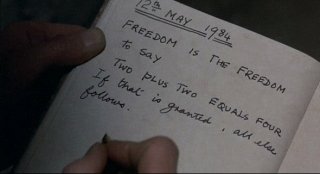
As Winston Smith wrote in his diary, “Freedom is freedom to say 2+2=4. If that is granted all else will follow.” And that is exactly the freedom Ryan launched a full-scale assault upon in his convention speech. In short, this was a new low for the GOP.

Mission Accomplished.


For over two decades, bin Laden has been al Qaeda’s leader and symbol, and has continued to plot attacks against our country and our friends and allies. The death of bin Laden marks the most significant achievement to date in our nation’s effort to defeat al Qaeda. Yet his death does not mark the end of our effort. There’s no doubt that al Qaeda will continue to pursue attacks against us. We must — and we will — remain vigilant at home and abroad.

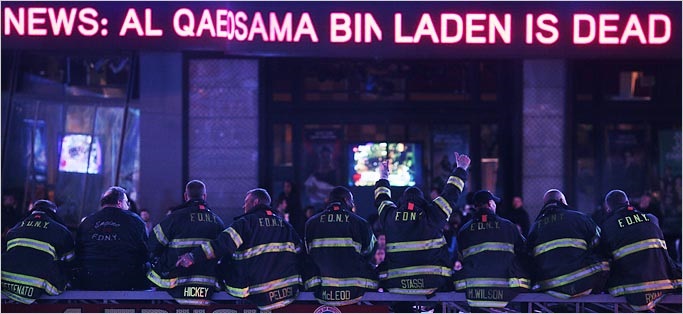
So, yes, as you may have heard, we finally found Osama Bin Laden, fulfilling a key promise President Obama made during the 2008 campaign. While I would have preferred to see the perpetrator of 9/11 captured alive and brought to trial — cause that’s how we do justice here in the US of A — congrats to the president’s team, the analysts who did the hard work, and the men and women who executed the operation, on finally getting their man.

All that being said, the second half of the president’s statement above is troubling. The death of Bin Laden should mark the beginning of the end of the 9/11 decade. With the splinter finally removed, it is time to take a long hard look not just at our continuing war in Afghanistan — after all, Osama was eventually found in Pakistan, mainly through what the Bunk would call good po-lice work — but at all the questionable and/or extra-constitutional actions we have taken in the name of fighting the terr’ists since September 11th. (Newsflash: Torture had nothing to do with capturing OBL.) If the death of Bin Laden doesn’t move us to this reconsideration, what then ever will?

Unfortunately (and of course), that doesn’t seem to be what’s happening. Instead, Congress is laying the foundation for a wider war: “Contained in the National Defense Authorization Act for 2012 is a new authorization to use military force that would grant the executive branch the power to ‘address the continuing and evolving threat posed by these groups.’ In practice, that means the president could use military force against any suspected terrorist across the globe — indefinitely.

Indefinite war? No thanks. There’s been an eerie touch of Emmanuel Goldstein in the way Bin Laden was used to justify all manner of extraconstitutional actions and civil liberties violations under Dubya — actions that have been ratified and continued under Obama. Now that the Bogeyman is dead, it’s time to stand down. It’s time to start acting like America again.

From a Dead Man…Greetings.

What I have wanted most to do…is to make political writing into an art.” By way of Return of the Reluctant, it seems George Orwell’s diary entries will be posted online in blog form beginning August 9, seventy years after he initially wrote them. Welcome to the political blogosphere, George! (And good luck breaking into the TNR-Politico-Atlantic-TPM mutual-regard society.)

Reality Bites.

I’m not going to put my lot in with economists.” As TPM noted, we seem to have finally reached the point where there are “no more sharks left to jump.” For alas, Sen. Clinton’s final, fraying tether to the reality-based community (and my general election vote, not that she’ll be getting that far anyway) gave up its last this weekend, as she — in defiance of her usual m.o. and very much in the manner of Dubya and the GOP — deemed universal opposition to her gas tax pander to be merely a figment of “elite opinion. (She’s also doubled down on her anti-Obama gas tax ads.) As Robert Reich noted: “In case you’ve missed it, we now have a president who doesn’t care what most economists think. George W. Bush doesn’t even care what scientists think. He rejects all experts who disagree with his politics. This has led to some extraordinarily stupid policies.” (Rabid Clinton partisan Paul Krugman, also a member of the elite-economist cabal, has yet to weigh in on his being cast down as an enemy of the people.)

As it turns out, one of the salt-of-the earth proles at the event (self-identified as an Obama voter making less than $25,000 a year) called Clinton out to her face for this blatant idiocy: “‘I do feel pandered to when you talk about suspending the gas tax,’ the woman said, adding: ‘Call me crazy but I actually listen to economists because I think they know what they’ve studied.’” Clearly, this woman will be requiring significant reeducation. “‘How can I help seeing what is in front of my eyes? Two and two are four.’ ‘Sometimes, Winston. Sometimes they are five. Sometimes they are three. Sometimes they are all of them at once. You must try harder. It is not easy to become sane.’” (Give Clinton credit: Her campaign has been a travesty, but it’s been great fodder for Orwell references around here.)

In any case, regarding the big picture: Unfortunately for earlier hopes that we’d be done May 6, it’s looking like tomorrow will almost assuredly bring a split, with NC for Obama and IN for Clinton. (That is, unless Zogby has finally broke out of its slump this cycle.) Meaning, of course, that Clinton will be even more mathematically eliminated. And yet, in all likelihood, we’ll slog on to June 3. Yay. (With that in mind, each side picked up another super today: Kalyn Free of OK for Obama and Theresa Morelli of Dems Abroad for Clinton. But as Morelli only counts for 1/2 a vote, that’s another 1/2-vote pick up for Obama.)

Update: make that two and a half: Obama picks up two more MD supers, Michael Cryor and Lauren Dugas-Glover. And it sounds like some of Clinton’s CA supers are reconsidering their options.

Update 2: Apparently, economists still mattered in 1992.

And they were all alike.

First we had Senator Clinton adopting various Hail Mary Rovianisms, which have been well recorded here, including but not nearly limited to an ad featuring Osama Bin Laden just this past week. Then Bill went on the Rush Limbaugh show. Then Sen. Clinton played nice with Richard Mellon Scaife, architect of the “vast right-wing conspiracy,” for his endorsement. And now we have this:

The creatures outside looked from pig to man, and from man to pig, and from pig to man again; but already it was impossible to say which was which.

Get to know the new metric…or else.

In the beginning, it was about momentum. When she lost momentum, it was about pledged delegates. When she lost pledged delegates, it was about the popular vote. And now that she’s on her way to losing the popular vote, it’s about the number of electoral votes held by the states in which the candidates have won primary victories.” Comrades! Pleddel and popvote now fullwise ungood and goldstein. The new metric of our glorious success is and has always been Elecvote. Be wary of thoughtcrime, brothers and sisters. Also, chocorat going up 15%.

Speaking of Newspeak, this may work against Sen. Obama, but I feel forced to admit it: His lead in pledged delegates, the popular vote, and the number of states won notwithstanding, Sen. Clinton won every state with “New” in its name — New Hampshire, New Jersey, New Mexico, and New York. And, since the superdelegates are looking to pick a “new” president, their choice is sadly all too clear. I’d hoped and assumed Sen. Obama would be our nominee, but you just can’t argue with ironclad logic like that.

Blair, Eric (file under Orwell, George).

This man has advanced Communist views, and several of his Indian friends say that they have often seen him at Communist meetings. He dresses in a bohemian fashion both at his office and in his leisure hours.” Big Brother was watching him: Ralph Luker of Cliopatria points the way to the recently-released UK Security Service files on George Orwell (as well as those on folk music archivist Alan Lomax and others.) “[W]hile his left-wing views attracted the Service’s attention, no action was taken against him. It is clear, however, that he continued to arouse suspicions, particularly with the police, that he might be a Communist. The file reveals that the Service took action to counter these views.”

He Loved Big Brother.

April the 4th, 1984. To the past, or to the future. To an age when thought is free. From the Age of Big Brother, from the Age of the Thought Police, from a dead man… greetings.” By way of Ed Rants: all of Michael Radford’s excellent film version of 1984, online.

Truman/False?

The idea that Truman and Dean Acheson could be hauled out as exhibits for preventive war in Iraq against ‘abject pacifists’ such as myself made me feel that I was living in Oceania, and the Ministry of Peace had rewritten the textbooks to prove that the legacy of a president who rejected preventive war in fact constituted the best justification for it!” By way of my friend Mark, Peter Beinart and Michael Tomasky go toe-to-toe over the legacy of ’48 at Slate‘s Book Club. I’m inclined to agree with the latter.

Dead Man Writing.

“When we think about the authoritarian world that Orwell painted, the catchphrases are one thing, but when you read the book again, the specifics and relevance for now are stunning.” Apparently, Tim Robbins is thinking of bringing 1984 to the screen (again). Hmmm…I dunno. I enjoy Bob Roberts and Dead Man Walking, but thought Embedded was way over the top. And it’d be really hard to make a better or more faithful adaptation than the Michael Radford version with John Hurt and Richard Burton.

America Embraces Room 101.

As the Cheney-Addington gang work to strip the Geneva Convention from prisoner treatment manuals, the Washington Post uncovers an overseas network of CIA “black sites,” a.k.a. gulags, some of which actually use old Soviet compounds in Eastern Europe(!) “It is illegal for the government to hold prisoners in such isolation in secret prisons in the United States, which is why the CIA placed them overseas…Legal experts and intelligence officials said that the CIA’s internment practices also would be considered illegal under the laws of several host countries, where detainees have rights to have a lawyer or to mount a defense against allegations of wrongdoing.”

Whatsmore, these gulags, created under this administration since 9/11, “were built and are maintained with congressionally appropriated funds, but the White House has refused to allow the CIA to brief anyone except the House and Senate intelligence committees’ chairmen and vice chairmen on the program’s generalities.” There’s no other way to look at this: By appropriating the tactics of our enemies, as John McCain warned earlier this month, we have abandoned our most fundamental principles and shamed our nation. Evildoers? Please. Dubya need look no further than his own White House and CIA. Update: Congress and the EU want answers.

Sippin’ on Gin and Ingsoc.

Just what does Tanqueray have in mind here? How is this foppish hipster supposed to sell gin?” Old friend Seth Stevenson assesses Tanqueray’s new spokesman, Tony Sinclair, who has come to grace a number of bus stops and billboards in my area. For the most part, I think gin is pretty vile — When it comes to the spirits, I’m a Jameson man. That being said, I did enjoy a glass of Victory Gin while re-watching Michael Radford’s powerful version of Nineteen Eighty-Four over the weekend. Winston Smith…now there’s a spokesman Tanqueray should get behind. Doubleplusgood.

Clearing the Book Bin.

In a perfect world, I’d write up book reviews here on GitM with the consistency and length of my movie posts. (Then again, in a perfect world, I’d also be able to dunk a basketball.) But, time being a factor, here instead are some short thoughts on non-history books recently consumed.


Revelation Space, Alastair Reynolds
Children of God, Mary Doria Russell
The Prestige, Christopher Priest
The Battle of Brazil, Jack Mathews
The Shawl, Cynthia Ozick
American Pastoral, Philip Roth
Why Orwell Matters, Christopher Hitchens

Revelation Space, Alastair Reynolds: “Working alone, living within the cramped confines of the pod, Sylveste spent weeks learning how to jump-start the lighthugger’s crippled repair systems…When the recuperative processes were in swing he was able to sleep, finally — not daring to believe that he would actually succeed. And in those dreams, Sylveste gradually became aware of a momentous, paralysing truth…before he regained consciousness, something had happened. Something had reached into his mind and spoken to him. But the message that was imparted to him was so brutally alien that Sylveste could not put it into human terms. He had stepped into Revelation Space.

I’d heard a lot of good things from sci-fi aficionados I trust about the Revelation Space arc of Alastair Reynolds, who holds a PhD in astronomy and clearly knows his stuff. In fact, one of the strengths of Revelation is in how Reynolds grounds what amounts to a sci-fi space opera in hard science ideas. For example, I don’t think I’m giving too much away to say that the book offers a hypothetical answer to Fermi’s Paradox, or that Hawking’s singularity theories play a significant role in the denouement. Of course, some scientific quandaries, such as the ability for ships to move at or around lightspeed, are left unexplained (it’s apparently been figured out by a shadowy, mysterious group known as the Conjoiners.) But, even those flights of fancy carry the touch of realism, as indicated by the time disparities throughout the book — Often, a character will get locked away in jail or have some other ugly incident befall him or her, and then fifteen years will pass in the space of a few paragraphs (or at least fifteen years relative to the prisoner — the time is shorter on the ship en route.)

These clever ideas notwithstanding, however, I found Reynolds’ writing style a bit dense and unwieldy at times. All in all, I ended up enjoying Revelation Space, but it was also a bit of a slog. In fact, I ended up putting it down for several weeks. There are four books (and counting) in the series, and I’ve heard they get better as they go along…but still, I’ve been putting off delving into #2, the prequel Chasm City, until I’ve got more time on my hands.

Children of God, Mary Doria Russell: “It was absurd in hindsight — the very idea that a handful of humans might have been able to do everything right the first time. Even the closest of friends can misunderstand one another, he reminded himself. First contact — by definition — takes place in a state of radical ignorance, where nothing is known about the ecology, biology, languages, culture, and economy of the Other. On Rakhat, that ignorance proved catastrophic. You couldn’t have known, Vincenzo Giuliani thought, hearing his own pacing, but remembering Emilio’s. It wasn’t your fault. Tell that to the dead, Emilio would have answered.

As y’all may or may not remember, I highly recommended Mary Doria Russell’s The Sparrow last fall, and have only now gotten around to reading the sequel, in which both Father Emilio Sandoz, sole survivor of the ill-fated Jesuit expedition, and the planet of Rakhat grapple with the consequences of the abortive, abysmal First Contact described in Book One. An anthropology PhD (I promise, I read sci-fi by non-PhDs too — this back-to-back was a fluke), Russell has constructed a clever and refreshing science fiction tale here that seems very far removed from most standard forays in the genre. I preferred Sparrow to Children — in fact, in some ways I think the resolution of the latter book detracts from the power of the first — but they’re both well worth-reading and readily accessible to people who get easily aggravated by the usual sci-fi literary tropes.

I will admit that at times I felt that Russell’s characters all spoke with the same voice — they all have the same wry intelligence and self-deprecating humor, and they tend to react in similar ways when pushed to the wall. But, it’s a forgivable lapse, and besides, given that this is the type of mistake made by newer authors, the tendency may well be rectified in her newest, just-published book, A Thread of Grace (No more sci-fi for now — Grace is a work of historical fiction set in WWII Italy.)

The Prestige, Christopher Priest: “First let me in a manner of speaking show you my hands, palms forward, fingers splayed, and I will say to you (and mark this well): ‘Every word in this notebook that describes my life and work is true, honestly meant and accurate in detail.’…Already, without writing a falsehood, I have started the deception that is my life. The lie is contained in these words, even in the very first of them. It is the fabric of everything that follows, yet nowhere will it be apparent. I have misdirected you with the talk of truth, objective records and motives. I have omitted the significant information, and now you are looking in the wrong place.”

After finishing up Batman Begins, Memento‘s Chris Nolan will apparently be making this film, and it should be a doozy. Tales of turn-of-the-century prestidigitators have perhaps been somewhat overdone in recent lit — At times, The Prestige reminded me of both Glen David Gold’s Carter Beats the Devil and the first “Houdini” half of Kavalier & Klay. Nevertheless, The Prestige, the sordid tale of two dueling stage magicians and their respective covenants with electrical pioneer Nikola Tesla, is a quick fantasy read that’s well worth picking up. Even if you figure out where it’s all going, and I’d say I guessed most of it about halfway through, the ending still has a Five Star level Twilight Zone-creepiness to it. All in all, with an eerie climax you’re not going to shake off lightly, The Prestige is a grim and captivating conjuration — read it before seeing the movie.

The Battle of Brazil, Jack Mathews: “Gilliam’s Brazil is a cautionary tale about the loss of passion in a bureaucratic society where people passively go along to get along. It’s his metaphor for the lives we now lead, overly dependent as we are on structure, materialism, and dubious technology. There isn’t a futuristic element to it, other than the likelihood that the future holds more of the same. The love story between the daydreaming bureaucrat Sam Lowry and the cynical truck driver Jill Layton is the major sub-text. The dominant theme is that only through fantasy can we escape the reality of our own lives.

I actually don’t quite agree with Jack Mathew’s take above on the film…there’s a lot more going on in Brazil than just Organization Man angst. [I tossed this out for my college paper almost a decade ago, but at some point I'd like to write a much-longer post around here that does Brazil (and, for that matter, Amadeus, Miller's Crossing, and several other of my Top Ten films) justice.] At any rate, you can get most of the information in The Battle of Brazil — which chronicles the attempts by Universal flunky Sid Sheinberg to either squash or re-edit the film — out of the companion documentary on the 3-disc Criterion set (which also includes the Sheinberg “Love conquers all” edit.) But, for fans of Terry Gilliam’s magnum opus (as well as people interested in studio realpolitik), there are a lot of fun anecdotes and vignettes to be had — For example, Rupert Everett or Tom Cruise as possible Sam Lowrys, DeNiro’s Method Acting Tuttle to everyone’s annoyance, and Gilliam’s point-for-point evisceration of several negative reviews of the film (including ones by Rex Reed, Roger Ebert, and the inimitable Pauline Kael.) This version of the book also contains the full screenplay (by Gilliam, Tom Stoppard, and Charles McKeown, the latter of whom plays Sam’s office neighbor Harry Lime.) Again, a quick read, and interesting in its own right as a tale of Hollywood inside baseball. But, of course, unlike The Prestige, see the movie before you read the book.

The Shawl, Cynthia Ozick: “She looked into Magda’s face through a gap in the shawl: a squirrel in a nest, safe, no one could reach her inside the little house of the shawl’s windings. The face, very round, a pocket mirror of a face: but it was not Rosa’s bleak complexion, dark like cholera, it was another kind of face altogether, eyes blue as hair, smooth feathers of hair nearly as yellow as the Star sewn into Rosa’s coat. You could think she was one of their babies.

I’ll be the first to admit that when it comes to evaluating serious and prize-winning short fiction like Cynthia Ozick’s The Shawl, I tend to feel slightly out of my depth. (But being uninformed about matters has never stopped me from commenting before, so why worry about it now?) At any rate, the question of how to address and make sense of insensible atrocities is one pondered by both fiction writers and historians. And, while I was moved and impressed by some of Ozick’s paragraphs or imagery at times, altogether, I don’t think these two stories squared that elusive circle very well.

At the risk of spoiling it for you [Seriously, stop reading if you don't want to know the end], the very brief first story in The Shawl, set inside a concentration camp, basically involves a mother’s reaction to watching her baby get thrown onto an electric fence. (The longer and better second tale picks up with the same mother, now a semi-sane Holocaust “survivor” in retiree-land Florida, thirty years later.) This first story is obviously shocking and repugnant, and perhaps as a way of approximating a small sliver of the unknowable horror of the Holocaust, it may even be a success. But, to be honest, I found it more exploitative than anything else — the central incident of the tale happens so quickly and with so little context that it reminded me of what David Edelstein (and others) noted of the egregious 21 Grams: “it doesn’t take insight or artistry to shake up an audience with dead kids. It just takes a certain kind of ruthlessness.

To be fair, perhaps my problems with The Shawl are faults of the genre. After all, if there’s any murdering of innocents to be done in a short story, it has to be done rather quickly, or else we’re getting into novella territory. Still, I found Bao Ninh’s novel The Sorrow of War a much more harrowing and successful survivor’s tale read of late, partly because it reflects at length on the questions of writing and remembering, but also because it had more room to breathe, more lulls between the horrific episodes, and, to my mind, more character development.

American Pastoral, Philip Roth: “He had learned the worst lesson that life can teach — that it makes no sense. And when that happens the happiness is never spontaneous again. It is artificial and, even then, bought at the price of an obstinate estrangement from one and one’s history…He whose natural nobility was to be exactly what he seemed to be has taken in far too much suffering to be naively whole again…Stoically he suppresses his horror. He learns to live behind a mask. A lifetime experiment in endurance. A performance over a ruin. Swede Levov lives a double life.”

A few years ago a good friend of mine let me her copy of Goodbye, Columbus as an introduction to the world of Philip Roth and…well, not to put too fine a point on it, I didn’t like it. (My impressions of the book are blurry now, but I remember thinking that not only could I not empathize with the main character, I actively disliked him, from his relishing his 1-on-1 basketball victories over his girlfriend’s little sister to his endless passive-aggressive pushing on the diaphragm issue. In retrospect, I guess that was probably the point.) So, when another good friend offered me her copy of American Pastoral, I was mildly hesitant.

Yet, I found Swede Levov’s fall from American grace vastly preferable to my first Roth experience, so much so that I aim to throw a few more of his books in the hopper at some point in the near future. (Looking back, it was probably a bad call to judge a writer of Roth’s stature and prolificness by only his first work anyway, however well-reviewed.) At times, I did think the “Americanness” aspect of the Swede’s arc was a tad overdone — for example, in the Johnny Appleseed segues, or the hinge point of the story being 1968. And perhaps the symbolism was occasionally just a little too cute (e.g. Miss New Jersey becoming a breeder of cows, or the dinner party incident that closes the book.) But, all in all, Pastoral turned out to be quite a powerful treatise on the charred smell emanating from all too many postwar American dreams, as well as a haunting case study of one man trying to keep it together once the wheels come off. (By the way, I’m open to suggestions for the next stop on the Roth train. Portnoy? I Married a Communist?)

Why Orwell Matters, Christopher Hitchens: “The three great subjects of the twentieth century were imperialism, fascism and Stalinism…Most of the intellectual class were fatally compromised by accomodation with one or other of these man-made structures of inhumanity, and some by more than one…[But after his experience as a budding imperialist functionary in India] Orwell was in a stronger position to feel viscerally as well as intellectually about the modernist empires of Nazism and Stalinism. Among many other things, of which an educated sympathy for victims and especially racial victims was only one, he had grown sensitive to intellectual hypocrisy and was well-tuned to pick up the invariably creepy noises which it gives off. He was already an old India hand, in other words, when it came to detecting corrupt or euphemistic excuses for undeserved and unchecked power.

I’m sure I’m not the only person out there who looks at Christopher Hitchens these days and laments a great writer and once-formidable man of the Left now — seemingly irrevocably — gone to seed. Still, Orwell being high in my personal pantheon of writers, I thought I’d give his extended essay Why Orwell Matters a look-see. The result is intriguing not only for what it tells us about Orwell, but also in understanding and humanizing this most recent incarnation of Hitchens. Throughout the book, Hitchens applauds Orwell’s enviable foresight and his “power of facing” unpleasant truths so often obscured to others by ideology or wishful thinking. As the passage above suggests, with the exception of severely understating the future role of the US in world affairs (and his occasional and unfortunate lapses into homophobia), Hitchens argues, Orwell got all the big questions of the 20th century right. He anticipated the demise of imperialism and — unlike many of his contemporaries on the Left — was as stringent an opponent of Stalinist totalitarianism as he was of Nazism.

Hitchens is correct in noting all of these remarkable insights and legacies of our man Orwell. (As an aside, Hitchens’ theory that Orwell could probably have gotten lifesaving treatment for his tuberculosis here in America is really just too depressing to contemplate.) Still, I don’t think it’s going too far to suggest that Hitchens is also trying to use Orwell as a paragon of independent thinking in order to justify his own recent cheerleading for the Bush administration and the war in Iraq.

I don’t know how Orwell would come down on the Iraq war. Who can know for sure? On one hand, as Hitchens would immediately point out, Orwell was no friend to tyrants. He put his own life on the line to defend Republican Spain, and — like most clear-headed people — wouldn’t shed a tear to see a two-bit sadistic despot like Saddam dispatched to the dustbin of history. On the other hand, Orwell clearly had a well-developed suspicion of imperialist enterprises, particularly those cloaked in the language of freedom and good intentions. If nothing else, I feel pretty confident Orwell would have lambasted the corruption of political rhetoric — and outright lies — that characterized our entry into this current conflict. I’m sure Hitchens is right to suggest that Orwell would rally against the inhuman ideology of terrorist fundamentalism, as he did against the nefarious -isms of his day. But that doesn’t mean Orwell — or Hitchens, for that matter — should be so sanguine in backing our current policy in Iraq. One does not necessarily flow from the other.

The Crying of Lot 84.


His anger, let us go so far as to say, was precious to him. He had lived his way into it – in Burma and Paris and London and on the road to Wigan pier, and in Spain, being shot at, and eventually wounded, by fascists – he had invested blood, pain and hard labour to earn his anger, and was as attached to it as any capitalist to his capital.” The Guardian excerpts Thomas Pynchon’s forthcoming intro to 1984. (Via Random Walks.)

Flights of Imagination.

The Science Fiction Book Club picks the 50 most significant science fiction/fantasy books of the last 50 years, although after the top ten they’re listed alphabetically (Via Lots of Co.) I’d say I’ve read about half of these, and the choices seem pretty legit. No surprise who‘s at the top of the list, but otherwise it seems like the fantasy side got short shrift. I guess the Narnia books (and for that matter Animal Farm and 1984) are over 50-years-old. Speaking of which, I can’t say I’m a very big C.S. Lewis fan (particularly as compared to Tolkien), but nonetheless – the Narnia film site is now live.

Paging Theodore Rex.

The Old World will burn in the fires of Industry…and yet, concerned about GOP vulnerability in the suburbs, Frank Luntz is now advocating a kindler, gentler environmental message for Republican candidates, including Orwellian substitutions of “conservationist” and “climate change” for “environmentalist” and “global warming” respectively. Well, dang, now that they put it like that, I feel much more at ease about the GOP cutting down trees and drilling up Alaska.

Truth and Consequences.

Misread misanthrope or principled truthteller? Louis Menand and Leon Wieseltier battle over the legacy of George Orwell. Only recently in my readings (in Menand’s Metaphysical Club and James Livingston’s Pragmatism, Feminism, and Democracy) have I encountered this notion that the pragmatism of the Progressives (such as Oliver Wendell Holmes, William James, and John Dewey) eventually leads to the same moral relativist conclusions as post-structuralism (in fact, Livingston argues that much of the postmodern devotion to figures like Foucault and Derrida is mainly a reflection of the European indifference to, if not ignorance of, American scholarship – James and Dewey came to the same philosophic conclusions decades earlier.) And, indeed, Herbert Croly’s 1909 The Promise of American Life, considered the bible of the Progressive moment, attacks abolitionism for much the same reasons as Louis Menand – that it was dangerous and destructive in its reliance upon absolute moral certainty. (Sadly, to say the progressives had a moral blind spot when it came to America’s racial dilemma is an understatement.) But, then again, the “prophetic pragmatism” of Cornel West is cleary infused with a moral sense that is based on certain underlying truths. (“Like Foucault, prophetic pragmatists criticize and resist forms of subjection, as well as types of economic exploitation, state repression, and bureaucratic domination. But these critiques and resistances, unlike his, are unashamedly guided by moral ideals of creative democracy and individuality.”) So, I’d say that, while I fall somewhere between Menand and Wieseltier on the subject of Orwell, and while I usually find Wieseltier to be a pompous ass (his own attack on Cornel West comes to mind), in the end I side with those who say keep the aspidistra flying. To paraphrase Orwell, all truths may in fact be equal, but some truths are more equal than others. It may involve some intellectual doublethink, but one can recognize that a truth may have some basis in subjectivity and still hold it – and fight for it – with conviction.

Agents Orange.


Speaking of Orwell (is it Eurasia or Eastasia today, Saddam or Osama?), the Dubya administration capitalizes on terror panic to drum up war fever (and good media coverage.) It’s amazing to me how worried many people here in town seemed about the recent orange alert (status update via Looka.) One friend told me that his out-of-town guests cancelled their flight into the city because of a possible attack, and a handful of other folks I know wouldn’t use the subway. I dunno…I just can’t get too stressed about something that’s so completely out of my hands. Besides, it’s probably true that living in New York City increases the chances that I’ll die as a result of terrorism, but it also vastly decreases the chances that I’ll die in a car wreck, which is still the leading cause of death in America for people under 33. So, it’s basically a wash. Not that I’m ambivalent about perishing in a gas attack or something worse, mind you, but I just don’t see the utility in freaking out every time the US intelligence community decides to cover its ass by issuing warnings based on non-specific “specific information.”

Suspicion Breeds Confidence.

How to Identify a Terrorist, from the Office of Homeland Security. (Via Quiddity.)

Photos on flickr

Twittering

Pinterested

Followed by: 25 people, Likes: 0
Follow Me on Pinterest 
My Pinterest Badge by: Jafaloo. For Support visit: My Pinterest Badge

Visions


Stories We Tell (4/10)

Visions Past

Star Trek: Into Khan (4/10)
The Great Gatsby (7.5/10)
Iron Man 3 (8.5/10)
Oblivion (6.5/10)
To the Wonder (3/10)
Side Effects (6/10)
West of Memphis (7/10)
GitM BEST OF 2012
GitM Review Archive

Currently Reading


Hidden Cities, Moses Gates

Recently Read

What It Takes, Richard Ben Cramer
Founding Finance, William Hogeland
Twilight of the Elites, Chris Hayes
Last Chance to See, Douglas Adams
The Forever War, Joe Haldeman
Uphill all the Way, Kevin Murphy

Omsbudsdog.

Syndicate this site:
RSS 1.0 | Atom (2.0)

Unless otherwise specified, the opinions expressed here are those of the author (me), and me alone.

All header images intended as homage. Please contact me if you want one taken down.

Archives