So, how about that Election Night? Once you factor in that the ridiculous gerry-mandering of 2010, coupled with Obama’s terrible, coattail-cutting first debate performance, killed any chance of Democrats retaking the House, Tuesday night went about as well as it possibly could. Every swing state except North Carolina swung blue. The Senate kept some of its best progressives (Sanders, Brown) and added a few more very promising contenders (Warren, Baldwin). Gay marriage and marijuana decriminalization both made important footholds. California moved to end Howard Jarvis’ Tax Revolt, now in its fourth decade. And the Republicans — again, the House notwithstanding — were routed, and their cruel Ayn Rand-inflected ideology decisively repudiated at the polls.
All things considered, it was a great night, and all the more for what it portended about elections to come. Ever-growing in recent years, the Rising American Electorate — unmarried women, people under 30, people of color — showed its power on Tuesday night, displaying its centrality as the backbone of our new Democratic coalition and sending Karl Rove, Bill O’Reilly, and other White Men of a Certain Age into very public paroxysms of despair. (Good times. Enjoy that 2004 experience, y’all.) And while the Republican base is looking long in the tooth these days, our Democratic coalition is only continuing to grow.
As I noted in 2010, even despite the dismal showing then, demography is destiny, and the rest of the country is and will continue to experience Californication. Today we got the first taste of what a really multicultural America will be like at the polls. See also David Simon of The Wire and Treme on this: “A man of color is president for the second time, and this happened despite a struggling economic climate and a national spirit of general discontent. He has been returned to office over the specific objections of the mass of white men. He has instead been re-elected by women, by people of color, by homosexuals, by people of varying religions or no religion whatsoever. Behold the New Jerusalem. Not that there’s anything wrong with being a white man, of course. There’s nothing wrong with being anything. That’s the point.“
So, all in all, 2012 was a great victory for we progressives, and things are suddenly looking up. But, of course, we’ve been here before.
I really hope President Obama and his closest advisors are looking at the same demographic realities as the rest of us, and that he decides to spend his second term governing closer to what he promised back in 2008. But I trusted in hope last time around, and, needless to say, thatdidn’tget itdone.
The fact of the matter is our Democratic standard-bearer, at least up to this point, is behaving and governing in a fashion that is clearly to the right of the growing Democratic base that got him elected and now re-elected. No more benefit of the doubt: It is up to us to put pressure on this administration to make sure they hold to the promises they’ve made. That work has to begin right now.
We all know what’s coming up first, and Glenn Greenwald already laid out the dismal pattern we can expect — and need to break — on the Grand Bargain front. True to form, Peter Orszag — and what does it say about our president’s priorities that he staffed up his first administration with this kind of jackass? — has already sent out the let’s-fiddle-with-social-security trial balloon. Erskine Bowles’ name has been aggressively floated as the new SecTreas and High Inquisitor in the matter of the Deficit Witches. By all accounts, President Obama seems to think he can play Nixon-in-China on Social Security and Medicare. But this is not at all why voters gave him a Democratic mandate, and that’s exactly the sort of wrong-headed notion, coupled with Katrina, that turned the electorate against Dubya in 2005.
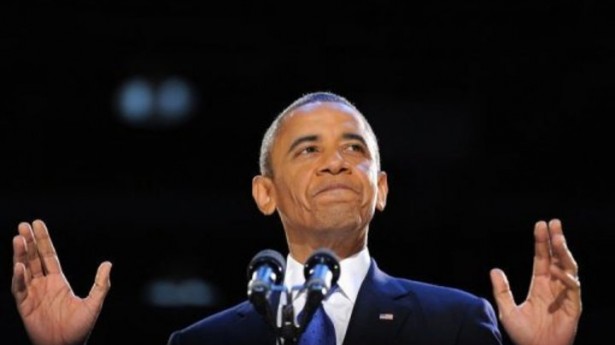
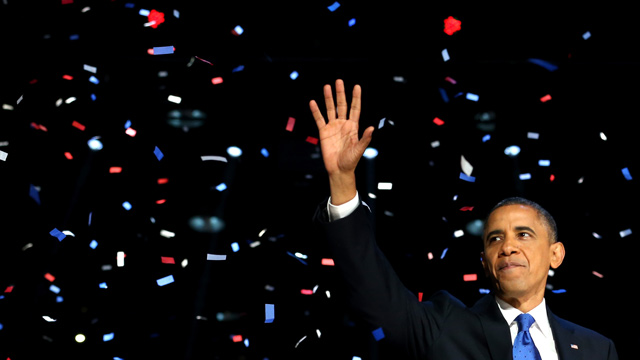
In his victory speech on Tuesday night, President Obama continued his recent turn toward the progressive rhetoric of citizenship and self-government. He said: “The role of citizens in our Democracy does not end with your vote. America’s never been about what can be done for us. It’s about what can be done by us together through the hard and frustrating, but necessary work of self-government. That’s the principle we were founded on.”
On one hand, I should be overjoyed that the President has taken this rhetorical turn, since it’s something I’ve been pushing for here for as long as GitM has been running. At the same time, President Obama has shown over the years an irritating penchant for co-opting progressive rhetoric only to serve centrist, corporatist, and/or neoliberal ends. It would be a shame if we let that happen again.
A presidency really concerned with fostering civic responsibility and self-government would look quite different than the one we have experienced up to this point. In the strictest and most literal sense, it would acknowledge, sometime before the second-term election night, that both our voting and campaign finance systems have been broken for decades, and require a significant overhaul. But, even more than that, a philosophy of encouraging citizenship and self-government presupposes different priorities and different policies.
First and foremost, to paraphrase Franklin Roosevelt, it would recognize that necessitous men and women are not free men and women, and work harder to ensure everyone has the basic economic liberty to choose their own path through life. It would not, to take just one example, make the center of their housing reform a foreclosure program designed to help banks rather than homeowners.
An administration advocating citizenship and self-government would do more to emphasize the fundamental importance of education at all levels, and invest mightily not just in schools and teachers but in after-school programs, early childhood education, anti-poverty and anti-hunger initiatives, and all the other efforts that can help alleviate the various and persistent environmental factors limiting children’s potential in America. That requires a significantly different and more comprehensive approach to the education issue than simply competitive grants that reward grant-writing skills and teaching to the test.
It would mean emphasizing a conception of citizenship that is broader and richer than just a world of workers, consumers, and automatons — one that, as per Walt Whitman, Ralph Waldo Emerson and Herbert Croly, encourages introspection, critical thinking, and self-exploration. This is a hard nut to crack, of course. But at the very least we could fight to give more men and women freedom from the necessities of work to do whatever it is they want to do. We are not just our jobs, or at least we shouldn’t be, unless that’s what we want. That means pushing for a higher minimum wage, equal pay for men and women holding the same job, increasing access to affordable child care, more worker protections, and a shorter work week.
Emphasizing self-government only works if the political system remains accountable to its citizens. That means, along with voting and campaign finance reform, working to break the hold of any particular special interest over the political process — namely, corporate power. But as Matt Stoller, Glenn Greenwald, and others have noted, this administration has perpetuated and even accelerated a two-tiered system of political and economic justice in America. The losses of bankers and corporate elites have been subsidized by the public, even when they clearly broke the law. Meanwhile, the average homeowner and debtor has been disparaged and left on their own underneath a crushing burden — so much so that inequality has actually increased over the last four years. Similarly, the Bush-era torture regime has been swept under the rug, while whistleblowers have been aggressively prosecuted. This will not do.
Meanwhile, even though Obama himself has been a user of illcit drugs, as have the last several presidents, there has been no attempt at all by this administration to undo the drug war destroying communities and putting so many in jail — Quite the contrary, in fact. Nor has this administration done anything to stop the reprehensible practice of private prisons selling their “workforce” as forced labor.
Citizenship is a bond — Being a citizen means that one is part of a larger community and has a stake in it, a sense that we’re all in it together. So emphasizing citizenship means investing in big projects and big ideas that bring the American community together in larger purpose, from a massive rebuilding of America’s infrastructure to a re-energized space program to a WWII-sized response to the climate change crisis. Instead, this administration has trafficked in deficit hysteria for several years, and clearly plans to bring another dose of it in the months and years to come. Meanwhile, the biggest project we have been involved with as a people in recent years is expending blood and treasure on remaking Afghanistan and Iraq. This, it is now clear, has been not just a considerable waste of public resources, but a policy that has resulted in thousands and thousands of lives lost around the world.
Especially in America, where we are tied together not by blood but by an idea, being a citizen also means agreeing on a story — a shared narrative that ties the members of the community together. Because our connection is a story — even a fiction, some might say — it is all the more important that our government uphold the founding values of that story. (As Charles Pierce eloquently argues here, this is why Obama’s re-election is important independent of everything else — it reaffirms our conviction that race is no longer any barrier to the highest office in the land.) But, quite obviously, this administration has not lived up to our founding ideals in many ways, especially with regard to how it has prosecuted the War on Terror. As Mark Danner says in the piece I just linked, “President Obama has taken a position so strongly in favor of unremitting military violence that he has left his Republican rival, struggle though he may to shoulder his way past him, no place to stand.” And let’s be honest: As a party, we Democrats utterly failed to call the president out on this.
So, yes, an emphasis on citizenship and self-government could very well be the basis of a new progressive politics. But, unless he makes a marked shift from his first term, I fear this president is just going to use these words as a new rhetorical toolbox to push for more half-assed, neo-liberal Third Wayisms and lousy Republican ideas from the mid-80′s. We face dire problems in this country, and yet this administration is somehow afraid to even consider the time-tested New Deal ideas, from public works to the HOLC, that worked in the past.
The only way President Obama will make that progressive shift, it is now clear, is if the American people push him in that direction. In this, what Obama said on election night is absolutely correct. No matter what the president has said on the campaign trail, we can no longer hope this administration will bring change we can believe in. He is going to have to be forced into it by a Democratic electorate that refuses to accept anything less. It’s not a coincidence that the two progressive reforms Obama finally embraced this year — same-sex marriage and the DREAM Act — were ones that had passionate, vocal, and uncompromising reform movements behind them.
The election results showed that progressives are and can be ascendant in America. But we need to be much tougher on this administration than we have been in the past. Lip service to good intentions and progressive ideals is no longer satisfactory. And that hard work of keeping this administration in line has to begin right now, before the tentpoles of our current social insurance system are chipped away at by way of Grand Bargain.
Democrats just elected this president for a second time, and we don’t want to see any more compromising with and capitulating to economic terrorists. It is past time for this president and this administration to do right by us.
“What you saw, I think, anyway, was…the end product of thirty years of a Democratic Party that has slid so far to the center-right that a Democratic president found himself arguing with a ‘severely conservative’ Republican candidate over the issues of how much the Democratic president had cut out of the budget, how many regulations he’d trimmed, how much more devoted to the middle-class-kick-in-the-balls Simpson-Bowles ‘plan’ he is, and how he would ‘reform’ Social Security and Medicare — and, frankly, a Democratic president losing some of those arguments to his left.“
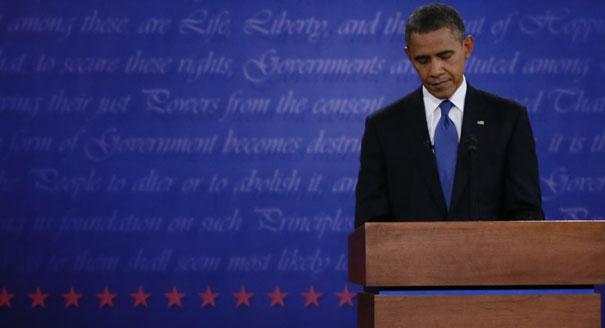
Hey all. Haven’t given up on the blog again, but I am in the midst of the final ascent on the old dissermatation. (With two more hopefully brief chapters to go, I just rounded page 1055. Yes, I know. This whole thing has just gotten out of hand. Ohhhh well. Everybody needs a coping strategy.) Anyways, between that and work GitM is back to being neglected for a few weeks. In the meantime, I strongly endorse this Esquire piece by Charles Pierce on exactly why Obama stunk up the bed so badly in the first Republican primary debate general election debate.
Basically, if you give America a choice between a Republican and a Republican, the Republican will win every time. The problem wasn’t Obama had an off night. The problem is this former great hope of the left actually believes Simpson-Bowles is a good idea (it isn’t) and that the deficit is a huge problem (it’s not.) Even while the Obama campaign is trying to convince us to get more than just a wee bit cult-y “For All”, the Grand Bargain train is already leaving the station.
In short, we seem to have reached a point where so many top Democrats have spent so many years doing the protective camouflage thing that they’ve completely forgotten which way is up. As a party, we are now clearly to the right of Nixon and verging on being right of Reagan. The president’s stinker of a performance on Wednesday was just a clearer-than-usual, real-time manifestation of the Democratic Party’s deeper dilemma: We have lost our way.
“This video, put together by NASA using temperature records from 1880 to 2011, shows you the warming world in just 26 terrifying seconds. Blue shows temperatures that are lower than the baseline average between 1951 and 1980, and reds show temperatures above the average.” By way of Mother Jones, a NASA animation tracks the warming of the earth over the past century and change. A crazy coincidence, I know.
I will say this: Since last week we watched Democrats — Democrats — chant USA, call out Mitt Romney for being insufficiently for the troops, and all but roll the severed head of Osama Bin Laden out on stage, perhaps it’s time to regain a little perspective.
It’s long past time to stop compounding the tragedy of what happened in New York and Washington eleven years ago by shredding the constitution in response. It’s time to get back to being America again.
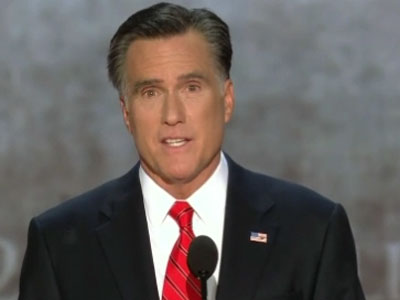
Those evil natured robots, they’re programmed to destroy us…So, yeah it’s hard to feel much of anything about Mitt Romney’s acceptance speech, other than that I saw more lifelike human performances in the Final Fantasy movie ten years ago. The guy is just forever lost in the uncanny valley to me. This will no doubt be a close election, and Romney could well win it by sheer dint of a bad economy and boatloads of under-the-table campaign cash. But I still find it hard to take his seriously as a candidate, and most of the time just end up feeling bad for his much more presidential father that the previously-moderate Mitt has become such an obvious sellout. (And, tbh, I’m much more worried about the truth-averse Paul Ryan’s no-doubt-bright future in his party than Romney’s bid this year. He’s the T-1000 to Romney’s T-800.)
In short, Romney has that generic, milquetoast liked-by-his-base-but-has-zero-crossover-appeal quality we’ve previously seen in Bob Dole and John Kerry, and just like Joe Biden’s “noun, verb, and 9/11” evisceration of Rudy 9ui11iani last cycle, Mike Huckabee already nailed Romney dead-to-rights in 2008 with his quip, “He looks like the guy who fired you.” I just don’t see Romney getting past that — and, if he does, it won’t be because of this speech.
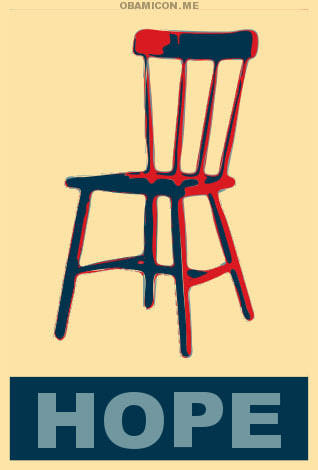
So…regarding Clint Eastwood’s much-maligned empty chair speech: I actually liked it. Not for its content per se – It was discursive and rambling and definitely embarrassing to sit through. But I admired it for being a brief burst of weirdo-improv in the midst of a four-day-long political commercial that’s usually been scripted right down to the second.
There was also the added bonus that Clint’s speech helps make the old dissertation that much more timely. Since, as it happens, the empty-chair routine was a favorite campaign trick of Burton Wheeler, Robert La Follette’s vice-presidential running mate in 1924. To pull the relevant paragraph:
“Wheeler got particularly good mileage out of debating an empty chair or cross-examining a straw dummy about Teapot Dome and various other campaign issues. ‘You knew all about the oil scandals and the Ohio gang, didn’t you?’ Wheeler would ask. Then, after the ensuing silence, he would add, ‘Well, knowing all these things, you kept quiet, didn’t you? And now you have the reputation of being a strong, silent man, haven’t you?’ Here, Wheeler told voters, was America’s ‘Silent Cal.’“
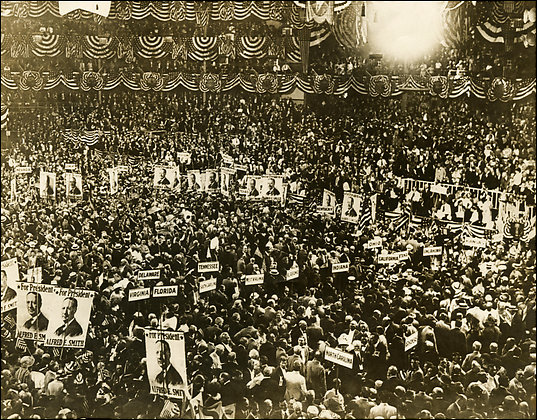
Clint’s gonzo chair bit also brought to mind one of my favorite chapters to write, on the disastrous 1924 Democratic Convention in Madison Square Garden — in which Al Smith and William McAdoo were dead-locked for over two weeks and 103 ballots, before the Democracy settled instead on West Virginia lawyer John W. Davis. To give you a flavor of the disaster:
‘This thing has got to come to an end,’ begged Democratic humorist Will Rogers a week into the ensuing fiasco, ‘New York invited you as guests, not to live.’ In years to come, Rogers quipped, when little children asked their fathers if they were in the war, they would reply, ‘No, son, but I went through the New York Convention.’ Mencken harrumphed that the ‘convention is almost as vain and idiotic as a golf tournament or a disarmament conference.’ Journalist Arthur Krock deemed the unfolding Democratic nightmare ‘a snarling, cursing, tedious, tenuous, suicidal, homicidal roughhouse.’ Lippmann thought the Democrats had taught America ‘more at firsthand about the really dangerous problems of America’ and ‘learned more of the actual motives which move the great masses of men than anyone of this generation thought possible.’ ‘No man or woman who attended the Convention of 1924 in the old Madison Square Garden will ever forget it,’ Daniel Roper, one of McAdoo’s lieutenants, said later in life. ‘This country has never seen its like and is not likely to see its like again.’ Over three decades later, Al Smith’s daughter still remembered those sixteen days with a shudder. ‘Traits that I do not like to think of as American played too great a part that year,’ she winced.
And, for the first time in history, the convention had all been broadcast nationwide through the miracle of radio.”
In fact, one of the first-ever radio catch-phrases emerged from the 1924 convention, when the Governor of Alabama, William Brandon, kicked off each round of voting with the same sentence: “Alabamah casts twenty-foah votes for Oscah Dubya Undawood!” (For years later, a resolute man or woman would be considered ‘as steady as Alabama for Underwood.’) In any case, back then memorable, often un-scripted or badly-scripted Eastwood-esque speeches were the norm. To take just a few notable examples:
James Phelan, nominating McAdoo: “When the roll of states got to California, boss James Phelan gave a florid fifty-minute nominating speech for McAdoo that was deemed by observers ‘the worst speech never heard.’ It, according to others, nearly ‘stampeded the convention of Smith’ and would have killed ‘Thomas Jefferson running on a ticket with Andrew Jackson.’ Long before Phelan got to his closing, the galleries were desperately screaming ‘Name your man! Name your man!’ When he finally Mc’did, McAdoo forces festooned with buttons and hatbands reading ‘Mc’ll do!’ broke out in an hour-long celebration, chanting ‘we don’t care what the Easterners do; the South and West are for McAdoo!’ In response, the galleries bellowed ‘Ku Ku, McAdoo!’ and ‘No oil on Al!’ The situation was only just beginning to get out of hand.”
FDR, nominating Al Smith:“When the roll of states reached Connecticut, the delegation yielded to their neighbor New York, meaning, everyone knew with bated breath, it was time for Al Smith’s official nomination. The deliverer of this good news to the galleries, on account of his relative stardom and offsetting attributes to the candidate, was Smith’s campaign manager, Franklin Roosevelt. (When Joseph Proskauer first pitched the idea to Smith, the candidate asked, ‘For God’s Sake, why?’ Proskauer replied, ‘Because you’re a Bowery mick and he’s a Protestant patrician and he’ll take some of the curse off of you.’)”
“Helped by his teenage son Jimmy, whose arm he gripped so hard it bruised, Roosevelt slowly made his way to the lectern on crutches. Once there – Joseph Guffey of Pennsylvania had already tested that ‘the pulpit’ could bear Roosevelt’s weight – he turned on the charm, winning the McAdoo crowd over right away by gently admonishing the galleries above. Then, delivering a speech written by Proskauer (although Roosevelt would rarely admit to it later), Roosevelt praised Al Smith as ‘the Happy Warrior of the political battlefield,’ a moniker, derived from Wordsworth, that would stick to Smith as surely as ‘The Sidewalks of New York’ had in 1920. The Smith crowd loved every minute of it, and the McAdoo crowd was quietly impressed – Franklin Roosevelt was back.”
Andrew Erwin, on the Klan:: “As soon as the anti-Klan plank was read, the floor and the galleries both went into full hysteria…by the time pro- and anti-Klan speakers began making their remarks late in the evening, the assembled Democrats were cheering and hissing with abandon. The wall of noise became particularly intense during the remarks of Andrew C. Erwin, the former mayor of Athens, Georgia. Expecting pro-Klan nostrums from the Georgian, the pro-Smith galleries booed Erwin mercilessly – until the room slowly started to realize that Erwin was actually denouncing the Klan, at which point a lusty cheer erupted from up above even as McAdoo Alley wailed with rage. When Erwin went back to his seat, only one member of the Georgian delegation stood to welcome him.”
William Jennings Bryan, on the Klan: “The last speech on the Klan issue was delivered by William Jennings Bryan, who pleaded with anti-Klan delegates that everyone could agree if only the three words ‘Ku Klux Klan’ were left out of the platform. It went over like a lead balloon. The galleries were so vociferous in their booing of the Great Commoner that Bryan had to stop three times. On the third such interruption, [Thomas] Walsh rose up and began gaveling and screaming in fury to quiet the balconies down. Rattled, Bryan slipped into the cadences of the church and implored the unruly congregation ‘in the name of the Son of God and Savior of the world. Christians, stop fighting and let us get together and save the world from the materialism that robs life of its spiritual values.’ The crowd was having none of it, and Bryan retreated to a chair on the platform, too tired to walk back to his seat with Florida. It wasn’t even his worst speech of the convention.”
“It was an entire evening based on a demonstrable lie. It was an entire evening based on demonstrable lies told in service to the overriding demonstrable lie. And there was only one real story for actual journalists to tell at the end of it.
The Republicans simply don’t care.
They don’t care that they lie. They don’t care that their lies are obvious. They don’t care that their lies wouldn’t fool an underpaid substitute Social Studies teacher in a public middle school…They don’t care that their history is a lie and that, by spreading it, they devalue the actual history of the country, which is something that belongs to us.”
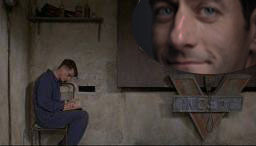
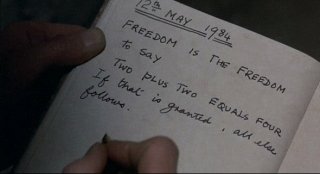
As Winston Smith wrote in his diary, “Freedom is freedom to say 2+2=4. If that is granted all else will follow.” And that is exactly the freedom Ryan launched a full-scale assault upon in his convention speech. In short, this was a new low for the GOP.
“If Republicans are willing, Obama said, ‘I’m prepared to make a whole range of compromises’ that could even rankle his own party. But he did not get specific.” (*cough* Grand Bargain *cough*)
So, Todd Akin. I must say, it’s heartening to see some of the Taliban-like tendencies of today’s GOP finally drawing condemnation in the culture at large. But the thing is, what Rep. Akin said is very much within the mainstream of his party. This was not a one-off event: They actually believe this tripe, and they’re constantly voting like The Handmaid’s Tale was meant to be aspirational.
In their very first month back in power, Paul Ryan, Akin and the gang — 225 Members, in fact — were trying to define rape down — “House Speaker John Boehner (R-Ohio) has dubbed [it] a top priority in the new Congress.” — and that bill passed the House(!)
Yes, today’s Democrats have their own serious problems — our leaders prostrate themselves before the phantom deficit gods, look the other way on Wall Street malfeasance, and have been actively terrible on the civil liberties front, and our policy playbook (individual mandate, cap-and-trade) has too often been cribbed from the Republicans of the ’90s. But it’s a difference in kind, not in degree. Akin is not an aberration in the GOP — He’s the new normal. Not that anyone who comes around here still does this sort of thing, but if you vote Republican, have no illusions about what you are doing: Ayn Rand and Akinism is basically what you’re voting for. Seriously, these guys are cray-cray.
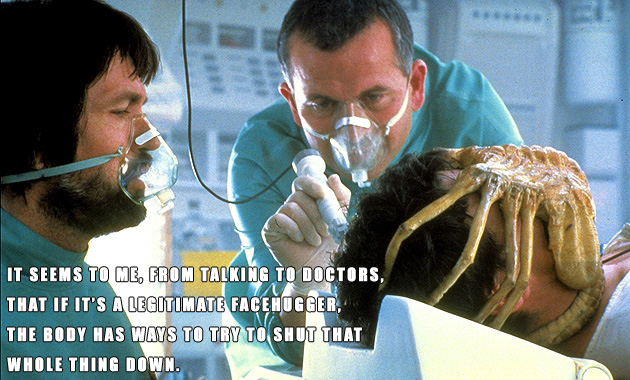
(By the way, the great facehugger pic above is from From Talking to Doctors — worth checking out.)
“I don’t want to start any blasphemous rumors, but I think that God’s got a sick sense of humor…” Or is there some other way to explain this, via @andrewducker:
‘Mitt Romney and Paul Ryan’ is an anagram of ‘My Ultimate Ayn Rand Porn.’“
Unfortunately, Mitt choosing Paul Ryan this morning means we’re probably going to be stuck with the media treating the Congressman from Wisconsin like he’s a Very Serious Person™ for at least the next three election cycles. But on the bright side, I’ve already said everything I need to say about this clownshoes, so I’ll just direct you to my post on Ryan from last year. And if you don’t particularly feel like clicking through, here’s the meat of what I said, below.
“For months, as you all know, the Serious People in the media have been banging the drum of thedeficit witchhunt even though, from an economic perspective, austerity at this hour makes about as much sense as Birtherism. And, in the past few weeks, they have doubled down on this idiocy by trying to elevate the most recent flavor of the month, Wisconsin Congressman Paul Ryan, as a Serious Man, come to tell us hard truths about the need for sacrifice.
By any reasonable standard, the Ryan budget should have been laughed out of the room as soon as it dropped. But, no, the press needed A Serious Man™ on the right for its lazy he-said, she-said approach to any political story. And, so Ryan got the Trump treatment and the rest is history. Ostensibly liberal pundits fell over themselvespraising Ryan’s budget. In response, the president eventually drew progressive kudos for pitching his own deficit reduction plan. (More on that in a sec.) With both sides established, the press can now continue to happily indulge in the usual medley of content-free, he-said, she-said inanities that, to them, constitutes political journalism. And everyone in Washington can continue to ignore the fact that, actually, more spending, not cutting the deficit, is what is needed to fix the economy right now. Win-win!
Regarding President Obama’s deficit proposals, he delivered an eloquent speech on the subject last month, to be sure — one of his best as president. But, even if we hadn’t already been burned far too many times by his rhetoric not matching up to his policies, it’s hard for me to take his remarks as some great moment of the left just because he finally articulated what should be pretty basic principles of American government. Particularly when you consider that the Obama plan is, of course, center-right-leaning, and yet it has nevertheless become the left pole in an exceedingly narrow economic debate.
In sum, the Trump boomlet of last month was not the exception. It was a clear and distilled expression of the rule, a sideshow to a sideshow. And because the Village press is so terrible, our entire politics is distorted — We are living out the consequences of this disaster yet again in the deficit debate. Only the sheer amount of money flooding the system right now is a bigger political problem than the broken state of the newsmedia.“
“For the Obama administration, Bowles has a number of qualifications. For one thing, Republicans adore him. Ryan has called him ‘my favorite Democrat.’ Appointing Bowles to be Treasury Secretary would ensure a smooth confirmation, and it would be interpreted as a sign of goodwill and ‘seriousness’ both by Republicans and by the media.“
“‘Quite frankly, his behavior is abhorrent,’ said Gardner, who emphasized that Digby does nothing to provide for the Chambers family, subsisting entirely on free handouts. ‘This asshole’s chowing down like he’s in a pie-eating contest. Meanwhile, the nation’s credit rating has been downgraded for the first time in history, and everyone’s fucking job is moving overseas. And he does know we’re fighting a war, too, right? Unbelievable.’“
My favorite Onion piece in a few moons: Pet Eating Like Country Isn’t In Goddamn Recession. “According to reports, the 5-year-old labrador appears callously unswayed by the constant stream of gloomy market forecasts and instead demands greater and greater supplies of dog food, to the point where he must think the Dow Jones industrial average is soaring through the fucking roof or something.“
“In the 2010 election cycle, 26,783 individuals (or slightly less than one in ten thousand Americans) each contributed more than $10,000 to federal political campaigns. Combined, these donors spent $774 million. That’s 24.3% of the total from individuals to politicians, parties, PACs, and independent expenditure groups. Together, they would fill only two-thirds of the 41,222 seats at Nationals Park.“
“The contrast in fortunes between those on top of the economic heap and those buried in the rubble couldn’t be starker. The 10 biggest banks now control more than three-quarters of the country’s banking assets. Profits have bounced back, while compensation at publicly traded Wall Street firms hit a record $135 billion in 2010. Meanwhile, more than 24 million Americans are out of work or can’t find full-time work, and nearly $9 trillion in household wealth has vanished. There seems to be no correlation between who drove the crisis and who is paying the price.“
Contrast this with Reid in 2005: “‘We killed the Patriot Act,’ boasted Minority Leader Harry Reid…to cheers from a crowd at a political rally after the vote.” Ladies and gentlemen, our Democratic Senate Majority Leader. And, yet, however hackadocious Reid is being in this instance, let’s remember — this is coming from the top, from the constitutional scholars at the White House. After all, as Mike Riggs notes in Reason: “If the PATRIOT Act lapses, and a sarlacc does not swallow LAX immediately after, it’ll be that much harder to convince Americans that those provisions are necessary.“
“Gabriel Schoenfeld, a conservative political scientist at the Hudson Institute, who, in his book ‘Necessary Secrets’ (2010), argues for more stringent protection of classified information, says, ‘Ironically, Obama has presided over the most draconian crackdown on leaks in our history — even more so than Nixon.‘”
In the New Yorker, Jane Mayer delves deeply into the Obama administration’s continued war on whistleblowers, via the prosecution of NSA whistleblower Thomas Drake. (See also Glenn Greenwald on this, as well as here and here.) “‘I actually had hopes for Obama…[b]ut power is incredibly destructive,’ Drake said. ‘It’s a weird, pathological thing. I also think the intelligence community coopted Obama, because he’s rather naive about national security. He’s accepted the fear and secrecy. We’re in a scary space in this country.’“
“‘This was maybe America’s last chance to fight back against the greed of the Wall Streetoligarchs and corporate plutocrats, to generate some serious discussion about public interest and common good that sustains any democratic experiment,’ West laments…’I thought Barack Obama could have provided some way out. But he lacks backbone.“
“Told that the data came directly from the Social Security Administration, Simpson continued to insist it was inaccurate, while misstating the nature of a statistical average: “If you’re telling me that a guy who got to be 65 in 1940 — that all of them lived to be 77 — that is just not correct. Just because a guy gets to be 65, he’s gonna live to be 77? Hell, that’s my genre. That’s not true,’ said Simpson, who will turn 80 in September. Understanding life expectancy rates at age 65 in 1940 is central to understanding Social Security itself.“
“Simpson’s forceful gesture came after an extended diatribe against Social Security, which he said is a ‘Ponzi’ scheme, ‘not a retirement program.’ Simpson argued that Social Security was originally intended more as a welfare program.” Um, no. But, in Simpson’s defense, the president who appointed him also harbors some misunderstandings about Social Security. And at least the Senator is right on public financing of elections. So, there’s that.
“Lloyd Blankfein went to Washington and testified under oath that Goldman Sachs didn’t make a massive short bet and didn’t bet against its clients. The Levin report proves that Goldman spent the whole summer of 2007 riding a ‘big short’ and took a multibillion-dollar bet against its clients, a bet that incidentally made them enormous profits. Are we all missing something? Is there some different and higher standard of triple- and quadruple-lying that applies to bank CEOs but not to baseball players?“
“To recap: Goldman, to get $1.2 billion in crap off its books, dumps a huge lot of deadly mortgages on its clients, lies about where that crap came from and claims it believes in the product even as it’s betting $2 billion against it. When its victims try to run out of the burning house, Goldman stands in the doorway, blasts them all with gasoline before they can escape, and then has the balls to send a bill overcharging its victims for the pleasure of getting fried.”
“‘Trump’s presidential run is no longer being treated as serious by the easily distracted and resolutely frivolous political press that covered it so thoroughly just a few short weeks ago. While it was always an unamusing joke…we had what felt like a lifetime of New Hampshire trip coverage and Piers Morgan interviews and ‘President Trump? It might be more likely than you think!’“
With last month’s embarrassing Trump boomlet seemingly run its course in the Village, Salon‘s Alex Pareene comes to bury, not praise, the Donald. “[T]ransparent idiocy didn’t cause the press to take Trump less seriously, but it did lead people to gradually grow to hate Trump, which made his ratings suffer, and the exposure of the artifice of the Trump persona was decidedly damaging to his ‘brand.’ Once your ‘brand’ has been damaged, say goodbye to credulous political press coverage!“
To be honest, I couldn’t care less about Trump, and mostly avoided all of his Birther shenanigans as they were unfolding two weeks ago for the same reason I try to avoid any political coverage — from right or left — of the “You won’t believe what Sarah Palin just posted on Facebook!” variety. It’s lazy, it’s boring, and it’s actively pernicious given all the real problems we face right now. (But at the very least, both Trump and Palin are noteworthy indicators of how far the GOP done fell.)
I’m only posting on this now to point out that the Trump boomlet was by no means a one-time-thing. When the President of the United States actually had to come on TV two weeks ago to prove he was an American citizen, there was much pearl-clutching by the Village press about what a travesty this had all become. “What a sad day in American political history,” lamented MSNBC’s Chuck Todd. Meanwhile, the Washington Post opined that the release “says something embarrassing — actually, make that disturbing — about the state of American politics” — soon after that newspaper of record invited Trump to the White House Correspondent’s Dinner. (An evening, by the way, that’s as good as reflection as any of how desiccated and domesticated today’s establishment press has become.)
For months, as you all know, the Serious People in the media have been banging the drum of thedeficit witchhunt even though, from an economic perspective, austerity at this hour makes about as much sense as Birtherism. And, in the past few weeks, they have doubled down on this idiocy by trying to elevate the most recent flavor of the month, Wisconsin Congressman Paul Ryan, as a Serious Man, come to tell us hard truths about the need for sacrifice.
By any reasonable standard, the Ryan budget should have been laughed out of the room as soon as it dropped. But, no, the press needed A Serious Man™ on the right for its lazy he-said, she-said approach to any political story. And, so Ryan got the Trump treatment and the rest is history. Ostensibly liberal pundits fell over themselvespraising Ryan’s budget. In response, the president eventually drew progressive kudos for pitching his own deficit reduction plan. (More on that in a sec.) With both sides established, the press can now continue to happily indulge in the usual medley of content-free, he-said, she-said inanities that, to them, constitutes political journalism. And everyone in Washington can continue to ignore the fact that, actually, more spending, not cutting the deficit, is what is needed to fix the economy right now. Win-win!
Regarding President Obama’s deficit proposals, he delivered an eloquent speech on the subject last month, to be sure — one of his best as president. But, even if we hadn’t already been burned far too many times by his rhetoric not matching up to his policies, it’s hard for me to take his remarks as some great moment of the left just because he finally articulated what should be pretty basic principles of American government. Particularly when you consider that the Obama plan is, of course, center-right-leaning, and yet it has nevertheless become the left pole in an exceedingly narrow economic debate.
In sum, the Trump boomlet of last month was not the exception. It was a clear and distilled expression of the rule, a sideshow to a sideshow. And because the Village press is so terrible, our entire politics is distorted — We are living out the consequences of this disaster yet again in the deficit debate. Only the sheer amount of money flooding the system right now is a bigger political problem than the broken state of the newsmedia.
“After the Civil War, political leaders in the defeated South announced their intention of resuming their seats in Congress and of using their power…to compel the federal government either to pay off all debts of the Confederacy or to default on the national debt which had been borrowed to finance the Union war effort…For this reason, [Reconstruction Republicans] wrote into our fundamental law an absolute prohibition against defaulting on the national debt. Its language establishes a complete firewall against the misuse of governmental power by one political faction to get its way by wrecking the public credit.“
“‘There is a huge irony,’ said SETI Director Jill Tarter, ‘that a time when we discover so many planets to look at, we don’t have the operating funds to listen.’ SETI senior astronomer Seth Shostak compared the project’s suspension to ‘the Nina, Pinta and Santa Maria being put into dry dock.’…This is about exploration, and we want to keep the thing operational. It’s no good to have it sit idle.”
Another casualty of the lousy economy and the budget crises (in this case, California’s) SETI’s Allen Telescope Array goes dark. “‘We have the radio antennae up, but we can’t run them without operating funds,’ he added. ‘Honestly, if everybody contributed just 3 extra cents on their 1040 tax forms, we could find out if we have cosmic company.‘”
“Treasury’s mismanagement of TARP and its disregard for TARP’s Main Street goals — whether born of incompetence, timidity in the face of a crisis or a mindset too closely aligned with the banks it was supposed to rein in — may have so damaged the credibility of the government as a whole that future policy makers may be politically unable to take the necessary steps to save the system the next time a crisis arises. This avoidable political reality might just be TARP’s most lasting, and unfortunate, legacy.” On his last day on the job, outgoing special inspector general for TARP Neil Barofsky laments the failures of the program he oversaw.
In very related news, see also NYT columnist William Cohan on the same subject yesterday: “Not only did the government’s theory fail in practice — unemployment remains relentlessly and historically high and American businesses seem intent on hoarding, rather than spending, the $2 trillion in cash on their collective balance sheets — but it also lost a once-in-a-century opportunity to change the mores of a momentarily chastened Wall Street, which remains badly in need of substantive reform. This is more than a shame; it is prima facie evidence of how deep Wall Street’s hooks have been — and continue to be — into the powers that be in Washington (and vice versa).“
“This chart puts the class war in simple, visual terms. On the left you have the ‘shared sacrifices’ and ‘painful cuts’ that the Republicans claim we must make to get our fiscal house in order. On the right, you can plainly see WHY these cuts are ‘necessary.’” Via JackDean and several other sites, This is What Class War Looks Like.
“You can practically break a search engine if you start looking around the Internet for those words. They’re used repeatedly with reference to our local, state and federal governments, almost always to make a case for slashing programs — and, lately, to go after public-employee unions. The phrase is designed to create a sense of crisis that justifies rapid and radical actions before citizens have a chance to debate the consequences. Just one problem: We’re not broke.“
“‘There can be no conceivable justification for requiring a soldier to surrender all his clothing, remain naked in his cell for seven hours, and then stand at attention the subsequent morning,’ he wrote. ‘This treatment is even more degrading considering that Pfc. Manning is being monitored — both by direct observation and by video — at all times.‘”
The president, meanwhile, assures us everything is ok because the Pentagon said so: “I have actually asked the Pentagon whether or not the procedures that have been taken in terms of his confinement are appropriate and are meeting our basic standards. They assure me that they are.” This, as Glenn Greenwald (who’s been on top of this all the way) points out, is exactly the same rationale Dubya used to use: “‘When [Bush] asked ‘the most senior legal officers in the U.S. government’ to review interrogation methods, ‘they assured me they did not constitute torture.’” Well, ok then.
Should Manning be in U.S. custody right now? Yes. He took an oath to the United States military and, knowing full well the consequences, broke it in an act of civil disobedience. If you can’t do the time, don’t do the crime — I get that. But should Manning be abused and tortured in U.S. custody? Of course not — Nobody should be. In fact, I thought we elected Barack Obama as president to make sure this never happened again.
Update: “Based on 30 years of government experience, if you have to explain why a guy is standing naked in the middle of a jail cell, you have a policy in need of urgent review.” P.J. Crowley reflects on his recent firing. “I stand by what I said. The United States should set the global standard for treatment of its citizens – and then exceed it. It is what the world expects of us. It is what we should expect of ourselves.“
“What is at stake in the long run? Two things, mainly, in my view. First, it seems to me that we as progressives need to make an honorable defense of the great legacies of the New Deal and Great Society — programs and institutions that brought America out of the Great Depression and bought us through the Second World War, brought us to our period of greatest prosperity, and the greatest advances in social justice. Social Security, Medicare, housing finance — the front-line right now is the foreclosure crisis, the crisis, I should say, of foreclosure fraud — the progressive tax code, anti-poverty policy, public investment, public safety, and human and civil rights. We are going to lose these battles- get used to it. But we need to make an honorable fight, to state clearly what our principles are and to lay down a record which is trustworthy for the future.“
In a hard-hitting address to the Americans for Democratic Action from last November, economist Jamie Galbraith puts the current situation of progressivism in perspective. His steely resignation may sound fatalistic, but it’s hard not to feel thus these days. “Recovery begins with realism and there is nothing to be gained by kidding ourselves…We need to lose our fear, our hesitation, and our unwillingness to face the facts. If we thereby lose some of our hopes, let’s remember the dictum of William of Orange that ‘it is not necessary to hope in order to persevere.’“
“The Pew Research Center’s topline stats show Wisconsinites favoring the public employee unions over Governor Walker by 42-31. But dig deeper. Among the 18-29 set, a vanishing small number of which belong to unions, the number expands to 46-13. Among nonwhites, it expands to 51-19. Among those who make less than $75,000 a year, it’s roughly 48-25 (I had to add a couple numbers together there). The future of the country is strongly on the side of workers in this struggle, forming the backbone of a new progressive alliance, a youth-labor alliance of color.
“But wait a tic: From within the Wisconsin State Capitol, Firedoglake‘s David Dayen sees a new way forward for the left. “While ultimately, the fight in Wisconsin and elsewhere is a rearguard action, it has awakened a sense of purpose and self-worth in a broad swath of America. I truly believe that because I saw it with my own eyes.”
“After the Anonymous attacks and the release of Barr’s e-mails, his partners furiously distanced themselves from Barr’s work. Palantir CEO Dr. Alex Karp wrote, ‘We do not provide — nor do we have any plans to develop — offensive cyber capabilities…’ But both of the Team Themis leads at these companies knew exactly what was being proposed…They saw Barr’s e-mails, and they used his work. His ideas on attacking WikiLeaks made it almost verbatim into a Palantir slide about ‘proactive tactics.’“
Bank of America contemplated hiring private-intelligence goons — the aforementioned HBGary, the aptly-named Palantir Technologies, and third-wheel Berico Technologies — to spread anti-Wikileaks disinformation discredit Salon’s Glenn Greenwald.
Private security firms like the aforementioned ones above are, as Marcy Wheeler puts it, deploying “intelligence techniques developed for use on terrorists [against] citizens exercising their First Amendment rights.” And
As HBGary target Glenn sums it up: “What is set forth in these proposals for Bank of America quite possibly constitutes serious crimes. Manufacturing and submitting fake documents with the intent they be published likely constitutes forgery and fraud. Threatening the careers of journalists and activists in order to force them to be silent is possibly extortion…Attacking WikiLeaks’ computer infrastructure in an attempt to compromise their sources undoubtedly violates numerous cyber laws. Yet these firms had no compunction about proposing such measures…and even writing them down. What accounts for that brazen disregard of risk? In this world, law does not exist as a constraint.“
“With this legislation, which was introduced last week by Rep. Chris Smith (R-N.J.), Republicans propose that the rape exemption be limited to ‘forcible rape.’ This would rule out federal assistance for abortions in many rape cases, including instances of statutory rape, many of which are non-forcible. For example: If a 13-year-old girl is impregnated by a 24-year-old adult, she would no longer qualify to have Medicaid pay for an abortion.“
On the principle that, as per MLK, “in the end, we will remember not the words of our enemies, but the silence of our friends,” I post more often here these days about issues I have with our own, ostensibly-lefty party. But, as Dangerous Meta reminds me: Just in case anyone forgot how crazy the Republicans are these days, the GOP Congress has, for pro-life purposes, actually fashioned a bill that defines rape down. “House Speaker John Boehner (R-Ohio) has dubbed [it] a top priority in the new Congress.” There are no words.
“We know what it takes to compete for the jobs and industries of our time. We need to out-innovate, out-educate, and out-build the rest of the world. We have to make America the best place on Earth to do business. We need to take responsibility for our deficit and reform our government. That’s how our people will prosper. That’s how we’ll win the future.“
It wasn’t just the bland corporate seminar tagline — Win the Future!™ — that rankled. Here we have a Democratic president — the great hope of the left only two short years ago, imploring us all to clap harder for a five-year budget freeze (only in non-defense, discretionary spending, of course, and still not enough for the GOP), a promise to review regulations that put an “unnecessary burden on businesses,” and a lower corporate tax rate. WTF, indeed.
Now, there’s nothing inherently wrong with national goals like increasing competitiveness and doubling exports (provided you aren’t suppressing wages to do it), and I’ve speculated here on getting rid of corporate taxes in the past. (10/12/00 — Arguably, they’re redundant.) But, really, what a thin gruel to offer the American people at this hour. Is there no other way to answer the challenges of the future than a Tony Robbins slogan and generous heapings of business seminar pablum? Have things gotten so bad for the Left that we’re supposed to applaud a president simply for not explicitly threatening Social Security?
Alas, it looks like that may be the case. In his address, the president made sure to make obeisance once again to the deficit witchhunt: “Every day, families sacrifice to live within their means. They deserve a government that does the same.” What you didn’t hear was any attempt to explain that family and government budgets are not the same, or that cutting spending in the midst of a fragile economic recovery is actually aterrible idea. It’s like Keynesianism never existed.
This administration — and all of Washington, really — is now so prisoner to Republican message-framing that “bring[ing] discretionary spending to the lowest share of our economy since Dwight Eisenhower was President” is somehow considered a great thing. Woohoo! Austerity we can believe in! It’s not the most inspiring peg to hang your hat on, to be sure.
Speaking of Ike, Obama also tried to inject some historical cachet into the speech by talking of one of the Eisenhower Era’s signature events: “This is our generation’s Sputnik moment,” he said, and it probably is.
But, as Fred Kaplan (and others) has well pointed out: “The lesson from the 1950s is that it takes more than private enterprise to revive American innovation. It takes lots of government spending.” And I’m not seeing how the president is going to be able to pull that off anymore, now that he’s willingly enclosed himself — and all of us — in the Republicans’ deficit-scare paddock. To really Win the Future!™, it’s going to take a lot more from this administration than a zippy corporate rebranding and a string of hoary, Third Way cliches.
“The politics of President Kennedy — patriotic service to country, support of civil rights and social justice, pro-growth economic and tax policies, and a strong national defense — are still my politics,” Lieberman said. “So maybe that means that JFK wouldn’t fit into any of today’s partisan political boxes neatly.“
“The westward movement of the U.S. population means six districts in states that went for Obama will shift to states that went for McCain — a small but significant shift that could help a GOP presidential candidate in 2012, provided they can hold those states for the party.“
The US Census Bureau announces the newly-reapportioned electoral map for 2010, and it shows electoral gains for (blue areas in) red states and the Northeast and Midwest diminishing (in growth rate, at least. The only state to actually lose people was Michigan.) Since the GOP will by and large control the redistricting process in most states, this is further bad news for Dems in the short term. Nonetheless, the overall demographic trends are still working in our favor.
In related news, Robert Cruickshank makes the modest proposal of removing the 435-member cap on the House, first passed in 1929. “In the 1930 Census, which found a population of just over 122 million, this produced 435 House districts of about 282,000 each. By 2012, however, a US House district in a state with more than 1 seat will represent about 708,000 people. That’s an increase of 2260% from 1790.“
“The message: the FCC Chairman caved to the most powerful interests and is adopting a rule that may end the Internet’s historic openness to all software and content as a level playing field. This will undermine the Internet’s role in as an engine of economic innovation and democratic participation. The rule was written by and for the giants like AT&T, Verizon, and Comcast, who are cheering the rule. And the FCC Chairman is trying to fool the public into believing they should thank him.“
“Here was the Delta Republicans’ historic task: negotiating terms of surrender to the Constitution, then reframing that Lost Cause as honorable, the better to preserve their insular plutocracy — perhaps their gravest sin in the first place — in order to integrate themselves more snugly into national and international circuits of corrupt wealth. Haley Barbour, who received his first Republican patronage job in 1970, is a true son of this confederacy.“
“Now, if that’s the standard by which we are measuring success or core principles, then let’s face it, we will never get anything done. People will have the satisfaction of having a purist position, and no victories for the American people. And we will be able to feel good about ourselves, and sanctimonious about how pure our intensions are and how tough we are…That can’t be the measure of how we think about our public service. That can’t be the measure of what it means to be a Democrat.
1) Alex Pareene at Salon cut right to the heart of the fallacy on display here: “[Obama] continues to imagine that his liberal critics are upset with the idea that compromises need to be made in order to accomplish progressive policy goals. Some of them are that stupid. But lots of them are actually critics of the White House’s legislative strategy, and their apparent willingness to preemptively compromise before the negotiations have already begun.” Yep.
2) See also Paul Krugman: “Leave aside the merits for a moment: what possible purpose does this kind of lashing out serve? Will activists be shamed into recovering their previous enthusiasm? Will Republicans stop their vicious attacks because Obama is lashing out to his left? It was pure self-indulgence; even if he feels aggrieved, he has to judge his words by their usefulness, not by his desire to vent…[W]hat we really don’t need right now is a president who blames everyone but himself, and seems more concerned with self-justification than with sustaining the alliances he needs.“
3) As I noted on Twitter, the president’s argument here is inherently contradictory. He began his presser by saying he had to make a bad deal because the Right, however wrongheaded, held stubbornly to their convictions. Then he verbally abuses the Left for…holding stubbornly to their convictions. Uh, it seemed to work pretty well for the GOP.
4) Speaking of Twitter, the Twitterverse response to the presidential presser is well worth perusing for gallows humor and hard truths. Take for example, “Obama: This is like the public option fight all over again where I caved and opposed the thing that reduced the deficit.“
5) As manyhavepointedout now, the president is also wrong on his New Deal history. In the presser, he claimed Social Security was only for widows and orphans. Wrong. He’s thinking of the civil war pension system, circa 1862. I know that law degrees are considered the be-all, end-all of our civilization these days, but an ostensibly progressive president not understanding the origins of Social Security is sort of a big effing deal. (And he didn’t just misspeak — He’s said it before.)
6) As historian Thomas Ferguson noted several weeks ago, this is not the first time the president has badly screwed up the history of the New Deal in a way that was ultimately self-serving. (As an aside: Given they they chose to structure a major policy speech around a fake Lincoln quote, his communications staff isn’t much better.)
7) As Dan Froomkin pointed out, Obama’s argument about the public option is also contradictory. He argues that Social Security and Medicare started out small, than belittles the public option because it “would have affected maybe a couple of million people,” i.e. it would’ve started out small.
8) Obama also no longer seems to understand how the public option was supposed to work. Here’s Froomkin: “What the president conspicuously disregarded was that the central point of the public option was that its existence would exert enormous competitive pressure on the private insurance system. The goal was not to serve a particularly large number of people directly — that would only happen if the private offerings were terribly inadequate. The goal was to keep the private sector honest. So no matter how many people it enrolled, ‘the provision,’ as Obama put it “would have affected” tens of millions.” In other words, the public option was designed to be a yardstick. So, even in terms of recent history, there are some serious revisions going on.
9) Politico’s catty analysis of the president’s relationship with Chuck Schumer offered more insights on Obama’s thinking today: “Obama himself warned Schumer that the millionaire strategy could sink the stock market. When a vote on the millionaire plan came up short last Saturday, the administration gloated.” The vagaries of the stock market? Is that really what we’re basing our tax policies on these days? (Also, I don’t think Chuck Schumer, of all people, needs to be informed of when and how Wall Street will balk. I think he has his finger pretty solidly on that pulse.)
11) Obama at the presser again: “Lookat whatI promisedduring the campaign. There’s not a single thing that I’ve said that I would do that I have not either done or tried to do. And if I haven’t gotten it done yet, I’m still trying to do it.” Um…do we really want to go there? Because I’m sure this would be news to Maher Arar. In any case, as a friend pointed out, this isn’t kindergarten — You don’t get a gold star just for “trying.”
Anyways, so, yeah, Obama doesn’t like “the professional left” very much. And, at this point, it’s safe to say the feeling is mutual. As for myself…well, these days I just feel like a sucker.
“The Fed accepted a total of $1.31 trillion in junk-rated collateral between Sept. 15, 2008 and May 12, 2009 through the Primary Dealer Credit Facility. TARP was nothing compared to this.” (Also, $500 billion of that junk was rated CCC or below, which — given the rampant grade inflation going on at all the rating agencies — means it was really garbage.)
So, yeah, Wikileaks isn’t the only document dump in town this week. As mandated by the Dodd-Frank Act (after much pushing from below), the Federal Reserve today released information about some of its dealings from December 2007 to July 2010. And, while folks are just now delving into the intel, it already seems that some of the bodies buried during the financial crisis are now floating to the surface: “A quick analysis…indicates that Citigroup was the greatest beneficiary, drawing on a total of $1.8 trillion in loans, followed by Merrill Lynch, which used $1.5 trillion; Morgan Stanley, which drew $1.4 trillion; and Bear Stearns, which used $960 billion.“
In very related news, former Alan Grayson staffer (and a Hill friend of mine) Matthew Stoller lays out a compelling case for a harder stance against the Fed from the Left from now on. Some brief excerpts:
“It is good that this debate is happening. It means that we will be able to examine the real power structure of the American order, rather than the minor food fights allowable in our current political system. This will bring deep disagreements, profound ones, but also remarkable possibility. Modern American industrial policy is to push capital into housing, move manufacturing abroad, build a massive defense establishment, and maintain an oligarchic financial sector. This system isn’t a structural inevitability. People built it, and people are unbuilding it…
Like most American institutions, the Fed has shrouded itself in myth, with self-serving officials discussing the immaculate design of the central bank as untouchable, secretive, an autocratic and technocratic adult in the world of democratic children. But the Fed, and specifically the people who run it, are responsible for declining wages, for de-industrialization, for bubbles, and for the systemic corruption of American capital markets.”
Also on this topic, it comes out today that Bank of America was given a break by the SEC on a securities fraud settlement “‘because of the nation’s perilous economic situation at the time’ and the fact that it had received billions of dollars in taxpayer aid, according to the report by the SEC’s inspector general…Specifically, during settlement negotiations, Bank of America won relief from sanctions that could have hurt its investment banking business.“
To tie this back to the top, according to Bloomberg’s Lizzie O’Leary, who’s also been parsing the new Fed data, “52% of the collateral Bank of America pledged to the #Fed’s PDCF was rated Ba/BB or lower, or didn’t have available ratings.” (And, let’s keep in mind, PDCF was only one of several emergency programs.)
So, in other words, the government kept banks like BoA alive by buying up trillions in toxic assets and looking askance at their illegal activity. They repaid us with record bonuses for themselves and an epidemic of foreclosure fraud — the “getaway car for the financial crisis,” as a friend well put it — that’s screwing over millions of American families. And in terms of fixing bad behavior on the Street, nothing changed whatsoever. Boy, that’s some deal.
What It Takes, Richard Ben Cramer Founding Finance, William Hogeland Twilight of the Elites, Chris Hayes Last Chance to See, Douglas Adams The Forever War, Joe Haldeman Uphill all the Way, Kevin Murphy