“Our prison system is increasingly built and run by for-profit corporations, who have a financial interest in increasing the number of people in prison while decreasing the amount of money it costs to house them. Since 1980, the US prison population has grown by 790%. We have the largest prison population of any nation in the history of the world. One in three African-American men will go to jail at some point in his life.”
In The Guardian Jill Filipovic examines the national shame that is our private prison-industrial complex. “Imprisoning that many people, most of them for non-violent offenses, doesn’t come cheap, especially when you’re paying private contractors…who are doing quite well living off of American corporate welfare -– at the expense of the American taxpayer.” $50 billion a year — that funds a lot of stadium.
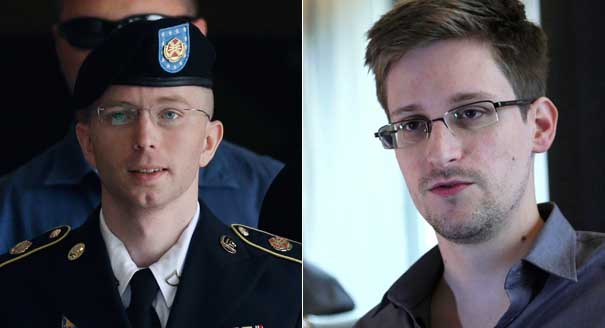
“‘I don’t see myself as a hero,’ he said, ‘because what I’m doing is self-interested: I don’t want to live in a world where there’s no privacy and therefore no room for intellectual exploration and creativity.’”
This is exactly what I was talking about last update. Obama acts tortured about continuing all of Dubya’s most terrible civil liberties violations, but then goes ahead and does them anyway. For Crom’s sake, he’s even picked James Comey, the guy who approved warrantless wiretaps back in 2006, to be the new FBI chief. And because this president and this administration is so brazenly two-faced about their anti-terror policies, you end up with disturbing polls like this:
Speaking of which, at the very least these revelations of blatant NSA overreach have had the healthy effect of exposing which alleged lefties out there walk the walk.
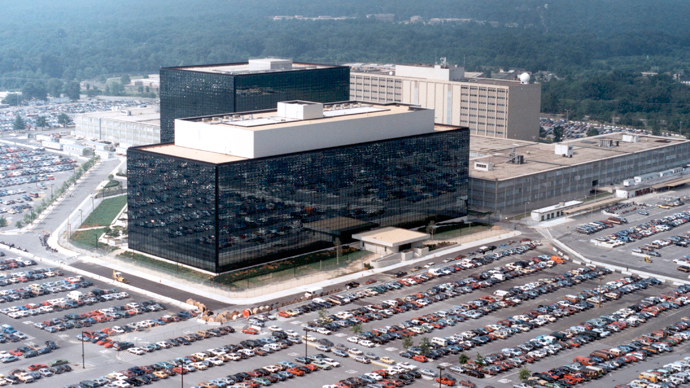
For example, in the Senate: On one hand, we have Ron Wyden, Mo Udall, and Jeff Merkley calling out Obama for continuing with this extra-legal, ginormous-net approach to surveillance. “‘As far as we can see, all of the useful information that it has provided appears to have also been available through other collection methods that do not violate the privacy of law-abiding Americans in the way that the Patriot Act collection does,’ Udall and Wyden said.”
On the other hand, here’s ostensibly Democrat Dianne Feinstein yesterday going full Body Snatcher about Snowden: “‘I don’t look at this as being a whistle-blower,’ Sen. Dianne Feinstein (D-Calf.) said. ‘I think it’s an act of treason.‘” (FWIW, John Boehner and Lindsey Graham were right there with her.) Of course, it’s never “treason” when Feinstein continually does it, and, in any case, this wasn’t breaking news either: The senior Senator from California has long been a quintessential “symbol of the worthless Beltway Democrat.”
This revealing breeze stirred by the NSA revelations is coursing through media outlets too. On one hand, Slate‘s Fred Kaplan has — quite correctly — called for James Clapper’s resignation, given that he flat-out lied to Congress: “We as a nation are being asked to let the National Security Agency continue doing the intrusive things it’s been doing on the premise that congressional oversight will rein in abuses. But it’s hard to have meaningful oversight when an official in charge of the program lies so blatantly in one of the rare open hearings on the subject.” Spot on.
Meanwhile, TPM’s Josh Marshall, who likes to pretend his blog is a font of independent thinking, hems and haws about it all in classic pusillanimous Village-think fashion, all the while making sure never to say anything that might harm his establishment respectability. “I’ve made clear that I don’t see Manning as a hero or a whistleblower or really anything positive at all…Pretty early I realized that to his supporters Manning was a whistleblower who was being persecuted by the government, almost like a political prisoner or prisoner of conscience.” No, Josh, it doesn’t “seem” that way “to his supporters” — That is in fact what is %#%@ happening.
In any case, so as not to fall into the same trap, I’ll just say it outright: First, if Snowden and Manning are traitors, then so is Daniel Ellsberg and so, for that matter, is Dianne Feinstein and any other politician or government official who leaks when it’s convenient. (Also, sorry, folks. there is no substantive difference between revealing secrets to the criminal Julian Assange or to the venerable Bob Woodward. But please do let me know when Richard Armitage is put in a sweatbox for 23 hours a day.)
Second, this vast surveillance apparatus NSA has been constructing is both obviously overkill and clearly legally and constitutionally repugnant, and if this president lived up to even half the rhetoric he continually espoused before he was elected, he would have ended it years ago. Quite frankly, the doubletalk from him, and from so many other Democrats about these revelations so far, is both inexcusable and out-and-out pathetic.
“And yet, as our fight enters a new phase, America’s legitimate claim of self-defense cannot be the end of the discussion. To say a military tactic is legal, or even effective, is not to say it is wise or moral in every instance. For the same human progress that gives us the technology to strike half a world away also demands the discipline to constrain that power — or risk abusing it.”
Didn’t get to this before heading out for a Memorial Day weekend camping trip: As y’all know by now, President Obama delivered a much-hailed State of the War on Terror address at the National Defense University, during which he called for the eventual repeal of AUMF, tighter oversight of drone strikes, and the closing of the Gitmo Gulag at last. “Our systematic effort to dismantle terrorist organizations must continue. But this war, like all wars, must end. That’s what history advises. That’s what our democracy demands.”
Sounds great! When’s it happening? Er…well, that’s that trick, isn’t it? When it comes to the first promise — the repeal of AUMF — as Brooking’s Benjamin Witte noted: “Obama does not need Congress to narrow or repeal the AUMF or to get off of a war footing. He can do it himself, declaring hostilities over in whole or in part. And Obama, needless to say, did not do anything like that.”
Ok, what about drone strikes? As Fred Kaplan and others — including the heckler at the speech — have pointed out, President Obama did not promise to transfer drone strike authority from the CIA (where they remain covert) to the military (where there’s more possibility of oversight.) Nor did he pledge to end “signature strikes,” meaning the current practice of unleashing fiery death upon unknown parties because they seem to be acting shady. This “supposedly new, restrictive policy on drone strikes,” writes Kaplan, “was neither new nor restrictive…In short, the speech heralded nothing new when it comes to drone strikes.”
Instead, Obama defended his drone policy as legal and effective. At one point, he asserted “for the record, I do not believe it would be constitutional for the government to target and kill any U.S. citizen — with a drone, or with a shotgun — without due process.” And then, in the very next paragraph, he asserts that particular executive prerogative in the matter of Anwar Awlaki — assassinated without due process. (FWIW, Obama is clearly using the Colbert reasoning here: “Trial by jury, trial by fire, rock, paper scissors, who cares? Due process just means that there is a process that you do. The current process is apparently, first the president meets with his advisers and decides who he can kill. Then he kills them.”)
As for Gitmo…well, we havebeen herebefore, so fool me once and all that. “‘The speech was deeply disappointing,’ says David Remes, a lawyer who has represented a number of Yemenis held at Guantanamo – adding that Obama only ‘created the illusion of forward momentum.’…The president has the power to issue national security waivers and direct the Secretary of Defense to certify detainee transfer if they are deemed not a national security threat – something human rights groups have been advocating. Didn’t hear much about that in the president’s address.
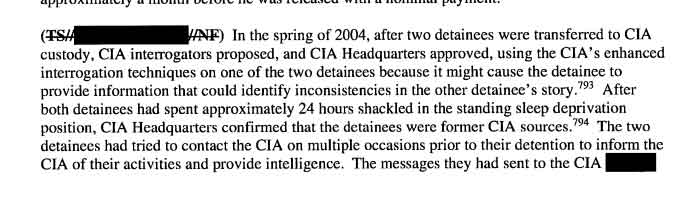
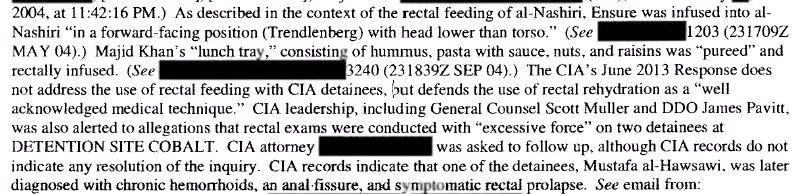
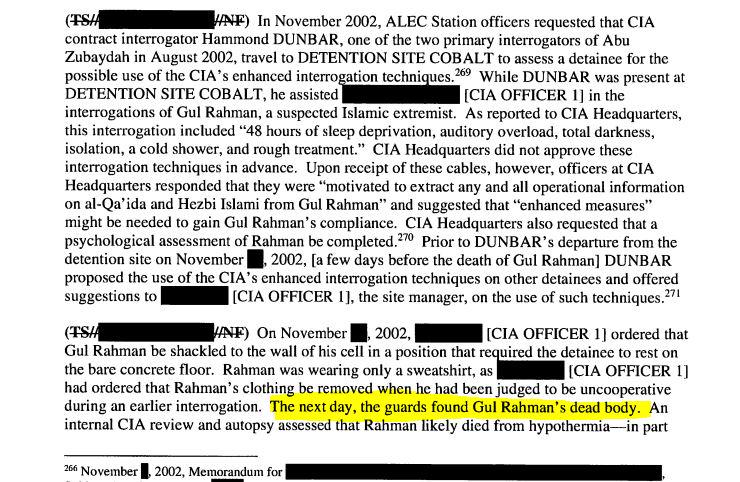
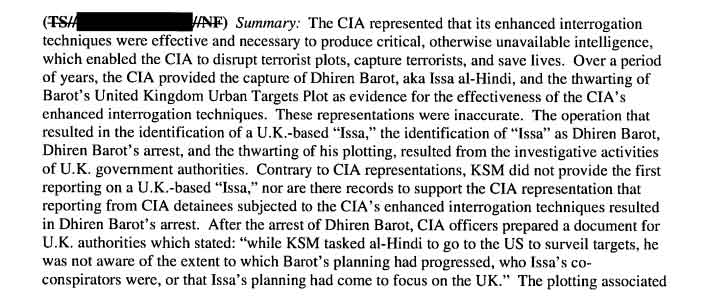
“‘[I]t is indisputable that the United States engaged in the practice of torture’ and that the nation’s highest officials bore ultimate responsibility for it…The use of torture, the report concludes, has ‘no justification’ and ‘damaged the standing of our nation, reduced our capacity to convey moral censure when necessary and potentially increased the danger to U.S. military personnel taken captive.’ The task force found ‘no firm or persuasive evidence’ that these interrogation methods produced valuable information that could not have been obtained by other means.”
“The sweeping, 577-page report says that while brutality has occurred in every American war, there never before had been ‘the kind of considered and detailed discussions that occurred after 9/11 directly involving a president and his top advisers on the wisdom, propriety and legality of inflicting pain and torment on some detainees in our custody.’”
And yet, as this report unequivocally lays out, the evidence of an American torture regime, planned and carried out after 9/11 at the highest levels of government, is indisputable. For the rule of law’s sake as much as for the values we purportedly stand for, we still need a reckoning.
“The Marathon was the old, drunk uncle of Boston sports, the last of the true festival events. Every other one of our major sporting rodeos is locked down, and tightened up, and Fail-Safed until the Super Bowl now is little more than NORAD with bad rock music and offensive tackles. You can’t do that to the Marathon. There was no way to do it…Now there will be. Someone will find a way to do it. And I do not know what the race will be now. I literally haven’t the vaguest clue.”
Obviously, yesterday was horrible. Let’s mournourdead and help our wounded. Let’s honor our first responders and civilian heroes like Carlos Arredondo, the “man in the cowboy hat.” Let’s figure out exactly what happened here and bring the perpetrators to justice. And then, let’s hold our heads high and work to live our lives without fear.
“Change is ‘snowballing in the right direction,’ said Tom Angell, chairman of Marijuana Majority. ‘I think you’re going to see a lot of action on the state level in the next several years and action will trickle up to the federal level…For a long time people would agree with us behind closed doors, but they would be afraid to say that in public,’ he said. Now, even in Washington, things are changing. ‘There was just a lot of cynicism and pessimism … I think that attitude is really going away.’“
“For decades, the politics of the drug war were straightforward: Being tough could help at the polls and came with no political downside; being open to reform had few advantages, but would be used against a candidate on the campaign trail. That calculation is no longer so simple.”
Wrong answer. The policy FAIL here is obvious and egregious — Why would anyone of a lefty bent support giving a president unitary and unchecked authority to kill anyone he or she wants, without even a semblance of due process? Would they be this sanguine about it if Dick Cheney was holding the kill button? But even notwithstanding that, Democrats are making a terrible political mistake by letting Senator Paul, along with opportunistic slimebags like Mitch MConnell and far-right asshats like budding McCarthyite Ted Cruz, get to the left of them on this issue.
I get that some senators had procedural issues with the filibuster of a Cabinet nominee. But, at a certain point, this just looks like typical Dem spinelessness and situational ethics — Is preserving proper Senate procedure really more important than preserving constitutional due process? And if Rand Paul is the only person who’s going to stand up and call shenanigans on the administration for this chilling executive overreach, then thank you, Rand Paul.
“I hoped that the public would be as alarmed as me about the conduct of the aerial weapons team crew members. I wanted the American public to know that not everyone in Iraq and Afghanistan are targets that needed to be neutralized, but rather people who were struggling to live in the pressure cooker environment of what we call asymmetric warfare. After the release I was encouraged by the response in the media and general public, who observed the aerial weapons team video. As I hoped, others were just as troubled– if not more troubled that me by what they saw.”
While pleading guilty to 10 of the 22 charges against him, Bradley Manning makes a long and detailed statement about why he gave classified documents to Wikileaks. “The more I read the cables, the more I came to the conclusion that this was the type of information that– that this type of information should become public. I once read a, and used, a quote on open diplomacy written after the First World War and how the world would be a better place if states would avoid making secret pacts and deals with and against each other.”
See also this on Gitmo: “[T]he more I became educated on the topic, it seemed that we found ourselves holding an increasing number of individuals indefinitely that we believed or knew to be innocent, low level foot soldiers that did not have useful intelligence and would be released if they were still held in theater.”
I’m with Glenn Greenwald on this – Bradley Manning should be considered a hero, the Daniel Ellsberg of our day, and the real crime here is how terribly he’s been treated by the powers-that-be for a justifiable act of whistle-blowing. “He knew exactly what he was risking, what he was likely subjecting himself to. But he made the choice to do it anyway because of the good he believed he could achieve, because of the evil that he believed needed urgently to be exposed and combated, and because of his conviction that only leaks enable the public to learn the truth about the bad acts their governments are doing in secret.”
“‘It’s startling to see a stadium will be named after them,’ Libal said. ‘It’s like calling something Blackwater Stadium. This is a company whose record is marred by human rights abuses, by lawsuits, by unnecessary deaths of people in their custody and a whole series of incidents that really draw into question their ability to successfully manage a prison facility.’”
Hey all. Apologies yet again for the lack of updates around here. As I said a couple oftimes last year, I’m still figuring out where the old Ghost fits in the scheme of life these days. There’s a negative feedback loop happening where I don’t post at GitM that often, so fewer people swing by here, so there are no comments or feedback on the posts that I do spend some time on, which makes me even less inclined to post, so thus even fewer people swing by here…you get the point.
I was thinking of starting up the movie reviews around here again for 2013, but having just spent a looong time on another giant project that few if any will ever peruse, I’m not really seeing the point of dedicating myself to spending even more hours of my day writing long-winded reviews that nobody ever reads. It’s just a lot of work with very little gain. I’ve been writing this blog for over 13 years and the reviews for over ten — If either were ever going to gain an audience, they would have done so by now.
I hate on the hipster Twitter kids, but establishment journalism is even worse. We live in a world where the totally inane Politicorules the roost and “wins the day”. Where our papers of record will keep warrantless wiretaps and drone bases quiet for years because the powers-that-be asked them to. Where idiot right-leaning “centrists” like David Brooks, David Gergen, Gloria Borger, and Cokie Roberts are queried for their inane views constantly, even though they don’t know anything and have never done anything with their lives but constantly mouth Beltway platitudes as if they were Holy Scripture. Where “journalists” like Chuck Todd, John King, and Jake Tapper — the latter of whom, let’s remember, made it big by kissing-and-telling on his Big Date with Monica Lewinsky — are taken seriously because they tsk-tsk about deficits like Serious People™ and passively nod along whenever obvious liars are lying. This isn’t journalism. It’s Court Stenography, Versailles-on-the-Potomac.
Ain’t no use jiving. Ain’t no use joking. Everything is broken. So, no, I don’t feel particularly inclined to talk about politics these days either, because there’s only so many times you can bellow in rage about it all, especially when nobody swings by this little corner of the Internet anyway. I’m not officially quitting GitM or anything, but let’s be honest. I’m not really what sure when, if ever, it’ll get its groove back. I’m not sure I see the point. And besides, as Richard said, a withdrawal in disgust is not the same as apathy.
“Under the new rules issued in March, the National Counterterrorism Center, known as NCTC, can obtain almost any database the government collects that it says is ‘reasonably believed’ to contain ‘terrorism information.’ The list could potentially include almost any government database, from financial forms submitted by people seeking federally backed mortgages to the health records of people who sought treatment at Veterans Administration hospitals.”
The WSJ tells of the (very limited) debate withing the administration that accompanied the NCTC’s new database on everybody. “It’s breathtaking’ in its scope, said a former senior administration official familiar with the White House debate.”
“It is literally impossible to conceive of any mindset more at odds with…basic principles than the one that urges that Barack Obama – unlike George Bush or Mitt Romney or whoever the scary GOP villain of the day is – can be trusted to unilaterally and secretly kill or imprison or surveil anyone he wants because he is a Good man and a trustworthy leader and therefore his unproven accusations should be assumed true. But this is, overwhelmingly, the warped and authoritarian sentiment that now prevails in the bulk of the Democratic Party and its self-identified ‘progressive’ faction, just as it did in the GOP and its conservative wing for eight years.”
I’ve said this before, but there’s an easy available metaphor to explain why what the administration is doing here is so unhealthy and reprehensible. As with the Ring, so too with indefinite detention, state secrets, extrajudicial assassinations, unmitigated use of drones, and the rest of the dark tools comprising today’s GWOT arsenal. It does not matter who tries to wield them — they will corrupt regardless, not to mention leave a trail of undeserving dead in their wake.
So, how about that Election Night? Once you factor in that the ridiculous gerry-mandering of 2010, coupled with Obama’s terrible, coattail-cutting first debate performance, killed any chance of Democrats retaking the House, Tuesday night went about as well as it possibly could. Every swing state except North Carolina swung blue. The Senate kept some of its best progressives (Sanders, Brown) and added a few more very promising contenders (Warren, Baldwin). Gay marriage and marijuana decriminalization both made important footholds. California moved to end Howard Jarvis’ Tax Revolt, now in its fourth decade. And the Republicans — again, the House notwithstanding — were routed, and their cruel Ayn Rand-inflected ideology decisively repudiated at the polls.
All things considered, it was a great night, and all the more for what it portended about elections to come. Ever-growing in recent years, the Rising American Electorate — unmarried women, people under 30, people of color — showed its power on Tuesday night, displaying its centrality as the backbone of our new Democratic coalition and sending Karl Rove, Bill O’Reilly, and other White Men of a Certain Age into very public paroxysms of despair. (Good times. Enjoy that 2004 experience, y’all.) And while the Republican base is looking long in the tooth these days, our Democratic coalition is only continuing to grow.
As I noted in 2010, even despite the dismal showing then, demography is destiny, and the rest of the country is and will continue to experience Californication. Today we got the first taste of what a really multicultural America will be like at the polls. See also David Simon of The Wire and Treme on this: “A man of color is president for the second time, and this happened despite a struggling economic climate and a national spirit of general discontent. He has been returned to office over the specific objections of the mass of white men. He has instead been re-elected by women, by people of color, by homosexuals, by people of varying religions or no religion whatsoever. Behold the New Jerusalem. Not that there’s anything wrong with being a white man, of course. There’s nothing wrong with being anything. That’s the point.“
So, all in all, 2012 was a great victory for we progressives, and things are suddenly looking up. But, of course, we’ve been here before.
I really hope President Obama and his closest advisors are looking at the same demographic realities as the rest of us, and that he decides to spend his second term governing closer to what he promised back in 2008. But I trusted in hope last time around, and, needless to say, thatdidn’tget itdone.
The fact of the matter is our Democratic standard-bearer, at least up to this point, is behaving and governing in a fashion that is clearly to the right of the growing Democratic base that got him elected and now re-elected. No more benefit of the doubt: It is up to us to put pressure on this administration to make sure they hold to the promises they’ve made. That work has to begin right now.
We all know what’s coming up first, and Glenn Greenwald already laid out the dismal pattern we can expect — and need to break — on the Grand Bargain front. True to form, Peter Orszag — and what does it say about our president’s priorities that he staffed up his first administration with this kind of jackass? — has already sent out the let’s-fiddle-with-social-security trial balloon. Erskine Bowles’ name has been aggressively floated as the new SecTreas and High Inquisitor in the matter of the Deficit Witches. By all accounts, President Obama seems to think he can play Nixon-in-China on Social Security and Medicare. But this is not at all why voters gave him a Democratic mandate, and that’s exactly the sort of wrong-headed notion, coupled with Katrina, that turned the electorate against Dubya in 2005.
In his victory speech on Tuesday night, President Obama continued his recent turn toward the progressive rhetoric of citizenship and self-government. He said: “The role of citizens in our Democracy does not end with your vote. America’s never been about what can be done for us. It’s about what can be done by us together through the hard and frustrating, but necessary work of self-government. That’s the principle we were founded on.”
On one hand, I should be overjoyed that the President has taken this rhetorical turn, since it’s something I’ve been pushing for here for as long as GitM has been running. At the same time, President Obama has shown over the years an irritating penchant for co-opting progressive rhetoric only to serve centrist, corporatist, and/or neoliberal ends. It would be a shame if we let that happen again.
A presidency really concerned with fostering civic responsibility and self-government would look quite different than the one we have experienced up to this point. In the strictest and most literal sense, it would acknowledge, sometime before the second-term election night, that both our voting and campaign finance systems have been broken for decades, and require a significant overhaul. But, even more than that, a philosophy of encouraging citizenship and self-government presupposes different priorities and different policies.
First and foremost, to paraphrase Franklin Roosevelt, it would recognize that necessitous men and women are not free men and women, and work harder to ensure everyone has the basic economic liberty to choose their own path through life. It would not, to take just one example, make the center of their housing reform a foreclosure program designed to help banks rather than homeowners.
An administration advocating citizenship and self-government would do more to emphasize the fundamental importance of education at all levels, and invest mightily not just in schools and teachers but in after-school programs, early childhood education, anti-poverty and anti-hunger initiatives, and all the other efforts that can help alleviate the various and persistent environmental factors limiting children’s potential in America. That requires a significantly different and more comprehensive approach to the education issue than simply competitive grants that reward grant-writing skills and teaching to the test.
It would mean emphasizing a conception of citizenship that is broader and richer than just a world of workers, consumers, and automatons — one that, as per Walt Whitman, Ralph Waldo Emerson and Herbert Croly, encourages introspection, critical thinking, and self-exploration. This is a hard nut to crack, of course. But at the very least we could fight to give more men and women freedom from the necessities of work to do whatever it is they want to do. We are not just our jobs, or at least we shouldn’t be, unless that’s what we want. That means pushing for a higher minimum wage, equal pay for men and women holding the same job, increasing access to affordable child care, more worker protections, and a shorter work week.
Emphasizing self-government only works if the political system remains accountable to its citizens. That means, along with voting and campaign finance reform, working to break the hold of any particular special interest over the political process — namely, corporate power. But as Matt Stoller, Glenn Greenwald, and others have noted, this administration has perpetuated and even accelerated a two-tiered system of political and economic justice in America. The losses of bankers and corporate elites have been subsidized by the public, even when they clearly broke the law. Meanwhile, the average homeowner and debtor has been disparaged and left on their own underneath a crushing burden — so much so that inequality has actually increased over the last four years. Similarly, the Bush-era torture regime has been swept under the rug, while whistleblowers have been aggressively prosecuted. This will not do.
Meanwhile, even though Obama himself has been a user of illcit drugs, as have the last several presidents, there has been no attempt at all by this administration to undo the drug war destroying communities and putting so many in jail — Quite the contrary, in fact. Nor has this administration done anything to stop the reprehensible practice of private prisons selling their “workforce” as forced labor.
Citizenship is a bond — Being a citizen means that one is part of a larger community and has a stake in it, a sense that we’re all in it together. So emphasizing citizenship means investing in big projects and big ideas that bring the American community together in larger purpose, from a massive rebuilding of America’s infrastructure to a re-energized space program to a WWII-sized response to the climate change crisis. Instead, this administration has trafficked in deficit hysteria for several years, and clearly plans to bring another dose of it in the months and years to come. Meanwhile, the biggest project we have been involved with as a people in recent years is expending blood and treasure on remaking Afghanistan and Iraq. This, it is now clear, has been not just a considerable waste of public resources, but a policy that has resulted in thousands and thousands of lives lost around the world.
Especially in America, where we are tied together not by blood but by an idea, being a citizen also means agreeing on a story — a shared narrative that ties the members of the community together. Because our connection is a story — even a fiction, some might say — it is all the more important that our government uphold the founding values of that story. (As Charles Pierce eloquently argues here, this is why Obama’s re-election is important independent of everything else — it reaffirms our conviction that race is no longer any barrier to the highest office in the land.) But, quite obviously, this administration has not lived up to our founding ideals in many ways, especially with regard to how it has prosecuted the War on Terror. As Mark Danner says in the piece I just linked, “President Obama has taken a position so strongly in favor of unremitting military violence that he has left his Republican rival, struggle though he may to shoulder his way past him, no place to stand.” And let’s be honest: As a party, we Democrats utterly failed to call the president out on this.
So, yes, an emphasis on citizenship and self-government could very well be the basis of a new progressive politics. But, unless he makes a marked shift from his first term, I fear this president is just going to use these words as a new rhetorical toolbox to push for more half-assed, neo-liberal Third Wayisms and lousy Republican ideas from the mid-80′s. We face dire problems in this country, and yet this administration is somehow afraid to even consider the time-tested New Deal ideas, from public works to the HOLC, that worked in the past.
The only way President Obama will make that progressive shift, it is now clear, is if the American people push him in that direction. In this, what Obama said on election night is absolutely correct. No matter what the president has said on the campaign trail, we can no longer hope this administration will bring change we can believe in. He is going to have to be forced into it by a Democratic electorate that refuses to accept anything less. It’s not a coincidence that the two progressive reforms Obama finally embraced this year — same-sex marriage and the DREAM Act — were ones that had passionate, vocal, and uncompromising reform movements behind them.
The election results showed that progressives are and can be ascendant in America. But we need to be much tougher on this administration than we have been in the past. Lip service to good intentions and progressive ideals is no longer satisfactory. And that hard work of keeping this administration in line has to begin right now, before the tentpoles of our current social insurance system are chipped away at by way of Grand Bargain.
Democrats just elected this president for a second time, and we don’t want to see any more compromising with and capitulating to economic terrorists. It is past time for this president and this administration to do right by us.
I will say this: Since last week we watched Democrats — Democrats — chant USA, call out Mitt Romney for being insufficiently for the troops, and all but roll the severed head of Osama Bin Laden out on stage, perhaps it’s time to regain a little perspective.
It’s long past time to stop compounding the tragedy of what happened in New York and Washington eleven years ago by shredding the constitution in response. It’s time to get back to being America again.
“Informant stated that the general aim of these science fiction writers is to frighten the people into a state of paralysis or psychological incompetence bordering on hysteria which would make it very possible to conduct a Third World War in which the American people would seriously believe [sic] could not be won since their morale had been seriously destroyed.”
They’re coming to get you, Bradbury…Apparently, the author of The Martian Chronicleswas on the FBI’s Communist watchlist in the 50′s and 60′s for penning potentially subversive “science fiction” stories. “Using a Freedom of Information Act Request, the Huffington Post received a copy of Bradbury’s file, and it turns out the FBI checked Bradbury’s passport records and staked out his house.”
(Ok, admittedly, that’s still unsubstantiated. Sorry, couldn’t resist.) In any event, a sturdy and plodding workhorse of a biopic, Clint Eastwood’s J. Edgar attempts to humanize the man who fanned forty years of fears about Communism to become architect of the F.B.I. and one of the most powerful figures in Washington. It’s…not bad, and I would say I was engaged for most of the movie’s run. But, even despite all the Brokeback Mountain-style kabuki restraint that Eastwood must’ve felt he had to employ to do justice to the are-they-or-aren’t-they relationship of Hoover and longtime partner Clyde Tolson, a film about a figure as polarizing as J. Edgar Hoover should take stronger stands about its subject. Despite some very good (and, in di Caprio’s case, very bizarre) performances, this is mostly biopic mush.
It doesn’t help that Eastwood has yet again opted for the tinkly piano and gray palette that seems to characterize all of his historical pictures. This worked wonders for Letters of Iwo Jima, not so much for Flags of our Fathers and this film. Here, Eastwood has set a story beginning in 1919 — perhaps the most lurid and tumultuous single year for America in the 20th century (I’m only ever-so-slightly biased on this) — and made it look like a drab, washed-out daguerrotype. In that fateful summer, after an anarchist’s bomb blows up the front porch of Attorney General A. Mitchell Palmer’s house in the ritzy West End of Washington (his neighbors, Franklin and Eleanor Roosevelt, had just parked down the street), Hoover is hand-picked to run the new “General Intelligence Division” of the Justice Department that will bring the perpetrators to justice.
With previous experience at the Library of Congress in organizing information, Hoover soon takes on two key assistants in Tolson (Armie Hammer, once again exuding Ivy League entitlement) and personal secretary Helen Gandy (Naomi Watts, who gets the best of the age make-up), and quickly attempts to make a CSI of the GID. Cut to forty years later, and Hoover — now balding, paunchy, and covered in latex — is obsessively snooping on Martin Luther King and making veiled threats to Attorney General Bobby Kennedy about his brother’s sleeping habits. With our two historical poles established, the rest of J. Edgar flits back and forth in time, telling the story of its protagonist as both a young and old man – Other than these two moments, the film spends most of its time, strangely enough, dealing with the kidnapping of the Lindbergh baby. (In 2004, when discussing The Alamo, I noted how fun it is to cast the story of American history with actors. Let me say that Josh Lucas totally works as Charles Lindbergh.)
For the most part, J. Edgar is an innocuous edutainment. But it also has some serious problems, and not just the standard-issue groanworthy biopic tropes like Freudian parent issues overdetermining the subject’s entire life story. (Here, Mom (Judi Dench) is a stern and overbearing sort who forces Hoover to bury his secrets within, even as he’s trying to pry up everyone else’s.) Y’see, it comes out rather late in the third act that Eastwood and screenwriter Dustin Lance Black have attempted to add a Fight Club-ish “unreliable narrator” schtick to the film: The whole time, we’ve been watching Hoover’s sanitized retelling of his own history. But this should-be-huge reveal is underplayed, and thus becomes somewhat buried. And, as a result, people who don’t know anything about the times are going to leave a theater with a very wrongheaded sense of the story.
For example, it’s never mentioned or adequately explained that the 1919 anarchist bombings which open the film only killed two people — one of them the bomber on Palmer’s porch, who either tripped or mis-timed the blast — and that, not unlike recent times, pretty much everything Palmer and Hoover did subsequently in 1919 was a massive overreaction. (Hence, the “Red Scare.”) They show Hoover and a team of G-men knocking down an anarchist printing press in Paterson, New Jersey linked to the bombs, but, with the arguable exception of Emma Goldman’s deportation proceedings at Ellis Island, they don’t show any of the many, many raids that were just glorified fishing expeditions and/or excuses to remove foreign-born potential Communists from American shores.
Similarly, when the film briefly depicts the Centralia Massacre that same year, it shows events in a way that Hoover, and many other Americans, probably saw them — I.W.W. radicals killing patriotic veterans in a turkey shoot. But that depiction does violence to the much more complicated truth of the event, which involved American Legion members deciding first to go march on some radical Wobblies. And you’d never know that the culmination of that day was an I.W.W. member and veteran grabbed from jail by soldiers, beaten, castrated, hung, hung, hung, shot, and shot. Again, Eastwood and Black have written themselves a pass for this, because they hint Hoover is an unreliable narrator at the end of the film. But that lede is buried.
So the history has definite issues, and this same tendency towards whitewashing detracts from the whole film. Granted, given how little we know, the Tolson-Hoover relationship should perhaps be treated with this discretion — although my understanding is they were more conceived of as a couple than this film lets on. (FWIW, Hammer is quite good here despite some unfortunate age-makeup, and a Supporting Actor nod is likely.) But, that aside, and to be blunt about it, sometimes an asshole is just an asshole. One can argue that Hoover had all the reasons in the world to be the way he was — an overbearing mom, a traumatic secret, whathaveyou. But this film spends more time trying to make us feel charitable towards its protagonist than it does putting his behavior in any kind of appropriate context. (For example, why is Hoover obsessed with MLK? Should he be wiretapping him? It’s never really addressed.) Should we feel for J. Edgar, after hearing his story? Perhaps, yes. But we should also leave the theater with a clearer sense of how illegal and often reprehensible his rise to power really was.
“The protests in the evening were characterized by increasingly violent encounters between protesters and law enforcement officers. Police officers launched canisters of tear gas into crowds of protesters on Broadway at 14th Street in front of Frank Ogawa Plaza at least four times Tuesday night, sending hundreds of people scattering down Broadway.“
Awww, a peace officer patting a kitteh! A kitteh left behind by evil protestors! And note the headline below-the-pic: “Protestors Wearing Out Their Welcome Nationwide.” Fair and balanced. (To be fair, the online coverage is better.)
Contrast this with Reid in 2005: “‘We killed the Patriot Act,’ boasted Minority Leader Harry Reid…to cheers from a crowd at a political rally after the vote.” Ladies and gentlemen, our Democratic Senate Majority Leader. And, yet, however hackadocious Reid is being in this instance, let’s remember — this is coming from the top, from the constitutional scholars at the White House. After all, as Mike Riggs notes in Reason: “If the PATRIOT Act lapses, and a sarlacc does not swallow LAX immediately after, it’ll be that much harder to convince Americans that those provisions are necessary.“
“Gabriel Schoenfeld, a conservative political scientist at the Hudson Institute, who, in his book ‘Necessary Secrets’ (2010), argues for more stringent protection of classified information, says, ‘Ironically, Obama has presided over the most draconian crackdown on leaks in our history — even more so than Nixon.‘”
In the New Yorker, Jane Mayer delves deeply into the Obama administration’s continued war on whistleblowers, via the prosecution of NSA whistleblower Thomas Drake. (See also Glenn Greenwald on this, as well as here and here.) “‘I actually had hopes for Obama…[b]ut power is incredibly destructive,’ Drake said. ‘It’s a weird, pathological thing. I also think the intelligence community coopted Obama, because he’s rather naive about national security. He’s accepted the fear and secrecy. We’re in a scary space in this country.’“
“I don’t mourn the loss of any terrorist’s life. What I do mourn is what we lose when by official policy or official neglect we confuse or encourage those who fight this war for us to forget that best sense of ourselves. Through the violence, chaos and heartache of war, through deprivation and cruelty and loss, we are always Americans, and different, stronger and better than those who would destroy us.“
““In fact, not only did the use of ‘enhanced interrogation techniques’ on Khalid Sheikh Mohammed not provide us with key leads on bin Laden’s courier, Abu Ahmed; it actually produced false and misleading information…In short, it was not torture or cruel, inhuman, and degrading treatment of detainees that got us the major leads that ultimately enabled our intelligence community to find Osama bin Laden.”
“For over two decades, bin Laden has been al Qaeda’s leader and symbol, and has continued to plot attacks against our country and our friends and allies. The death of bin Laden marks the most significant achievement to date in our nation’s effort to defeat al Qaeda. Yet his death does not mark the end of our effort. There’s no doubt that al Qaeda will continue to pursue attacks against us. We must — and we will — remain vigilant at home and abroad.“
All that being said, the second half of the president’s statement above is troubling. The death of Bin Laden should mark the beginning of the end of the 9/11 decade. With the splinter finally removed, it is time to take a long hard look not just at our continuing war in Afghanistan — after all, Osama was eventually found in Pakistan, mainly through what the Bunk would call good po-lice work — but at all the questionableand/orextra-constitutional actions we have taken in the name of fighting the terr’ists since September 11th. (Newsflash: Torture had nothing to do with capturing OBL.) If the death of Bin Laden doesn’t move us to this reconsideration, what then ever will?
Unfortunately (and of course), that doesn’t seem to be what’s happening. Instead, Congress is laying the foundation fora wider war: “Contained in the National Defense Authorization Act for 2012 is a new authorization to use military force that would grant the executive branch the power to ‘address the continuing and evolving threat posed by these groups.’ In practice, that means the president could use military force against any suspected terrorist across the globe — indefinitely.“
Indefinite war? No thanks. There’s been an eerie touch of Emmanuel Goldstein in the way Bin Laden was used to justify all manner of extraconstitutional actions and civil liberties violations under Dubya — actions that have beenratifiedand continued under Obama. Now that the Bogeyman is dead, it’s time to stand down. It’s time to start acting like America again.
“The military trial of civilians is an atrocity!” Why, yes, yes it is. And, if you didn’t think so already, Robert Redford’s The Conspirator, an occasionally flat but still edutaining courtroom drama, aims to sway you to that point of view by coming strong with the history — in this case, the 1865 trial of Mary Surratt for her alleged role in the murder of President Lincoln.
The good news is The Conspirator is nowhere near as preachy and inert as Redford’s last attempt at liberal muck-raking, Lions for Lambs. (I’ll confess I don’t have much patience for didactic message movies that bray at me to embrace opinions i already hold — See also Paul Greengrass’ Green Zone.) Nonetheless, this film still occasionally suffers from the same mix of well-meaning blandness and dramatic torpor that characterizes almost all of Amistad, Steven Spielberg’s similar 19th century courtroom exercise: The values being reified are all laudable, to be sure, but the story as told is strangely lifeless (and I say that as someone who probably enjoys the genre of movies-to-be-shown-in-high-school-history-when-the-teacher-is-out more than most.)
Fortunately, the movie grew on me after awhile. Its depiction of broader Washington DC often feels stagy, and some of the acting support here doesn’t help matters. (As Surratt’s daughter Anna, Evan Rachel Wood overdoes it in her every scene, and the very 21st-century Justin Long is just miscast here as a Union veteran.) But as the lens of the story narrows down to the nitty-gritty of the court case in its middle hour, The Conspirator finds a surer footing. At its best moments, Redford’s film feels like an episode of Law and Order: Civil War Unit, one whose resonances — military tribunals, indefinite detentions, victor’s justice, and whatnot — still feel “ripped from the headlines.”
After establishing that our protagonist here, Frederick Aiken (James McAvoy, with an impressive American accent — he should help out his countryman Ewan) is a Union war veteran wounded in his nation’s service, The Conspirator begins with the terrible crime that will concern us. On the night of April 14, 1865, only five days after Lee’s surrender at Appomattox, several men attempt to kill President Lincoln, Vice-President Johnson, and Secretary of State Seward, with mixed results. Seward manages to survive some nasty stab wounds, Johnson’s killer loses his nerve…but, as we all know, the flamboyant actor-turned-assassin John Wilkes Booth manages to kill the 16th President of the United States in cold blood. It is a horrible act of treason, the first assassination America has ever seen, and, make no mistake, everyone involved will pay.
And so, under the direction of Secretary of War Edwin Stanton (Kevin Kline, only slightly less Cheneyesque than Richard Dreyfuss in W) the conspirators (minus Booth, who is shot during capture) are rounded up and put on, for all intent and purposes, show trial — one headed by military men and quite clearly designed to come back with guilty verdicts. (FWIW, this film mostly elides over the Manhunt part of the story.) Nonetheless, according to that quaint old Constitution, even such dastardly criminals as these deserve defense counsel, and ultimately the young Union lawyer we met at the outset is roped into defending Mary Surratt (Robin Wright) by his mentor, Maryland senator Reverdy Johnson (Tom Wilkinson).
Captain Aiken takes to his new position reluctantly, especially since he feels pretty certain that Surratt — the proprietress of the boarding house where the conspirators plotted — is guilty as all Hell. But as he learns more of Surratt and her pious Christian, Ur-mother ways, he starts to wonder if maybe she’s just taking the fall for her son John (Johnny Simmons of Jennifer’s Body), who is still on the lam. And, as he grows ever more sick of the obvious railroading happening at trial under the direction of Judge David Hunter (Colm Meaney) and prosecutor Joseph Holt (Danny Huston, doing his officiously sinister bureaucrat thing), Aiken becomes a convert to his duties, even as proper Washington society begins to shun him for seeming to take on the Confederate cause. Sometimes a man has to make a stand, etc. etc.
I don’t know much about the Mary Surratt trial other than what Wiki has to offer, so I can’t tell you if Redford and screenwriter James Solomon have done justice to the specifics of the story — It seems to have a versimilitude about it, at any rate. But one place where I thought The Conspirator faltered is in establishing the Big Picture. True, the film begins grimly with Lincoln’s assassination — hard to fault it there, I suppose. But particularly once the courtroom scenes take hold, it doesn’t do a very good job of putting everything in emotional context — that all of this is happening mere days and weeks right after the close of America’s bloodiest war. (Nor, for that matter, is slavery mentioned.) And so, while the Law and Order aspects of the story are often compelling in their own right, the trial also feels flat, and strangely disconnected from all the events that put it in motion.
Which is too bad, really. Since, if anything, that Civil War backdrop adds depth to the viewpoint Redford seemed to be trying to uphold. There we were after four years of bloody war, 600,000 dead and the president assassinated, and Aiken is still taking a stand for the constitutional rights of Mary Surratt — even though an innocent verdict might well put the sides at each other’s throats again. (Contrast this with the cowardly behavior ourpasttwoadministrationshaveshown with regard to tribunals, detentions, Gitmo, etc, even though, neither on 9/11 or since, has Al Qaeda ever represented the kind of existential threat to our republic that we faced in 1865.)
Speaking of the Civil War angle: In a way, I admire the shrewdness of this film: It tries to pitch a civil liberties morality play in such a way that the people who will feel most aggrieved about the injustices being shown, civil libertarians notwithstanding, are the folks among us with residual sympathy for the Confederacy — not normally a left-leaning or libertarian bunch. But, let’s get real: They’re not going to see this film, or, if they do, see it as anything other than lefty propaganda. Like Inside Job or Casino Jack and the United States of Money, The Conspirator is for the most part just preaching to the choir. One of the best things you can say about it is that, for the middle hour at least, you may not mind humming along.
“‘There can be no conceivable justification for requiring a soldier to surrender all his clothing, remain naked in his cell for seven hours, and then stand at attention the subsequent morning,’ he wrote. ‘This treatment is even more degrading considering that Pfc. Manning is being monitored — both by direct observation and by video — at all times.‘”
The president, meanwhile, assures us everything is ok because the Pentagon said so: “I have actually asked the Pentagon whether or not the procedures that have been taken in terms of his confinement are appropriate and are meeting our basic standards. They assure me that they are.” This, as Glenn Greenwald (who’s been on top of this all the way) points out, is exactly the same rationale Dubya used to use: “‘When [Bush] asked ‘the most senior legal officers in the U.S. government’ to review interrogation methods, ‘they assured me they did not constitute torture.’” Well, ok then.
Should Manning be in U.S. custody right now? Yes. He took an oath to the United States military and, knowing full well the consequences, broke it in an act of civil disobedience. If you can’t do the time, don’t do the crime — I get that. But should Manning be abused and tortured in U.S. custody? Of course not — Nobody should be. In fact, I thought we elected Barack Obama as president to make sure this never happened again.
Update: “Based on 30 years of government experience, if you have to explain why a guy is standing naked in the middle of a jail cell, you have a policy in need of urgent review.” P.J. Crowley reflects on his recent firing. “I stand by what I said. The United States should set the global standard for treatment of its citizens – and then exceed it. It is what the world expects of us. It is what we should expect of ourselves.“
“After the Anonymous attacks and the release of Barr’s e-mails, his partners furiously distanced themselves from Barr’s work. Palantir CEO Dr. Alex Karp wrote, ‘We do not provide — nor do we have any plans to develop — offensive cyber capabilities…’ But both of the Team Themis leads at these companies knew exactly what was being proposed…They saw Barr’s e-mails, and they used his work. His ideas on attacking WikiLeaks made it almost verbatim into a Palantir slide about ‘proactive tactics.’“
Bank of America contemplated hiring private-intelligence goons — the aforementioned HBGary, the aptly-named Palantir Technologies, and third-wheel Berico Technologies — to spread anti-Wikileaks disinformation discredit Salon’s Glenn Greenwald.
Private security firms like the aforementioned ones above are, as Marcy Wheeler puts it, deploying “intelligence techniques developed for use on terrorists [against] citizens exercising their First Amendment rights.” And
As HBGary target Glenn sums it up: “What is set forth in these proposals for Bank of America quite possibly constitutes serious crimes. Manufacturing and submitting fake documents with the intent they be published likely constitutes forgery and fraud. Threatening the careers of journalists and activists in order to force them to be silent is possibly extortion…Attacking WikiLeaks’ computer infrastructure in an attempt to compromise their sources undoubtedly violates numerous cyber laws. Yet these firms had no compunction about proposing such measures…and even writing them down. What accounts for that brazen disregard of risk? In this world, law does not exist as a constraint.“
“A military trial of civilians is an atrocity…” Now isn’t that quaint? Union war hero James McAvoy finds himself reluctantly defending Robin Wright (a.k.a. Mary Surratt), a possible accessory to the assassination of Abraham Lincoln, in the trailer for Robert Redford’s The Conspirator, also with Kevin Kline, Justin Long, Alexis Bledel, Evan Rachel Wood, Colm Meaney, Danny Huston, and Tom Wilkinson. Here’s hoping the historical setting here can ease the didacticism that marred Lions for Lambs.
“‘To the extent there are gaps in our laws,’ Holder continued, ‘we will move to close those gaps, which is not to say…that anybody at this point, because of their citizenship or their residence, is not a target or a subject of an investigation that’s ongoing.“
First of all, Gawker‘s John Cook has already explained why this attempted line of prosecution doesn’t work. However docile the “nation’s watchdogs” remain on any other given day, the newspapers that published these leaks would have to be considered co-conspirators in any Espionage Act-related indictment. “We think its fairly obvious that the Department of Justice won’t go after the Times or any of the other papers involved in the story. But if it doesn’t, that’s just evidence that its attempt to use the Espionage Act to go after Assange isn’t about enforcing laws: It’s about retribution, harassment, and rattling sabers.“
Let’s get real here. There’s no threat to our troops in these leaks — Even the Pentagon admits that. (A more overlooked problem, as a friend pointed out, is what this leak might mean for human rights workers.) Wikleaks’ methods are of the blunderbuss variety, yes. (That probably speaks in their favor: They don’t seem to tailor their leaks to suit a predetermined spin. They just dump data. And, hey, somebody should be doing the media’s job.) And, sure, Assange comes off as more than a bit pretentious, but what of it? If being a jackass were a crime, our prison system in this country would be completely broken…oh wait, it already is.
“‘He was one of the last true progressives,’ said Michael Zimmer, a Feingold supporter who teaches media and communication at the University of Wisconsin. “Who is left now?‘” One important addendum to the 2010 midterm overview that deserves its own post.
Of course, the fight goes on, so let’s hope Feingold will be back in public life someday soon. Big Russ has ruled out a 2012 primary shot, but if Wisconsin’s other Senator, Milwaukee Bucks owner Herb Kohl, should decide to retire in 2012 at the age of 77, Feingold would be a great candidate to go toe-to-toe against yet another “Galtian nincompoop” of the first order, current GOP golden boy Paul Ryan.
Imagine for a moment you are president of the United States.
You were just elected in the midst of a worsening economic crisis, one that demands bold action and decisive leadership to confront. Fortunately, you enter office with an historic wind at your back: You enjoy unprecedented enthusiasm and goodwill from millions of new voters, a clear mandate for change, and, most importantly, sizable majorities in both the House and Senate.
You also know that the political opposition — who hold a long and storied record of being ruthless, craven and despicable to get what they want — will try to prevent your agenda by any means necessary.
And, being a student of history, you know that, particularly in the face of a poor economy, this political opposition is very likely to pick up congressional seats in the next election (with a few notable exceptions, one of which I’ll get to in a moment.) In other words, a pendulum swing against you is highly probable, and so the majorities you have are probably as big as they are ever going to get.
Basically, you have two years, and likely two years only, to do pretty much anything you want in order to grapple with this economic crisis. Do you [a] take a page from FDR’s 100 Days, go big, and push hard for the progressive agenda you laid down in your election campaign, which has the added benefit of enthusing the “rising American electorate” that got you elected? Or do you [b] try to ingratiate yourself with people who will always hate you, water down your signature legislative initiatives from the outset, and seemingly go out of your way to depress the lefty base that got you elected?
1) It’s the Economy, Stupid. Though it may be mostly Dubya’s fault, the economy is obviously still in terrible shape. The official unemployment rate hovers just under the double-digits, and real unemployment and underemployment levels are much higher. Household incomes are down, consumer debt is up, millions of homeowners are stuck with underwater mortgages, and millions more feel in danger of slipping under. As everyone knows, when economic times are bad, the party in power suffers.
Compounding the situation, families are feeling under the gun at exactly the same time that those same wealthy few who precipitated the Great Recession are now rolling in dough. Having evaded pretty much any and all serious consequences for the meltdown they created, the Big Brains on Wall Street are instead giving themselves record bonuses, and trying to profit from even more rampant corruption on the foreclosure front. To no one does this ugly sight look like change we can believe in.
2) Republicans voted, Democrats didn’t. Again, not rocket science: Democrats lost because Republicans came out and Democrats stayed home. Look at the breakdown of exit polls: As per the norm in midterms, the 2010 electorate was older than the population at large. (23% of the vote versus 13% of the population.) And 57% of those seniors, worried that the threat of Creeping Socialism might somehow interfere with their federal retirement security and universal health care, pulled the lever for Republicans.
So, working back from these factors — economic performance and voter turnout — it follows that the two best things the administration could have done to improve Democrats’ standing this year would have been to get the economy moving again and to get the Democratic base fired up and ready to go. So what happened? Let’s look at the tape.
The Economy: As Paul Krugman has already pointed out, much of the story of this election was written way back in February 2009, when the Obama administration chose to settle on a stimulus package that was watered-down to appease Republicans who would never, ever vote for it. In fact, thanks to Larry Summers, the stimulus was low-balled from the start — Summers made sure Christina Romer’s higher-end projections for the amount needed never even made it to the president’s desk.
So the crystal was in the steel at the point of fracture, and mainly because Obama, doing the President Goldilocks routine that would become a trademark, watered down the Recovery Act early-on to appease an opposition that was unappeasable.
Going along with this frustrating passivity was the increasing sense over time that this administration, elected to be change we could believe in, was more than a little cozy with the Wall Street yokels who caused the economic disaster in the first place. Yes, TARP was originally Dubya’s baby — not that very many voters seemed to remember that fact. (And it’s hard to blame them when folks like Geithner keep touting its merits.) Still, acceding to the $700 billion bailout for Wall Street — with little to no strings attached — was an extraordinarily inopportune way to kick off an administration theoretically premised on fundamental change.
But, even those fundamental breaks with real reform aside, the entire health care process got badly screwed up when the administration, in a misguided attempt to curry bipartisan favor for reform, let Max Baucus dink around for weeks on the Senate Finance Committee. While Republican Senators Snowe and Grassley played Lucy to Baucus’ Charlie Brown and kept moving the football, the Tea Party August of 2009 took shape, and almost a year in legislative time was lost. And, by the time Baucus finally released the durned thing, the bill had once again been watered down to gain imaginary Republican votes that were never, ever going to be forthcoming.
“I don’t honestly know what this president believes. But I believe if he doesn’t figure it out soon, start enunciating it, and start fighting for it, he’s not only going to give American families hungry for security a series of half-loaves where they could have had full ones, but he’s going to set back the Democratic Party and the progressive movement by decades, because the average American is coming to believe that what they’re seeing right now is ‘liberalism,’ and they don’t like what they see. I don’t, either. What’s they’re seeing is weakness, waffling, and wandering through the wilderness without an ideological compass. That’s a recipe for going nowhere fast — but getting there by November.“
And, hey, look what happened.
Remember how I mentioned a midterm outlier way up at the beginning of this post? That was 1934 — when, in an economy even worse than the one America faces now, Roosevelt managed to pick up seats in both the House and Senate. FDR gave us the 100 Days, a flurry of political activity we haven’t seen before or since. Now, granted, the Roosevelt team did not have to contend with either unfettered money corrupting the system or a pathetic Fourth Estate in a death spiral — both severe problems with our current political culture that must be addressed. Still, when elected in the midst of a similar economic crisis, with similar expectations, this administration did not bring about a 100 Days. It gave us Three Months of Max Baucus dicking around to appease intractable Republicans.
So why did the 2010 shellacking happen? Because of the economy, yes. And because of low turnout, yes. And also because of troubling trends like corrupting money everywhere and a national press in severe decline — The fact that the media followed Christine O’Donnell more than any other 2010 candidate tells you all you need to know about that broken-down disaster we call the Village these days.
But, nonetheless, all of these determining factors were exacerbated in the wrong direction by the administration’s fatal addiction to the Fetal Position fallacy. As I said of this year’s State of the Union address, “people were not looking to President Obama for this sort of deficit tsk-tsking and small-bore, fiddling around the margins. You’d think we Dems would have learned this by now. But curling up into a fetal position and mouthing moderate GOP-lite bromides will not stop the Republicans from kicking us, ever.“
Some argue politics is the art of the possible. That’s true, but I believe much, much more was possible if this administration had actually deigned to fight for it.
Some say the president can only do as much as Congress lets him — he needs 60 votes, yadda yadda yadda. I’d say that he had 60 votes, and even then did not push to make things happen as much as he could. I would also argue that the presidency of the United States is actually a remarkably powerful position these days, that Obama has showed no inclination to act progressive on crucial matters like civil liberties that are totally in his bailiwick, and that, even now with a Republican House, the administration could move forward with a progressive agenda, if it so desired.
Some say it is time to go for the Dems to embrace a more “centrist”, GOP-lite Third Way from now on. I think we’ve been experimenting with that sad sack of failure for decades now — it’s our First Way — and it’s been proven over and over again not to work. (Just ask the Blue Dogs, who got eviscerated on Tuesday. Why vote for Republican-lite when you can have the real thing?)
Basically, it comes to this. Without vision, the people perish…and vote GOP. And because this administration did not go big, because it did not produce the change people so desperately desired, and because it forsook the possibility of real progressivism early and often to indulge their fantastical belief in the magical unicorns of High Broderism, the Democrats have now lost the House — ironically the one branch of government that, under Speaker Pelosi, actually tried to get done what had been promised.
“They will be satisfied when we have Canadian healthcare and we’ve eliminated the Pentagon. That’s not reality.’ Of those who complain that Obama caved to centrists on issues such as healthcare reform, Gibbs said: ‘They wouldn’t be satisfied if Dennis Kucinich was president.’” In the virulently stupid department, insulting the base and further depressing midterm turnout = change we can believe in? Um, no, not really. Thankfully, I was away from civilization when press secretary Robert Gibbs threw his whiny temper tantrum about “the professional left,” so I missed out on the initial bout of aggravation about it.
Suffice to say, Robert Borosage, amongothers, was on the case: “The left is pushing the president from the left? The horror. The shame…The president is in trouble because his historic reforms were too timid, not too bold…We can argue about whether the president fought hard enough, or compromised too soon — but the reality is that the reforms, as bold as they were, are not sufficient to deal with the mess we are in.” And that doesn’t even get into the torture and civil liberties clusterfrak, where reform has been non-existent. Dennis Kucinich? I’d be happy with the Barack Obama I ostensibly voted for, thanks much.
“The top-secret world the government created in response to the terrorist attacks of Sept. 11, 2001, has become so large, so unwieldy and so secretive that no one knows how much money it costs, how many people it employs, how many programs exist within it or exactly how many agencies do the same work.“
Sigh. In the WP, Dana Priest and William Arkin attempt to survey the breadth and depth of our post-9/11 intelligence complex, and the results are troubling, to say, the least. Basically, nobody, not even the SecDef, has any clue how big some of these programs are, or what the armies of private contractors are up to half the time. “After nine years of unprecedented spending and growth, the result is that the system put in place to keep the United States safe is so massive that its effectiveness is impossible to determine…’Because it lacks a synchronizing process, it inevitably results in message dissonance, reduced effectiveness and waste,” Vines said. “We consequently can’t effectively assess whether it is making us more safe.’” If you have to ask…
For a good overview of the Post‘s laudable coverage, check out this worthwhile post from Wired‘s Danger Room and Glenn Greenwald’s pithy summation of the problem. “This world is so vast, secretive and well-funded that it’s very difficult to imagine how it could ever be brought under control…[Meanwhile] The Drudge and Politico sewers still rule our world — ‘fights over nothing’ — and happily distract us from Top Secret America, what it does and what it takes.” But, hey, what’s Sarah Palin been up to?
“From the early 1930s until the modern story broke in 2004, the newspapers that covered waterboarding almost uniformly called the practice torture or implied it was torture: The New York Times characterized it thus in 81.5% (44 of 54) of articles on the subject and The Los Angeles Times did so in 96.3% of articles (26 of 27). By contrast, from 2002-2008…The New York Times called waterboarding torture or implied it was torture in just 2 of 143 articles (1.4%). The Los Angeles Times did so in 4.8% of articles (3 of 63).“
In very related news, borrowing the riff from this great cartoon, The Daily Show‘s Jon Stewart finally drops the hammer on the Bushification of Obama on the civil liberties front. Like many progressives, I’m discontented foralot ofreasons with this administration at this moment, but Obama’s egregious record on this front still stands above them all. An end to imperial powers and civil liberties violations of the Dubya era should have been an absolutely non-negotiable aspect of “change we can believe in” — particularly coming from Obama “the constitutional scholar.” And a White House that will capitulate on these basic human rights will capitulate on anything. Which, when you get right down to it, they pretty much have.
“‘A suspect who has received and understood the Miranda warnings, and has not invoked his Miranda rights, waives the right to remain silent by making an uncoerced statement to the police,’ Justice Kennedy wrote.‘” Breaking 5-4 along the usual lines — Roberts, Alito, Thomas, Scalia, and Kennedy in the majority — the Supreme Court determines Miranda rights must now be specifically invoked. “Justice Sonia Sotomayor, in her first major dissent, said the decision ‘turns Miranda upside down’ and ‘bodes poorly for the fundamental principles that Miranda protects.’“
“The bottom line is this: Current procedures under the CSRT are such that a perfectly innocent individual could be held and could not rebut the Government’s case and has no way of proving his innocence. I would like somebody in this Chamber, somebody in this Government, to tell me why this is necessary.” Me too, Senator Obama, me too.
FWIW, Politico’s Josh Gerstein — while bending over backwards, as per the Village norm, not to call torture “torture” — suggests civil liberties concerns are overblown here, but check out his reasoning: “The Obama administration…has, so far, resisted seeking a full-scale preventive detention law that would apply to future captives. Instead, it has pleaded with civil liberties and human rights groups not to oppose some legal mechanism to allow the continued detention of Al Qaeda captives, at least some of whom may be untriable because of aggressive interrogations many view as torture.“
Oh, please. We have to hold them forever because wetortured them? How utterly and completely effed up is that? As Stephen Colbert well put it: “It’s essentially the same stance taken by George Bush. With one important difference: Obama makes the kids like it.”
“The US military is rushing to embrace sustainability. Its primary motive is not ethical. It is trying to keep pace with China in a strategic race to harness clean energy. Any future conflict between superpowers will almost certainly feature eco-weapons and green tactics. The oil-burning Americans are starting to realise how badly they are lagging behind.“
In Britain’s New Statesman, John Naish looks at the national security and job implications of our falling behind on green tech. “The more the military thinks about green technology, the more it sees how it goes hand in hand with improving operational effectiveness…Afghanistan is the principal driver for Nato nations. Resupply convoys can be eight miles long and they in effect say: ‘Please hit me with a roadside bomb.’ Up to 60 per cent of the convoys carry fuel and water. If you reduce that need for supply, you save lives.”
See also the “clean energy is a national security issue” argument made by Operation FREE (mainly in terms of Iran and its $100 million a day in oil profits): “‘There’s no greater threat to our national security than our dependence on oil.’ Marine veteran and Operation Free member Matt Victoriano told Kerry.‘” To be honest, I could really do without the implicit saber-rattling involved with some of this argument. But let’s face it, that’s how we got a space program.
Another very busy week at work, and haven’t had time to do a real update. But, in the meantime, via @Normative and since today is Tolkien Reading Day (i.e. the day Isildur’s Bane was destroyed and Sauron fell), here’s a great editorial cartoon on the dangers of the ring on the executivepower front. (I presume that’s meant to be Russ Feingold in the Elrond role.) The Hearts of Men are easily corrupted, and the Ring of Power has a will of its own…
I don’t mean to be too harsh — There’s nothing terribly wrong with this edutainment-y attempt to explain de-Baathification, highly dubious detainee procedures, and most notably the faked WMD casus belli to disinterested laypersons by way of action-thriller. And, in a way, I sorta admire the gutsiness of the the attempt. But, if you were already well aware of these grim developments, and I assume most GitM readers are, then it’s hard to escape the sensation that one is mainly just being talked down to for two hours. Wait, there were no WMD in Iraq? You’re kidding me, right? And, while I’m a great fan of Greengrass’ previous output — I said over and over again in this space that I wish he had stuck with Watchmen, and on the Top 100 films of last decade list, Bloody Sunday was #84, his twoBournes were at #49, and the exemplary United 93 was at #6 — The Green Zone feels quite a bit more leaden than usual.
As with the political edutainment project Greengrass aspired to here, I like the idea of fusing his highly visceral action work (the Bournes) with his fly-on-the-wall discursions into recent history (Sunday, ’93)…on paper. But The Green Zone gets lost somewhere in the interstice, and lacks the gripping power of either of these previous Greengrass grooves. Instead, Zone ends up mostly being two grainy hours of watching Matt Damon run around at night, as he tries to uncover an insidious government plot that our nation has been fully aware of for years…and has chosen to greet with a yawn.
More on that depressing problem in a bit, but, first, to bring y’all up to speed: Loosely based on Rajiv Chandrasekaran’s Imperial Life in the Emerald City, a non-fiction examination of Dubyaite imbecility and excess in post-war Baghdad, Green Zone begins with a brief sequence set amid the original Shock-and-Awe period of the war, followed by, a few weeks later, a tense raid on a possible WMD storehouse by American soldiers. Led by Chief Warrant Officer Roy Miller (Damon), this crack MW2-ish assault ends up finding, well, bupkis, just like the time before and the time before that.
To Chief Miller, the problem here is obvious — the intel must be rotten. But, when he brings this up at the next briefing for high-level military muckety-mucks, he is basically told to shut up and do his job. Nonetheless, events soon conspire to introduce Miller to the “Jack of Clubs” in the Dubya deck, a Baathist general (Yigal Naor) with a still-clearly extant power base in Baghdad. And, when our hero digs deeper to figure out how this Jack might know “Magellan,” the top-secret source of all this lousy intel, he soon finds himself trapped — along with a very Judith Miller-y reporter (Amy Ryan) — in a power play between a slimy executive branch bureaucrat (Greg Kinnear, stuck no more) and a grizzled CIA hand (Brendan Gleeson), one that might just end up getting Miller fragged by the creepy Special Forces guy (Jason Isaacs, with great accent) who keeps popping up…
Along the way, there’s a digression into a detainee facility with all the makings of an Abu Ghraib waiting to happen, the tearful homecoming of the administration’s hand-picked Iraqi stooge (re: AhmedChalabi), some rather pained attempts to make the decision to de-Baathify an action beat…In other words, Green Zone is basically an attempt to dramatize the Iraq war for people who, for whatever reason, weren’t paying much attention the first time ’round. And, to be fair, it’s done with solid acting all around (including several folks recognizable from United 93), quality production values, and a reasonable degree of versimilitude throughout. (Note also the brief Paul Rieckhoff cameo, which should nip any IAVA whining about dramatic license right in the bud.)
But, for all its edutainmenty truths to tell, Green Zone still ends up feeling rather fake and film-ish to me, perhaps in part because — unlike Greengrass’ other recent histories — it seems to subscribe to a very movie-like All the President’s Men view of things, where, once word of misdeed gets out, justice will be done tho’ the heavens fall. Not to get all Debbie Downer up in here, but that’s not really the way the world works anymore, is it? One of the saddest and scariest moments in the recent and very worthwhile Daniel Ellsberg: The Most Dangerous Man in America is when Ellsberg explains how he thought everything would change once the Pentagon Papers got out…and then he finds that, in the face of clear and irrefutable evidence of government wrongdoing, most people just shrugged.
This is the uncomfortable horror that Green Zone almost seems willfully designed not to recognize. The whole premise of the movie seems to be that, if We the People knew what really went down in Iraq (or could just be taught via action-movie), we would be totally livid about the corruption involved. But, is the problem really that the American people don’t know what happened in the build-up to Iraq? Or is it that we know pretty well what happened and don’t much seem to care?
One of the main reasons Bloody Sunday and United 93 work so well is that they offer complex, nuanced portraits of complicated times. But, as Green Zone moves along, it just ended up feeling more and more like a cartoon to me, and one predicated mainly on wishful thinking. Like I said, I guess I admire what Paul Greengrass & co. were trying do here, but Green Zone as an action film feels flat and mostly uninvolving. And Green Zone as a political enterprise — Iraq War: The Movie!, basically — often seems at best condescending and at worst dangerously naive.
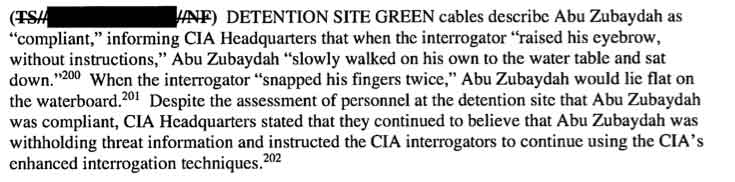
“Interrogators were instructed to start pouring water right after a detainee exhaled, to ensure he inhaled water, not air, in his next breath. They could use their hands to “dam the runoff” and prevent water from spilling out of a detainee’s mouth…[T]o keep detainees alive even if they inhaled their own vomit during a session – a not-uncommon side effect of waterboarding – the prisoners were kept on a liquid diet. The agency recommended Ensure Plus.“
On one hand, the film makes for an interesting moral counterpoint to The Fog of War: Ellsberg’s actions put the lie to a lot of McNamara’s convenient post-hoc rationalizing therein — clearly, SecDef could’ve done more at the time to end the war in Vietnam.) On the other, Ellsberg also works as a prequel of sorts to All the President’s Men — to say nothing of a generation of seventies paranoia epics like The Parallax View and Three Days of the Condor. But in the end, The Most Dangerous Man in America probably works best as an eloquent testament to the words of the late Howard Zinn (who appears here as an old friend of Ellsberg): “Dissent is the highest form of patriotism.“
Like Man on Wire, Ellsberg starts here in media res, and at the scene of the history-making crime. Furtive eyes scan back and forth as an old-school Xerox copier whirrs in the dark, its green light illuminating maps of Southeast Asia and the ominous words “Top Secret” from below. With no zip drives or electronic files to speak of, analyst Daniel Ellsberg is forced to copy the 7000 pages of the Pentagon Papers page by painstaking page. It’ll take months (and eventually he enlists the aid of his kids.) As the Xerox churns, we get up-to-date on the ramifications of the document being processed — bombs fall from the sky over North Vietnam and Cambodia, weary troops patrol the hot, fetid jungle, and Nixon and Kissinger obsess over the leaks in their war machine (with Kissinger giving Ellsberg his moniker: “the most dangerous man in America.”)
Cut back to several years earlier, when the future leaker of the Pentagon Papers seemed quite a different man indeed. A fresh-faced young ex-Marine with a crisp, no-nonsense Kennedy era haircut, Ellsberg began his tenure in government as one of the Best and the Brightest, with an enthusiasm for his 80-hour workweek matched only by his hawkishness. As one of McNamara’s boys, Ellsberg concedes to helping massage the data to create a casus belli for the war. His first day on the job is the Gulf of Tonkin incident that wasn’t, and he spends subsequent weeks trying to dredge up some, any, horrible atrocities in the region that might involve Americans.
But, over time, the scales fall away from Ellsberg’s eyes. In part because he makes the acquaintance of a luminous lefty-leaning journalist named Patricia, who eventually becomes his fiancee…twice. (Ellsberg has a great line about a guy he meets at a peace rally who’s a Trotskyist. He asks this fellow how in Hell he ever became a Trotskyist. The answer: “The same way anybody becomes anything. I met a girl.”) And in part because, driven with an analyst’s overriding compulsion to find the right answer, he starts going to Vietnam himself to lead recon missions on the side and get a better sense of the situation on the ground. Simply put, the Ground Game is not going well.
The rest, as they say, is history. Moved to throw a shoe into the gears of the war machine he had helped nurture into existence, Ellsberg goes rogue and decides to publish the top-secret history of the war. But, even if you feel like you know the story of the Pentagon Papers pretty well, and I thought I did, there are some fresh and intriguing insights here. For example, I’m not really one for Freudianism or overthinking coincidences, but it turns out Ellsberg suffered a tragedy at the age of 15 that made him uniquely primed to play the role in history he ended up playing. (His father fell asleep at the wheel during a road trip, prompting a crash that sheared the car in two and killed Ellsberg’s mother and sister. In other words, watch the authority figures at the wheel verrry carefully.)
And then there’s the man himself, who’s an engaging presence throughout (if perhaps with a touch of monomania — I could see him being a hard guy to get along with.) If The Most Dangerous Man in America has a flaw, it’s that the movie is quite one-sided in the end — Ellsberg even narrates much of the story, and you get the sense at various points there may well be some whitewash being applied. (Ellsberg has an ex-wife, and kids, that aren’t even mentioned for the first 45 minutes or so.) Still, I’m inclined to give Ellsberg — and Ellsberg — the benefit of the doubt (and not just because the man loves his movies.) Ever since George and the cherry tree, we’ve been smoothing the edges of our patriotic tales. And, whatever his misdeeds as a man, Daniel Ellsberg, the film makes clear, is a patriot, through and through.
I use this Cornel West quote rather often, but that doesn’t make it any less true: “To understand your country, you must love it. To love it, you must, in a sense, accept it. To accept it as how it is, however is to betray it. To accept your country without betraying it, you must love it for that in it which shows what it might become. America – this monument to the genius of ordinary men and women, this place where hope becomes capacity, this long, halting turn of the no into the yes, needs citizens who love it enough to reimagine and remake it.“
Daniel Ellsberg is one of those citizens. He saw an obvious crime being perpetrated by our government across multiple presidencies, and he did his part to help put a stop to it. In many ways, the story told in The Most Dangerous Man in America seems quaint: Johnson actually asked Congress for authority to bomb Vietnam? The press wasn’t rolling over like a lapdog in the wake of obvious propagandistic lies? (In fact, the media types who show up late in Ellsberg clearly possess some of the narcisstic sense of self-entitlement that has been our undoing of late. Ellsberg the civilian sweats blood and tears to get this 7,000-page document out in public, and the press poobahs act like they’re both the knowing gatekeepers and the heroes of the story.)
But just because Ellsberg’s brand of patriotism has fallen out of fashion in the era of Judith Miller and the chattering class doesn’t make this story any less relevant. It makes it more relevant. If we’re going to keep our young republic through its third century, we need more men and women of Ellsberg’s stripe. Men and women who will buck the trend, risk the ridicule and wrath of their well-connected peers, and stand up against injustice done under our collective name when they are party to it.
Presidents will get their due on this and every subsequent Presidents Day to come. But, now and again, it’s good to honor those patriots who, through non-violent principle and sheer, dogged determination, help to keep our leaders in check when the separation of powers fails — ordinary folks like you, me, and Daniel and Patricia Elllsberg.
Stories We Tell (4/10) Star Trek: Into Khan (4/10) The Great Gatsby (7.5/10) Iron Man 3 (8.5/10) Oblivion (6.5/10) To the Wonder (3/10) Side Effects (6/10) West of Memphis (7/10) GitM BEST OF 2012 GitM Review Archive
Currently Reading
Hidden Cities, Moses Gates
Recently Read
What It Takes, Richard Ben Cramer Founding Finance, William Hogeland Twilight of the Elites, Chris Hayes Last Chance to See, Douglas Adams The Forever War, Joe Haldeman Uphill all the Way, Kevin Murphy